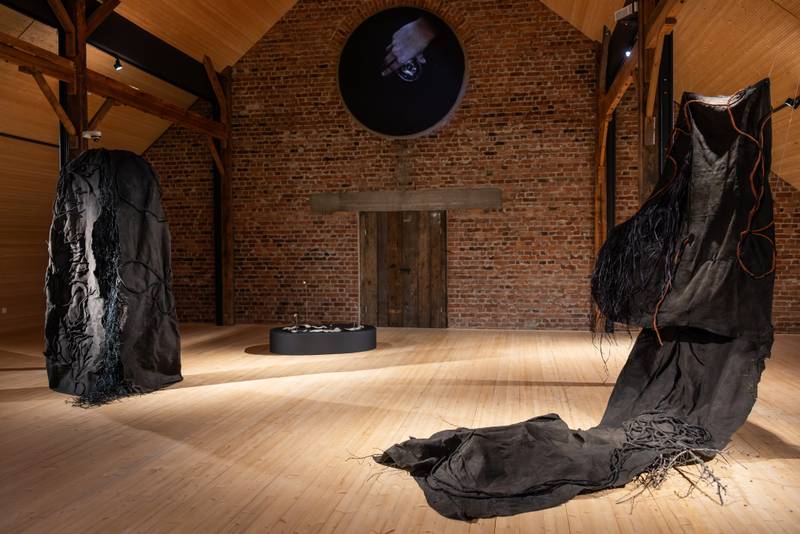
Sarah Nakiito, Exhibition view of SECOND SKIN Primordial Ties part VI (2025), (Still I Rise), Kunsthalle Seinäjoki, Photo: Krista Luoma
Elham Rahmati (b. 1989, Tehran) is a visual artist based between Helsinki and Tehran. She is the co-founder and co-editor of NO NIIN, an independent online monthly magazine at the cusp of art, criticality, and love. She has worked as the curator and producer of the Academy of Moving People & Images (AMPI), an independent film school in Helsinki, and as a curator at Third Space. Elham holds an MA in Visual Arts from the Accademia di Belle Arti di Firenze and an MA in Visual Culture, Curating, & Contemporary Art from Aalto University.
Vidha Saumya (b. 1984, Patna) is a Helsinki-based artist-poet. She is the co-founder and co-editor of NO NIIN – an online monthly magazine in Finland, and a founding member of the Museum of Impossible Forms – an award-winning cultural para-institution in Kontula, Finland.
Sarah Nakiito’s practice is shaped by the duality of her lived experience between Sweden and Uganda. Her works examine contrasting cultural responses to crisis, drawing attention to the instinctive collectivism in migrant and diasporic communities versus the individualism often present in Western contexts. This tension is embodied through her use of bark cloth: Olubugo, a traditional Ugandan material, is interwoven with the inner bark of the linden tree—once vital in Swedish pre-industrial society. This fusion creates a living, breathing textile—one that charts the convergence of Nakiito’s layered identities and histories. Her work resists erasure, not only honoring tradition but actively sustaining it as a contemporary, evolving practice.
With Sarah, we—the curators of Still I Rise, currently on view at Kunsthalle Seinäjoki—discuss the evolution of Nakiito’s artistic practice, shaped by migration, the pandemic, and shifting notions of home. She reflects on her use of indigenous materials, the intersections of Swedish and Ugandan craft traditions, and the emotional weight of diasporic identity that underpins her work.
ELHAM: How did this idea for this exhibition come about? Will you share some background on the project?
SARAH: When I applied for the open call, I applied with an idea I am no longer pursuing. But I allow myself the freedom to change my mind. It’s always difficult when we apply for things years in advance, and in my case, the pandemic shifted my focus entirely.
The work I am creating emerged during the pandemic when I noticed how Swedish society, particularly ethnic Swedes, responded to the crisis. Unlike migrant communities, many people in the West lack a collective approach to survival. Migrants, who have experience with war and displacement, instinctively looked out for each other – getting food for neighbors, ensuring the vulnerable were taken care of. In contrast, many Swedes retreated to their countryside homes, isolating themselves from the city’s chaos. This experience made me think about belonging and community in times of crisis.
In Finland, the situation was different. Russia had moved its military closer to the Finnish border, and Finland, unlike Sweden, has a living memory of war, occupation, and defense. This shared experience with displacement and survival is something Finnish people and migrants from outside Europe understand deeply. This realization led me to rethink my project, shifting my focus to the themes of home and belonging.
For the exhibition, I am working with indigenous materials from Uganda, particularly bark cloth (Olubugo), and combining them with materials from Sweden’s Skåne region, where I have lived for 20 years. One of these is the inner bark of the linden tree, a material historically used in Sweden before industrialization replaced natural fibers with polyester threads. Weaving these two materials together reflects the intersection of my identities and histories.
As a Ugandan who has lived in the diaspora for 30 years, I recognize how easy it is to romanticize cultural elements that I no longer have direct access to. This is common among those in the diaspora—we sometimes idealize aspects of our heritage because they feel distant and unattainable.
VIDHA: Let’s talk about your relationship with bark cloth. You describe it as familiar and distant, tied to your heritage yet somewhat estranged. How does working with this material influence your understanding of identity?
During the pandemic, I began an artistic exploration called Second Skin, which examines migration, identity, and healing. Working closely with bark cloth grounds me—it carries the resilience of colonized people. Historically, it was highly valued in Uganda and used as currency, bedding, and ceremonial wear. Arab and Indian traders once exchanged it as a commodity, yet today, it has lost much of its historical significance.
In Uganda, bark cloth still plays a role in significant life events. For instance, in kwanjula (engagement ceremonies), a man presents it as part of the dowry, alongside livestock and modern gifts like iPhones. It is also used in mourning rituals—bodies are wrapped in banana leaves and bark cloth before burial, a practice still common in rural communities.
For many young Ugandans, bark cloth is primarily associated with either engagements or funerals. I’ve thought a lot about how my perspective on these traditions has been shaped by my context. As a Ugandan who has lived in the diaspora for 30 years, I recognize how easy it is to romanticize cultural elements that I no longer have direct access to. This is common among those in the diaspora—we sometimes idealize aspects of our heritage because they feel distant and unattainable. In my case, I lost my parents at a young age and have no close family in Uganda. My ties to the country are largely symbolic – my name, my face, and body. My name, in particular, carries a strong cultural significance; any Ugandan or even East African who hears my last name can immediately place my origins down to a specific region. I carry my name with great pride, as it is one of my strongest links to my culture.
I’ve also spoken with friends who were adopted, and we share a similar feeling of longing for a place we are connected to yet remain somewhat outside of. The reality of returning to Uganda often contrasts with the image we build in our minds. We may not feel as fully embraced as we expect, and the experience highlights how much we have been removed from that context. This sense of disconnection—both in the Western world and in our places of origin—is a complex and deeply felt experience.
E: How does your diasporic position reflect in your work? How do you avoid the trap of romanticization?
I don’t see romanticization as a trap to avoid – I acknowledge it as part of my experience. I’m very aware of its presence. The first time I returned to Uganda at 20, after living in Sweden for ten years, I had this idea that I was escaping racism and otherness in Sweden, seeking a place where everyone looked like me, where my name wasn’t strange, and where I wouldn’t feel like an outsider. But when I arrived, I realized that the feeling of being different hadn’t just disappeared. If I didn’t speak, I could blend in, but my movements, body language, and even how I sat were noticeably different. These cultural nuances, which I had lost track of over time, became strikingly clear.
I don’t try to reject or suppress these feelings. Instead, I remain aware of them without necessarily leaning into them. With each visit, especially my most recent one – where I stayed for two and a half months instead of just a few weeks – I found new ways of navigating Ugandan society. I used to overexplain myself, apologizing for my imperfect Luganda or justifying my behaviors by referencing my life abroad. But this time, I didn’t. I’ve learned to be comfortable in whatever space I occupy.
Rather than engaging with the idea of romanticization in my work, I simply remain conscious of it. I don’t deny its influence, but I don’t let it dictate my perspective. Instead, I approach my identity and experiences with awareness and acceptance.
V: In this exhibition, you’re specifically working with bark cloth, which carries a deep colonial history, generational shifts in perception, and a legacy of erasure. Rather than focusing on explanation, how do you see your work inviting viewers into these contexts? How do you imagine different audiences—whether in Finland or Uganda—engaging with the material and the themes of migration and identity?
I don’t focus on making people understand the work in a prescriptive way. Instead, I see the material positioning me within a particular context that viewers – especially Finnish audiences – might recognize. Finland has its own indigenous materials and traditions, particularly in the area where this exhibition will be shown, so there’s already a potential point of connection.
For me, migration and identity are central to this work, and I think the exhibition’s context will influence how these themes are received. If I were to show this work in Uganda next year, for example, the reading would be entirely different. There, no one would need to ask, What is this material? – it’s already familiar. But because I’m using bark cloth in unconventional ways, even in Uganda, it might provoke new interpretations.
Ultimately, themes of migration, identity, and selfhood resonate across cultures, particularly in societies that have had to defend and negotiate their histories. I see the work as engaging with these ideas in ways that allow for multiple readings shaped by the viewer’s own experiences and cultural context.
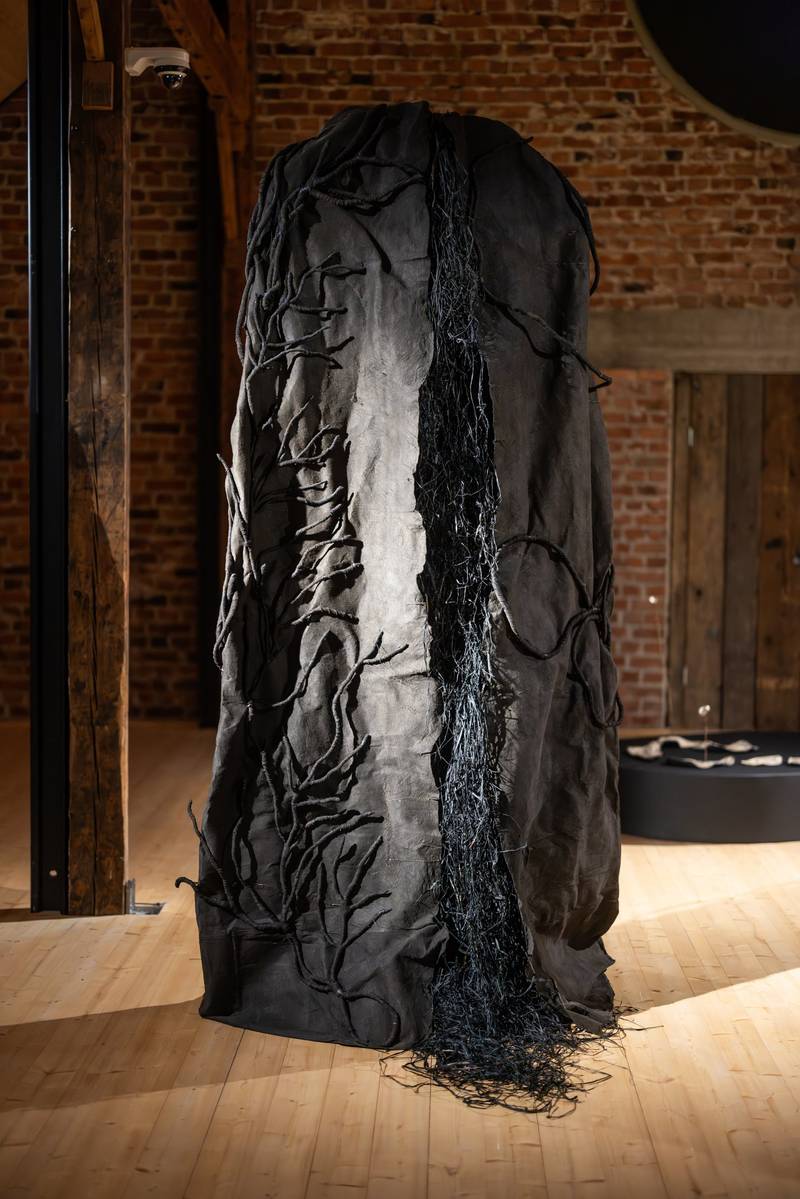
Sarah Nakiito, Exhibition view of SECOND SKIN Primordial Ties part VI (2025), (Still I Rise), Kunsthalle Seinäjoki, Photo: Krista Luoma
E: Earlier, you mentioned that the history of bark cloth has been erased by colonial powers. Do you see your practice as a form of resistance or reclamation against this erasure? How do you work to bring these hidden histories to the forefront, and what techniques or motivations guide you in this process?
Simply using the material is an act of resilience – it asserts that bark cloth still holds significance for Ugandans today. In Uganda, I purchased a large quantity of it and visited the farmers who cultivate and care for the mutuba trees. This is generational work—many of these trees were planted by their fathers, their grandfathers, and even further back. One farmer pointed to a tree and told me how his grandfather had taught him to harvest the bark, highlighting a lineage embedded in these trees.
I also noticed that my interest in bark cloth, as someone who no longer lives in Uganda, was appreciated. It reaffirmed its relevance and provided farmers with an incentive to continue growing and maintaining these trees. Historically, nearly every Ugandan household had a mutuba tree in their garden, but today, you must seek out specific farmers to find them. Many have been cut down in favour of fruit trees and other crops. By purchasing a significant amount of bark cloth, about 100 kilos, filling four enormous suitcases, I was not only supporting these farmers financially but also reinforcing the value of their work. For many, this purchase alone provides enough income to sustain them for the year.
Another crucial aspect of sustaining this practice is an initiative by Ugandan artist Fred Mutebi, which allows people to adopt a tree. I’ve adopted one myself, meaning I pay a small yearly fee of about 20 euros to support the farmers who care for it. Each year, they harvest the bark and send it to me in Sweden, or I can collect it in Uganda. This system not only ensures a steady income for the farmers but also helps preserve and expand the practice.
My work is both an act of resistance and a means of sustaining this tradition. It acknowledges the bark cloth’s historical significance while actively sustaining it, ensuring it remains a living, evolving practice rather than a relic of the past.
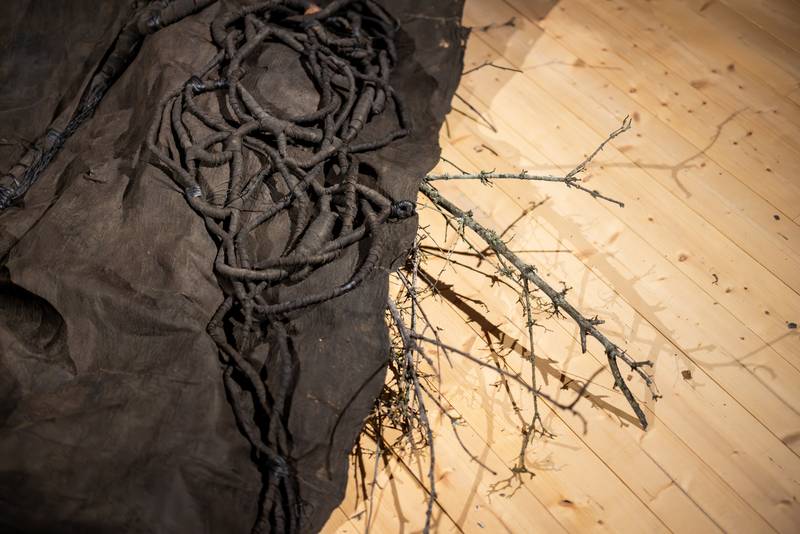
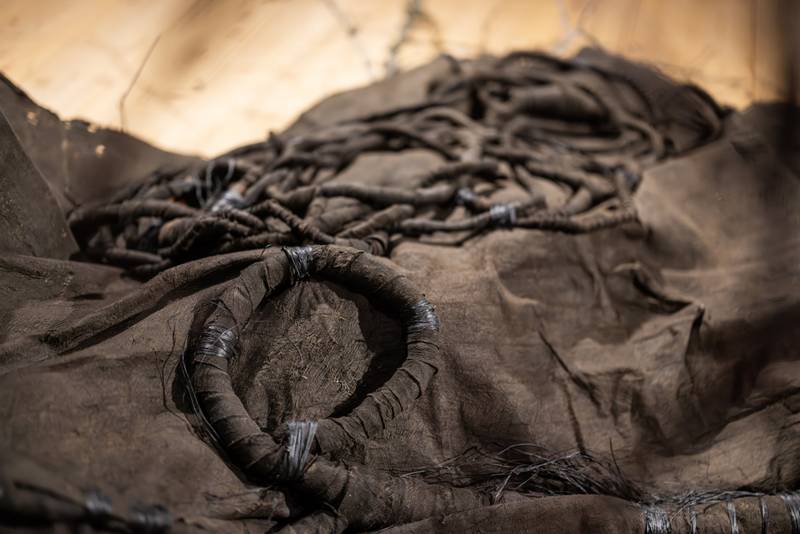
Sarah Nakiito, Detail view of SECOND SKIN Primordial Ties part VI (2025), (Still I Rise), Kunsthalle Seinäjoki, Photo: Krista Luoma
V: Considering the bark cloth’s texture and connection to skin, you explore the relationship between the body, the material, and memory. What emotional or intellectual journey do you hope your work initiates for viewers experiencing this exhibition?
The bark cloth plays a significant role in the work I’m presenting. However, it’s not the sole focus of my practice, even though it appears prominently in this piece. My practice has always been centered around the body. I trained as a dancer when I was younger, and I also studied fashion design and pattern-making. I’ve released a clothing line and now incorporate costume design into my artistic practice. Many of my performance art pieces are directly connected to the body or center around it in some way. I also work with natural skincare. So, I’ve always placed my being, my body, at the heart of my work.
The figure I’m presenting in Finland can be seen as a body rising from the ground, marking its place in the world. It’s an image of resilience, particularly for marginalized groups and individuals. In these politically charged times, this statement of refusal to succumb to despair feels particularly relevant for many people across the globe. I keep returning to Maya Angelou’s poem Still I Rise – you know it, right? It’s about defiance, strength, and resilience in the face of adversity.
As I reflect on this question, I think about how we, especially in Africa, continue to rise despite the Neo-colonial forces and challenges we face. Marginalized groups – queer communities, Palestinians, and others in the context of East Africa – are all part of this resistance. Despite the odds, we continue to stand tall, and I wanted this work to reflect that. This piece is a way of standing up for ourselves, using the material to elevate our voices and give value to African people and their history.
So, this is something I’ve been thinking deeply about while creating this work: resisting, rising, and asserting our place in the world.
V: What new territories or concepts are you excited to explore in your future works?
One of the areas I’m excited to explore is film. While in Uganda for another project, I worked with traditional healers and herbalists, creating a performance piece that I turned into a film. It was an intense but rewarding process – very different from my usual solo practice as a visual artist. Film requires collaboration, coordination, and a structured timeline, which was a big learning experience. Right now, I’m in post-production, having recently worked on the sound in London, where I got to experiment with sound mixing and engineering.
This experience also deepened my love for sound. I’ve been DJing for over a decade, experimenting with sound, but I never aimed to be a musician or producer. However, working on this film made me realize how much I enjoy creating and manipulating sound, and I want to incorporate it more into my practice.
Another exciting direction is working on larger spatial installations. The exhibition in Seinäjoki is one example, but I have other ideas for monumental works. A major challenge has always been space, but now, with access to a collective workshop, I have more opportunities to experiment on a bigger scale.
So moving forward, I see my practice expanding into film, sound, and large-scale spatial works; these areas I’m most eager to explore.
-
 READ
READDr. Aiswarya Rao on navigating hostile spaces for people-particularly women- with disabilities through the organization ‘Better World Shelter for Women with Disabilities’, building safe spaces, changing policies, and tying art into livelihood, fun, and friendship.
Blending Art, Friendship & Advocacy: A Conversation With Dr. Aiswarya Rao
-
 READ
READAbinaya and Vanessa reflect on their experiences in the Tamil community and discuss the pressure to represent Tamilness for non-Tamil audiences. Abinaya discusses her work with Tamil Guardian, which sought to combat Sri Lankan government propaganda and elevate the voice of the Eelam Tamil polity. Vanessa discusses her role in editing Tamil Futures, a creative arts magazine aimed at the global Tamil community, which prioritized creative archiving and documenting underrepresented histories.
Writing Tamilness: Perspectives From Tamil Futures and Tamil Guardian
-
 READ
READCraftsmanship that leaves a polished finishing and evocative historical notions hidden underneath the fine details. Man Yau’s work with ceramic installations arrests the viewer, while encouraging to revisit and contemplate the uncanny contemporaneity that the artworks embody. In this interview, we discuss artistic processes, practices and labour as well as the intertwining of the personal and the thematic in Yau’s two exhibitions from the spring 2021: M.Y. Chinoiserie at Kuvan Kevät, Exhibition Laboratory, and Dried flowers last forever at Boy Konsthall.
On “The Feeling of Being on Display and Under Pressure” — a Conversation With Man Yau
-
 READ
READBulldozers, often seen as neutral tools of industrial demolition, are instruments of territorial domination, urban redevelopment, and political suppression. Yet within these acts of destruction, counter-narratives emerge—poetry, mourning, and collective remembrance—that reclaim agency in the face of state-sanctioned ruination. If ruination is a strategy of power, it is also a site of resistance.
On Bulldozer Politics: An Interview with Léopold Lambert & Shivangi Mariam Raj