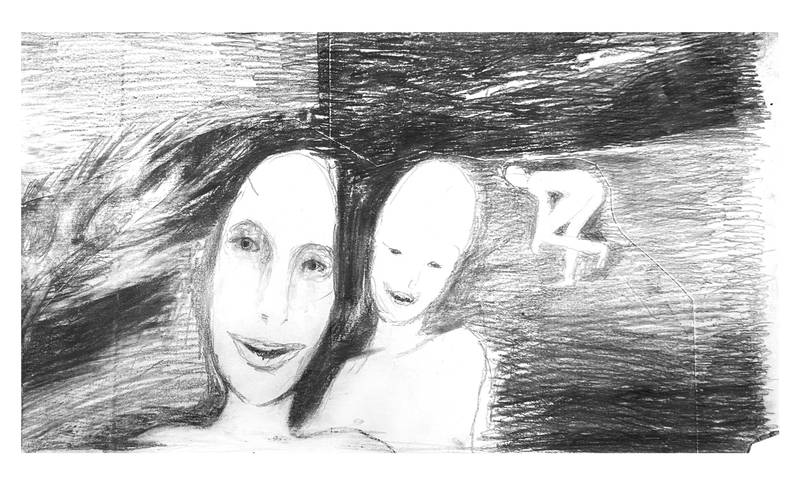
Anastasiia Sviridenko, Experiencing light, graphite on paper, 2023
Dr. Jaice Sara Titus is an independent researcher based in London, originally from Kerala. Their work sits at the intersection of psychoanalysis, culture and politics.
Improvisational comedy, commonly referred to as improv, is frequently described by its practitioners as a practice of freedom. Yet much of the existing literature on improv either takes this claim at face value, focuses on historical or biographical accounts, or translates improv’s techniques into lessons for education, therapy, and industry. I draw upon psychoanalytic theory, particularly the work of Jacques Lacan, to investigate why people feel free when they improvise and what the limits of this freedom are.
Roger Caillois differentiates between play as paidia, as unrestrained freedom, and ludus, as the rules of the game.1 In improv, the tension between these poles is creative and productive, whereby constraints are a condition of possibility for improvised play to take place, to narrow and focus the field of play. The core rule of improv is “Yes, and…”, which means you always accept the reality that other players have established in the scene and build upon it. From these emerge moments of serendipity, of expression that feels spontaneous and free. Here, Lacan’s work becomes doubly useful, both as a theorist of language and a sceptic regarding notions of absolute freedom. In improvisation, this sense of freedom arises from the operation of language: the feeling of being able to speak without imposition, to make an unpredictable choice, or to speak beyond oneself and surprise oneself and others through the operation of metaphor and metonymy within the signifying chain. Through improvisation, the limitations of language become possibilities for further extemporisation. The failure of the signifier to fully signify allows it to potentially signify more than might have been intended when it was originally used. This not only allows for a polyvalent humour arising from, for example, a double entendre, but also for other players to take up the signifier and fix it with a new meaning, however temporarily, retroactively transforming its earlier significance. It provides the player with a seeming omnipotence in language. Improvisors themselves have a conception of an “ego” which they see as a constraint, and they seek to bypass it, to make an “unconscious choice” that will lead to greater incongruity in performance. While improvisors, like everyone, are driven to repetition, the structure of improv gives rise to a radical diversity in repetition. This diversity takes place in what I have termed the “sandbox of the impossible”, where an improvisor can do “impossible” things or make the “impossible” choice.
ComedySportz embraced franchising, competition and family-friendly spectacle, explicitly defining itself as a business rather than an art form. These divergent paths reflect a broader tension between artistic experimentation and commercial viability. While long-form improv spread through informal networks of players, short-form formats thrived as franchised, scalable products.
Yet I am led to ask what happens when the constraints shaping improv are related not only to language but to the limits of capitalism? Improv emerged in the mid-twentieth century within countercultural and left-leaning contexts, shaped by experiments in political theatre, spiritual liberation and collective creativity. Early long-form improv sought to challenge bourgeois norms and engage audiences in new social and political ways. As improv gained popularity, however, it increasingly encountered economic and organisational pressures. The need to sustain venues, attract audiences and generate income led to professionalisation, repetition and a shift toward more accessible, comedy-driven formats. This trajectory culminated in institutions such as Second City, where improvisation became a means of producing polished, marketable satire rather than an open-ended political experiment. While framed as expanding improv’s reach, this shift marked a movement away from its radical origins and toward commodified entertainment.
Subsequent developments in improv illustrate how capital repeatedly operates as a limit on the freedoms the form promises. Alternative models emerged that attempted to carve out niches within capitalism. ImprovOlympic, for example, developed a membership-based system that provided stability and allowed long-form experimentation to flourish for a time. By contrast, ComedySportz embraced franchising, competition and family-friendly spectacle, explicitly defining itself as a business rather than an art form. These divergent paths reflect a broader tension between artistic experimentation and commercial viability. While long-form improv spread through informal networks of players, short-form formats thrived as franchised, scalable products.
Over time, improv increasingly became integrated into corporate training, self-improvement and therapeutic industries, marketed as a tool for flexibility, resilience and personal growth. What had once been a collective, potentially subversive practice was repackaged as an individualised commodity, available for purchase on a weekly basis. Crises within the industry, such as internal competition and closures during Covid-19, exposed the limits of even the most stable models. The closure and acquisition of major improv institutions demonstrated how capital ultimately reasserts itself, absorbing or dissolving spaces that once promised alternatives. In this sense, improv’s history illustrates a broader dynamic: practices that generate a sense of freedom within constraint are nonetheless reshaped by the logic of commodification when embedded in capitalist systems.
While improv is often framed as an inclusive and liberating performance tradition, it has often been dominated by middle-class white men. Amy Seham contrasts improv’s stated ideals of community, spontaneity and liberation with its actual practices, showing how they are shaped by race, gender and power.2 Because improv relies on performers intuitively recognising what others in the group are thinking or feeling, problems arise when cultural references are not shared. Monica Gaga, a Black queer improviser, explains that when she introduces race or culturally specific material in a mostly white group, “the dynamic changes quickly. It feels heavy in the air – this room’s not ready for me to bring all of myself.” Comedian Athena Kugblena similarly notes, “They don’t know what Supermalt is, they don’t know what ashy skin means, or about the plastic on the sofas – it’s just not their life”. These dynamics can reproduce exclusion. Gaga describes white players free-associating from “Nigerian” to “online scammers,” illustrating how improvisation can slide into crude stereotyping. When she adopts an accent, audiences laugh before any joke is delivered: “It’s literally just the accent that my mum’s got”. For Seham, the “Yes, and…” rule often suspends difference under the terms set by a white, middle-class male majority.
These tensions surfaced publicly after the Black Lives Matter rebellion of May 2020. At ImprovOlympic, a petition accusing its cofounder Charna Halpern of racism gathered over 2,000 signatures. At Second City, comedian Dewayne Perkins detailed racist practices after the company tweeted support for Black Lives Matter, leading co-owner Andrew Alexander to resign, stating, “The Second City cannot begin to call itself anti-racist… That is one of the great failures of my life”. While David Shepherd, cofounder of The Compass Players, had hoped improv itself might radicalise audiences, it was instead external political struggle that disrupted the industry’s symbolic order, demonstrating that even highly commodified cultural forms can be unsettled by collective challenges to the status quo.
On the far right, free expression is reframed as an Enlightenment value unique to “Western civilisation”. Humour plays a central role in this discourse, functioning as both vehicle and cover. Memes, “free speech” events and racist jokes circulate ideology while masking intent and evading consequence. Here, freedom of speech is exercised over and against marginalised groups on the condition that it appears as a joke.
Beyond the improv industry itself, my research led me to consider how improvisation has increasingly intersected with reactionary politics, particularly through appeals to freedom of speech framed against “cancel culture”. High-profile improvised outbursts by stand-up comedians such as Michael Richards and Daniel Tosh—respectively a racist rant and a rape joke—illustrate how claims to spontaneity lack accountability. While Richards’ career effectively ended and Tosh issued an apology, figures such as Jerry Seinfeld later complained that accusations of racism and sexism had rendered comedy spaces, especially universities, hostile to free expression.
Critics such as Sofie Hagen counter that such complaints often reflect an inability to be funny without causing harm, noting that many comedians succeed precisely by developing more inventive humour. These debates shift attention away from abstract notions of free speech and toward questions of power. Comedy lacks formal mechanisms of accountability, yet access to platforms is highly uneven. Women, people of colour and disabled comedians are routinely marginalised, while established figures invoke free speech defensively. As Aparna Nancherla suggests, the issue is not whether speech is possible, but whether it is exercised reflectively and responsibly.
On the far right, free expression is reframed as an Enlightenment value unique to “Western civilisation”. Humour plays a central role in this discourse, functioning as both vehicle and cover. Memes, “free speech” events and racist jokes circulate ideology while masking intent and evading consequence. Here, freedom of speech is exercised over and against marginalised groups on the condition that it appears as a joke. The “half-joke” is particularly effective: it allows speakers to disavow responsibility while sustaining ideological meaning. Rather than releasing tension, the half-joke generates ambiguity while concealing intent from those not already attuned. As philosopher Mladen Dolar observes, laughter provides the distance in which “ideology can take its full swing”. 3
This dynamic entered the political mainstream most significantly through Donald Trump, who described his dealmaking as improvisational, and commentators noted that his rallies resembled improvised monologues structured through riffs, free association and abrupt shifts rather than coherent argument. I was about a year into my doctoral research on improvisational comedy when, in 2015, I first watched Donald Trump take part in the presidential debates. Here was someone who appeared to be making it up as he went along. As a Slate article observed at the time, “Trump likes to freestyle. In his overheated, screwball way, he’s a master of the form. His improvisational skills are pretty much the core of his appeal—he’s not scripted, he’s good television.” I felt there was a strong link between what Trump seemed to be doing with my own interests in improvisation and freedom. Trump refined his speech in real time, registering audience response and naming racialised “others”—first Mexicans, then Muslims—as enemies within. These gestures were not strategic in a programmatic sense but politically instrumental, mobilising long-standing racial anxieties through ambiguity.4 Trump joked about Mexicans and Muslims while simultaneously creating a hostile environment for them – it’s only funny for some.
Trump’s statements often functioned as what academic Jennifer Saul terms a “synchronic figleaf”: racist claims simultaneously expressed and disavowed through hedging between “good” and “bad” migrants. Statements such as using bleach during Covid-19 or encouraging double voting required rather more diachronic corrections, being reframed as jokes by White House press secretaries. These half-jokes enabled a steady circulation of ideology while shielding any responsibility. From a position of power, Trump used improvisation to shift the parameters of what could be said and done, normalising punitive policies through ambiguity and humour. By his second term, the hedging of good and bad migrants had been replaced by pronouncements of Somalis as “garbage”, flooding cities in Minnesota with ICE agents who have killed people on the streets.
The discourse of free speech on the right thus serves contradictory masters: impossible total expression and paranoia about restriction by the left. The big tech platforms that monopolise many conditions of public speech exemplify this; following Trump’s election defeat and his incitement of violence at the Capitol, companies such as Twitter and Facebook removed his platform, only to later accommodate his demands on his return to office. This sharply demonstrates the ways that improvisation, reaction and capital converge in the contemporary politics of speech.
A king or tyrant may speak freely, but without danger. This makes a mockery of contemporary attempts to frame powerful figures as victims of suppression.
In the wake of the May 1968 uprising in Paris, Lacan remarked that “We live in an area of civilisation where, as they say, there is free speech, namely, that nothing of what you say is of any consequence”.5 Today, freedom of speech has become a central site of struggle. We inhabit a paradoxical moment in which immensely powerful actors depict marginalised groups and younger generations as threats to free speech, while the practical conditions of speech are increasingly governed by large concentrations of capital. Making sense of this contradiction requires distinguishing between competing conceptions of what “free speech” is understood to mean.
Political theorist Teresa Bejan suggests that contemporary disputes reflect a tension between two rival notions inherited from ancient Greece: isegoria, the equal right to participate in public speech and debate, and parrhesia, the license to say whatever one pleases to whomever one wishes.6 In current debates, those who claim to be silenced tend to demand parrhesia, while those who emphasise structural exclusion and unequal access to platforms argue for isegoria. Although these terms are ancient, they are most often mediated today through Michel Foucault’s lectures on parrhesia. As Foucault put it, his concern was not with abstract truth but with “the problem of the truth-teller, or of truth-telling as an activity… or as a role.” 7
Parrhesia is not equivalent to free speech as it is commonly invoked today. It is fearless speech: direct, frank truth-telling that entails real risk to the speaker. (Foucault) Crucially, those in positions of power cannot practice parrhesia precisely because they risk nothing. A king or tyrant may speak freely, but without danger. This makes a mockery of contemporary attempts to frame powerful figures as victims of suppression. Moreover, linking parrhesia directly to a right to free speech involves a historical distortion. As Arlene Saxonhouse notes, parrhesia emerged in contexts without universal rights, and was characterised by two features: first, that speaking entailed the risk of legal sanction, and second, that truth-telling exposed the speaker to judgement by others.8 Ironically, those accused of suppressing free speech often face significant risks themselves, including expulsion, harassment and public attack by opponents with greater reach.
I argue that contemporary claims that free speech is under threat emerge from two distinct but overlapping tendencies. The first is a strategic intervention by right-wing political actors and media figures, who frame everything from no-platforming to calls for inclusion as existential threats to expression. This discourse responds to long-term political and demographic shifts, particularly among younger people and people of colour, which polling suggests are unfavourable to the right, including growing scepticism toward capitalism and increased openness to socialism.
The second tendency is affective rather than strategic. It involves a layer of people, often though not exclusively older, who experience demands for inclusion or racially sensitive language as a threat to established modes of enjoyment. Here, freedom of speech becomes bound up with what Slavoj Žižek describes as a libidinal structure, a “jouissance of the other,” in which the other appears as someone who “wants to steal our enjoyment (by ruining our ‘way of life’) and/or… has access to some secret, perverse enjoyment”.9 Right-wing actors mobilise this affect to build coalitions that cross class boundaries. Together, these strands constitute one pole of what is now described as the “culture wars.”
The challenge for those who seek to establish true freedom is to establish new paradigms beyond the deathly embrace of right-wing populism and neoliberalism to a true universality.
A further complication arises when the “left” and marginalised groups are interpellated as “globalists,” aligned rhetorically with the CEOs of big corporations or centrist politicians. The figure of “George Soros” often functions here as a master signifier, bridging antisemitic conspiracy theories with attacks on progressive politics. This conflation, driven by the likes of Trump, is aided by the way that militant struggles for liberation were diminished in the neoliberal era. This ends in the farcical spectacle of, as Asad Haider puts it, Hillary Clinton (and indeed, later, Kamala Harris) appropriating “the languages of civil rights, identity politics, intersectionality, privilege and all the rest, which were conjoined in her campaign to the continuation of a neoliberal and militarist legacy, that she had participated in”. The challenge for those who seek to establish true freedom is to establish new paradigms beyond the deathly embrace of right-wing populism and neoliberalism to a true universality. In Žižek’s words, this requires acting as though our choice is not forced, and understanding politics as “the art of the impossible – it changes the very parameters of what is considered ‘possible’ in the existing constellation”. 10
To conclude, I want to return to comedy to improv by drawing on Alenka Zupančič’s distinction between true and false comedy. In false comedy, the symbolic order remains intact. As Zupančič writes, “[t]he paradigm of these comedies is simply the following: the aristocrat… is also a man (who snores, farts, slips…)”. 11 Much satire directed at Trump functions in this conservative way, mocking his unsuitability for office without questioning the emptiness of “presidentialness” itself. True comedy, by contrast, targets the symbolic position rather than just its occupant. Zupančič offers the example of laughing not merely at a baron slipping on a banana peel but at his “barronness” itself. 12 There is a deliberate play on words here: baron and barren. What is exposed is not the individual’s failure but the barrenness of the role—the fact that it yields nothing of value. Anything less may feel sharp but achieves little. As comedian Chris Morris observes:
I think we’ve got used to a kind of satire which essentially placates the court… lo and behold, you get slapped on the back by the orthodox elite who say ‘jolly good, can you do us another one?’
-
 READ
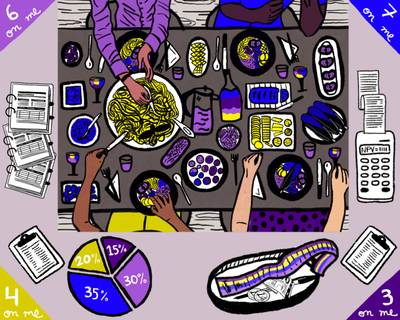
READThe practice of non-binary accounting is not new. Friends who “anexactly” rotate covering tabs for food and drink at bars, who do not keep a precise ledger delineating who owes what to whom, are constantly engaging in small-scale non-binary accounting practices. This text wonders whether a more rigorous formalization of the practice of non-binary accounting that is specifically geared towards subverting and dismantling binary accounting practices could be “scaled up”, so that communities and public institutions “splitting the tab” for large scale social initiatives can transact “anexactly”.
Accounting Otherwise: Non-Binary Book-Keeping & Fugitive Public Financing
-
 READ
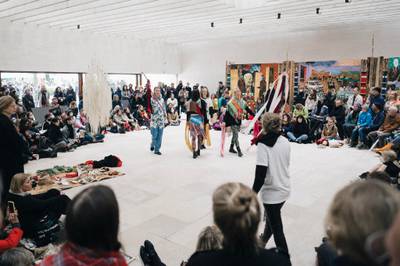
READSystems and structures that prescribe most societal functions today, including the production and presentation of art, have little consideration for bodies performing these functions. Let us acknowledge these disparities and allow them to guide our ways of being and acting ethically.
Embodied Curating: Attuning the Body From Artistic to Political
-
 READ
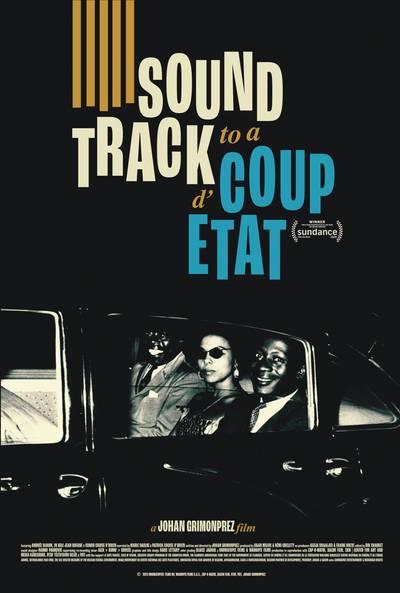
READThe story of the Democratic Republic of Congo isn’t just about coups or Cold War power plays – it’s also a story told through rhythm, resistance, and reinvention. Soundtrack to a Coup d’État invites us to see music not as something that plays in the background of history, but as a key player in it – used by empires, reclaimed by artists, and still resonating in the voices of those who won’t be silenced.
Frontlines of Power: Sonic Politics in the Democratic Republic of Congo
-
 READ
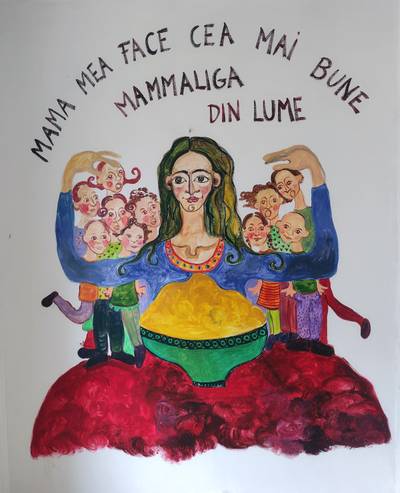
READCollaborative methodologies can open research to plural knowers, knowledges, and ways of knowing which institutions stand to gain social and racial capital and good assessments of diversity and inclusion practices. But can such collaborations be truly reciprocal? What do the co-researchers gain, and who decides on the terms and potential gains of co-researching?
Creating Critical Tools Through Romani Vernacular Storytelling