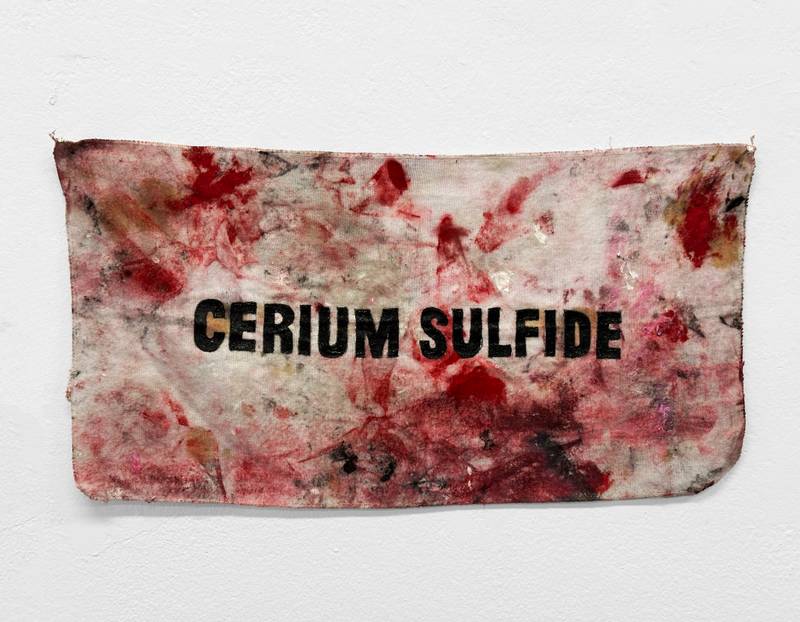
Cerium Sulfide, 2025, oil on cloth, 29 x 55 cm
Paula Alzugaray is an art critic, editor, and curator. She holds a postdoctoral degree in History, Criticism, and Theory of Art from School of Communications and Arts of the University of São Paulo (ECA-USP). As a thinker working across the relational fields of communication and visual arts, she engages in multiple formats of artistic, filmic, documentary, and written production.
Considering that, in the year 2022, at the height of a political struggle against the irruption of fascism in Brazil, we collaborated in the writing of a Manifesto of Political Imagination, which would later take shape as a Manifesto of the Pirate Party of Brazil. Considering that this Manifesto adopted the structure of a magazine, conceived in such a way that the irrational gesture, the poetic, and the revolutionary might subvert the conventions of editorial discourse. Considering that this magazine was organized as a game, in the situationist sense. Considering that the teams set face to face upon this board were the research group After the End of Art and the journalists of celeste (then, seLecT). Considering that a collectively designed magazine is a political act whose labor consists, precisely, in preparing future ludic possibilities.
In this fateful year of 2026, in which fascism once again emerges as an imminent threat to Brazil and to the world, and in which tyrannical forces press upon Iran, we return, through this collaboration with NO NIIN magazine, to the writing of the Manifesto of Political Imagination. This time, using the interview as our medium.
The rules of the game. Considering that declared theft produces a fracture in the very concept of authorship, and that the procedure of copying is central to Dora Longo Bahia’s practice, this is an interview in which both questions and answers are composed of modified, copied, or plagiarized texts—drawn from articles, lectures, and texts from videos and films—just as the artist, in fact, operates in her own work.
The players. Considering that there are three players, interacting within a field of trialectic geometry: one agent who devours (the interviewer), and another who is devoured (the interviewee)—and vice versa. On a third margin, there is the image (of the artist’s work), which fractures the specular logic of interviewer versus interviewee.
-
May I come in?
-
Hum?.. Yeah. Of course. Aha.
-
You want to come in, come in then…
-
Thank you for admitting me into your commune, and for agreeing to play with me [since 2018 we have collaborated in the making of magazines and since 2020, I have been part of the research group you coordinate]. The game consists in posing a series of questions—for instance: who said, this is what I want, these are my orders, should my will replace reason? Or: who should never act according to what they desire? Or: who is nothing more than an animal the color of flowers? There are many others.
-
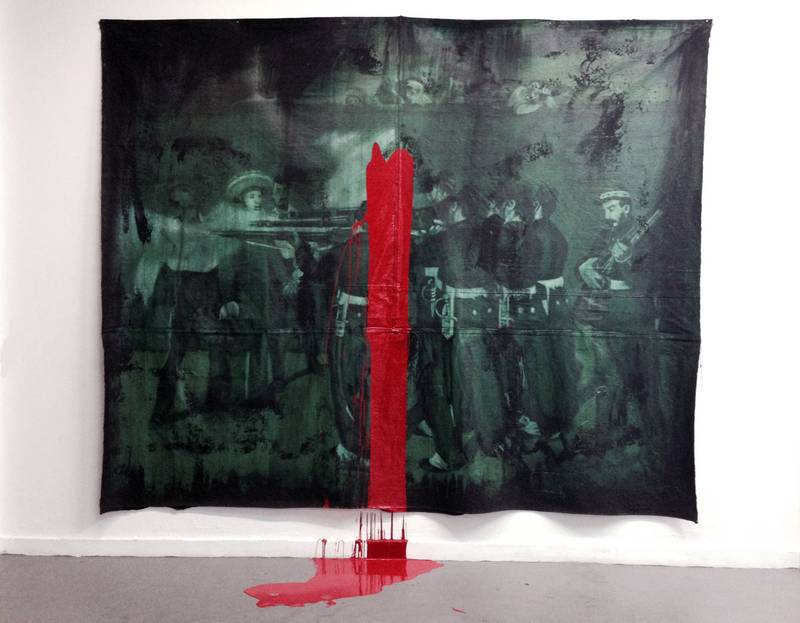
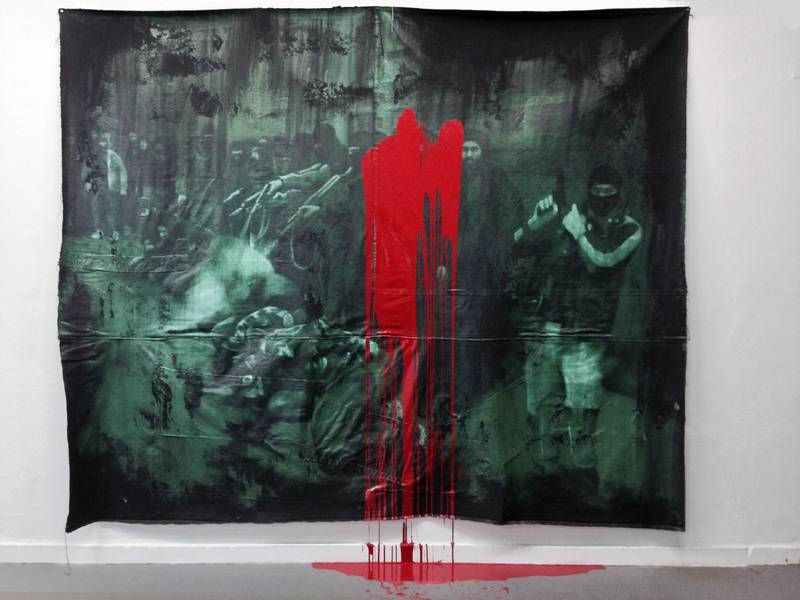
The answer to all these questions is the same.[They then laugh ferociously, striking one another on the shoulders. With lips slightly parted, they spit blood.]
-
Do you remember? In our magazine of political imagination, the themes were organized as communes.
-
Yes. The first commune, To Fight*,* or Zapanteras, took shape through the encounter between the Black Panthers—an urban organization that fought for land, justice, peace, and self-determination—and the Zapatistas, Indigenous people struggling for self-determination, land, justice, and peace.
-
And Depois do Fim da Arte (DFA) [After the End of Art]?
-
It is a research group formally affiliated with the Department of Visual Arts at ECA-USP and certified by CNPq, coordinated by myself. Grounded in the situationist assertion that art has been surpassed, DFA began meeting in 2015 to investigate the role of the artist in contemporaneity and the relation between art and the broader social context. Its aim is to present practical experiments—publications, exhibitions, film clubs—that make explicit the contradictions embedded in artistic practice, as well as the controversies surrounding the social function of art and the status of the artist.
-
And informally?
-
It is a gathering of people who meet on Friday nights to talk about art, to learn and to fail in solidarity, to share practices and ideas, to draw up strategies for making art politically—and to set them into motion. To hate together and to love together. To struggle through art.
-
Well… figure it out.
-
Like the magazine?
-
Like the magazine.
-
And babies?
-
And babies.
-
Q. And babies? A. And babies.
-
And what do you say about the lack of female representation in the history of Brazilian politics?
-
We did not carry out our revolution in the shadow of men. Our revolution is independent. We refuse to speak this language, to murmur—as they do—the words of lack: lack of penis, lack of money, lack of sign, lack of name. They say that any one of us could invoke another sun goddess, such as Cihuacóatl, who is at once goddess and warrior. We could, for instance, on the occasion of one of their deaths, take up their weapons and their ammunition.
-
The wolves’ eyes begin to shine in the half-light.
-
Why is making art a form of doing politics?
-
“To make art is to do politics” is a complicated statement, for it depends on how one defines both art and politics. There is a crucial difference between “making political art,” which has lately become quite fashionable, and “making art politically.” To make art politically means to align the form, the process of production, and the distribution of the work with its ideological content. “Making political art,” on the other hand, corresponds to a metaphysical conception of the world. Within it, situations—such as misery, hunger, or war—are described while still operating under a representational logic, which allows the works to remain in conformity with bourgeois ideology. By contrast, “art made politically” belongs to a dialectical conception of the world, in which concrete analyses of concrete situations are carried out with the aim of showing the world in struggle—and thus transforming it. Rather than producing images of the world as “fully complete” in the name of a relative truth, making art politically demands both the study of the contradictions between relations of production and productive forces, and the production of scientific knowledge about revolutionary struggles and their history.
-
The living—and therefore—mortal body is the central object of all politics. There are no politics that are not body politics.
-
What is the nature of the work of art?
-
I don’t understand the question. The nature of an oak tree?
-
Well, if you ask me, that’s what art is for.
-
How can one distinguish artistic value from artificial values imposed by the art market?
-
By looking at the work and at the context of its production, as identified through its form.
-
At a certain point, art ceased to be spiritual or ideological.
-
If painting is not made to decorate apartments, but is instead an instrument of war—of attack and defense against the enemy—what is the importance of a work engaging with public life, drawing attention to social problems, and occupying public spaces such as the street or a magazine?
-
Every image is the result of a construction—and that construction actively participates in the symbolic and social disputes of its time. To represent conflict is not enough. One must infiltrate it and act. The status of contemporary art may reside precisely in this conflict in which every artist operates, immersed in contradictions. The work circulates as a commodity and, at the same time, claims to be a critique of the commodity. It is, simultaneously, an object of exchange and a field of dispute. Perhaps the difference between the work of art and the commodity lies in the unstable possibility the former has of revealing the very structure that transforms it into value. There are moments in which art attains something close to the dignity of manual labor.
-
In the beginning was the image.
-
And what is the role of intellectuals in the revolution? Does this question still make sense? What revolution are we talking about?
-
The question persists, and the revolution remains very distant (or very near). To thematize the diseases of the capitalist system is not enough. One must interrogate the forms that cut across it. So-called “political” art may depict injustices, tragedies, or insurrections and still reproduce the very same narrative hierarchies, regimes of visibility, and corporate structures that sustain what it seeks to critique. To make art politically, on the contrary, implies fragmenting narrative, destabilizing durability, distributing authorship, and interrupting the transparency of representation through the very means employed in the production of the work. I seek to situate my practice within this second strand. It is not easy. How is one to act politically in the present context? I have tried and failed. It does not matter. I will try again and fail again and fail better. This old formula accompanies Godard’s question (and Lenin’s, and Chernyshevsky’s): how should the intellectual (the artist) act so as to provoke social, economic, and political change—no less necessary today than in 1970, 1902, or 1862? By trying and failing and failing better (repetition). By adjusting procedures and recalibrating positions, as Godard does through his work.
-
I think you are confusing subject and object, she said.
-
Is plagiarism necessary?
-
Plagiarism is necessary. It is progress that entails it. Plagiarism, citation, and appropriation are very different. And there is also détournement, which re-radicalizes earlier critical conclusions that have been petrified into respectable truths and, therefore, transformed into lies. Détournement is the opposite of citation, of the appeal to a theoretical authority that is inevitably contaminated by the very fact of having become a citation. Citation is nothing more than a fragment torn from its own context and development and, ultimately, from the general structure of its period and from the position (appropriate or erroneous) it represented within that structure. Unlike citation and imitation—which are classical ways of connecting past to present, here to there, this to that—détournement is a method that reveals the erosion and loss of relevance of former cultural spheres. Plagiarism, when perpetuated (I plagiarize someone and am then plagiarized by another), is the opposite of “appropriation.” Appropriation constitutes a new form of property, whereas plagiarism marks the end of all property, of any feature that would render something unique, exclusive, or exclusionary. Plagiarism is the theft of theft, since all private property—which underpins the mercantile ordering of life—is itself theft. In the field of the visual arts, collage—once made famous by cubism—now goes by the name of “appropriation art.” This “appropriation art” is a displacement; it is the infidelity of the element. It stands in opposition to Lautréamont’s original formulation, according to which détournement was a return to a greater fidelity of the element. Art must react, take, remake, subvert, resignify—not in order to “appropriate” and constitute new property, but rather to “disappropriate,” to undo property (citing or plagiarizing Debord, Wark, Zacarias, etc.).
-
Each body penetrates another and coexists with it.
-
Do I fuck you or do you fuck me?
-
We fuck each other.
-
The body is cut into pieces.
-
What relation might there be between the impropriety of artistic labor and the collaboration that takes shape through your teaching practice?
-
In projects such as Anarcademia (2007-2012) and The History of the Working Class (2025), I share experiences drawn from my participation in rock bands. To be part of a band is an act of solidarity, manifested in the offering of time, resources, and emotional support, strengthening communal bonds. Within a band, individual practice exceeds individualism and becomes essential to a final outcome that is always collective. To participate in a band is to exercise a form of solidaristic labor that emerges from a shared position within the process of production, from the recognition of a common material condition, in which individual production is valued as part of a whole. I seek to make it clear in my work that “politics” should not appear merely as a theme, but also as a method—whether through the choice of materials, the exposure of processes, the refusal of a stabilized form, or the sharing of authorship. The means of production may vary according to the field of action, and in each of them the attempt assumes a different form.
-
Are the institutions, means, and cultural structures of the contemporary art world the last refuge of political and intellectual radicalism? Judging by the letter of resignation you sent to the curators of the 28th São Paulo Biennial, in November 2008—exposing the prohibitions, interruptions, and prejudices to which the Anarcademia project was subjected in that edition—you would not agree. What, then, is the last refuge?
-
The last refuge of political and intellectual radicalism is art itself—not the institutions. Yet institutions may reveal, host, and make possible the experience of art. They may also censor it, conceal it, or frame it (which is to say, remove it from its context). And by institution I mean not only museums, galleries, universities, and publications, but also language itself—structured upon dominant forms that reinforce inequality and the abuse of power.
-
Escape from the theoretical level and think differently.
-
In the face of the supposed dialectical proximity between marginality and spectacle, what options remain for the artist?
-
There is no dialectic between marginality and spectacle. “Marginality” is part of the spectacle. There is no margin within the capitalist system. The artist’s option is to try—and, if it fails, not to turn this into drama, but to try again, fail again, fail better (repetition of repetition).
-
Capitalism has produced its new religion: the spectacle, the earthly realization of ideology.
-
Which authors from your library are in closest dialogue with your artistic practice?
-
At present: Jean-Luc Godard, Guy Debord, and Asger Jorn.
-
Everything about her was red.
-
Which kind of red? Cadmium Red? Venetian Red? Red Doc?
-
Red patience.
-
And painting? Philip Guston grew weary of abstract purity and withdrew to the mountains to tell stories and draw comics. Critics said the artist risked a well-established career in favor of an art engaged with political reality.
-
KKK. Ha Ha Ha. Rs.
-
And Rosa?
-
The other one.
-
Mamma mia, what OTHER? GOD GOD, so you still don’t understand?
-
Do you think I look like a jaguar? But there are times when I really look like one.You haven’t see me.
-
I saw everything everyone saw.
-
You want to know about the jaguars?
-
Eh, the jaguar’s my relation, the jaguaretê are my people.
-
I… Macuncôzo… Don’t do this, don’t… Nhenhenhém… Heeé!… Hé… Aar-rrã… you arrhoôu he… Remuaci…Rêiucãanacê…Arraã…Uhm…Ui…Ui…eeê…êê…ê…
-
 READ
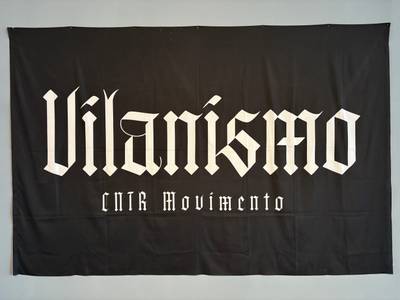
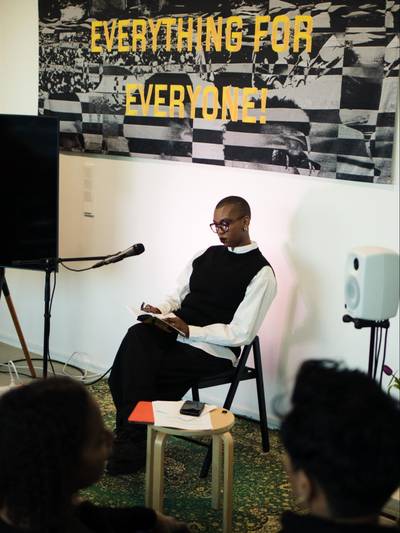
READEveryone in Vilanismo is someone I met and grew close to within the contemporary art circuit. Some even earlier, through graffiti, like Robson, or São Paulo’s pixação scene. The idea was to understand how their practices could move forward collectively, while also allowing me to be part of that vehicle, amplifying one another. So the starting point was affection and mutual admiration.
Vilanismo: An Ethics of Care and a Philosophical Framework Emerging from Afro-Paulistano Culture
-
 READ
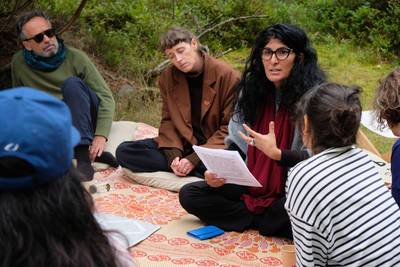
READI think of how many people are not able to be involved in social movements because of their own disability or their caring responsibilities, or the way that forms of social violence take away their capacity, or their ability to fight that social violence, because they’re simply trying to stay alive.
Dreaming of Liberation: An Interview with Lola Olufemi
-
 READ
READThis interview grows out of that ongoing process of working, thinking, and speaking together. While it takes the form of questions and answers on the page, in reality, it unfolded as a dialogue: her narratives of Palestine, her frameworks of hospitality and self-determination, and her reflections on Sweden intertwined with my own questions, concerns, and the shared struggles I see myself as part of.
Commoning Private Space: An Interview with Sandi Hilal
-
 READ
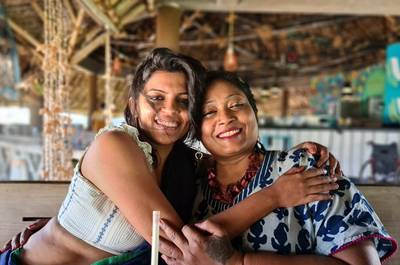
READDr. Aiswarya Rao on navigating hostile spaces for people-particularly women- with disabilities through the organization ‘Better World Shelter for Women with Disabilities’, building safe spaces, changing policies, and tying art into livelihood, fun, and friendship.
Blending Art, Friendship & Advocacy: A Conversation With Dr. Aiswarya Rao