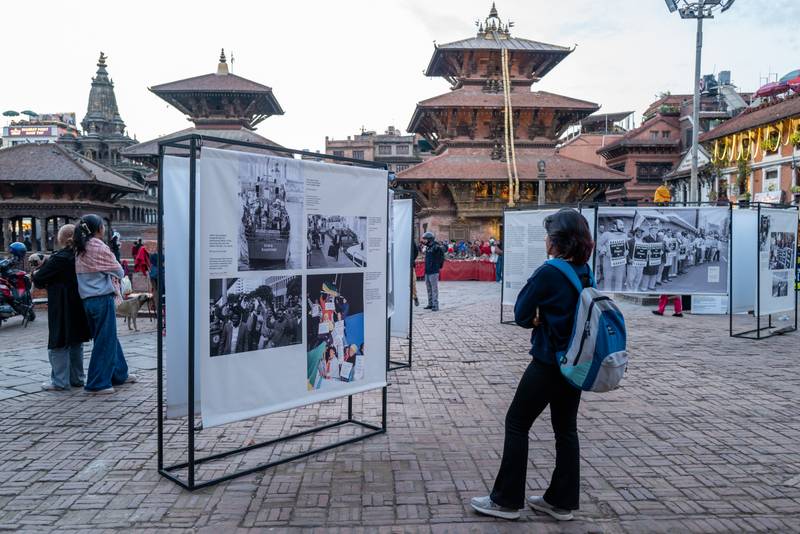
Visitors engage with Martyrs, Saints and Sell-outs in Patan as part of PhotoKTM6. Curated by Siona O’Connell, the exhibition brings together photographs by Benny Gool, Zubeida Vallie, and Adil Bradlow documenting South Africa’s anti-apartheid struggle. Photo: Phoebe Chen
Saurabh Karki is a poet, lyricist, and freelance writer. Drishyabahira (2006, Poetry Collection), Aandolan (2006, Drama), and Private is Political (2019, Drama) are his notable works. He has written Karpat, a movie about the Nepalese Civil War, which will soon be released in theatres. He has completed a master’s degree in sociology from Tribhuvan University in Nepal.
In 2025, Nepal made history when its Gen-Z youth protested against corruption, nepotism, and the social media ban on September 8-9, 2025, leading to the ouster of Prime Minister K. P. Sharma Oli’s coalition government within 48 hours as the street protests turned into a nationwide movement. Every decade, Nepal finds itself marching on the streets, demanding changes to the system to serve its people better; गाउँगाउँबाट उठ (Rise up from every village) – the revolutionary song by Shyam Tamot from the 1979 Nepalese student protests echoes across the nation. Twenty years ago, in 2006, the Jana Andolan II (People’s Movement – II), a 19-day uprising, overturned the 240-year-old Hindu monarchy into a federal democratic republic and made its then-king a member of the general public. A decade ago, Nepal drafted and adopted a new constitution amid significant chaos, conflict, and foreign pressure as a fast-tracked solution to a decade-long political deadlock.
The Gen-Z Revolution of 2025
Sparked by a government-imposed ban on social media platforms such as Meta and TikTok in the first week of September 2025, Gen Z protested in favour of transparency, accountability, and corruption control. To discredit the movement, Gen-Z was called a “whim” and accused of the coordinated fire attacks across the nation. As the protest grew bigger and violent, 76 people, including protesters, police officers, and inmates, were killed in prison riots, with the government officially declaring 45 of these individuals as “martyrs”. A preliminary report prepared by Nepal Police showed 13,182 instances of firing across the country, leaving over 2200 civilians injured. In the midst of this turmoil, gossip about the restoration of the monarchy grew louder.
On September 12, 2025, under a doctrine of necessity, Sushila Karki was sworn in as prime minister by the president, with a mandate to hold elections within six months. She promptly announced that fresh elections would be held on March 5, 2026, a year ahead of schedule. With the injured still in the hospital and the mourning period for the dead not even finished, political parties that had endorsed the authoritarian rule started opposing the newly formed interim government by protesting at Maitighar.
Two months after the Gen-Z revolution, the Nepal Art Council hosted the sixth edition of PhotoKTM under the theme of ‘Global South solidarities’ from November 14 to December 14, 2025, across various locations in the Kathmandu valley, with the Nepal Art Council in Babar Mahal serving as the anchor venue. Other public spaces used for exhibitions included Mangahiti & Chyasal (Patan), Tribhuvan University (Kirtipur), Nandi Keshar Bagaincha (Naxal), and Nigu Pukhu, Madhyapur Thimi, for hosting travelling pop-up exhibitions; and Bhandarkhal Garden and Patan Museum as venues for the opening night.
In Context: A Festival Born of Crisis
Established in 2015, in the aftermath of the 7.8-magnitude earthquake, PhotoKTM is Nepal’s first international photography festival, initially seeking to reactivate public spaces in Lalitpur. Over successive editions, it has developed a distinctive programming model that supports emerging and established artists through curated exhibitions, residencies, and the South Asia Incubator Program. By providing a space to nurture unique voices through workshops, publications, exhibitions, and commissions, the festival documents and engages with social change in Nepal and internationally.
PhotoKTM is organized by photo.circle, a platform for photography in Nepal that brings together photographers, visual practitioners, researchers, educators, and cultural organizers – particularly from across South Asia – to explore the political lives of images shaping histories and futures of the region and beyond. Through crowdfunding alone, they have rallied community support, keeping the Festival free, open, and largely uncensored, proving that people-powered initiatives can sustain independent cultural spaces even in turbulent times.
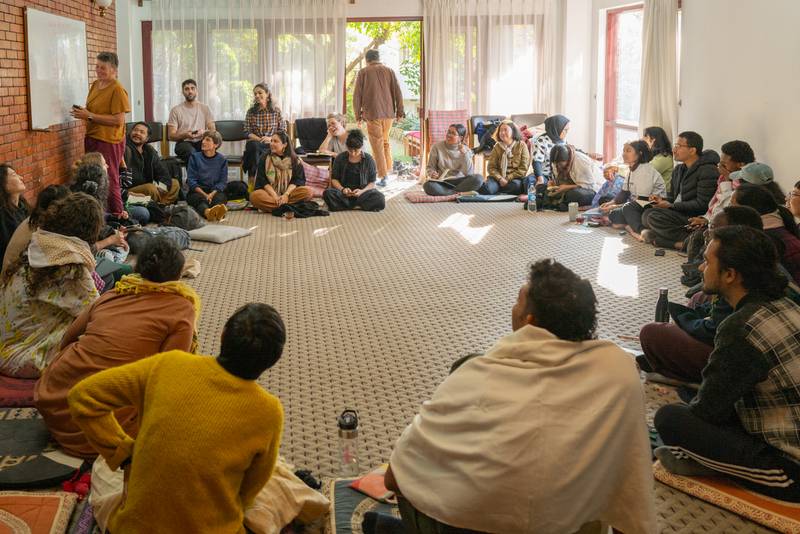
Participants engage in a session of the KTM Assembly during PhotoKTM6, a gathering that brought together cultural organisers, collectives, and arts practitioners from across the majority world to share experiences, build connections, and explore collective challenges and possibilities. The KTM Assembly was collectively conceived and facilitated by yasmine eid-sabbagh, Prathama Raghavan and NayanTara Gurung Kakshapati. Photo: Phoebe Chen
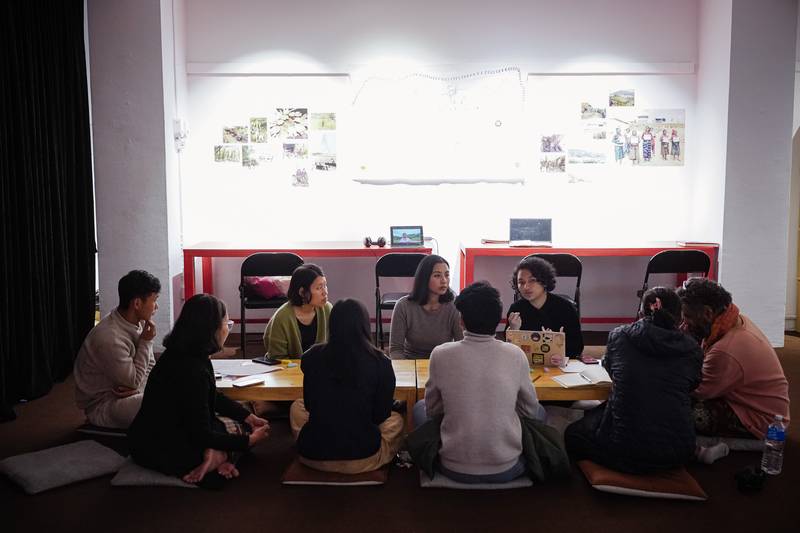
Participants gather for a reading circle at the Community Reading Room at PhotoKTM6, a shared space where visitors could explore a diverse collection of books, zines, magazines, and other printed matter that delved deeper into the festival themes. Photo: Rojan Shrestha
Each edition of PhotoKTM is realized through extensive collaboration among curators, volunteers, artists, cultural institutions, and local communities. Its planning includes thematic research and programming with workshops that emphasize participatory learning and knowledge sharing. This decentralized structure reflects the Festival’s people-powered philosophy, prioritizing collective cultural production over institutional dominance. The Festival features documentary, conceptual, historical, and community-based photography, with artist selection guided by thematic relevance, sociopolitical context, and collaboration.
The curatorial team brings together international perspectives and local voices, ensuring that global conversations stay rooted in Nepal’s social and cultural context. Each edition invites and celebrates stories from around the world alongside narratives from Nepal’s diverse population across terrains and ethnic identities, centring on that edition’s theme to emphasize that “Kathmandu is the center of the world.”
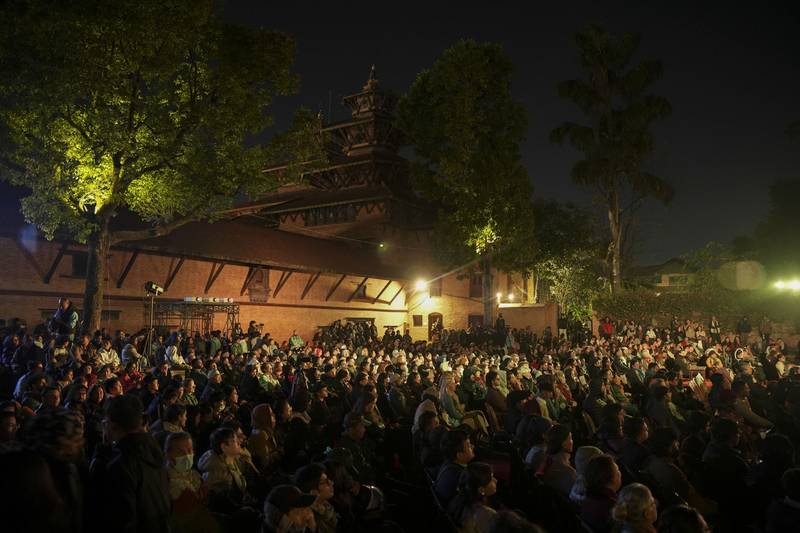
A packed audience at PhotoKTM6 Opening Night at Bhandarkhal Garden, Patan Museum. Photo: Amit Machamasi
Global South Solidarities in Action
Walking into the Nepal Art Council reminded me of the smell of gunpowder, the chants of slogans, and the moisture of blood evaporating in the air. Against the cold breeze of the winter afternoon, the warmth of the welcome greetings and the presence of artists from across the world gathered in Kathmandu felt almost like fiction.
Works presented at PhotoKTM 25’ articulated memories and cultures of villages, towns, and people, as seen in the publication उर्लँदो नदीसरी: महिला र परिवर्तनका कथाहरू (Like a Rising River: Stories of Women and Change) (pub. Srijanalaya). Rooted in lived experiences and shared resilience of women from Kavre, Sarlahi, Surkhet, Doti, and Kailali districts in Nepal, who have historically been excluded from public narratives, the published stories reveal pathways toward equality, dignity, and justice.
Prints in varying sizes of politically and environmentally themed visuals were displayed in public spaces. The use of locally sourced materials and accessible display methods enhanced their contextual authenticity. The commitment to platforming non-mainstream voices reflected in the festival’s physical space. Right next to the entrance of Nepal Art Council, in the community reading space, a banner reading, WE STAND TOGETHER WITH BOJHENI, brought attention to Bojheni, a government-backed substation project started in 2015 that threatened to displace over 500 Indigenous Tamang households under conditions of secrecy and intimidation. Acts of resistance echoed in smaller, yet no less powerful forms of expression throughout the festival – interspersed with hand-drawn simple drawings on a white cloth, were other slogans such as TO REMEMBER IS TO RESIST; DOWN WITH AMERICAN IMPERIALISM.
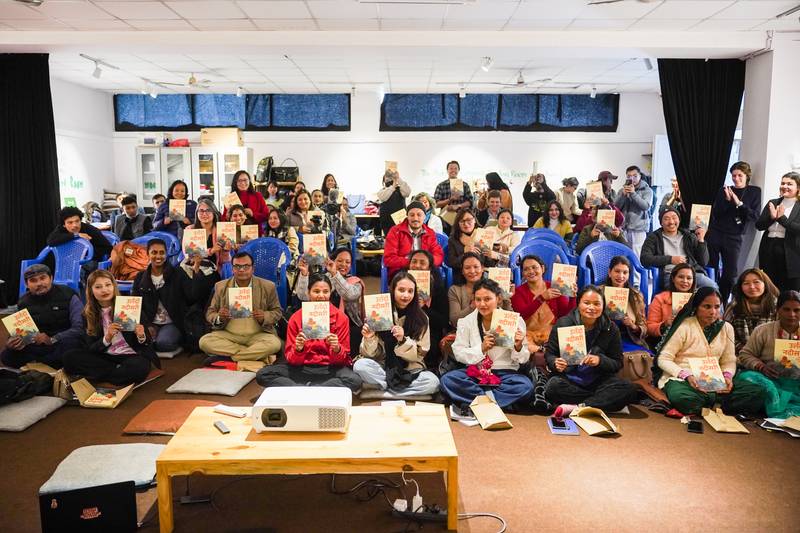
Attendees pictured with copies of Like a Rising River: Stories of Women and Change, a publication by Srijanalaya at its launch at PhotoKTM6. Photo: Rojan Shrestha
Local struggles for land and identity converge with global conversations on sovereignty. Nearby, a poignant inquiry, “What memory do seeds keep, if they are clones, imitations? Perhaps they keep a lie about progress, a falsehood sown a thousand times,” pasted on the walls carries with it another question – Do seeds (and thus, customs, ideologies, civilizations, or systems) actually transfer lived experience? Or is it merely genetic/mechanical repetition? Gourd, squash, and teocintle (the ancestor of domesticated corn) seeds from Mexico, Paraguay, Ecuador, and Colombia were exhibited as living repositories of indigenous knowledge, heritage, and culture, representing food sovereignty and intergenerational knowledge transfer, which women have historically protected. They were presented with their local names, signalling their link to ancestral regions, languages, and culinary customs that help maintain their uniqueness. The seeds possess nutritional and medicinal properties that, through saving, storage, and replanting over generations, have played an important role in maintaining lineage, connecting past knowledge to current survival, and fostering resilience to threats posed by monoculture.
Small-scale farmers worldwide face threats from monoculture imposed by large-scale agribusiness corporations, government policies/subsidies, and the historical legacies of colonialism and industrialization, which erode their economic value and practical knowledge. In Nepal, where the vast majority of farmers use traditional farming methods, the question is urgent: do we, as a nation, need to begin to worry about preserving the seeds and memories they hold?
Agricultural concerns were not confined to Nepal. ‘Global South solidarities’ were articulated through artworks that drew on shared histories of colonialism, resistance, forced migration, and ecological vulnerability. Several works foregrounded Indigenous voices and knowledge systems, extending solidarity to grassroots resistance movements. A more sustained examination of internal hierarchies within Global South contexts, such as ethnic marginalization, caste structures, and intra-regional power imbalances, would have further enriched the festival and deepened its engagement with the theme of solidarity. By highlighting parallels among sociopolitical struggles in Nepal, Latin America, Africa, and Southeast Asia, the festival reinforced the theme’s relevance and authenticity. The artworks revisited Third World legacies and both local and transnational narratives of struggle, echoing enduring voices of resistance and solidarity.
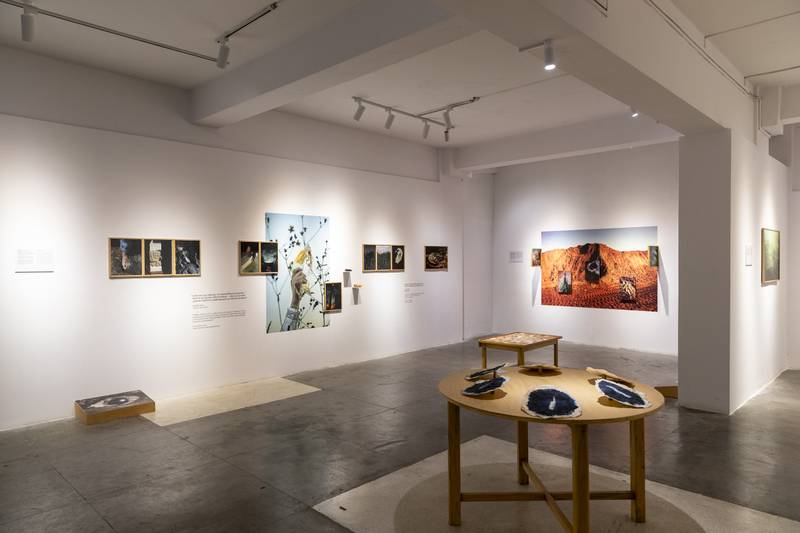
Installation view of Humo, Semilla, Raíz by Isadora Romero, tracing the loss and preservation of native seed varieties across Colombia, Paraguay, Ecuador, and Mexico. The exhibition was curated by Tanvi Mishra. Photo: Shikhar Bhattarai
Historical roots of extractive agricultural systems and their afterlives are brought into focus in Sammy Baloji’s video installation Aequare: The Future That Never Was (2023), which traces connections between exploitative agricultural methods developed during Belgian colonial rule in the Congo and their ongoing consequences in the Democratic Republic of the Congo. The Latin verb aequare, meaning “to equate,” underscores this connection between colonial-era practices and their persistence in the present. The film, composed of colonial-era footage of scientific control with scenes of local inhabitants interacting with the same decaying, inherited infrastructure, focuses on the town of Yangambi, the second-largest tropical rainforest region in Congo, which is believed to play a central role in regenerating the planet’s atmosphere. Baloji questions the legacy of colonialism marked by reckless exploitation of people and nature, where millions of lives were lost to forced labour of slavery, disease and famine.
While Baloji addressed this legacy through the scale of land, history, and ecological violence, Ahmed Alaqra’s Between Us, A Thread turned to the intimate and interpersonal consequences of ongoing crises in Gaza. The project, presented as a series of printed letters and a book, began as an email exchange between photographers and image-makers who were friends of the artist to check in with one another. In every email, the act ‘to hope’ that this is not the last becomes a poignant reminder that in times when the land burns and language breaks, the thread insists on another form of communication that is tender, slow, and unmonetized. In his reply to Sara’s email on September 9, 2025, Ahmed writes about the summer of 2024, when they first met in Amman. “At a time where it felt illegal to be happy, where every trace of hope was taken away, where laughter itself was a burden of guilt.”
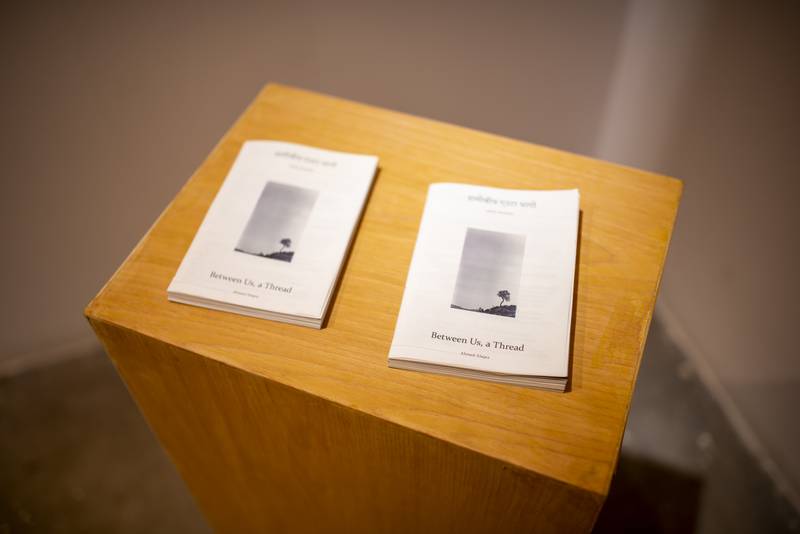
Between Us, a Thread by Ahmed Alaqra, a publication bringing together letters and emails exchanged between Palestinian and Arab photographers, image-makers, and custodians of memory, including Amera Elnaal, Hashim Nasr, Lina Khalid, Maen Hammad, Moayed Abu Ammouna, Mohammad Alfaraj, Mosab Abushama, Omar Malas, Rabab Chamseddine, Reem Ali, Rotana Shaker, Ruba Alfaraouna, Tamara Kalo, Yaqeen Yamani, Yasmin Huleileh, Yazan Khalili, and Zara Naber. Photo: Dipankar Shrestha
This focus on survival through fragile acts of communication continued in the work of yasmine eid-sabbagh and Rozenn Quere, Possible and Imaginary Lives. Constructed from family photographs and more than 40 hours of recorded interviews, the project follows the story of four sisters born in Palestine between 1930 and 1940 who were forced into exile one after another. Their flight began in Syria, continued in Lebanon, and continued beyond the Lebanese war. The photographs presented were reminiscences of their memory – of the dead, but more fundamentally of existence itself. This meditation on survival and recognition foregrounds historical erasure and the struggle for agency, as the act of photographing and narrating repeated displacement became part of the sisters’ lives. Although these places no longer exist as they once did, they are preserved in the sisters’ memories.
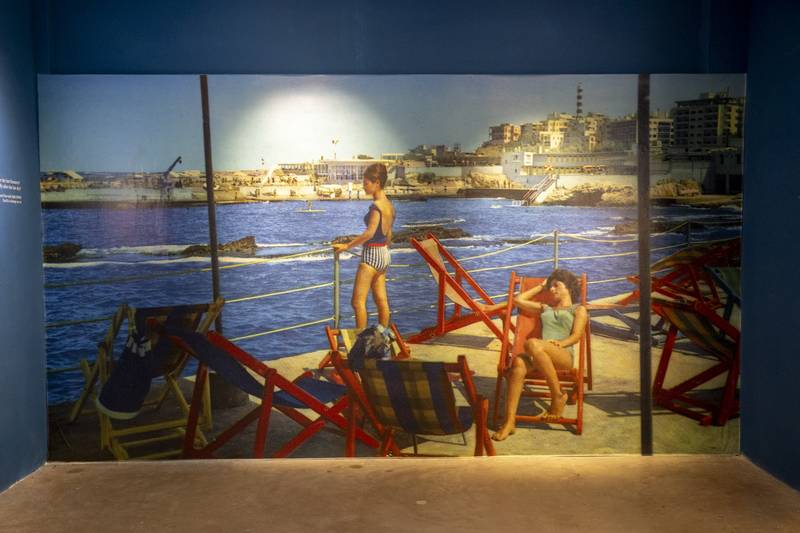
Detail from Possible and Imaginary Lives by yasmine eid-sabbagh and rozenn quéré, a photo and video series documenting the story of four Palestinian sisters, born in the 1930s and 1940s, whose lives unfolded through exile, from Palestine to Syria, Lebanon, and beyond. Photo: Samagra Shah
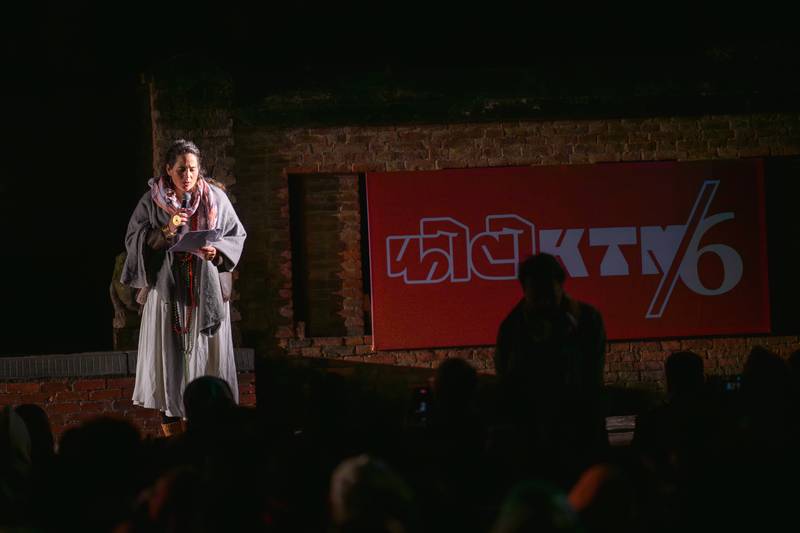
yasmine eid-sabbagh, the invited interlocutor for PhotoKTM6, addressing the gathering during the festival’s opening night at Bhandarkhal Garden, Patan Museum. Photo: Phoebe Chen
Tailoring Freedom – Renty & Delia (2021) by Sasha Huber examined memory, agency, and recognition by confronting the power imbalance between photographer and subject. The work responds to 1850 daguerreotypes commissioned by Louis Agassiz, in which enslaved people – including Renty and his daughter Delia – were forced to pose naked to support racist eugenic theories. Huber intervened by covering reproductions of their bodies with thousands of stapler pins, a labour-intensive process that materializes pain while restoring dignity and visibility. The project connected to contemporary debates over ownership and care, including Tamara Lanier’s 2019 lawsuit against Harvard, which demanded the return of the daguerreotypes and ultimately led to a collaboration with the International African American Museum to present the archives with ethical responsibility.
From the violence of the archive to the ongoing exploitation of living bodies, Tasmila Akhter’s photo documentation, Life and Struggle of Garment Workers (2008-2025) shifted the focus to communities of workers surrounding large garment factories in Bangladesh. Bangladeshi garments are widely known, yet the stories of labour, resistance, and survival behind them rarely reach global attention. Among the four million garment workers in Bangladesh, 80% are women who continue to hope for an end to this cycle and for a better life. The low wages, long working hours, and fragile hopes echo stories of garment workers in Nepal, underscoring how systemic exploitation crosses national borders. Working with age-old machines and wages long rendered inadequate – around $37 – these workers are pushed to their human limits while enduring persistent exploitation and abuse.
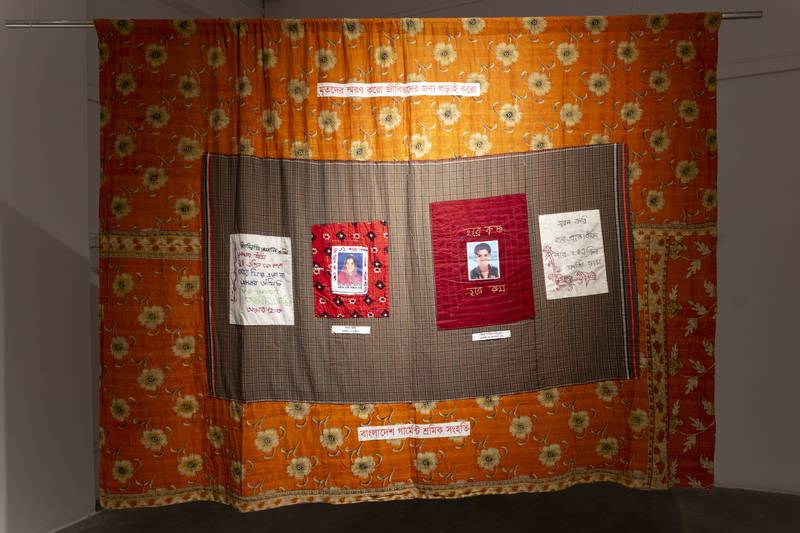
One of the five memorial quilts created by women affected by the 2013 Rana Plaza factory collapse in Bangladesh. Presented as Smrity Katha o Kotha at PhotoKTM6 by Taslima Akhter and Robin Berson, the quilts incorporate photographs, embroidered texts of remembrance and garments of the deceased in the 2013 Rana Plaza factory collapse. Photo: Samagra Shah
This ongoing struggle is inseparable from the Rana Plaza tragedy of April 24, 2013, when the nine-storey factory building collapsed, killing 1,134 workers and leaving hundreds missing. The disaster has since become a focal point for collective memory and activism, linking personal grief with public demands for justice. Akhter’s photographs document protests led by workers and their families, as well as renewed labour movements, including the 2023 demand for a minimum wage of $225, which was ultimately set at around $110.
Memory and resistance are further explored in Smrity Katha o Kotha, an exhibition by Taslima Akhter and Robin Berson, in which two handcrafted kathas (quilts) stitched by women who lost family members in the collapse were displayed. Made from the preserved clothing of the deceased and sewn with photographs, embroidered verses, and handkerchiefs bearing words of grief and remembrance, the quilts transformed loss into a tactile, intimate form of storytelling, extending the exhibition’s cycle of memory, resistance, and care.
This movement from global histories of labour and mourning to place-specific narratives continued on the next floor, where works by Nepali artists who had completed the Festival’s residential workshops were presented. Developed over months, these works were rooted in local contexts and in shared perspectives of a community shaped by direct encounters with the land and with one another during the exhibition.
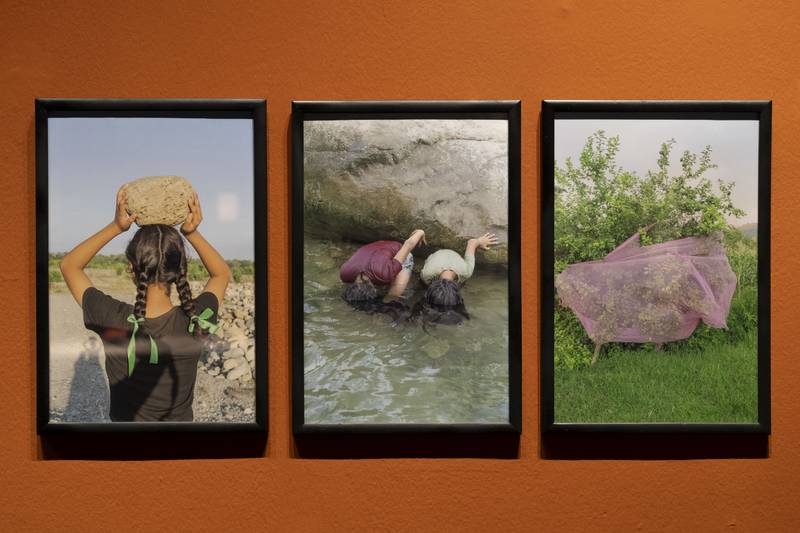
Installation view of Tender by Sushila Bishwakarma, a reflection on the changing landscapes of her village in the Chure-Bhawar region, where forests thin, streams vanish, and hills are reshaped by development projects. Photo: Samagra Shah
Continuing the dialogue on land, memory, and loss, Sushila Bishwakarma’s artwork Tender, drew attention to the exploitation of land and the marginalization of women in the Chure-Bhawar region. She discussed the “collateral damage” to landscapes of soil, stones, forests, and rivers, as depicted by images associated with the ideas of ‘progress’ and ‘development’. Despite being a major water source and stabilizer for the fertile Terai, the region faces severe threats to its biodiversity, with landslides and floods increasingly eroding plant and animal communities, displacing people, and destroying villages. This tension between development and erasure also informed Panchardobato by Enuma Rai. Set in a Kirati village in Khotang district, the photo story reflected a community guided by Mundhum, its ancestral system for coexisting with nature. Enuma described how an ancestral burial ground on a hill was chosen as the site for a 110-foot statue of the first Kirati King, Yalambar. Despite local opposition and the site’s sacredness, these voices were ignored. According to Enuma, the statue is an attempt to erase the community’s existence and both its tangible and intangible heritage. Questions of cultural loss extended from land to language in Ji ta Newa Bhyaa Mawa (I don’t know Nepal Bhasa) by Jyoti Shrestha. The Newar community, among the oldest inhabitants of the Kathmandu Valley, shares traditions and language across religious identities. Yet Jyoti cannot speak her mother tongue, Nepal Bhasa, which UNESCO has listed as endangered. She shared that without her language, she feels alienated in the culture meant to be her own, a feeling reflected in her blurred, dimly lit photographs.
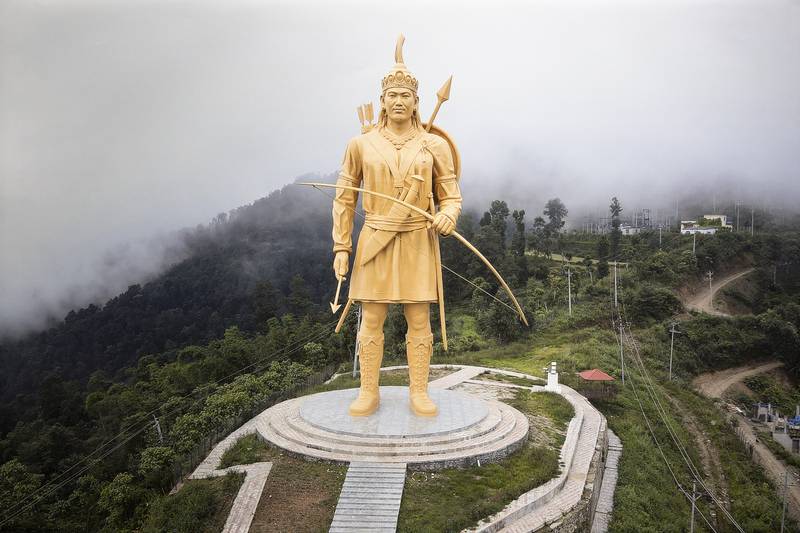
Image of the statue of Yalambar, the first Kirat king, from Enuma Rai’s work titled Panchardobato, where ancestral burial grounds were disrupted to erect the statue. Photo: Samagra Shah
This sense of disconnection from home reappeared in Why doesn’t home feel like home, a photo series by Karma Tshering Gurung. From Manang, a mountainous region near Tilicho Lake, Karma works hundreds of kilometres away from his village. While his brother plans to convert their ancestral home into a snooker hall, Karma believes the house embodies his parents’ identity, memory, and connection.
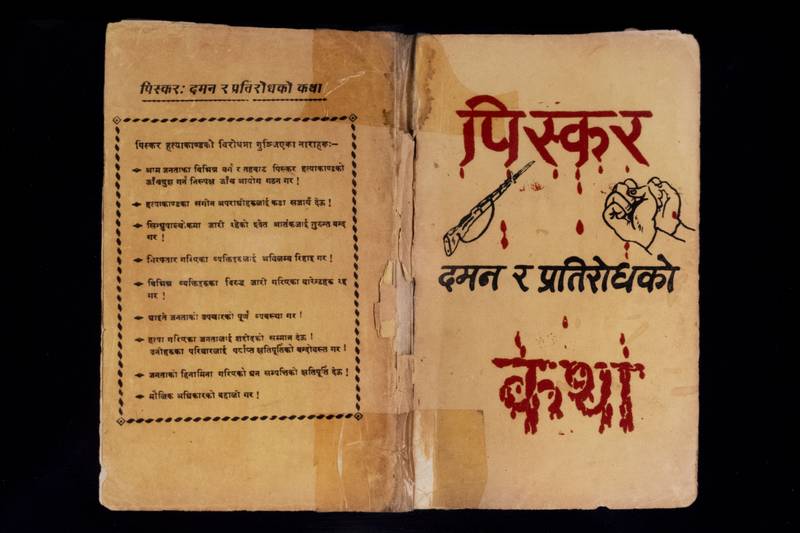
Archival document featured in The King Didn’t Like the Song by Manoj Bohara, tracing collective memory and resistance following the 2040 BS Piskar massacre. Photo: Samagra Shah
Extending the themes of memory, loss, and erasure, The King Didn’t Like the Song by Manoj Bohara recalled a time when Nepal was a monarchy and songs of resistance against monarchical tyranny echoed through villages and cities. During Maghe Sankranti 2040 BS (January 1984) in Piskar Village, a police action turned a holy celebration into the Piskar Massacre. Manoj documented this history by placing government-owned and independent media coverage side by side. Forty-two years later, as the Gen-Z youth gathered to oppose corruption and demand accountability, the new kings from that monarchy to this tyranny)– without crowns, within this Federal Democratic Republic – once again “did not like the people’s song”. That enduring pattern came to a head on September 8, 2025, which will be remembered as a day when those in power, through armed police officers, silenced voices they refused to hear.
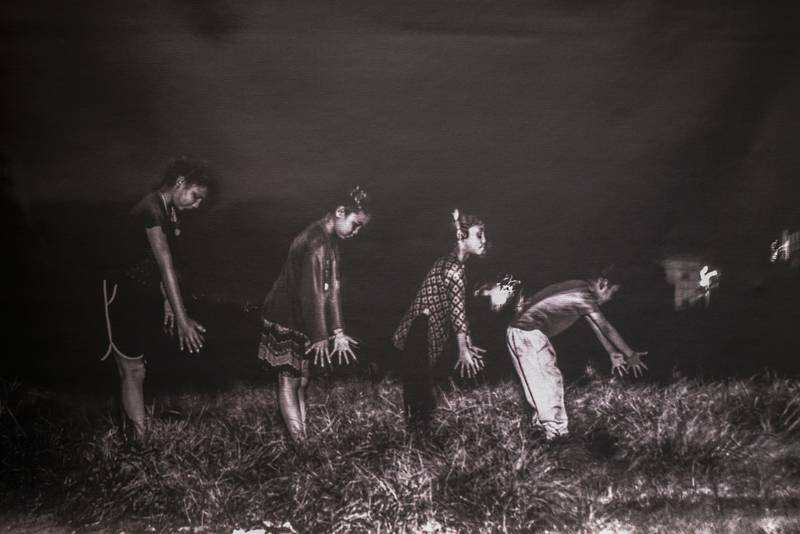
Detail from Ji ta Newa Bhyaa Mawa by Jyoti Shrestha, a personal exploration of growing up in Kathmandu without learning Nepal Bhasa and the resulting experiences of language loss, cultural alienation, and reclaiming belonging. Photo: Phoebe Chen
Scaling up: Visibility, Public Impact and Scope
While the 2025 edition of the Festival attracted a diverse audience of students, artists, activists, academics, and international visitors, its overall reach among the local public remained limited. Active social media visibility did not translate into on-site attendance. Exhibitions and film screenings encouraged urban audiences to engage with layered narratives; displays across galleries and public spaces balanced intimate, personal stories with large-scale installations that invited broader political reflection. Some artworks required sustained engagement to fully absorb their meanings, making the communication of Global South solidarities heavily dependent on explanatory texts. Cross-media and conceptual experiments, though appealing to young practitioners and photography students, proved less accessible to general audiences without mediation. Nevertheless, utilizing guided tours, workshops, and community-oriented programming helped bridge this gap, drawing participation from colleges, youth collectives, and women’s groups. The spatial character of each venue closely shaped curatorial and aesthetic decisions. Experimental installations combining archival materials, large-scale projections, prints, and site-specific displays, supported by active engagement from volunteer guides, were effective. Immersive, multi-site presentations strengthened narrative flow and fostered intimate viewing experiences, despite occasional overcrowding and site-specific limitations.
The dialogue between local narratives from Nepal and other regions of the Global South reaffirmed PhotoKTM’s relevance within Kathmandu’s art ecosystem. Compared with earlier editions, the sixth edition of PhotoKTM, marking its tenth year, demonstrated expanded international collaboration and a broader thematic scope. Organizers emphasized deeper engagement with global political narratives and multidisciplinary experimentation. The festival expanded in scale, with additional venues across three districts and a wider range of programming throughout the month-long exhibition. This edition favoured installation-based and conceptual approaches over the documentary photography that dominated previous editions. While the expanded scale introduced logistical challenges, including venue coordination and resource distribution, the sixth edition nevertheless signalled a maturation of PhotoKTM’s institutional credibility and curatorial confidence.
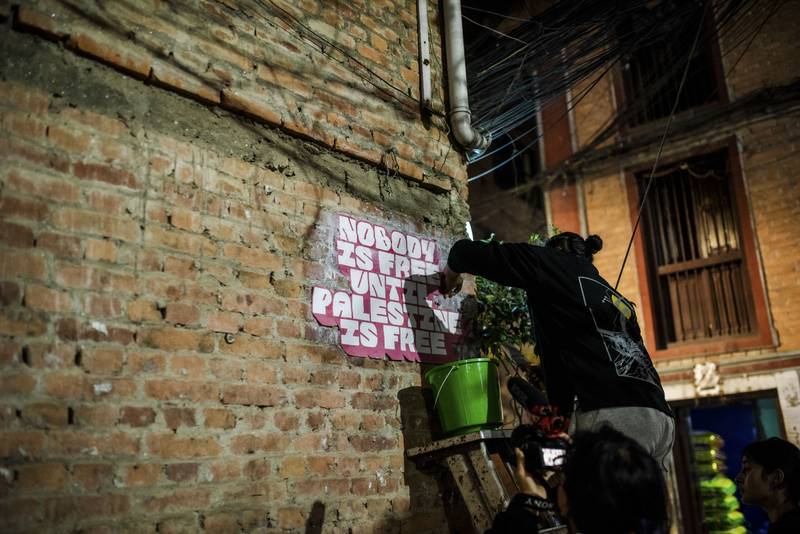
A wheatpaste mural in the making in Patan during PhotoKTM6. Photo: Dipankar Shrestha
Solidarity in a Time of Flux
PhotoKTM, and in particular its sixth edition, functions as both a political gauge and a cultural platform. It is unrealistic to quantify its influence on the everyday, non-art public. Still, Nepal’s ongoing struggles with democratic fragility, federal identity, and civic reorganization are reflected in the festival’s focus on solidarity, resistance, and communal memory. By encouraging critical engagement with representation, governance, and historical continuity amid the March elections and persistent political uncertainty, the event contributes to public discourse without directly intervening in electoral politics.
PhotoKTM’s sixth edition closed in December, but the solidarities it evoked remain – in stickers demanding freedom for Palestine, in quilts stitched from grief, and in seeds that remember their true names. Amidst Nepal’s political instability and democratic fragility, PhotoKTM asserts that while art cannot guarantee revolution, it steadily shapes a future that values diverse voices over elite dominance. Stories of resistance across the Global South remind Nepali society that resistance and revolution are not merely ideals; they are sometimes the only hope. PhotoKTM’s legacy affirms the role of art in fostering pluralism, grassroots agency, and collective imagination, sustaining reciprocal transnational bonds and solidarity from the ground up that outlast autocratic regimes or crises.
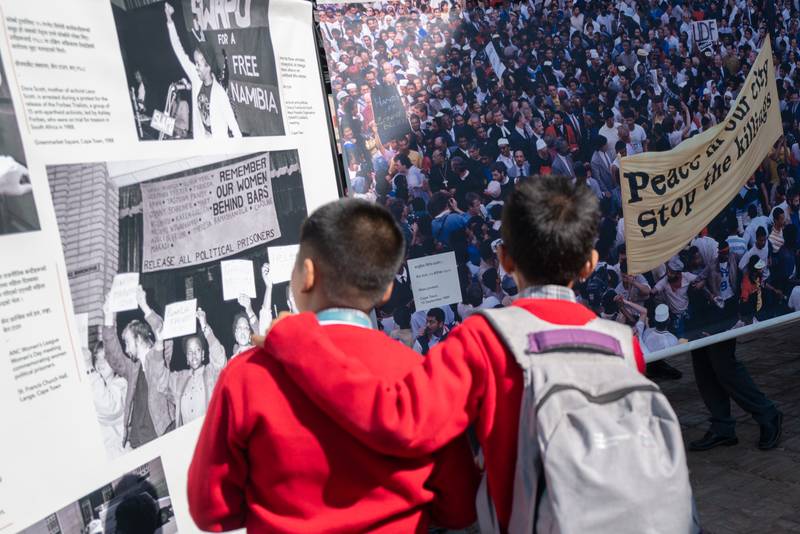
Nepali school children engage with Martyrs, Saints and Sell-outs at PhotoKTM6 in Patan. Curated by Siona O’Connell, the exhibition brings together photographs by Benny Gool, Zubeida Vallie, and Adil Bradlow documenting South Africa’s anti-apartheid struggle. Photo: Phoebe Chen
-
 READ
READI could see a lot of love. But I was still trying to find the anarchy that breaks through and what it breaks through. I wondered if I should write about the positionality of the festival in what can be termed as its cultural intervention into events and processes that affect us today.
Finding Anarchy: A Review of Helsinki International Film Festival
-
 READ
READHow will Flow Festival respond to criticisms about its relationships with its free workforce, security contractors, Helsinki Police and its Zionist holding company? Will it align with or distance itself from the actions and affiliations of its financial backers?
Flow Festival: A Retrospective
-
 READ
READClose Watch exhibited at the National Finnish Pavilion at Venice Biennale, 2022, is a multimedia installation that, at its core, utilises the artist themself as an embodied intervention within a focused area of artistic research and apparent critique. In the context of this work presented as an exhibition at the national pavilion and its implications of somehow representing Finnish Art, this text seeks to question whether issues pertaining to embodiment and social intervention – and by extension, research conducted and artistic practice developed through it – can ever be free of the power relations implicit in the political, identity-driven understanding of society today.
Who Watches Whom? Ruminations on Power, Gaze, and Field Through Pilvi Takala’s Close Watch
-
 READ
READAïnata (2018), shot in South Lebanon, is the debut documentary by the Lebanese research-based artist and filmmaker, Alaa Mansour. The memories being reconstituted in the film are those of Aïnata, a town in South Lebanon nestled within olive and tobacco farms, plagued for decades by Israeli occupation and violence.
Memory and the Fractured Image: A Review of Alaa Mansour’s ‘Aïnata’