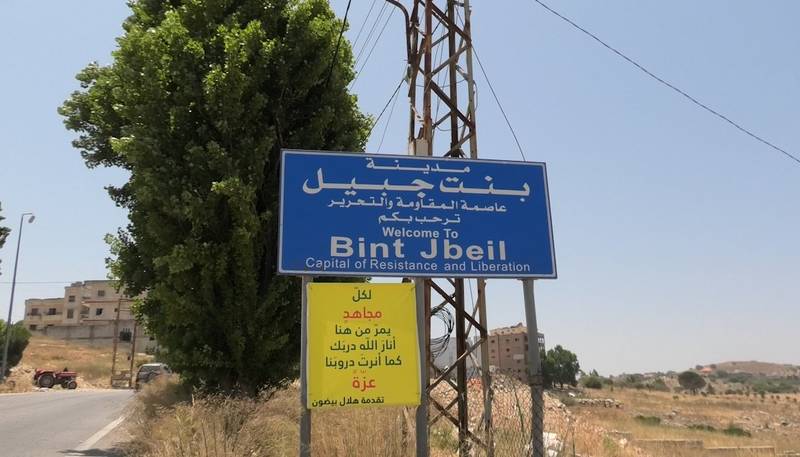
The iconic entryway to Bint Jbeil, welcoming travelers to the designated “Capital of Resistance and Liberation” in Southern Lebanon. From x
Wijdaan al-Zniti is an independent writer, analyst, and visual curator focusing on Palestine, Lebanon, and the wider SWANA region. Her work explores geopolitics, political memory, visual culture, and decolonial narratives.
The Lexicon of the Eraser
There is a specific kind of violence that does not announce itself with the whistling of a missile, though it always precedes and follows it. It is the violence of the shorthand. Operating through the detached, clinical vocabulary of mainstream journalism, this shorthand acts as an epistemological knife, slicing away the moist flesh of lived experience to leave behind a dry, militarized shell. When applied to the Global South - and specifically to Jabal Amil, the historical, stubbornly unyielding region of Southern Lebanon - this linguistic blade carves out artificial spaces of emptiness where dense, generational reality once stood. The corporate map is drawn by erasing the soil.
Bint Jbeil rarely occupies space in international coverage for long. It surfaces only during moments of hyper-visible, spectacular escalation - an Israeli invasion, a devastating airstrike, a tense border confrontation - then immediately recedes into the background of a familiar, comforting geopolitical landscape curated by Western newsrooms. When it does appear, it is instantly flattened into a mechanical nomenclature: “Southern Lebanon,” “a Hezbollah stronghold,” “a volatile border town.” This is deliberate colonial literacy. It is a cynical way of reading a geography exclusively when it bleeds, mapping its existence entirely through the parameters of imperial “security.” To reduce a centuries-old market town to a mere “stronghold” performs a neat, bureaucratic erasure. It strips the landscape of its human density, converting homes into targets and neighborhoods into tactical coordinates.
We must ask: whose comfort does this abstraction serve? It serves the occupier, who wishes to encounter an empty space of targets rather than a populated landscape of ancestors.
If a place is merely an abstract military node, then its total destruction becomes a logistical adjustment rather than a tragedy of forced displacement, shattered memories, and cultural loss. The drone camera demands a void. Beneath this sanitizing language, the visceral specificity of the place disappears: the heavy, sweet smell of tobacco leaves drying on wooden frames, the cool shade of its ancient stone arches, and the generational trade lineages that linked its merchants to al-Jalil long before colonial borders and Israeli occupation entities carved up West Asia.
We must ask: whose comfort does this abstraction serve? It serves the occupier, who wishes to encounter an empty space of targets rather than a populated landscape of ancestors. To interrupt this shorthand is an act of refusal. It is a demand to read Bint Jbeil not through the crosshairs of an empire, but through the persistent, stubborn memory of its soil.
Jabal Amil and the Deep Roots of Counter-History
To undo this shorthand, one must practice an intentional inversion of the gaze. It requires us to reject the timeline handed to us by corporate media — which begins exclusively when Israel decides to bomb or invade — and look instead at the deep, sedimented history of Bint Jbeil and the wider Jabal Amil region. The town is situated near the artificial border drawn by imperial cartographers through the 1923 Paulet-Newcombe Agreement, followed by the 1949 Armistice Line, but its history ignores these modern scars.
For centuries, Bint Jbeil was the beating heart of Jabal Amil, a historic center of Shia scholarship, agricultural resilience, and anti-imperial organizing. Long before the rise of contemporary political parties, the people of Bint Jbeil practiced an indigenous politics of refusal. During the Ottoman period and under the French Mandate, the town stood as a nexus of peasant solidarity and intellectual resistance.
When the French imperial authorities attempted to “partition” the region and isolate the South to secure their colonial holdings, the leaders of Jabal Amil refused to be passive spectators. On April 24, 1920, leaders, scholars, and fighters gathered at the historic Wadi al Hujayr Conference. Under the spiritual and political guidance of Sayyid Abd al-Husayn Sharaf al Deen - the towering intellectual and jurist from nearby Sur - they articulated a proto-decolonial vision. Sharaf al Deen issued a historic fatwa calling for armed resistance against French colonial incursions, while simultaneously insisting on cross-sectarian unity and a fierce refusal to submit to European Sykes-Picot cartography.
This conference was the formalization of an Amili tradition of defiance. Bint Jbeil was an active participant in this movement, serving as a refuge for fighters and a marketplace for ideas that challenged both Western imperialism and regional feudalism, al-Iqta. This is the historical bedrock upon which the town’s contemporary identity rests. It was an active subject of its own history, rather than a passive, empty space waiting to be occupied and militarized.
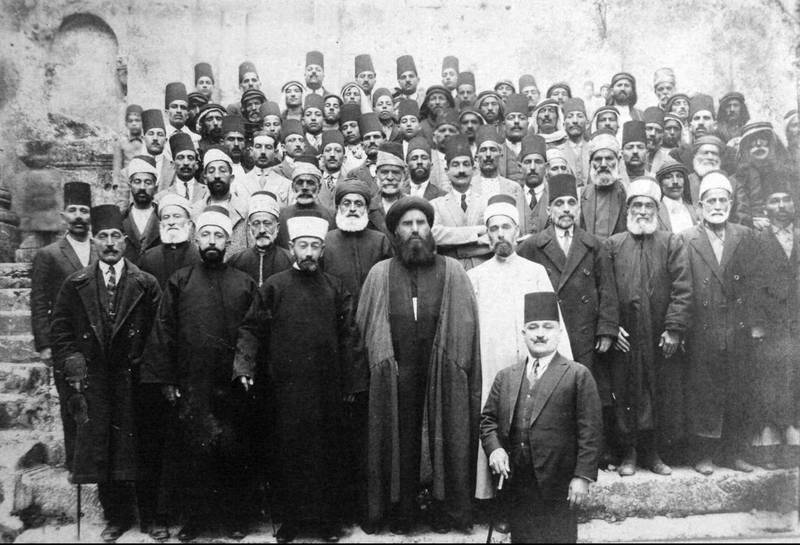
Archival photograph of the historic Wadi al-Hujayr Conference, April 24, 1920. At the center stands the towering Amili jurist and intellectual Sayyid Abd al-Husayn Sharaf al-Deen, surrounded by the religious, scholarly, and regional leadership of Jabal Amil.
The Amili Intellectual Tradition
The reduction of Bint Jbeil to a sterile “military zone” performs another crucial erasure: it mutes its identity as a sanctuary of words. For centuries, Jabal Amil has been known as a cradle of scholars, a geography where communities preserved their existential autonomy through intensive literary production, radical jurisprudence, and a fierce poetic tradition. To read Bint Jbeil decolonially, we must read it through the eyes of its thinkers alongside its fighters. A community that writes cannot be easily emptied. Consider the legacy of Sheikh Ahmad Arif al-Zain, who in 1909 founded the pioneering journal Al-Irfan in the South. Al-Irfan was a radical cultural monthly that broadcasted ideas of modernization, anti-colonialism, and scientific inquiry across the entire Arab world from a distinctly Southern Lebanese axis. It provided a fierce platform for Amili intellectuals to dismantle both Ottoman and French narratives of Southern backwardness systematically.
This intellectual architecture is inseparable from the region’s literature, where voices like Muhammad Ali al-Shamseddin and Hassan Abdallah transformed the physical topography of the South - its red soil, its unyielding olive trees, its scarred valleys - into a sacred lexicon of belonging and defiance. Hassan Abdallah’s seminal poem Darwish al-Jabal (The Mountain Derwish) captures precisely this mystical, stubborn attachment of the Amili peasant to a landscape constantly threatened with physical liquidation.
When international coverage flattens Bint Jbeil into a generic tactical coordinate, it deliberately severs this lineage of the written word. It hides the fact that resistance in the South was written in verse, debated in schools of jurisprudence, and bound to the soil long before it was ever organized into modern political factions. The language of Bint Jbeil is itself a living archive - a linguistic repository of patience, dry humor, and a refusal to be intimidated by the structural asymmetry of imperial power. The ink of the South runs as deep as its blood.
Genesis of the “Capital of Armed Resistance”
The transformation of Bint Jbeil into the “Capital of Armed Resistance” is an organic, generational evolution born directly from regional trauma, state abandonment, and the visceral necessity of survival. We must confront a fundamental reality here: the weaponization of this landscape was a response to an occupying entity driven by a compulsive, pathological obsession with flattening everything that speaks of Lebanon’s millennia-old history. This colonial project harbors a deep, visceral hatred for the very fact of an indigenous population that refuses to clear out. Yet, no matter how many times the Israeli apparatus attempts to pulverize this soil, it encounters an unyielding truth: the resistance of Jabal Amil is a cyclical, self-renewing force of liberation that cannot be structurally extinguished. The tank can destroy the house, but it cannot occupy the memory of the stone.
This material necessity deepened following the 1948 Nakba, which violently severed Bint Jbeil’s historical, organic economic lifelines to al-Jalil and al-Nasra, suddenly converting a thriving regional market hub into a dead-end border periphery. Left defenseless by a central Lebanese state that systematically abandoned the South throughout the 1960s and 1970s, the people of Bint Jbeil were forced to develop an autonomous doctrine of self-defense. This localized infrastructure became the psychological and operational crucible for guerrilla warfare during the devastating Israeli invasions of 1978 and 1982.
Throughout the brutal 22-year occupation that followed, the inhabitants refused to submit to either the occupying forces or their proxy militia apparatus. Instead, they weaponized their intimate, ancestral knowledge of the rugged landscape - its deep valleys, hidden olive groves, and ancient architecture - transforming the entire municipality into an asymmetric fortress. The point of this militarization is entirely defensive; it is the ultimate assertion of the right to exist. When the occupation finally collapsed under the weight of sustained local armed resistance in May 2000, Bint Jbeil stood as the definitive proof of an un-negotiated indigenous liberation. It was here, on May 26, 2000, that the historic Khitab bayt al-’ankabut speech was delivered by Hezbollah leader Sayyed Hassan Nasrallah. This moment forever cemented the town in the political imagination of the Global South as the geographic, living proof that an indigenous population, deeply rooted in its soil, could dismantle a heavily militarized, high-tech Western colonial apparatus. The web of the empire was unraveled by the roots of the land.
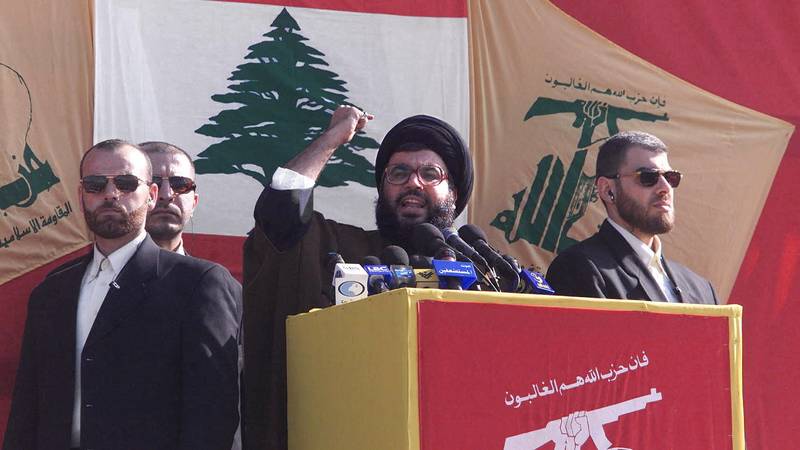
Hezbollah leader Sayyed Hassan Nasrallah delivering the historic Liberation Speech in Bint Jbeil on May 26, 2000. By Rabih Moghrabi - AFP
Today: Urbicide, Erasure, and Occupation
In the current landscape of the mid-2020s, Bint Jbeil finds itself at the epicentre of a systematic project of absolute territorial erasure and forced depopulation. During the heavy 2026 Lebanon War, Israeli occupation forces actively deployed a dual strategy of urbicide and domicide. This campaign is a calculated effort to physically manufacture a permanently depopulated, occupied buffer zone. Meticulous satellite data and field reports published by platforms like Al Jazeera and L’Orient-Le Jour reveal a catastrophic reality: over 90 percent of the town’s urban mass has been either entirely leveled or severely damaged.
More than 3,000 housing units have been reduced to gray ash, with the violence deliberately concentrated on the town’s historic commercial center, its ancient neighborhoods like Ain al Saghira, and invaluable cultural heritage sites, including the 400-year-old Great Mosque. Critical health and educational infrastructure, such as the Salah Ghandour Hospital, have been systematically targeted to render the geography fundamentally uninhabitable.
Even as Israeli occupation forces, paratroopers, and AI-powered combat engineering units attempt to maintain operational control over the rubble, the town remains an active, fiercely contested site of confrontation. The Lebanese people have been forcibly displaced to Saida and Beirut. However, local armed resistance continued to wage urban warfare from the ruins, blocking the stabilization of an occupation line. The Lebanese government, despite its complicity, has formally denounced this campaign as a calculated blueprint to erase property records, municipal IDs, and centuries of indigenous presence. This equates the destruction of Bint Jbeil directly to the colonial methods of spatial annihilation witnessed in Gaza.
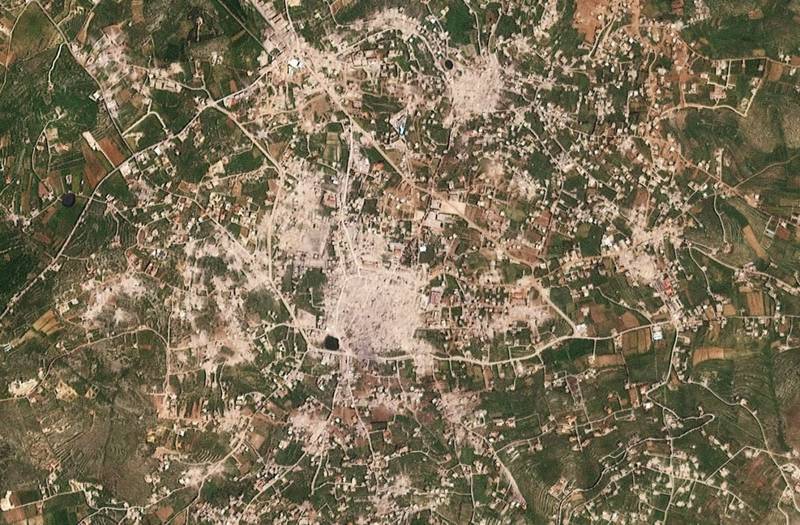
Satellite reconnaissance imagery documenting the methodical scale of urbicide and spatial annihilation in Bint Jbeil. By L’Orient Le Jour - Planet Labs
The Fabric of the South: Local Popular Culture and Everyday Rituals
To counter this weaponized abstraction, one must dive deep into the cultural landscape of Bint Jbeil, where resistance is woven into the sensory and mundane fabric of daily life. The town’s identity is anchored in Souk al-Khamis, a centuries-old institution that historically transformed Bint Jbeil into an economic crossroads. Long before the colonial borders of 1923, merchants from Safad, Tiberias, and al-Nasr traveled north to exchange Palestinian textiles and sea fish for Amili grains, soap, and tobacco. The persistence of this market, rebuilt after every war, is an act of economic decolonization. It insists that the town’s true orientation is regional and relational, rather than a peripheral edge defined by an occupation line.
The cultural texture of Bint Jbeil is also intimately tied to the soil through Amili tobacco (al-tebgh al-amili). Tobacco cultivation is a grueling ritual of endurance. Entire families participate in the cycle: planting the seeds in winter mud, harvesting the heavy green leaves under the scorching summer sun, and sewing them onto long strings to dry under the village eaves.
Here, the historical tragedy of Karbala is constantly re-read through a decolonial lens: the ancient refusal of Imam Husayn to pledge allegiance to a tyrannical ruler is mapped directly onto the contemporary refusal of the South Lebanese peasant to submit to Zionist and Western hegemony.
The tobacco leaf is a central motif in local popular consciousness, celebrated in folk songs and subaltern poetry as the nabat al-fuqara. It represents a historical struggle against state monopolies, such as the Régie, and the physical danger of farming lands littered with Israeli unexploded cluster munitions. To smell the pungent, earthy scent of drying tobacco in the alleys of Bint Jbeil is to understand a community that extracts life from a landscape designed to be a minefield.
Furthermore, the social life of the town is punctuated by specific mourning rituals and collective spaces that double as sites of memory preservation. The traditional Hussayniya (the congregational hall for Shia commemoration) functions in Bint Jbeil as a radical civic forum. Here, the historical tragedy of Karbala is constantly re-read through a decolonial lens: the ancient refusal of Imam Husayn to pledge allegiance to a tyrannical ruler is mapped directly onto the contemporary refusal of the South Lebanese peasant to submit to Zionist and Western hegemony.
During the annual commemoration of Ashura, the streets of Bint Jbeil resonate with chants that seamlessly blend historical lamentation with direct political denunciation of colonial border violence. This is supplemented by secular spaces of gathering, such as the local cafés around al-Saha, where elders drink bitter coffee, smoke waterpipes, and engage in al-Zajal, an ancient form of improvised spoken-word poetry. In these Zajal sessions, local poets use the specific Southern dialect, al lahja al-janoubiyya, to chronicle the village’s survival, turning oral history into an impenetrable fortress against imperial archives.
“Welcome to Bint Jbeil, the Capital of Resistance and Liberation.” This sign might read as a mere political slogan or an ideological marker. But this inscription is an organic statement of fact, authored by the very bodies of the South Lebanese people. This sign is a reflection of a population whose relationship to the soil is absolute, visceral, and non-negotiable.
Ultimately, Bint Jbeil teaches us that the language of empire can never fully contain or suppress the reality of an indigenous landscape. The international media will continue to use its sterile shorthand propaganda, reducing a rich cultural topography to an abstract “security threat”, and regional powers will continue to project their ideological desires onto its wounded hills. But the town itself remains as an ongoing project of decolonial memory and material reconstitution.
This refusal to disappear is echoed profoundly by the people who live along this fractured border. As one elderly resident of the Bint Jbeil area stubbornly remarked while surveying the wreckage of her family home: “They can shatter the concrete, and they can pull down our mosques, but they cannot harvest the roots of our tobacco or buy our absence. We return because the soil remembers our names, and staying here is the only victory that matters.” This voice captures the essence of Lebanese people that refuses to be transformed into “communities” or an abstract “statistic of war”.
As you approach the entrance of the town, a prominent metal sign spans across the roadway, clearly displaying the inscription: “Welcome to Bint Jbeil, the Capital of Resistance and Liberation.” This sign might read as a mere political slogan or an ideological marker. But this inscription is an organic statement of fact, authored by the very bodies of the South Lebanese people. This sign is a reflection of a population whose relationship to the soil is absolute, visceral, and non-negotiable.
The true power of the people of the South does not lie in their ability to match the spectacular violence of the Israeli colonial machine, but in their baseline refusal to disappear. It is found in their cyclical return to the rubble, their stubborn cultivation of the valleys, and their poetic preservation of memory. Israel and the West operate through the lexicon of the eraser, attempting to turn history into a clean slate of tactical targets. But as long as the people of the South return to rebuild their homes, tend their fields, and speak their dialect, they prove that the soil possesses a memory that no amount of gray ash can bury. The sign at the entrance of Bint Jbeil is a monument and an active promise of the future – a clear declaration that this land belongs to the ancestors who built it, the peasants who tend it, and the resistance that keeps it free.
-
 READ
READA conversation with Isabel and Carl Gakran about the Zág (Araucaria), an indigenous tree threatened with extinction. We talked about their project (Instituto Zág), Indigenous climate justice and the intersection between the Palestinian and the (Brazilian) Indigenous struggles.
Zág Trees, Forest Spirits, and the Settlers: A Conversation with Xokleng Kin
-
 READ
READWhile azerbaijan was bombing Armenians with israeli and turkish UAVs and paying bonuses to turkish-backed Syrian mercenaries for beheading Armenians, the “international community,” whatever that’s supposed to mean at this point, expressed lousy words of “concern,” and displayed a nauseous stance of both-sideism, devoid of any tangible action. The existence of this unrecognised republic and its indigenous population wasn’t legitimate enough for world powers to lift a finger.
Violent Septembers: An Armenian Perspective Amid the Ongoing Occupation
-
 READ
READI’ve been reporting from Manipur since June 2023. From the very beginning, I could understand that though women were contributing as much as men in facing the brunt of the war, their roles never received enough acknowledgment nor were their views taken into account while making important decisions. As an outsider, I could see that women leaders had a much more pragmatic method and manner of dealing with most situations, yet they found no place on the leadership table. This, I was made to understand, stems from a society that is founded on a patriarchal structure, yet a visible reluctance of present-day male-dominated organizations to relinquish space to women during a crucial time as this continues.
What it means to survive a war, with dignity
-
 READ
READTo revisit these images today—historical, archival, and contemporary—is to confront multiple temporalities: the gaze of missionary projection, the habitual and the foreseeable. These layers coexist, sometimes always in tension, revealing the land’s persistence beyond imposed narratives. Unbiblifying is not about erasure; it is about recognizing the sacred not as revelation but as habit, not as myth but as presence.
Theology of the Image: Unbiblifying the Sacred