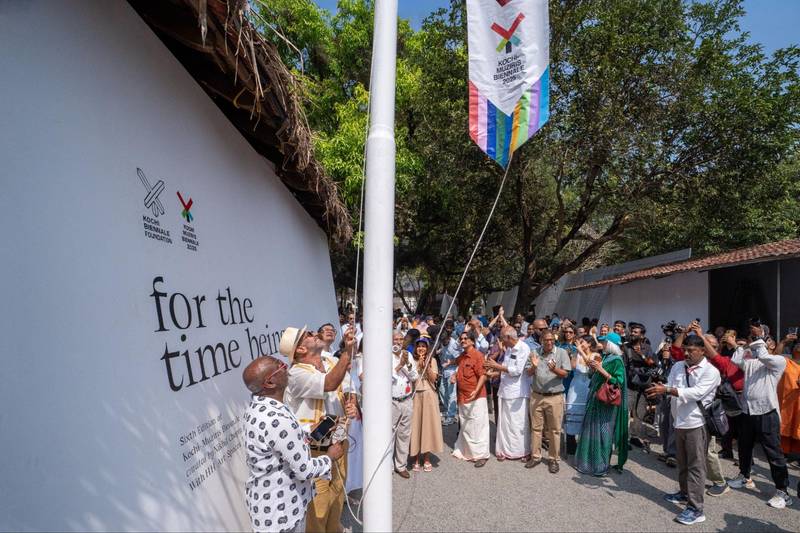
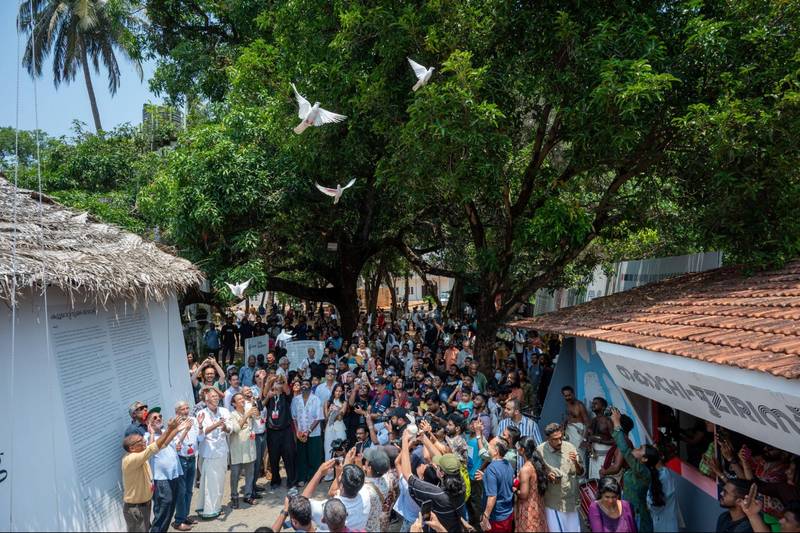
Caption for this image in the Kochi Biennale review is: Flag hoisting ceremony of KMB 2025 held at Aspinwall House
Manisha is an independent art writer and storyteller based in Bangalore, India. Her work spreads across disciplines like mycelium, connecting art, writing, education, and community while weaving together themes of identity and culture through a thoughtful, interdisciplinary lens. Follow her on Instagram or her website to learn more.
Kochi-Muziris Biennale (KMB) is a rare, non-gated space in India that enables critique, experimentation, and broad public access, while also generating undeniable economic benefits for the city. For 16 years, KMB India has remained unrivalled in India for contributing to the local economy of Fort Kochi and Matancherry through arts and culture programming. Here, the audience witnesses possibilities for critique: grand ideas aren’t made to fit into living rooms; concepts are explored because the goal has never been to be palatable, and, most importantly, it opens its doors to art lovers and patrons with various levels of aspiration. In a Frontline video from 2018, during the fourth edition, Bose Krishnamachari, one of the co-founders of KMB, described the Biennale as “an opportunity given to the younger generation of artists… we believe that art is everywhere,” emphasizing that art is best learned through seeing and affirming the power of a historic, multicultural city like Kochi as the perfect backdrop for an event that champions secular voices and freedom of expression – both of which, as he notes, are not easily sustained in India today. Kochi, shaped over centuries by Chinese and Jewish settlers, Mysorean sentries, Portuguese, Dutch, British, and others, carries its layered histories in its streets, warehouses, and hotels, which now serve as stages for the Biennale. The city of Kochi itself has become a collaborator, its texture allowing multiple artistic voices and communities to coexist, interact, and resonate within the same space. But the city is also often indifferent to this performance: trees sway, humidity presses in, life moves at its own unhurried pace. For all its openness to change, Kochi imposes its own rhythms and constraints, complicating navigation of the Biennale and prompting the question: whose time is being used as the medium?
The sixth edition of the Kochi-Muziris Biennale is curated by Nikhil Chopra, a multidisciplinary artist, in collaboration with HH Art Spaces, an artist-led organisation based in Goa. Chopra noted in a phone interview that it was crucial for him and HH Spaces to build alliances and trust, and, most importantly, to open the Biennale on December 12, 2025, preserving the Biennale’s precedent of opening dates since its first edition. “I kept driving into everyone’s psyche…one consistent thought and consistent aim that we put out there as an unchangeable, unmovable target, which was to open at 5 pm on the 12th, no matter what,” Chopra explained over the call. “And not be afraid of allowing the audiences into the process.” He views the current Biennale as a process unfolding like a three-act play over its 110-day duration.
We, too, arrived in Kochi carrying the particular optimism reserved for biennales: the promise that time will slow, meanings will accrue, and attention will be rewarded. Online, the sixth Kochi-Muziris Biennale spoke of “economies of friendship” and time as material; on site, time felt anything but considered.
While the Biennale did open on the day, it was not fully ready for the influx of visitors from across the country and the globe. For instance, the curatorial walkthrough immediately after the opening did not take place. Of the 29 venues, only five were open and ready for visitors. Mainly, the high-profile collateral events and exhibitions slated for the opening were fully prepared for the press previews. Most Biennale venues opened sporadically over the weekend, others much later, leaving visitors to navigate the Biennale through hearsay and text chains. Weeks later, we discovered additional programming we might have planned for—had we known it existed. Despite spending 1,842 euros and more than 72 hours in Kochi, we were left bewildered, unable to fully grasp the curatorial intentions behind the Biennale. While we admire the courage it takes to open an event of this scale to the public while still in progress, experimentation should not come at the expense of basic public communication.
The overall strategy feels less like openness and more like opacity: a scavenger hunt across scattered Instagram accounts, last-minute cancellations, and a website that fails to reflect current schedules or clearly link artworks to their artists. For a Biennale that positions itself as inclusive, this lack of accessible, centralized information undermines meaningful public engagement. On the ground, each artwork is accompanied by a single wooden signboard that compresses artistic intent, biography, and title into a few lines, providing insufficient context for first-time audiences encountering complex contemporary work. Accessibility is not only physical; it is informational. Without adequate framing, interpretation becomes guesswork.
Meanwhile, English-language media coverage has largely spotlighted the same handful of names, suggesting a cycle of invite-only previews and influencer-driven visibility that narrows, rather than broadens, public discourse. While multiple major outlets have covered the biennale, many have failed to address these inconsistencies in communication, programming, and accessibility — instead choosing to focus on covering artists with pre-existing cultural capital, which runs counter to the ethos of a “people’s biennale.”
Throughout the Biennale, exhibition labels consistently failed to mention the names of production art workers, fabricators, installers, and local labourers responsible for realising the works and transforming the space. Labels foregrounded artistic intent while failing to credit the workers (by name) whose bodies and time sustained the exhibition.
One of the first openings was a new gallery in Matancherry, with an outpost in Mumbai, already making strides in the Mumbai contemporary art market, with Trespassers by Benitha Perciyal emerging as a standout work. While the gallery’s roster included several new names, the inclusion of modern masters from Sri Lanka and West Bengal underscored a persistent market reality: despite the significant cultural momentum generated by the Biennale, the Indian art economy remains heavily tethered to the Modernist canon. This trend reflects a broader hesitation among primary market intermediaries to invest in experimentalism. Such risk-aversion creates systemic barriers for emerging artists, dealers, and curators seeking to establish sustainable careers. Ultimately, it highlights a discrepancy between the Art industry’s rhetorical appeals to “community,” “solidarity,” and “kinship” and the functional reality of institutional gatekeeping, which continues to prioritize established capital over genuine structural growth.
What does it mean to run a biennale on economies of friendship? “By never shouting at anyone, always acknowledging everyone’s presence, and always appreciating their efforts,” says Chopra. He talks about the power of sustaining friendships over time, what it means to curate as a collective rather than as an individual, and how to use this network to secure resources and programming for the biennale. His own artistic practice constantly asks viewers to see the body as a medium in the process of making art, and he brings this ethos to the Biennale through site-specific installations, successive activations, and programming that is alive and breathing. When I think about this conversation, it seems believable that the Biennale has been reclaimed and absolved of its history in the public eye.
Throughout the Biennale, exhibition labels consistently failed to mention the names of production art workers, fabricators, installers, and local labourers responsible for realising the works and transforming the space. Labels foregrounded artistic intent while failing to credit the workers (by name) whose bodies and time sustained the exhibition. “Collaboration” and “participation,” in this context, appeared more symbolic than structural.
We spoke with a young worker, fresh out of college, who was working late into the night to ensure a large-scale metal installation was completed correctly. He didn’t know the artist and operated with little oversight beyond the immediate curatorial team. While this was just one encounter, there were other exhibits where the art handlers, production assistants and installation teams – despite working long hours – were proud of the outcome and genuinely excited for the artist they were working for. Kochi is already a visually rich setting, layered with heritage buildings and historic sites, so the decision to install large, time-consuming sculptures – constructed by underpaid masons who also double as art handlers – felt like a different kind of exclusionary practice within a Biennale that otherwise promises utopias of inclusion.
Some artists exhibiting at the Biennale also shared that their works were damaged or compromised by inconsistent production quality and inadequate care. In comparison with the Serendipity Arts Festival (SAF) in Goa – another privately funded event with a comparable history that opens soon after KMB – the contrast in professional support was striking. While the two cannot be directly equated, as art is only one of several segments within SAF, the organisational support differed significantly. At SAF, every artwork had a docent present to guide visitors, and support staff were paid a standardised rate of Rs 1,000 per day, ensuring a baseline of professional compensation and accountability.
Inspired by the Venice Biennale, which originated in 1895 through a city council resolution that embedded it within a civic mandate and public accountability, the Kochi-Muziris Biennale has remained a foundation-led initiative. Partially supported by the state of Kerala, KMB occupies an ambiguous institutional position – publicly framed yet privately administered. Persistently challenged by funding constraints, this ambiguity was evident in 2018, when, despite a ₹23-crore budget, KMB received only ₹3 crore of the ₹7 crore promised by the government, illustrating the gap between aspiration and institutional reality. This structural ambiguity mirrors a broader shift in India’s contemporary art ecosystem.
As a relatively young democratic nation, India is witnessing wealthy upper-class individuals investing significant sums into contemporary art (at least publicly) through a growing proliferation of biennales, festivals, and art weeks across the country. Whether through inheritance, as seen in restoration projects led by former royalty, or through newer models of patronage advanced by collectors such as Sana Rezwan of RMZ Foundation, elite cultural investment is increasingly structured through private foundations and partnership-driven initiatives. While institutions like the Inlaks Foundation offer direct scholarships that tangibly redistribute resources to artists, many newer patronage models privilege visibility over sustained financial support. From a business perspective, such models appear coherent and largely well-intentioned. On the ground, however, they often fail to benefit artists equitably: support remains opaque, does not consistently reach practitioners directly, and frequently extends only to underwriting platforms and public visibility.
As the Biennale demonstrates, funding structures are rarely made fully transparent, with decision-making concentrated among private patrons and advisory circles rather than public institutions. While corporate and individual sponsors receive prominent visibility, the mechanisms by which resources are allocated to participating artists remain largely undisclosed, reinforcing a model of cultural production governed by private discretion rather than public accountability.
Historically, KMB has been marked by organisational changes, funding issues, and resignations. In 2018, shortly before the opening of its fifth edition, a co-founding member, an artist and curator, Riyas Komu, resigned after allegations of sexual misconduct were raised against him. The allegations first came to public attention through an Instagram account (still active) titled Scene and Herd, with a bio that reads, “cutting through BS in the Indian Art World, one predator and power play, at a time.” They go on to assert their anonymity. Once these posts surfaced, the biennale set up an investigation and, a few months later, citing the absence of a formal complaint, the biennale committee, in a statement, decided to drop the inquiry and said they “look forward to Riyas Komu resuming his roles” at the foundation. While Komu never officially returned to the KBF team, he was present this year as artistic director of the Ishara Foundation, commissioned by Sabih Ahmed, which hosted collateral programming alongside its exhibit, Amphibian Aesthetics.
Earlier in the same year, CEO Manju Sara Rajan and the exhibition manager, Miriam Joseph, resigned amid financial mismanagement, according to the Indian Express. Following their resignation, several reports surfaced seeking to trace leaked emails about mismanagement and to verify the claims. At no point did the Biennale comment on these allegations or establish an inquiry, as it did with Komu. It wasn’t until 2024 that this post was filled by Thomas Verghese, a management professional.
The Biennale maintained its rhythm until its fourth edition. Its first significant disruption followed the COVID-19 pandemic, after which further delays were attributed to infrastructure constraints. These were later publicly reframed in an open letter as failures of financial management and artist liaison. Amid criticism of the inadequate compensation for manual labourers and art handlers involved in installations, the fifth edition of the Biennale was postponed again and eventually opened a week later than its usual December 12 opening in 2022.
A month after the opening of the sixth edition, news of its cofounder Krishnamachari Bose’s resignation was announced on January 14, 2026. While the Biennale’s press release cites “family reasons,” his interviews and public appearances suggest a more complex calculus. “The Foundation is in a strong place, and future editions are already gaining momentum, which gives me confidence and peace in making this decision.” (Outlook India). The resignation underscores a recurring tension at KMB: the struggle of maintaining ambitious, publicly visible ideals within a foundation-led structure where accountability and governance are often opaque. The Indian Express later reported in March 2026 that his departure followed a sexual harassment complaint received by the Kochi Biennale Foundation in December from a female employee. KBF chairperson Venu Vasudevan stated that the allegations were “one of the reasons” for his resignation. The complaint alleged that Krishnamachari made unwanted sexual remarks and physical advances towards her at his Kochi apartment. Krishnamachari has denied the allegations as “misleading and unsubstantiated” and announced plans for legal action.
This tension between vision and institutional constraint became even more tangible during this year’s edition of ‘Edam,’a collateral exhibition curated by Aishwarya Suresh and KM Madhusudhanan. Indian painter and printmaker Tom Vattakuzhy’s work, Supper at a Nunnery, a reinterpretation of Da Vinci’s Last Supper featuring Mata Hari in place of Jesus, initially drew curatorial support as a bold exercise in freedom of expression. The piece, referencing a play by C Gopan, aimed to shed new light on a historically documented figure and convicted spy. Yet when protests arose among certain Christian groups who labelled the painting “offensive,” the curators ultimately withdrew it. Together, the resignation and curatorial reversals reveal a Biennale caught between its founding ideals and the realities of governance, funding, and public scrutiny.
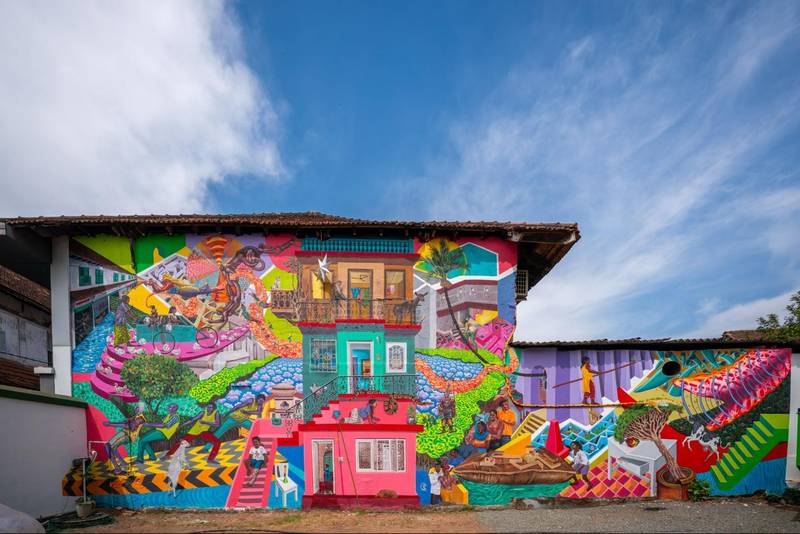
Island Mural Project at Kochi-Muziris Biennale 2025-26
Despite these inadequacies, KMB occupies a singular space in Indian contemporary art; one where large-scale works can be realised, participatory projects are given room to breathe, and artists are afforded the opportunity to experiment and collaborate with a city. It exists at the intersection where art is created for all audiences, regardless of lineage or insider knowledge, and outside the “white cube,” even while working with artists who have long circulated within established gallery systems. Juxtaposed with these experienced practitioners are students, children, emerging artists, local creators, and artisans who may never show beyond Kerala.
This year, for instance, a video interviewing the Biennale’s sign painters, led by Narenderan Chettan and his team of four: Pramod, Manoj, Jayan and Bijeesh, who return year after year to ensure the stylistic voice remains consistent, clean, and culturally grounded, went viral on Instagram. Made by Prajwal Xavier, a calligraphy and typography artist, these often-overlooked efforts point to the Biennale’s real strength: its ability to blend expertise with local knowledge and nurture a genuinely diverse creative ecosystem. It is precisely this potential that makes the Biennale’s structural and institutional failures around care, credit, and accountability feel not incidental but consequential.
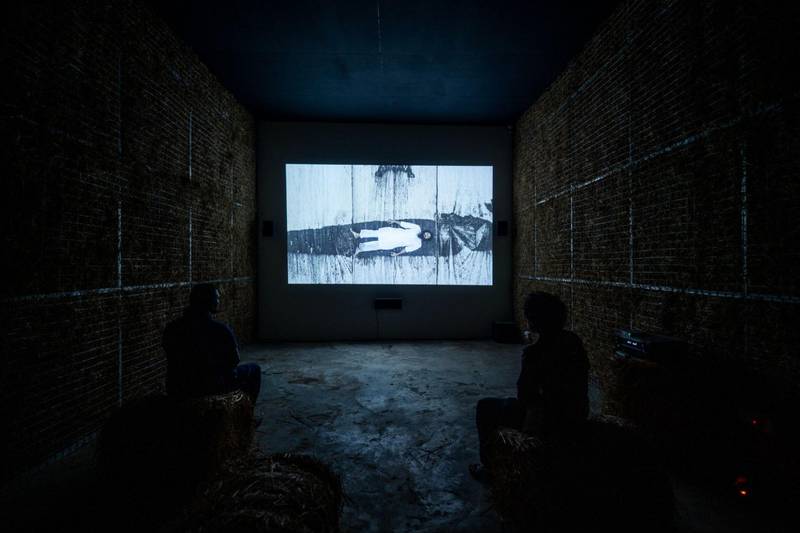
Kulpreet Singh, Film Still from Indelible Black Marks, 2022–24 Duration_ 8 minutes, 27 seconds
Another notable work was Indelible Marks by Kulpreet Singh, offering a grounded engagement with labour and materiality. The exhibition comprises a series of paintings, a site-specific installation, and a film that examine industrial activity, climate change, and the agrarian crisis without exaggeration. Each frame of the film echoes fibrous farm landscape, powdery and blackened remains of stubble burning present in Singh’s paintings, creating a cohesive dialogue between mediums. Moving from the rhythmic sounds of water along the Arabian Sea to the aggressive burning of stubble in the agricultural fields of Patiala, viewers arrive at their own conclusions. Here, labour and bodies are not abstracted but shown as spent, present, and consequential, offering a counterpoint to the Biennale’s more performative gestures of inclusion.
Like Gold, a group exhibition curated by critic and historian Murtaza Vali and presented by Rizq Art Initiative (RAi), felt attuned to the Biennale’s layered ambitions. It explored the cultural, material, and historical ties between the Malabar Coast and the Arabian Gulf, bringing together artists from multiple geographies working across mediums and subjects under a unifying theme. Drawn from a colloquialism, the title aptly reflected the works themselves: whether Cop Shiva’s photographs of himself in costume as Mahatma Gandhi, dipped in gold, or Indu Anthony’s gold-foiled prints inscribed with phrases in Malayalam – often double-edged admonitions likening women to gold (precious), directed at girls, such as notes on keeping their hair tied, reinforcing gender norms. As mixed-media art slowly finds its footing in contemporary Indian collections, Like Gold offers a multidimensional, thoughtful engagement with labour, oppression, religion, and migration. The exhibition resonated with the Biennale’s broader conceptual framework, using the region’s history and materiality as a lens to explore pressing socio-cultural issues.
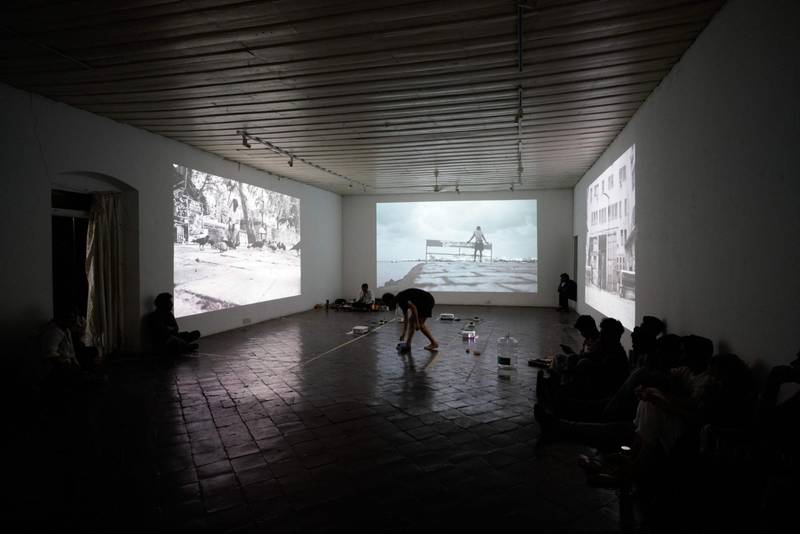
The programming at Forplay Society was another notable exhibition that, in many ways, embodied the Biennale’s commitment to community-led practices, using time and the body as a medium for viewing and as material to ground the work. This artist-run, non-commercial initiative, founded in 2016 by Seljuk Rustum, maintains a robust programme of experimental, sound and movement-based performances, collaborating with artists and collectives from Japan, Taiwan, Australia, Denmark, Germany, the Netherlands, and across India. It resonated with the ambition of the Biennale to activate new venues, creating spaces that platform unconventional artists and unexpected programming.
One memorable night during the opening week, we were in a neon-lit room, activated by an interdisciplinary performance collective called antibodies from Japan, responding to sounds generated by a vacuum cleaner, a microphone, and sheer lung power. At the door, patrons were invited to pay-as-you-like. After the performance, the host publicly acknowledged and celebrated the contributions of the neighborhood children who had played a key role in building the venue. The evening then spilt onto the street, turning into an impromptu afterparty as pop Malayalam music blared and everyone joined the celebration.
Despite its fraught history and its unique access to scholars, artists, and critics, in its current edition, it chooses the confusing path of conflating wealth with taste, and power with knowledge, treating criticality as a byproduct of collaboration.
After more than a decade of accumulated legacy and expectation – much of it tied to hopes for a sustainable, inspiring, and inclusive model – the Biennale continues to stumble. This year in particular, the Biennale presents a strange mix of ambition and surface-level criticality, perhaps shaped by the algorithmic logic of the internet. As India’s art market rapidly expands, there is a growing impulse for artists, collectors, curators and critics to be in India, be from India, or simply be seen in India, often without a meaningful understanding of what that actually entails. Many artworks at the Biennale’s main venue (Aspinwall) were enveloped in buzzwords, buried beneath phrases such as “creating a space for pause and reflection” or “how fabric becomes part of everyday lives and lived histories.” Such language serves as discursive padding, compensating for paintings and installations that are still in the early stages of cultural articulation. While this kind of indulgence is encouraging to students fresh out of college during annual showcases, it feels misplaced in the context of a Biennale that claims to foreground raw, sustained practices rooted in cultural specificity and technical rigour.
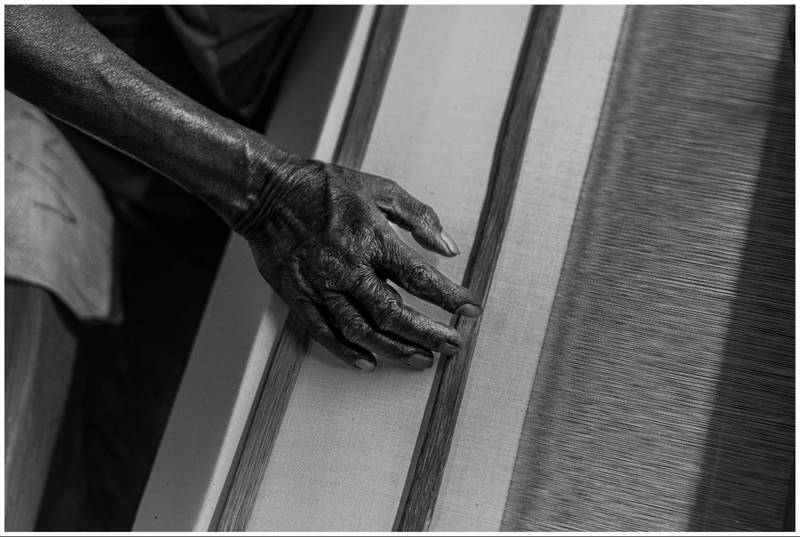
Hanging by a Thread by Lakshmi Madhavan.
At times, the Biennale exhibits feel like they are sampling old tracks and presenting them as new remixes, relying on familiar rhythms to generate engagement. Everyday objects elevated onto pedestals for little more than the act of elevation itself, like the traditional Kasavu weave, is a well-worn visual strategy which, alongside close-up shots, black-and-white photographs of weavers’ hands, hung flush together as if literally Hanging by a Thread in Delhi-Balarampuram-based Lakshmi Madhavan. Shown within Looming Bodies, a title that gestures, perhaps too neatly, toward the relationship between weavers, artists, and outcome. The installation features three large textiles produced using Kerala’s Kasavu technique, woven with gold and silver threads into silk and cotton. Supported privately and developed in collaboration with a Delhi-based photography company documenting Madhavan’s engagement with the Balarampuram Weaving Community, the work foregrounds process and collaboration. While there is nothing inherently flawed in sharing artistic labour with a broader audience, the presentation felt formulaic. In Kochi, the installation added little to the Biennale’s broader conversations about time as medium, bodies as site, and collective grief in politically turbulent times. It felt unaware.
At a moment marked by political crisis, widening inequality and cultural overproduction, criticality cannot be treated as an accidental outcome of collaboration. It must be deliberate.
Beauty/Pain by Sheba Chhachhi and Janet Price presented at Aspinwall interrogates the female body as a site of discipline and aesthetic control acquires an added institutional dimension. The work critiques how beauty is constructed through regimes of visibility, endurance, and performance; yet within the Biennale’s expansive, sponsor-backed exhibition architecture, it also becomes part of a curated spectacle that relies heavily on visual impact and circulation. The irony is productive but palpable: a project that questions the aestheticisation of women’s suffering is re-situated within a global art platform that thrives on visibility, scale, and international attention.
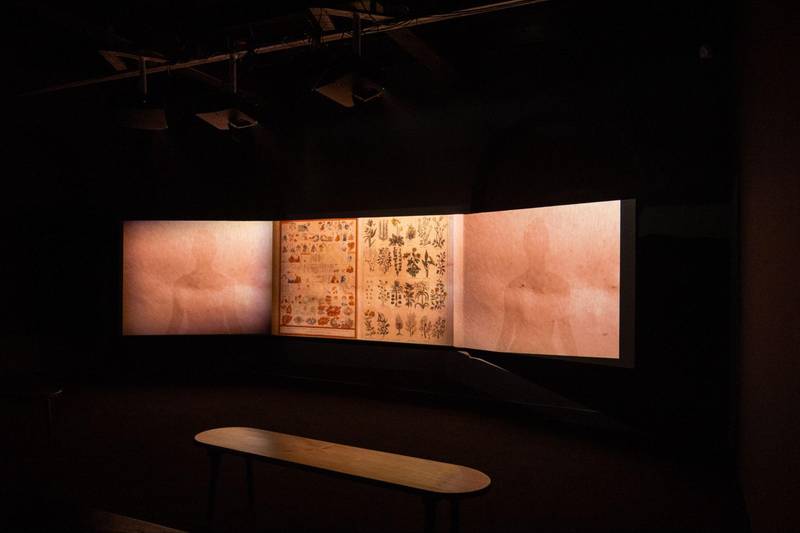
Sheba Chhachhi and Janet Price, Beauty_Pain, three-channel video installation, (2025), KMB 2025-26, Courtesy of the Kochi Biennale Foundation
In this context, the work not only critiques gendered embodiment but also mirrors the Biennale’s own economy of display. Just as the work exposes how beauty conceals structures of pain and labour, the Biennale’s polished rebranding obscures the infrastructural and financial asymmetries underpinning its production. The presentation thus risks softening the work’s political edge, transforming feminist resistance into consumable cultural capital. To sit within a period of political crisis – from extremism, targeting minorities, media censorship, threat of en-mass unemployment, climate change, increased violence – and yet cling to the self-image of a young, thriving economy is to risk becoming so absorbed by wealth that painful truths are conveniently erased. In such a climate, inequality, systemic failures, and the struggles of marginalized communities and dissent are smoothed over, reduced to abstract statistics or easily digestible narratives for easy viewing. The focus this year shifts from accountability and critical reflection to spectacle and surface-level optimism, leaving the deeper tensions of society largely unexamined. It is against this backdrop that a recurring point of unease with the Biennale emerges: despite its fraught history and its unique access to scholars, artists, and critics, in its current edition, it chooses the confusing path of conflating wealth with taste, and power with knowledge, treating criticality as a byproduct of collaboration.
Kochi-Muziris Biennale occupies a rare and vital space within India’s cultural landscape, making it all the more important to acknowledge its aesthetic shortcuts, curatorial lapses, and ethical faultlines with honesty and clarity. At a moment marked by political crisis, widening inequality and cultural overproduction, criticality cannot be treated as an accidental outcome of collaboration. It must be deliberate. Consider this a plea for care. Care for the viewer’s body and time, for the histories embedded in materials and spaces, and for the ethical weight carried by representation – especially in a moment that demands precision rather than spectacle.
-
 READ
READI could see a lot of love. But I was still trying to find the anarchy that breaks through and what it breaks through. I wondered if I should write about the positionality of the festival in what can be termed as its cultural intervention into events and processes that affect us today.
Finding Anarchy: A Review of Helsinki International Film Festival
-
 READ
READThere is no universal ‘the’ trans body. Where does this article ‘the’ come from and what does it do? To us it seems that to look at something through the lens of ‘the trans body’ is claiming to know something that is situated in some imagined universal trans body – ultimately projecting one’s own body as that universal human in the trans context; the same universal human that the work claims to critically dismantle. White, non-disabled, thin, masculine and middle-class.
The Trans Body in Venice: A Critique of Universalising Transness
-
 READ
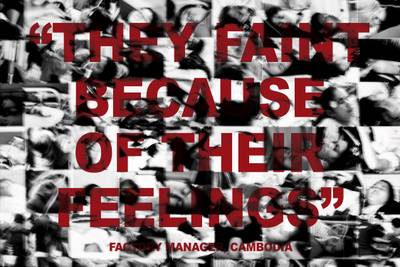
READIf the problems that individuals face in their personal lives are rooted in systemic issues, then it is unrealistic to expect them to find lasting solutions solely through individual self-improvement efforts. Individual change is not simply a matter of personal effort but is also shaped by the broader social conditions that individuals find themselves in. Abril’s work highlights this hypocrisy of the oppressor in a perverted patriarchal society in which women are blamed and ridiculed for showing symptoms of distress—Mass Hysteria.
Our Bodies Protest on Our Behalf: A Review of ‘Laia Abril – On Mass Hysteria’
-
 READ
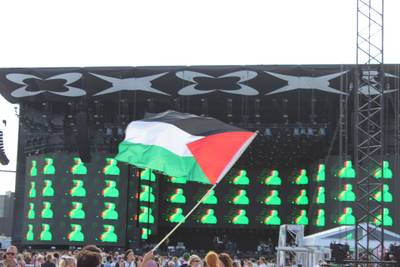
READHow will Flow Festival respond to criticisms about its relationships with its free workforce, security contractors, Helsinki Police and its Zionist holding company? Will it align with or distance itself from the actions and affiliations of its financial backers?
Flow Festival: A Retrospective