Photo by Mina Keykhaei
Mina Keykhaei is a visual artist and researcher based in Tkaronto/Toronto, where she works from the position of a settler-immigrant on the lands of the Mississaugas of the Credit, the Anishinaabeg and the Haudenosaunee.
The war began on the last Saturday of February. I found out from my phone, in the kitchen, before I had eaten. Strikes across Iran, dozens of sites. On the news they said it: regime change. The actual phrase, out loud, like a weather forecast. My mother lives there. I called. Nothing. The line stayed dead for days.
The state shuts down the internet when it is afraid of at least some of its people, which means the people disappear from your screen at exactly the moment you most need to see them. I kept sending messages anyway. You do it because the hands need work. Meanwhile Toronto went on being Toronto. The streetcar was short-turned at the usual place. At the supermarket the cashier asked if I had fun plans for the weekend, and I heard myself say: not really, you?
Here is what I have not been saying out loud: nothing in the language of that war surprised me:Liberating the women of Iran, freedom, no other choice left but foreign intervention. I had heard all of it before, for years, in much gentler rooms. Rooms with track lighting and land acknowledgments and wine in small plastic cups. Rooms where I was the one being invited to say it. By the time the missiles flew, the rescue had been in rehearsal for years, and people like me had been offered parts.
This essay is about the part. About the role that waits for the diaspora artist before she arrives, what she is asked to bring and what she is asked to leave at the door. And about what it might mean, after the bombs, to become a less welcomed guest.
In the fall of 2022, after Jina Amini was killed, my inbox changed. Calls for submissions from magazines, galleries and cultural organizations appeared, some with the word urgent in them. Special issues, vigils, emergency programming, panels assembled in three weeks, institutional social media accounts suddenly fluent in a politics they had never previously been able to pronounce. We would be honoured. Your perspective in this difficult time. I am not being sarcastic when I say that much of it was sincere.
I have watched a room who wept at the word daughter become suddenly professional at the word sanctions. I have felt the temperature drop when Palestine entered a conversation about freedom, when someone asked, who funds the funder?
But a welcome can be warm and still have a fine print. What was wanted was understood, without anyone spelling it down. Speak about the Islamic Republic. Speak about the morality police, the hijab, your mother, your fear. Speak in a way that lets the institution feel brave, secular, feminist, and innocent. Pain was wanted, not analysis. Courage, not accusation. Difference, but never a politics that reaches back into the room. I have watched a room who wept at the word daughter become suddenly professional at the word sanctions. I have felt the temperature drop when Palestine entered a conversation about freedom, when someone asked, who funds the funder? The room does not argue with you. That is the elegant part. It checks the time. The moderator thanks you for raising such an important point, and then there is a coffee break.
What this produces, over enough seasons, is a figure I have come to think of as the eligible dissident. Not merely visible: eligible. The artist whose biography can stand in for politics. Whose injury arrives at the right scale, vivid enough to move a room, distant enough never to implicate it. Whose pain can be programmed, protected, translated, applauded, and safely misunderstood. Eligibility decides who gets the residency, the panel, the emergency fund, who is called courageous and who is called difficult, which dissident gets invited back.
Consider what happened to a single gesture. In the Shahnameh, when word comes that Siavash has been murdered, Farangis cuts her hair. Women in Kurdistan still cut their hair at gravesides. The gesture belongs to mourning, and it is older than the Islamic Republic and older than the monarchy the republic replaced. So when women inside Iran cut their hair on camera in the autumn of 2022, they were doing something exact: carrying the graveside into the street, aiming grief at the state like a pointed finger. The risk was part of the meaning. In Tehran, in Sanandaj, scissors could cost the body the hair grew on.
On the 4th of October that year, a member of the European Parliament took out scissors in the middle of a speech and cut off her ponytail at the podium, saying Jin, Jiyan, Azadî. The chamber applauded. The clip circled the planet by evening. I watched it many times, trying to locate what troubled me, because her anger looked real and I had no reason to doubt it. The trouble was not falseness. It was translation. Mourning had been detached from the grave and reattached to position-taking. At that podium the gesture cost nothing and risked nothing, and the applause that followed was the sound of an institution being moved by itself. The same parliament votes, in less cinematic sessions, on the budgets of a border regime that Iranian and Kurdish migrants drown against in the Channel and the Aegean. No one has ever cut anything for them. The next day, dozens of French actresses cut locks of their hair on camera, pour la liberté, and I cried watching it, which I am putting on the record because I am not above the gesture, and this essay would be worth much less if I were.
And then in February the Grammys created their first award for Best Song for Social Change and gave it to “Baraye,” a song stitched together from tweets, each one beginning with the Persian word for: for dancing in the alley, for the fear of a kiss, for my sister, your sister, our sisters. The First Lady of the United States presented it. The room stood. The songwriter was in Iran. He watched, presumably, on a screen, in a country whose banks and medicines were being strangled by the government of the very First Lady who was applauding him. The ovation and the sanctions came from the same capital. I have not found a way to write that sentence so it doesn’t sound like a punchline, which may be the problem with the whole genre, including mine.
Now the part the clips left out. I have tried to write this section more times than any other. It keeps coming out as a list, and a list is its own kind of disrespect.
On the last Friday of September 2022, in Zahedan, in the far Southeast where the country runs out of the version of itself that exports well, security forces opened fire on worshippers and bystanders after Friday prayers. People came to call it Bloody Friday. It was the deadliest single day of the entire uprising. The dead, most of them Baluch, were counted in the dozens and then in the dozens again, Even now, the numbers do not sit still.
For that body to be grieved over here, it would first have to be translated: shaved, unveiled, subtitled, made secular, made young, preferably made female.
There was no scissors moment for Zahedan. No actress wept for it on camera, no parliament rose, no category was invented at an awards show. For a long time I told myself the reason was distance, or difficulty: the city is hard to pronounce, the province is poor, the footage was bad, the dead were men. But that explanation flatters everyone. The truer reason is that the image was already taken. A young Baluch man in Baluchi dress, bearded, outside a mosque, on a Friday: the Western eye has spent twenty-some years being trained on that photograph. Whole wars were advertised with it. The caption was written long before the bullets came, and the caption does not say victim. When state violence enters a body like that, sympathy finds no door, because mourning him would mean un-reading two decades of front pages, and nobody un-reads the front page. Susan Sontag spent her last book asking what pictures of distant suffering do to the people who look at them; the colder question is about the pictures that never circulate at all, because the looking was arranged in advance.
For that body to be grieved over here, it would first have to be translated: shaved, unveiled, subtitled, made secular, made young, preferably made female. A bareheaded girl on a car roof in Tehran could be mourned at any distance, because she already resembled the rescuer’s idea of freedom. Mourning her flatters the mourner. The men of Zahedan could not be mourned, because they resemble the rescuer’s idea of enemy. Some bodies arrive pre-captioned, and no quantity of their blood revises the text.
A movement gets translated in the order of its usefulness, and whoever’s mourning cannot be made into an image the room already wants will wait outside with their dead. The eligible dissident, it turns out, is selected twice: once against her country, and once against her own.
I should price my own position here. By the spectacle’s lights I am the mournable kind — a woman, an artist, grief that photographs. That is exactly why I do not trust the mourning. I come from people for whom that Friday was not a news item.
Then the rescue arrived. First as twelve days of US-Israeli bombs falling on Iran in June2025, then again this February, returning with its purpose stated plainly into the cameras: regime change. The men announcing it borrowed the movement’s own vocabulary. Women. Life. Freedom. The fantasy that had been rehearsed for years in cultural rooms, the idea that our liberation would arrive through their recognition, finally put on its uniform. I am not saying the panels caused the war. I am saying the panels taught a public to want it, and to feel that wanting it was feminism.
On the first morning of the war, three missiles came down on a primary school in Minab, in the South, a two-storey building with pink flowers painted on its wall. The dead were counted at fifty-seven that night, and the count climbed for a week, past a hundred, past a hundred and fifty, most of them girls between seven and twelve years old. They were American Tomahawk missiles. Woman, life, freedom. The rooms that had risen for the daughters of Tehran did not rise for the daughters of Minab; the question that circulated instead was whose missiles, as if the children were an attribution problem. Their pictures did not travel, and not because pictures of dead children lack power — we know how far one can go when the killer is an official enemy. These were the wrong killers. Zahedan had already taught me the rule. The South’s dead are not invisible; they are expensive. Looking at them would cost the viewer something, and the whole spectacle had been priced on the promise that looking costs nothing.
Every community that flees a revolution produces a faction loyal to whatever the West backed before the fall; Miami has run on that fuel for sixty years, and our version pledges itself to a monarchy that has been dead since 1979 and survives as television. That faction is the one the host can hear.
And what of the rooms of 2022? A new professionalism. Statements about complexity. Programming quietly shelved. A few institutions discovered, on the day the missiles flew, that art should not be political after all. I was eligible exactly as long as the villain was mine alone. My pain was fundable when it accused Tehran; it became an inconvenience the moment it accused anyone nearer.
The casting, I should also say, was not done only to us. Part of the diaspora auditioned. Every community that flees a revolution produces a faction loyal to whatever the West backed before the fall; Miami has run on that fuel for sixty years, and our version pledges itself to a monarchy that has been dead since 1979 and survives as television. That faction is the one the host can hear. Its politics rhyme with the host’s foreign policy, so it gets the satellite channels, the think-tank chairs, the seat beside the anchor, and after enough years of amplification it begins to be mistaken for the community itself. Some of them asked for the sanctions. Some asked, out loud, for the bombs, and when it turned out that bombs do not deliver hope, they went quiet and kept the studio lights. The eligible dissident has a louder cousin, the eligible diaspora, and the rest of us are left to choose between being mistaken for them and being inaudible.
Meanwhile the word that emptied every room, sanctions, stopped being abstract even for people who had managed never to think about it. It was never abstract for us. Try, from this city, to send money for a parent’s medicine. The bank teller tells you, not unkindly, that they don’t work with that country. You hand cash to a man who knows a man, a system older than banking and by now more reliable than banking, and you pay a percentage for the privilege of paying a pharmacy. The historian Nicholas Mulder wrote a whole book to say what every Iranian grandmother already knows, that sanctions are a weapon, war carried on through other offices. A blockade is not one dramatic act. It is a thousand small rooms where the answer is no. Two decades ago Lila Abu-Lughod asked whether Muslim women actually need saving, and Gayatri Spivak had already compressed the whole imperial grammar into eight words, white men saving brown women from brown men. The old sentence is still there, only now it arrives with better technology.
So what is left, for an artist who has read the menu and recognized her own name on it?
I can only tell you what is on my table. For years, I made quicker work, easier to read, and it was read, in exactly the rooms this essay has been describing. I am trying to unlearn that legibility — not by going silent, because the silent artist is only another role the room knows how to admire, but by making work that comes when it is invited, takes the honorarium, and then declines to explain itself.
The bad guest declines to separate the violence over there from the innocence in here. She does not bring her biography as proof. She mentions sanctions at the feminist panel and the war at the vernissage. She asks what the land acknowledgment is for, if the land is not given back.
Call this the method of the bad guest. The bad guest accepts the invitation. She comes, she eats, she is not above the honorarium or the grant. But she behaves incorrectly. She declines to separate the violence over there from the innocence in here. She does not bring her biography as proof. She mentions sanctions at the feminist panel and the war at the vernissage. She asks what the land acknowledgment is for, if the land is not given back.
I am not interested in purity. There is no place clean enough to write from, certainly not from this far inside; the form I filled out toward funding this essay is part of the arrangement the essay describes. I am not interested in despair either, which has already been organized for us, efficiently, by people with much better resources. What I am after is smaller and harder. To be of less use: to the feminism that needs me rescued, to the nationalism that needs me loyal, to the institutions that need my grief as proof that they listened, and to the part of myself that still, after everything, waits to be welcomed.
-
 READ
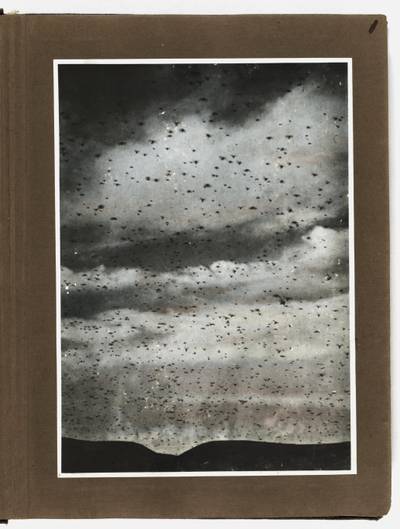
READTo revisit these images today—historical, archival, and contemporary—is to confront multiple temporalities: the gaze of missionary projection, the habitual and the foreseeable. These layers coexist, sometimes always in tension, revealing the land’s persistence beyond imposed narratives. Unbiblifying is not about erasure; it is about recognizing the sacred not as revelation but as habit, not as myth but as presence.
Theology of the Image: Unbiblifying the Sacred
-
 READ
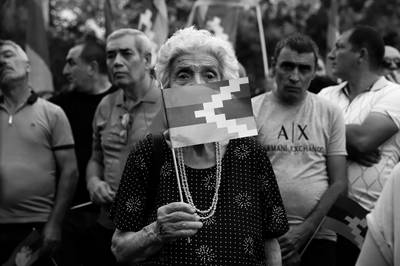
READWhile azerbaijan was bombing Armenians with israeli and turkish UAVs and paying bonuses to turkish-backed Syrian mercenaries for beheading Armenians, the “international community,” whatever that’s supposed to mean at this point, expressed lousy words of “concern,” and displayed a nauseous stance of both-sideism, devoid of any tangible action. The existence of this unrecognised republic and its indigenous population wasn’t legitimate enough for world powers to lift a finger.
Violent Septembers: An Armenian Perspective Amid the Ongoing Occupation
-
 READ
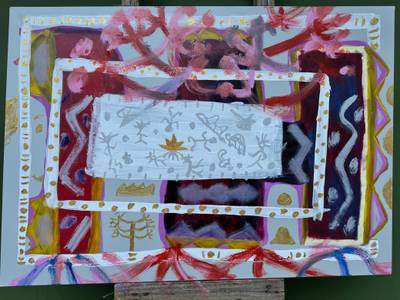
READA conversation with Isabel and Carl Gakran about the Zág (Araucaria), an indigenous tree threatened with extinction. We talked about their project (Instituto Zág), Indigenous climate justice and the intersection between the Palestinian and the (Brazilian) Indigenous struggles.
Zág Trees, Forest Spirits, and the Settlers: A Conversation with Xokleng Kin
-
 READ
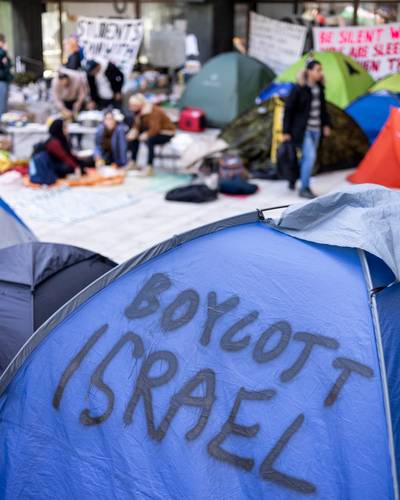
READThe opposition is not only between institutions and student activists—it also exists within our movement, manifesting in differing strategies. Should we focus on direct, visible actions or institutional processes? Should we shame the university publicly or appeal to its conscience? These approaches are not mutually exclusive—they reinforce each other.
Disrupting Complicity: Students Organising for Palestine in Finland