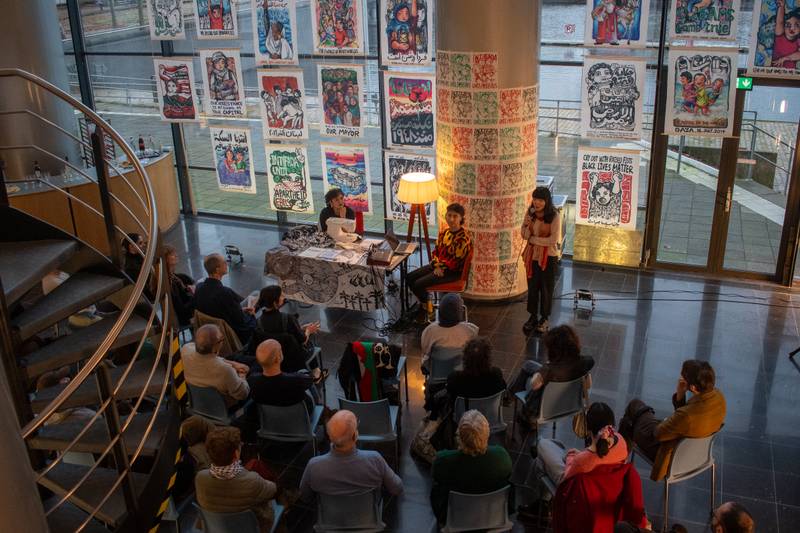
Photo by Emily Yamaguchi of Framer Framed, of the main hall of the International Institute of Social History building, Amsterdam, December 2025.
Giulia Crispiani is an editor, translator, writer and visual artist based in Rome. She collaborates with NERO Editions, bruno, Dutch Art Institute and teaches at NABA Roma.
As I attempt to recount my witness of the exhibition After Storms: A Meeting in the Archive by artist Golrokh Nafisi and researcher Ahmadali Kadivar for the International Institute of Social History (IISH) in Amsterdam (co-commissioned by Framer Framed, on view at until April 9th, 2026), the present that stands before the archive increases its physicality as someone or something at the entrance of the building. From December 2025 when I saw it, until today, as I am writing (February 2026), we all know what has been unfolding; several years could have passed and still be considered severe; we remain forever indebted to mourning.
This review wrote itself against its capacities; that would be comparable not to an impossibility but to an antagonist force that conditions its movement, like a strong wind against a body in motion. First of all, because this review desired to be written in dialogue with the work’s authors, despite the communication line having been cut for a long time; and secondly, because the stakes of this limitation were far higher, for it wanted to speak of solidarity while a violent outburst was holding all the words in the world hostage, as if I found myself incapable of writing—a feeling, for me, definitely out of the ordinary. Thus, the drafting was delayed, pending the chance to finally hold a conversation to understand the truth of what is at stake amidst its erasure via algorithmic distortions, biased interpretations, inflated numbers, and factual loss of lives in rivulets of blood seeping through the walls of our thinking, as if one could become immune to tragedy. Eventually the writing made its way through the storm.
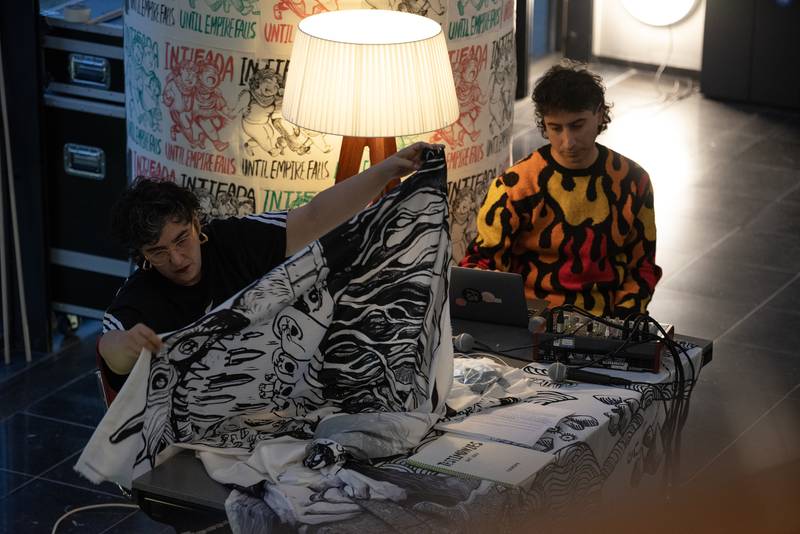
During the opening of the exhibition, Ahmadali Kadivar shared music from the IISH archive that he discovered during a week-long residency while searching for Dutch revolutionary songs. Some of these songs were related to the boycott campaign against South African apartheid and the strong social movement that Amsterdam experienced during that period.
A timeline could help us reconstruct this blockade in order to break it, although the purpose of the act of writing doesn’t mean to deviate from its initial intention, that remains valid to actually become even more poignant than ever, because when we speak of revolution, social unrest and upheavals, we know time is not linear. If the aim is to speak of solidarity but also to act in solidarity, we can take Nafisi and Kadivar’s work as both an occasion to speak about the meaning of solidarity and their presence in the archive inherently as a gesture of solidarity with the “sit-in” in the first week of December that led to the installation as a form of presence, staying with, and aligning with the legacy of labour and social movements. In the archive, possibilities remain always open, and different horizons seem to collide. This presence carries a few heavy questions with it, such as what is the role of an archive?, and what is the actual meaning of solidarity at this very moment? What have we learned from the past two and a half years living and working while a genocide was live-streamed on our phones? After Storms grounds the essentiality of these questions, it waits for them to sprout and watches them turn into roots.
Both the archive and the installation are records of these storms, not as forecasts but as direct witnesses of their happening, at times on-site, on the frontline, and some other times with a geographical jetlag yet in synchronical proximity. Their production always happens in the duration of the event. If the IISH’s archive covers a time span of over five centuries, Nafisi’s illustrations have been appearing in protests around the world for almost two decades. The archive is also returning to recollect in the aftermath of each storm, and some of Nafisi’s banners are also meant to celebrate and remember. To save a detail, a fragment of minor history from its inexorable dissipation.
Each event is significant per se, although it exists in permanent and permeating continuity with all the others; we might say that one triggers (or perhaps already contains) another. Each song will find those who went looking for freedom, outside of the timeline. As the struggle contains its failure, revolutionary time is a quantum; it needs repetition, reparation, insistence, and reconsideration. Although there’s no storm like another, the experience of its impact remains as a collective share. Something we can all learn from, if we truly wish—although, it must be noted, the hegemonic narrative doesn’t make the task easy. All that is contained in the IISH archive has been turned into a secret; only researchers with a treasure map can find their way through it, despite that being an actual collective heritage, a common—part of our history, yet one we no longer learn in school (did we ever?).
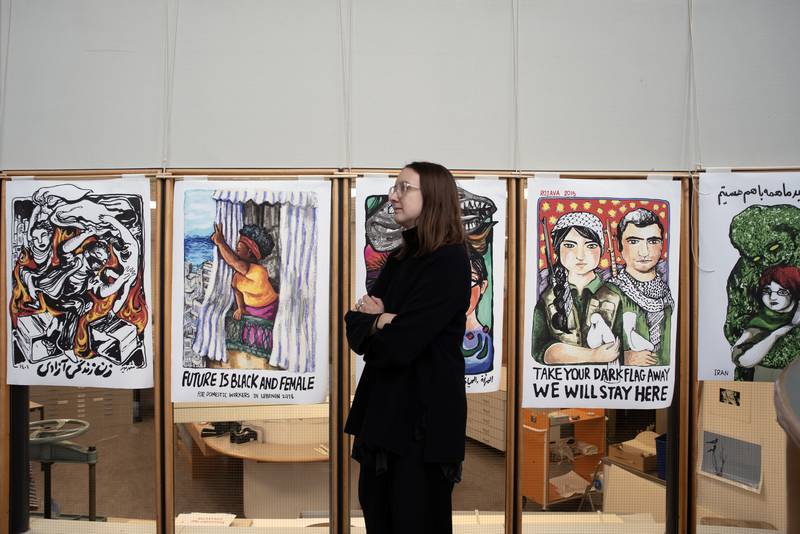
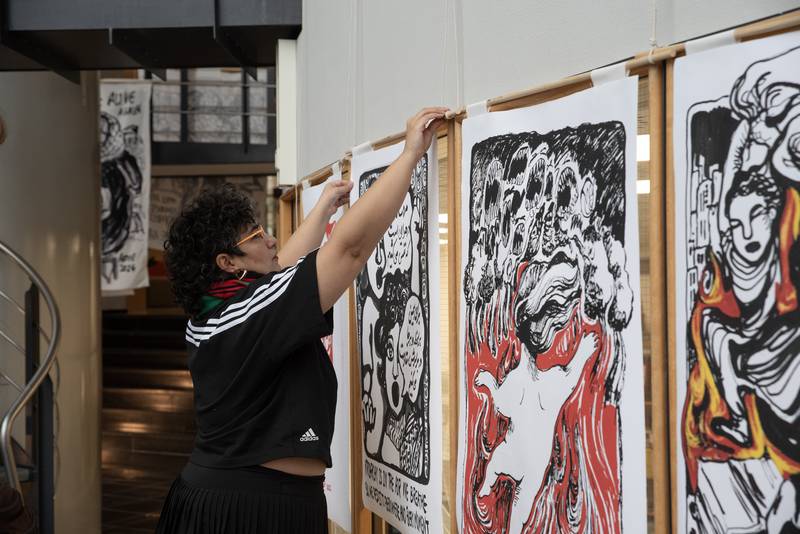
Posters were hung from every possible place in the building, like traces left behind by protesters after a demonstration.
It is worth dwelling on the fact that this meeting happens in the archive, in the exceptionality of its location, there where the aftermath of these storms multiplies. “Although the IISH was officially founded on 25 November 1935, its history begins in the decade before, in the person of Nicolaas Wilhelmus Posthumus. During World War II, the institute’s existence was seriously threatened, but after a period of recovery, it flourished again in the 1960s and 1970s. In addition to the earliest collections, such as the Marx-Engels archive, the Max Nettlau collection, and the archives of the political and trade union branches of the international and national labour movement, the IISH now began to house a broader palette of social movements.” Our meeting happens on the 90th anniversary, to trace “questions, reflections, and gestures drawn from collective memory, turning the archive into an active participant.” Since its establishment, the premises of the foundation were to preserve this history from fascism’s erasure mechanisms, again, we all know too well. Did the archive have to hide or go on exile? How did it survive?
“What makes one belong to the soil of a city? Perhaps it is the footsteps of those who turned the bricks of the streets into barricades against genocide.”
During their meeting with the archive, in the week of the sit-in the foyer of the IISH became a workshop, where Nafisi prepared with her sewing machine all the banners to be hung, while Kadivar engaged with the archive, dived, went looking, and found some traces that were later shared with the audience at the opening. Revolutionary songs punctuated a reading that I wish could reverberate across time and space: “What could be more tragic for a revolution than to become an archive? Perhaps a revolution that never becomes one” 1—in that moment when a practice looks back to see its footsteps, to realize all of a sudden that its persistence can be indexed into a library. The installation is still standing, and its power comes from this overlap—the meeting, which seems to insist on synchronicity—as if all these struggles would have happened at the same time, and because of the overall failure that turned them into secrets, perhaps they did, or they are still about to happen. Then from the meeting with the archive, one can keep thinking of that shared horizon, what made the urgency in the first hand. In the historicization of these storms, the affect of images and slogans carries something more than meaning, a somatization of some sort, a precise sensation on our bodies, a pressure on our chest, even though we weren’t there, our bodies collectively return to that presence, our skin shivers in a spark of our vision, in the vivid imagination of what kind of world we were summoned into.
“What makes one belong to the soil of a city?
Perhaps it is the footsteps of those who turned the bricks of the streets into barricades against
genocide.” 2
The illustrations were already collected last year into the book Testimonies, which collected the illustrations from 2009 to 2024, indeed in “a visual report of what lives in the memory of our bodies.” In solidarity with protests in many cities around the world, from Riace to Baghdad, and letters from friends in solidarity. Meanwhile, Kadivar was working on the book Songs of Continuous Cities, a sound archive of Azerbaijani-Turkish 45rpm records from Iran from the 1950s to the 1970s. Kadivar and Nafisi also worked together on the graphic novel Walvistraan: A Love Story in a Time of Extinction and Isolation reviving the history of the Molenwijk neighborhood in Amsterdam, interspecies ecologies, and labour movements into a piece of fiction. All these works belong in continuity to the same landscape, where the city belongs to our bodies, and our bodies are present and vigilant; they feel actively part of the city. Is there a form of archiving that doesn’t entail the end or the rediscovery of something, but rather its rhizomatic rooting? And what is the meaning of solidarity in the time of genocide, amidst the inexorable rise of fascism? How did that swiftly change since the 7th of October, and in what way do we still witness it changing? When we talked on the phone the other day with Golrokh she said that solidarity alone isn’t enough, that it needs another word, that has been “international” for a while, but after more than two years of genocide we saw that no longer suffices, our horizon cannot find a homeland and remains in exile, like the songs that were found in the archive and played at the opening, they sound new to us because they are (secret) songs in exile. Yet, when found they surprise us for their contemporaneity, as if time didn’t pass, their obstinacy still perseveres.
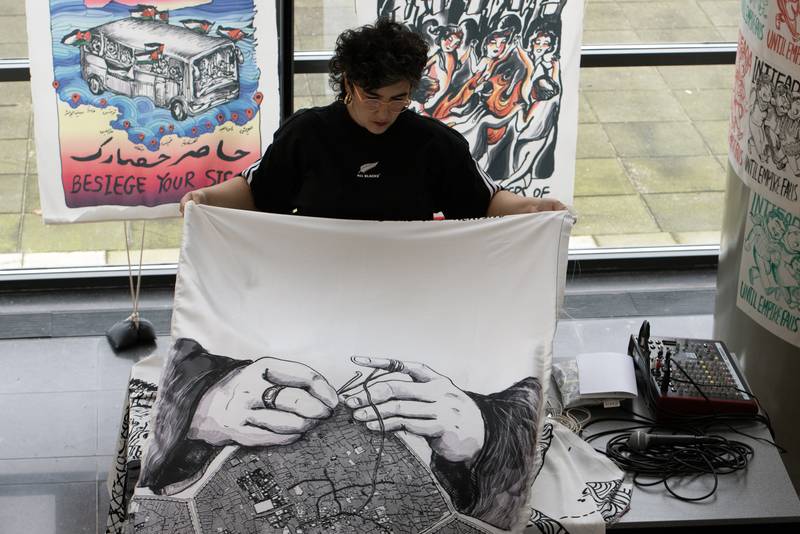
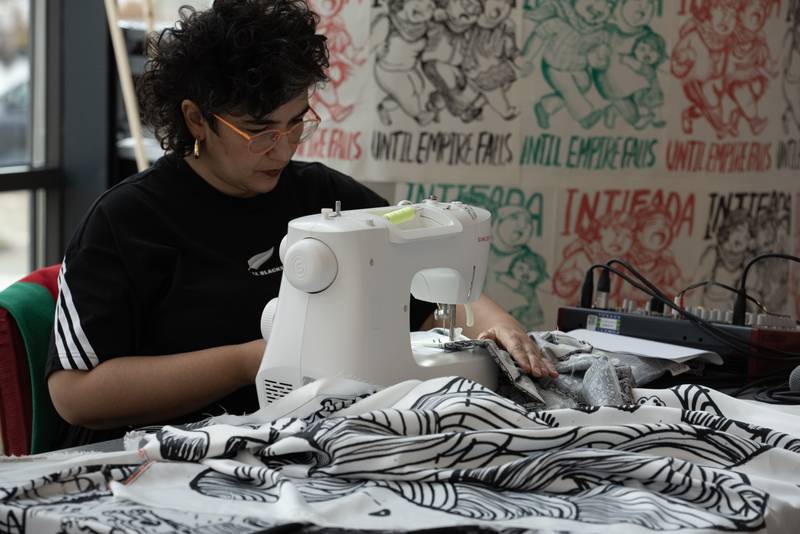
During the week-long residency in the archive, Golrokh sat in the main hall preparing the banners to be hung.
As we feel the icy breath of fascism looming over our shoulders we may find our strength in the labour of our partisan comrades, in the words of all of those who fought before us, proceeded in darkness with extreme rigor and clarity—peaking back from the archive it seems—with no hesitation. Certain phrasings are just repeated, amplified, insisted upon.
If solidarity means staring at the same horizon, even when we are in exile, communication is cut, and reality is distorted, we trust that the imaginary remains the same, that beauty is soothing as something that must be preserved at all costs. The archive we can become part of and we have in mind is nothing like a museum, there to mask hegemonic narratives—not simply something that keeps us divided in folders, but a tool to actualize our thinking and speaking, in all its liveliness and proximity, if we are at war, we are planting seeds for the days ahead—that can hold through violence and censorship. How do we show up into each other’s storms, if the moisture is too thick, that would be the point of inquiry—what the archive should attempt to do while it is established. And in meeting the archive, how do we resist its removal? Beside contributing by making it alive, singing all the songs out loud again, relearning and reviewing all the slogans, if erasure forcibly occupies our landscape, how will we utilize our bodies to prevent the repression of our stories? The archive too is a matter of survival.
In both archives and museums, silence can be utilized very intentionally for the production or revision of history, to voluntarily exclude some stories or bring forward certain suprematist narratives. As mentioned in the opening text, with Refat Alareer in our hearts, we know that our horizon is made of our stories, and that we become depositary of each other’s record. We witness with our presence, and we insist in our recounting. Love is our compass.
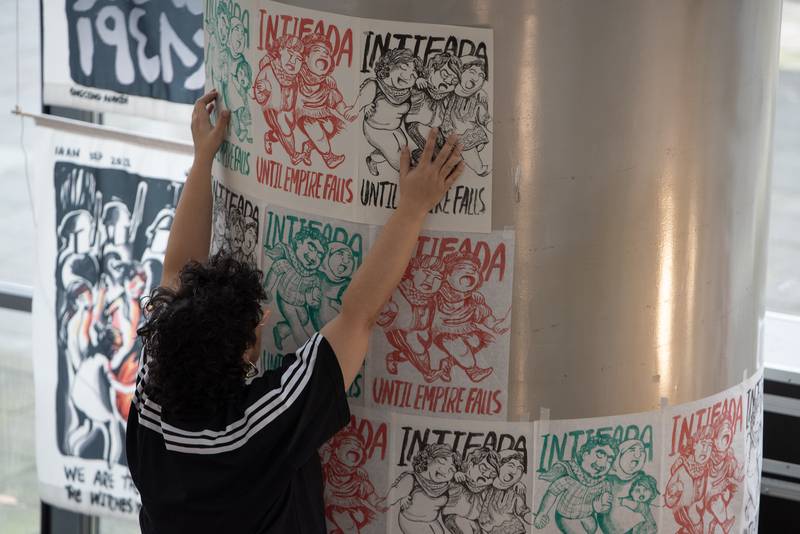
Meanwhile we have all of a sudden realized how many storms we went through together. How many we remember although they happened before we came. Which one we still celebrate, and which one we mourn. How much each has changed the conformation of our landscape, thus slowly shifting our horizon—or perhaps it was the horizon that adjusted to withstand inclement weather, and so did our skin, it became thicker. So did our voice, as it tuned in and began to sing along. Now that the incumbency of fascism and war clouds our horizon, we must hold each other tighter than ever.
“That moment when the word solidarity becomes the form of an arm tightly wrapped around
your arm, your body resonates with the scream of another body next to you…
There—a rehearsal for a new society
A way of living for another.
Imagining equality from your bones.
Which images and which songs can return us to that rehearsal again?
We want to return, we will return.” 3
-
 READ
READAn activation by Palestinian artists Maen Hammad, Dina Salem, Sari Tarazi, and Ahmad Alaqra was hosted at DoubleDummy, Arles, between July 1-7, 2024, during the opening week of the Rencontres d’Arles. It conveys a timeline of the ongoing genocide in Gaza using information shared via alternative messaging platforms like Telegram.
Radical Re-imagining of Visual Order Amid the Ongoing Genocide of Palestinians: A Review of ‘Against Abstraction’
-
 READ
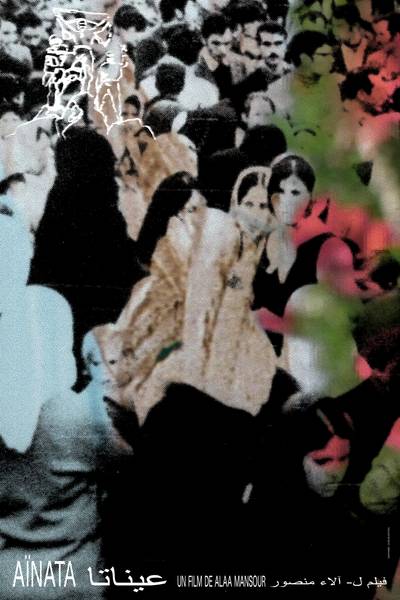
READAïnata (2018), shot in South Lebanon, is the debut documentary by the Lebanese research-based artist and filmmaker, Alaa Mansour. The memories being reconstituted in the film are those of Aïnata, a town in South Lebanon nestled within olive and tobacco farms, plagued for decades by Israeli occupation and violence.
Memory and the Fractured Image: A Review of Alaa Mansour’s ‘Aïnata’
-
 READ
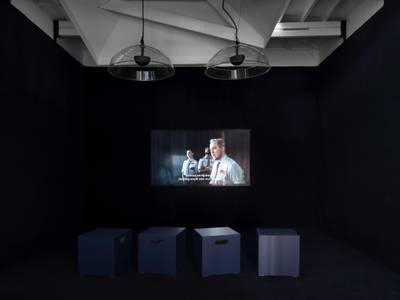
READClose Watch exhibited at the National Finnish Pavilion at Venice Biennale, 2022, is a multimedia installation that, at its core, utilises the artist themself as an embodied intervention within a focused area of artistic research and apparent critique. In the context of this work presented as an exhibition at the national pavilion and its implications of somehow representing Finnish Art, this text seeks to question whether issues pertaining to embodiment and social intervention – and by extension, research conducted and artistic practice developed through it – can ever be free of the power relations implicit in the political, identity-driven understanding of society today.
Who Watches Whom? Ruminations on Power, Gaze, and Field Through Pilvi Takala’s Close Watch
-
 READ
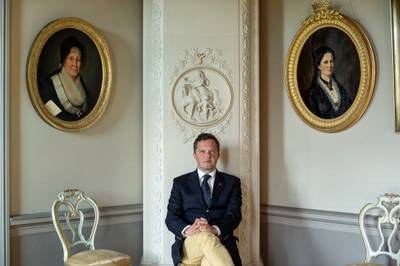
READThe wealthy are equated with such minorities as if being wealthy were a specific cultural phenomenon or even an identity based on a form of discrimination. Veering through notions of whether wealth improves mental well-being or is taboo in Finnish society, Eetu Viren peruses the exhibition’s banality and ridiculousness to expound on questions of wealth and power and why the Finnish National Museum hosted an exhibition that characterizes the wealthy as a “minority group.”
The Poor Rich People: A Review of ‘The Philosophy of Wealth’