Ines Montalvao is a multidisciplinary creative with demonstrated work in curation, experience & concept design and co-creation in international projects and exhibitions, with museums and other organizations. Ines focuses her creative practice in the field of art-science, exploring cross-disciplinary approaches like creative writing and storytelling, illustration, performance, and other innovative ways to create narrative environments that enact emotions and enable meaningful experiences.
People show up for one another in ways formal systems cannot fully anticipate; neighbors organize food, shelter, transport, and companionship; knowledge is shared across generations, making small acts of attention a form of collective resilience. Yet, care is more than an informal aid. It is a set of practices, infrastructures, and commitments that can be intimate, informal, and political. It forces us to ask who is cared for, who does the caring, and which forms of care are recognized and resourced. And what happens when we treat the work of sustaining life as an unlimited resource? Canopies of Care attends to these questions through conversations that bring together art, science, civil society, and lived experience. This current Artists with Evidence (AwE) program of conversations, encounters, and community building, is guided by prevention, relief, repair, and renewal: how we prepare, show up in a crisis, tend to what has been damaged, and make room for new ways of living.
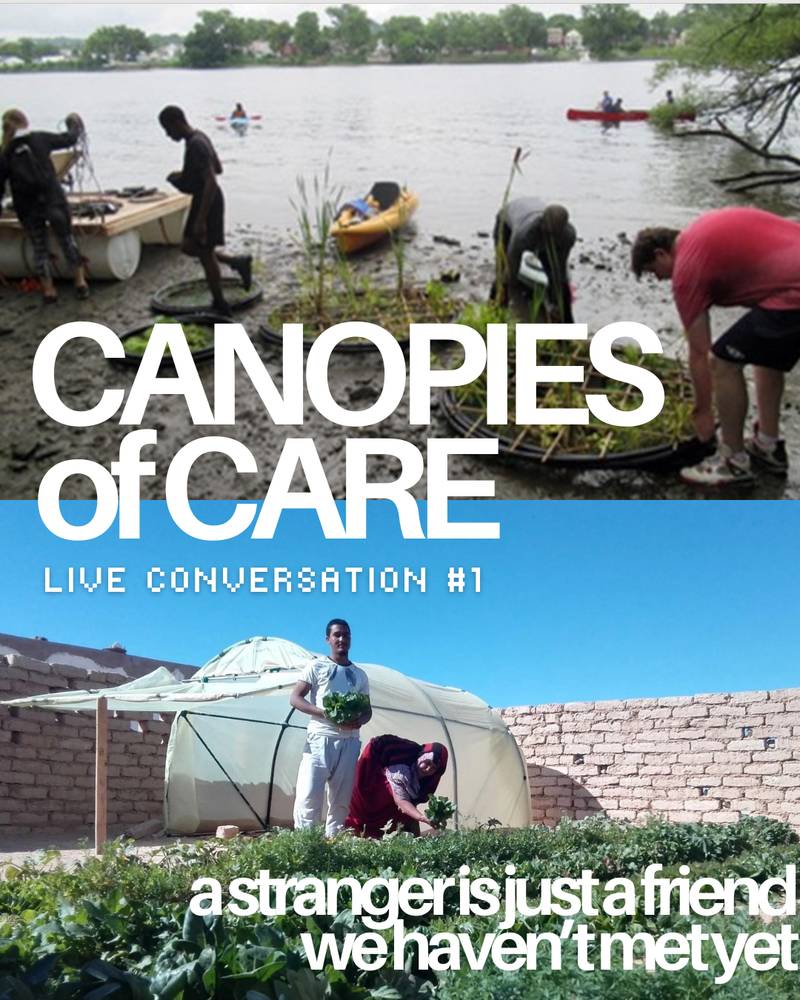
Canopies of Care has become a central thread in my current and upcoming curatorial work at AwE to understand the visible and invisible infrastructures of care that sustain communities, shape relationships, and help us navigate uncertainty. The work began in June 2026 with a live conversation, “A stranger is just a friend we haven’t met yet”, co-hosted by Colin Greer and me, in conversation with Scott Kellogg and Mohamed Sleiman Labat. Kellogg shared his work at the RADIX Ecological Sustainability Center in Albany, New York, which puts ecological education, urban agriculture, food sovereignty and community resilience into practice. Labat, an artist and cultural practitioner born and raised in the Sahrawi refugee camps in Algeria, presented his perspectives on gardens, displacement and collective creativity. Despite different political and material realities, their experiences revealed common ground, cultivating food and knowledge with scarce resources and keeping a sense of possibility alive through sharing.
Bringing these perspectives together did not mean treating their circumstances as equivalent. We collaboratively agreed on the framing, using a script-like document open to everyone’s input. We did technical prep with our sound editor and each guest, and Colin helped ensure the best possible recording conditions while creating space for storytelling without losing sight of the distinct histories, power relations, and experiences each brought to the conversation. This first conversation was the program’s spring-summer seed-planting season.
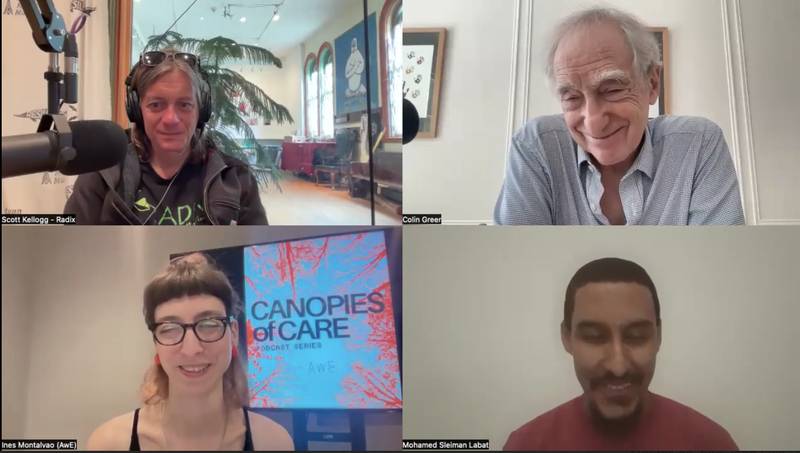
Online conversation “A stranger is just a friend we haven’t met yet” (2026) for Canopies of Care. Clockwise: Scott Kellogg, Colin Greer, Mohamed Sleiman Labat and Ines Montalvao.
Scott has spent 17 years transforming a 1-acre parking lot (provided by the city of Albany) into a sustainable community hub featuring gardens, a greenhouse, solar panels, and electric transport. His environmental projects include restoration initiatives in the Hudson River and urban farming that create jobs and provide a safe space for youth in marginalized neighbourhoods. Mohamed built an art studio from discarded materials in the Sahrawi refugee camps and helped families launch desert-based “sandoponic” gardens to manage water scarcity. Throughout the conversation, Mohamed shared clear examples of these initiatives and captured the spirit of our discussion when he said: “Hope is a verb”. Like hope, care is practiced imperfectly and collectively everyday, through how we work and relate to one another.
Their contributions ground the ethos of Canopies of Care in practices rooted in sharing food and knowledge, and in the collective work of sustaining a place. The conversation also gave us a starting point for asking what makes such practices possible, and what kinds of environments allow people to feel supported over time.
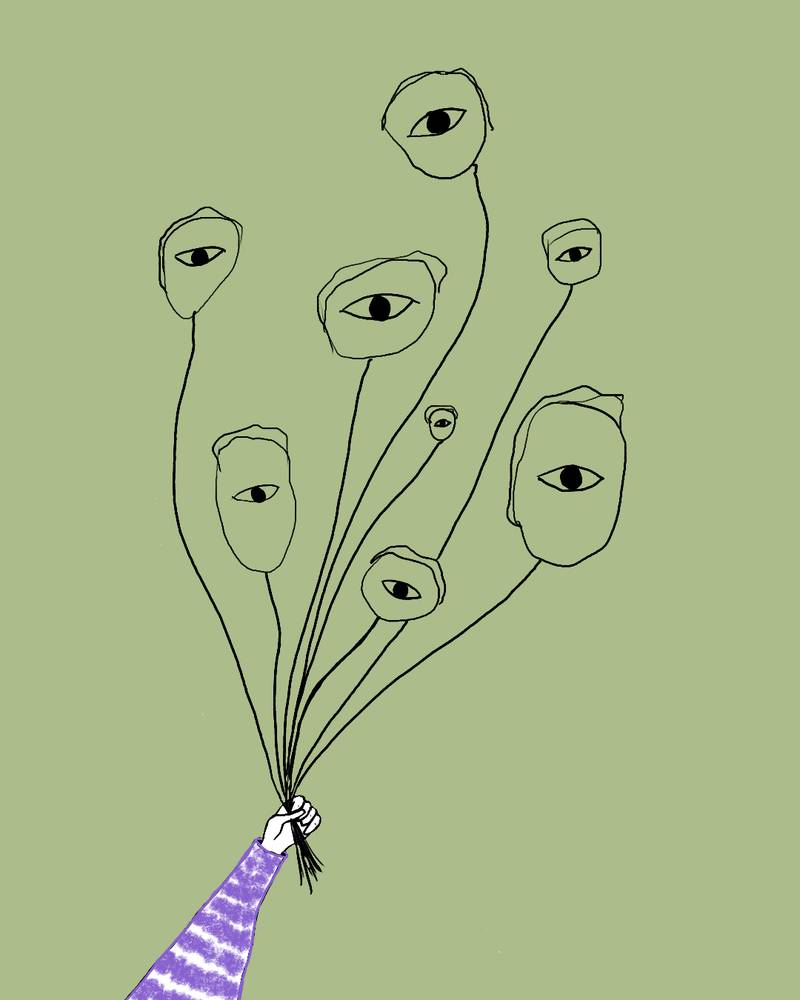
Visual anchor when presenting on the intersection of art-science and the transformative power of cross-disciplinary collaboration. Illustration by Ines Montalvao.
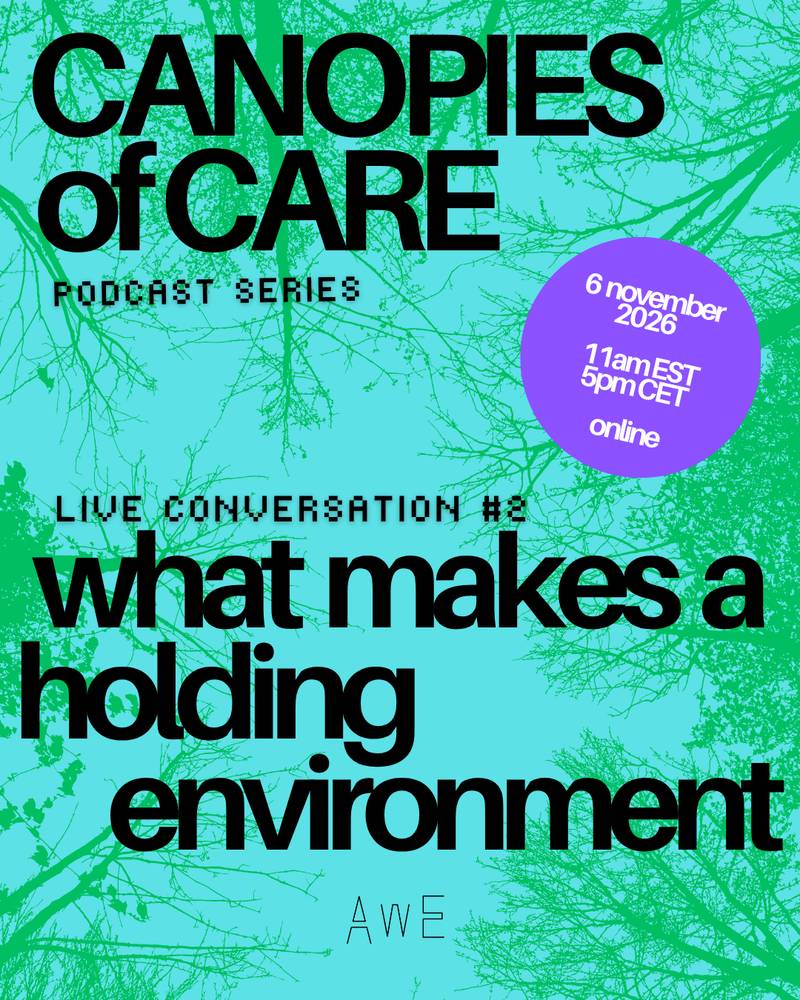
As we approach our second online conversation in November 2026, “What Makes a Holding Environment”, with Senem Pirler and Henna Asikainen, we ask about belonging and the different bodies that seek it, human and non-human, migrating and displaced, working and caregiving: what does it mean to feel we belong somewhere? Henna Asikainen will share insights into her artistic practice and work “Between Two Shores”, which explores migration, displacement, ecological relations, and the connections between human and more-than-human worlds. Senem Pirler, through her work “Withholding”, will bring questions around bodies, sound, memory, and the conditions that shape our sense of belonging. Together, their practices open up ways to think about migration, inclusion and exclusion, and the environments in which people can thrive.
What forms of care are needed when people move, communities change, or work consumes the time and energy required to live?
Drawing on pediatrician and psychoanalyst D. W. Winnicott’s concept of the holding environment (the relational conditions that allow individuals to feel supported, develop, and belong), we ask how to create and sustain such environments and what care means when belonging itself is contested. A holding environment (Winnicott, 1965) builds over time, often before we know we will need it, through habits and shared responsibilities that let people respond when circumstances become difficult.
I find the idea of a holding environment useful because it moves care from individual kindness to the conditions that encourage participation and belonging. A holding environment can start as simply as creating an online gathering where people don’t need to arrive with a presentation, a polished idea, or an immediate outcome. This environment is not created by the invitation alone; it depends on how people are welcomed, how a conversation is facilitated, whether different ways of participating are possible, and whether there is room to listen without having to agree. Such conditions do not remove structural inequalities, but they help recognize and work with the needs and differences that people bring into a shared space.
This raises questions like: What forms of care are needed when people move, communities change, or work consumes the time and energy required to live?
Time is essential for bringing people together and creating the conditions for meaningful conversation, and it yields a slow harvest. When I think about what we plant, what we nurture, what we let rest, and what we hope will survive, hope is not a guarantee that things will turn out well. Hope and care are things we do, present in small, everyday actions, sowing, watering, nurturing, and sharing knowledge to make something possible for someone else. This has become a way of understanding my curatorial work at AwE, where I have been Program Director since May 2023, and it in particular shapes how I approach Canopies of Care. I imagine it as a place where ideas take root, relationships develop, and different forms of knowledge grow alongside one another.
How do we create meaningful encounters across disciplines, geographies and experiences? How do we make room for the unexpected within a system that demands speed, productivity and measurable outcomes?
Whether driven by urgency or guided by slowness, we need sustained room for imagination, dialogue, and attention. For us, maintaining this space is strongly related to accessibility. We want our online programs to be accessible and low-threshold, welcoming people from different backgrounds and geographies. Accessibility also means considering the demands we place on people’s time, the language we use, and how we recognize their contributions. Online formats enable participation across contexts, but they don’t remove every barrier. Time zones shape who can attend comfortably; digital access and language influence who can participate; caregiving, fatigue, and competing work demands affect people’s time and attention.
For us, accessibility means accommodating primarily guests’ and hosts’ time zones, sharing conversations as podcast episodes to extend access, and keeping the format simple without requiring presentations or extensive preparation. These choices lower barriers to participation, while reminding us that accessibility is an ongoing practice of acknowledging people’s different circumstances.
Under these circumstances, how do we create meaningful encounters across disciplines, geographies and experiences? How do we make room for the unexpected within a system that demands speed, productivity and measurable outcomes?
When developing a program, I consider whose perspectives are present, whose are missing, what assumptions the framing might carry, and whether the format allows people to contribute without being reduced to representatives of a discipline or experience. I also consider the time needed for preparation and listening, the accessibility of the encounter, and what might happen after it ends. A conversation doesn’t require everyone to reach the same conclusions. Sometimes its value lies in making differences more legible, allowing an unexpected connection to emerge, or leaving us with a better question than the one we started with.
My background spans natural sciences, exhibition design, museums and science centers, curating, illustration, writing, sound, and participatory practices. I have worked in environments where knowledge is communicated to the public and artistic contexts where knowledge can be questioned, embodied, felt, or imagined differently. I joined AwE because I saw an opportunity to bring together this complex composite of my work without reducing my experiences to a single narrative, and to bring people together around questions that no single perspective can adequately address. I endeavor to create conditions where different kinds of knowledge can encounter one another without one being reduced to another’s language or authority.
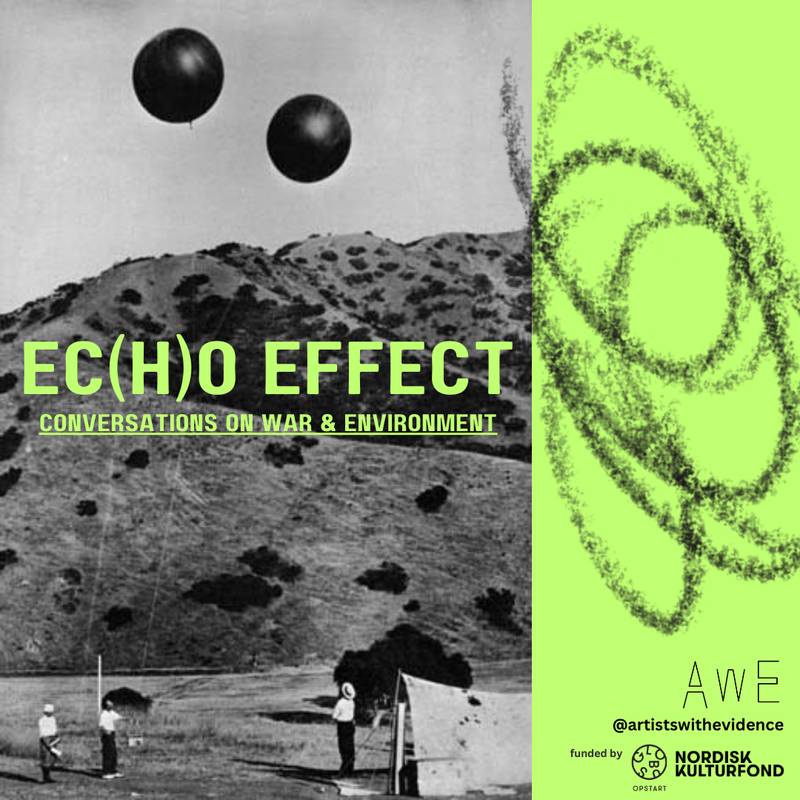
I developed one of my first curatorial threads through Ec(h)o Effect: Conversations on War & Environment, a series of six online conversations that explored the intricate interplay between war and environment, delving into climate change, resource scarcity, mass migration, histories of extraction, displacement, resource control, unequal exposure to violence, and eroding democracy. These conversations can easily stay confined to expert circles, where policy and geopolitical language leave little room for the textures of everyday life. How do people live with uncertainty? How are histories carried in bodies and places? Using storytelling not as a decorative addition to evidence, but as a way to approach what evidence alone may not convey, I wanted to invite people whose perspectives might not usually sit together on a panel. Each conversation brought together Ali Akbar Mehta and Colin Greer as recurring voices, alongside guests whose perspectives could open unexpected paths through the subject. Together, they brought an interdisciplinary approach to questions of art, politics, ecology, and conflict, connecting critical thought with cultural and political practice, civic engagement, social justice, and community-based work, and moving the conversations between structural analysis, ethical questions, and the consequences of political decisions. Ec(h)o Effect began with online conversations, then became a YouTube series and later a podcast.
Why art–science, and whose knowledge counts?
I don’t believe that art is just a tool for translating science into accessible forms or that putting artists and scientists in the same room automatically produces meaningful collaboration. We have to catalyze ways of working across forms of inquiry, expression, and understanding, drawing on scientific evidence, artistic experimentation, embodied knowledge, political analysis, oral histories, sensory experience, and speculation. Artistic practices reveal what conventional analysis overlooks or help imagine new possibilities. Scientific work offers evidence and methods; lived experience can challenge the assumptions that shape both. None is sufficient on its own, and none should be included merely to legitimize another. Art–science practice can create so-called narrative environments: contexts in which people encounter evidence through stories, spaces, and experiences, and where its meaning is shaped by how it is presented (Austin, 2020). This also resonates with Donna Haraway’s account of situated knowledge: what we know is partial and shaped by our position and relationships, rather than produced from a view from nowhere (Haraway, 1988). Her later call to “stay with the trouble” also speaks to the value of staying with complexity rather than reaching too quickly for reassuring solutions (Haraway, 2016).
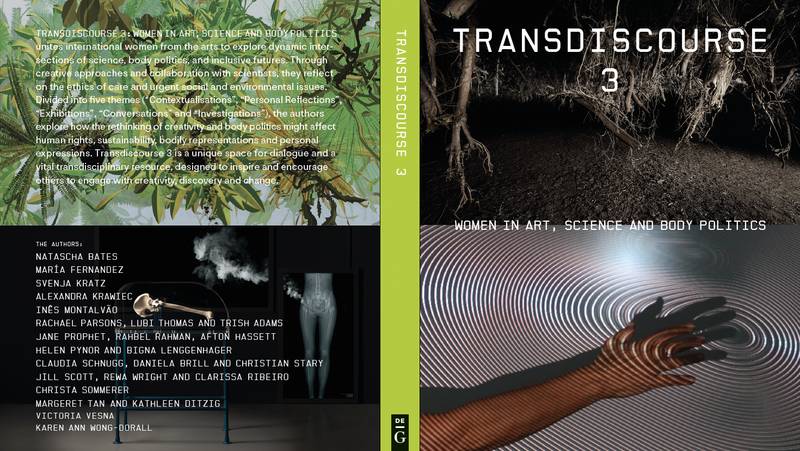
Cover of the book, Transdiscourse 3: Women in Art, Science and Body Politics, edited by Jill Scott, De Gruyter (2026)
The art-science field is not exempt from structural inequalities. Among others, women and non-binary practitioners have had their expertise overlooked and their work positioned outside dominant accounts of innovation and knowledge production. In my essay “Art as evidence: The future is not what it used to be!” for Transdiscourse 3: Women in Art, Science and Body Politics, I consider questions of evidence, women’s participation in art–science and body politics (Montalvão, 2026). Who is recognized as a producer of knowledge, whose experiences are considered credible, and which bodies and perspectives are acknowledged are questions that run through scientific institutions, artistic histories and public discourse.
Multidisciplinary programs should not simply gather different people around an established framework. They should allow the framework itself to change. If our problems cross disciplinary boundaries, our conversations need to do the same.
This is also why I care about who gets to participate and who is authorized to do it, just as Beatriz da Costa’s art–science practice questioned how to produce evidence and where disciplinary boundaries are drawn (da Costa, 2008).
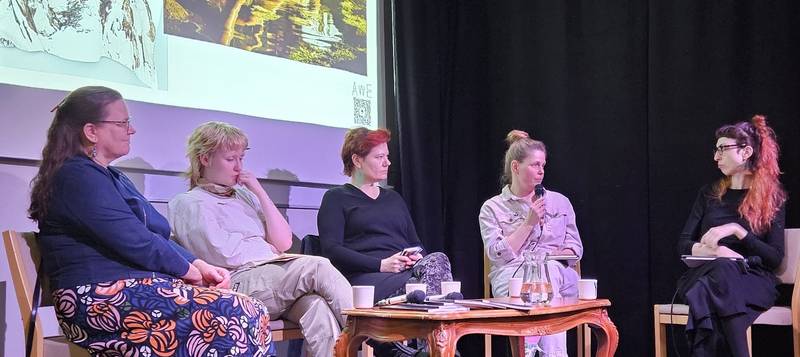
Conversation “Transcending Boundaries: an evening of art-science” for Climate & Death with Ines Montalvao and guest speakers (left to right) Research Professor Raisa Mäkipää, activist Ainu Kyrönseppä, interdisciplinary artist Eeva-Liisa Puhakka, and post-disciplinary artist and researcher Mari Keski-Korsu at Tekstintalo, Helsinki (2024)
Making space for women and non-binary voices is not simply a matter of representation. It is about changing the conditions under which knowledge is produced, shared and valued, and recognizing that supposedly neutral systems can carry histories of exclusion. This thinking informed Climate & Death, which brought together perspectives on climate, mortality, decay and grief. It also shaped a conversation I hosted with women and non-binary voices working across art and science. I wanted participants to speak from their practices and experiences, rather than fit a predetermined account of what art–science should look like.
Environmental change cannot be separated from economics, politics, culture or justice. War affects ecosystems and bodies; climate disruption reshapes migration and belonging; care is intimate, social, ecological, and political. I return to these notions in my curatorial work: multidisciplinary programs should not simply gather different people around an established framework. They should allow the framework itself to change. If our problems cross disciplinary boundaries, our conversations need to do the same.
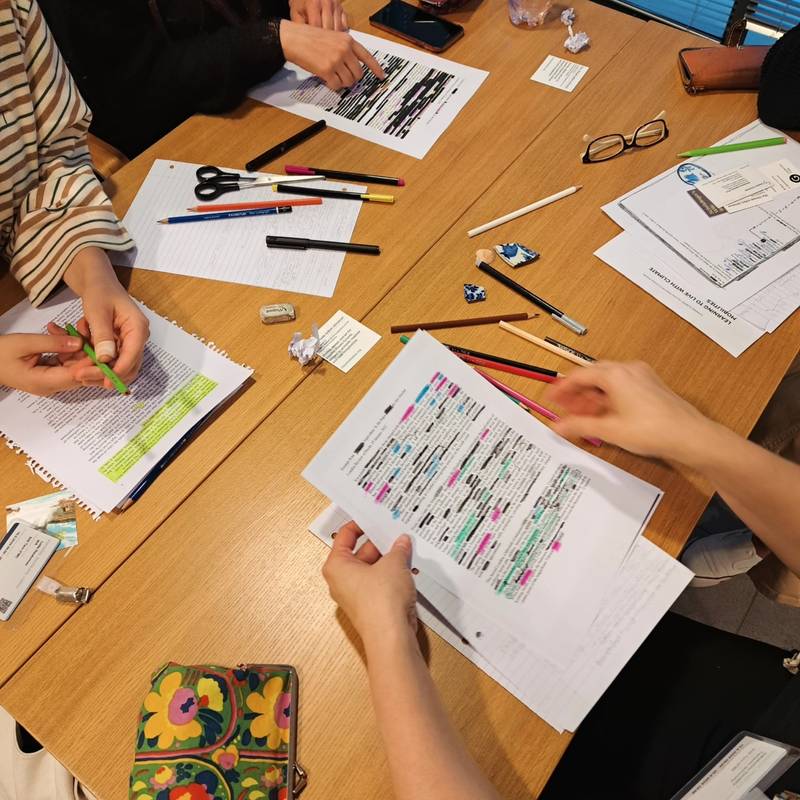
Workshop “(re)Writing the Future: Objects, Memory, and Narrative” led by Pippa Goldschmidt at the Climate Security Festival (2024). Through physical objects tied to land and cityscape trauma, participants explored collective writing, reworked existing texts and poems, symbolizing how we continually reshape landscapes while retaining traces of the past.
AwE’s work has also developed through partnerships and public programs. We have participated in two editions of the Climate Security Festival, with the 2024 event exploring food security and the broader relationships among climate, security, and society. The next festival, November 16-17, 2026, focuses on Shared Atmosphere. As part of it, we will present a Canopies of Care film screening, including a full-length film session, a program of international short films, and an audience discussion.
I am drawn to the idea of a shared atmosphere because it connects the material and the relational. We inhabit atmospheric conditions together, but not equally: our bodies, infrastructures, locations and political circumstances shape our exposure to environmental change. Film offers another way to encounter these questions through image, sound, duration, and proximity, without pretending that distant experiences are identical.
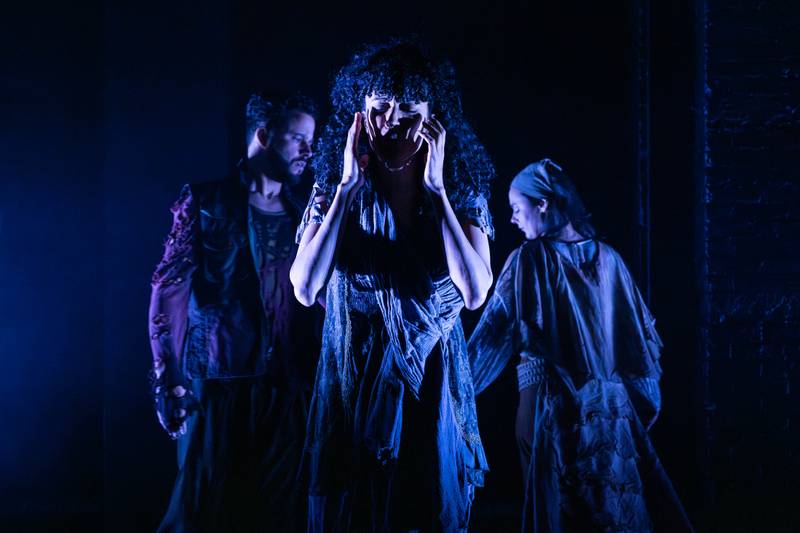
From the performance When the Smoke Clears, directed by Danilo Gambini, produced by Artists with Evidence. Photo by Alexia Haick (2026)
Another collaboration that helped carry this work forward was Live from the Threshold, developed with the Heinrich Böll Foundation. In October 2025, the project combined a live event in New York City with guests Cara Hagan, Linda O’Keeffe, and Nikki Lindt, including a preview performance of When the Smoke Clears, later premiered in February 2026; with an intimate conversation with artist Kathy High in Troy, upstate New York. It continued our exploration of conversations as a format that can travel beyond the moment of gathering, while preserving the intimacy of being in the room with the speaker. It explored thresholds between public and private, uncertainty and possibility, the visible and invisible, above and below ground, and individual and collective experience. These collaborations helped shape the approach we now develop through Canopies of Care, where a conversation isn’t an isolated event but part of a longer process of listening, connecting, and cultivating relationships.
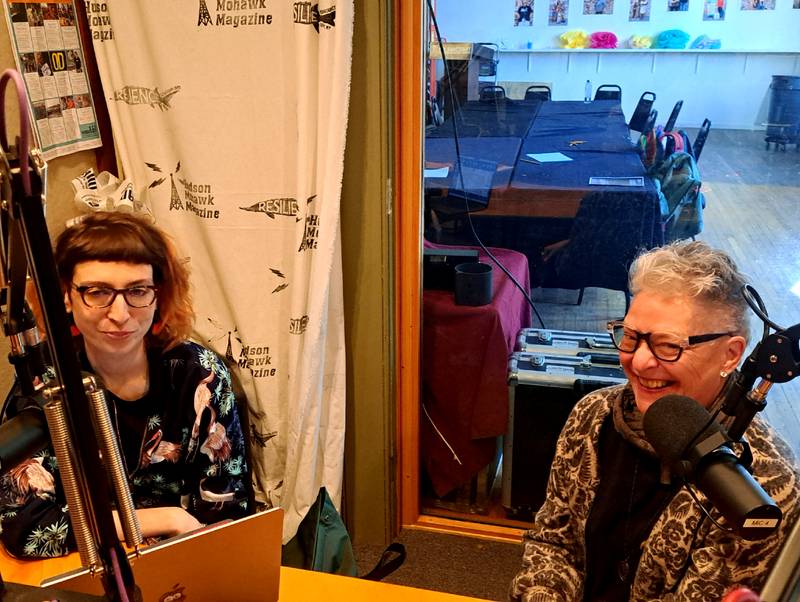
Ines Montalvao (L) in conversation with Kathy High ® for podcast episode #2 of Live from the Threshold at the Sanctuary for Independent Media’s radio room (2025)
Over the next one to two years, I would consider Canopies of Care successful if it helped relationships continue beyond individual encounters: if participants returned to one another’s questions, if new collaborations or exchanges developed where there was a shared interest, and if the program created space for forms of knowledge that are usually peripheral. I would also want it to evolve through what we learn from the people who participate. For me, failure wouldn’t mean every conversation failed to produce a tangible outcome. It would mean letting pressure to produce more undermine the care the program seeks to cultivate.
I don’t measure success or failure quantitatively, but by whether something evokes an emotion and makes someone want to know more, get in touch, or collaborate, regardless of the circumstances.
The question is not simply how to do more with less. It is how to stay aligned with our principles and make the work worthwhile without exhausting the people who sustain it. Community is a source of strength, but it is not inexhaustible.
We operate in a system that rewards scale, speed, constant visibility, and quantifiable output, even when our resources don’t match those expectations. Thoughtful programs require research, coordination, communication, relationships and follow-through. Much of this labor remains invisible, especially when a nonprofit relies on a mix of funding, partnerships, and network engagement. Right now, we have funding for the Canopies of Care conversation series and podcast episodes, and we are actively fundraising to add an in-person event.
Funding cycles often demand predefined outputs upfront, whereas the most meaningful results of a conversation emerge later through deepening exchanges. Managing administration, coordinating partners, documenting, and reporting takes significant time alongside core research. While necessary to sustain the organization, administrative demands can crowd out the slower, unpredictable processes that give a program its depth.
When funding is available, we prioritize compensating participants and collaborators, and paying for services such as production assistance, sound design, editing, music composition, communications, and other program-related work. In a small organization, material conditions affect my choices as a Program Director when curating projects.
Limited resources also mean that some essential work, such as updating the website and publishing profiles of creatives in our network, must sometimes wait. These conditions shape how a program can grow: community and shared commitment make the work possible, but sustaining it also requires recognizing labor and resourcing – the less visible work that holds collaborations together.
The question is not simply how to do more with less. It is how to stay aligned with our principles and make the work worthwhile without exhausting the people who sustain it. Community is a source of strength, but it is not inexhaustible. Meaningful work shouldn’t depend on people giving endlessly of themselves, nor should collaboration excuse overlooking labor or paying people unfairly. Without romanticizing scarcity, we must recognize that care needs material conditions to be practiced.
Working closely with our networks isn’t just a way to stretch a budget; it helps us stay relevant and meaningful. Funding is essential, but not the only resource: relationships, trust, shared interests, and the willingness to show up matter too.
Tending a program, like tending a plant, takes continuous time, resources and attention.
Artists with Evidence emerged in New York in 2021, with an international outlook and an interest in the questions that arise where art, science and society meet. Registered as a nonprofit in New York, AwE operates globally, bringing people and perspectives together across borders. The AwE Creative Network currently comprises over 90 individuals across disciplines and geographies. For example, AwE’s Imaginarium gatherings are low-threshold online encounters where creatives in the network can simply be present with one another, a valuable and rare opportunity to meet without a finished outcome or fixed agenda. The AwE Library is another part of this ecosystem: a growing, living resource where people can contribute and knowledge can circulate.
Notes: Ec(h)o Effect: Conversations on War & Environment, was supported by the Nordic Culture Fund through its Globus Opstart program; Live from the Threshold was co-funded by the Heinrich Böll Foundation; and all Climate Security Festival editions and Climate & Death were co-organized with the Initiative for a Safer Climate.
-
 READ
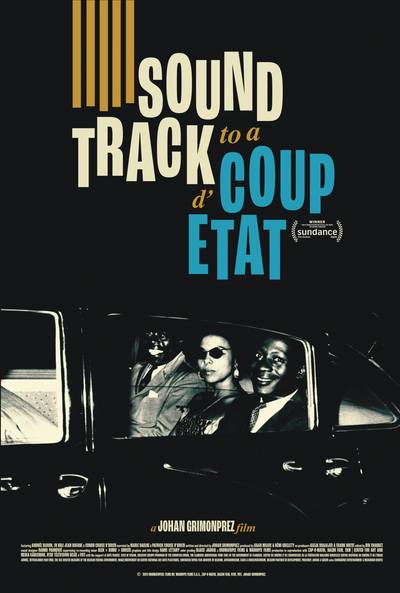
The story of the Democratic Republic of Congo isn’t just about coups or Cold War power plays – it’s also a story told through rhythm, resistance, and reinvention. Soundtrack to a Coup d’État invites us to see music not as something that plays in the background of history, but as a key player in it – used by empires, reclaimed by artists, and still resonating in the voices of those who won’t be silenced.
Frontlines of Power: Sonic Politics in the Democratic Republic of Congo
-
 READ
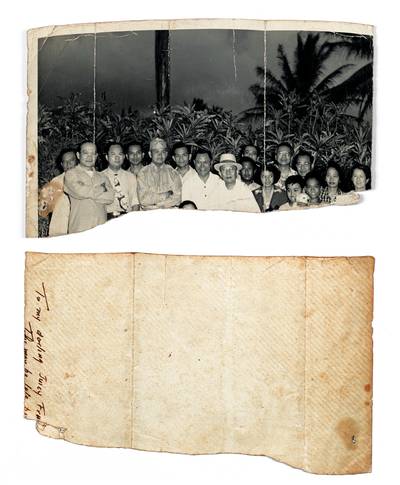
The diversity of the Filipino diasporic experience is often left unaddressed and conveniently reduced to give way to a cohesive idea of identity. How do we go back? And should we do that at all?
A Displacement, a Discomfort, a Translocation
-
 READ
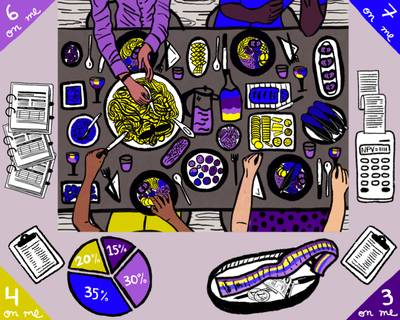
The practice of non-binary accounting is not new. Friends who “anexactly” rotate covering tabs for food and drink at bars, who do not keep a precise ledger delineating who owes what to whom, are constantly engaging in small-scale non-binary accounting practices. This text wonders whether a more rigorous formalization of the practice of non-binary accounting that is specifically geared towards subverting and dismantling binary accounting practices could be “scaled up”, so that communities and public institutions “splitting the tab” for large scale social initiatives can transact “anexactly”.
Accounting Otherwise: Non-Binary Book-Keeping & Fugitive Public Financing
-
 READ
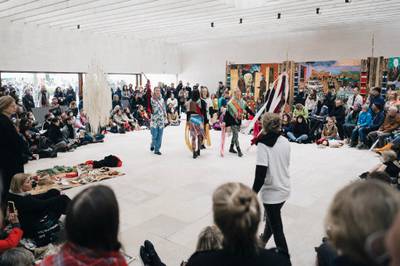
Systems and structures that prescribe most societal functions today, including the production and presentation of art, have little consideration for bodies performing these functions. Let us acknowledge these disparities and allow them to guide our ways of being and acting ethically.
Embodied Curating: Attuning the Body From Artistic to Political