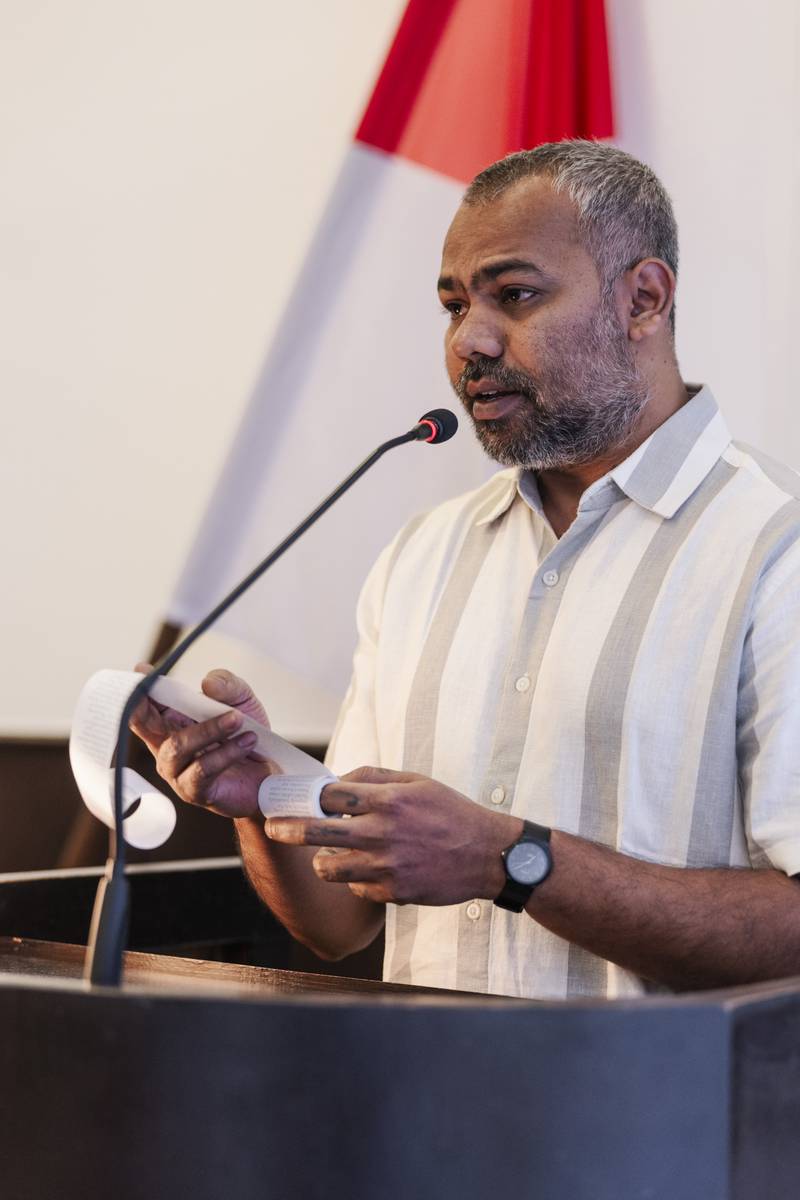
Portrait of Yogesh Barve by Adam Šákový
Anupam Roy (b. 1985) is a multidisciplinary artist, researcher, and educator based in India. His practice engages with the politics of image-making in relation to land, labour, ecology, dispossession, and collective political struggles.
A pair of mechanical Menaki-Neko strike one another. Elephants accumulate inside a glass box, and a cloud is trapped in another. In Tayen Tayen Fish, the absurd is neither escape nor decoration. Objects in the exhibition ask what happens when systems of caste, class, labour and power become so familiar that their violence appears ordinary. Yogesh Barve works across drawing, sculpture, digital simulation, found public imagery and industrial production, testing the distance between a familiar object and the conditions that give it meaning. He creates immersive environments that blur boundaries between work and non-work, studio and city, and personal and public realms. Through minimalist visual languages, he explores questions of equality, access, and technology as a tool for decolonization. In 2017, he established “Dalit Poetry and Literature,” a YouTube channel dedicated to spotlighting literature and voices outside the Brahmanical canon. Saviya Lopes, who has closely witnessed the artist’s practice over the years, joins the conversation as it turns towards criticism, vulnerability and accountability. The conversation also asks who gets to explain artistic work, whose labour remains unacknowledged, and when the demand for explanation itself can become exploitative.
ANUPAM: Tayen Tayen Fish is your first solo exhibition in almost a decade. Did it begin with a single argument, or did the works come together differently?
YOGESH: One always carries an accumulation of emotions and inquiries, a perspective on the world we live in, and when an opportunity arrives, we start assembling them. Many works were ideas in a diary or notes on my phone, and some were already taking shape in the studio. The exhibition deadline became an event in itself, where works from different timelines came together. Side by side, they all hint at systemic failures. Those failures are subtle, and they come from the places where we are comfortable, the ones we have absorbed as casual absurdities in our lives. The title came later, as an idiom: “Tayen Tayen Fish”, the deflation that follows a lot of effort. The making always came first.
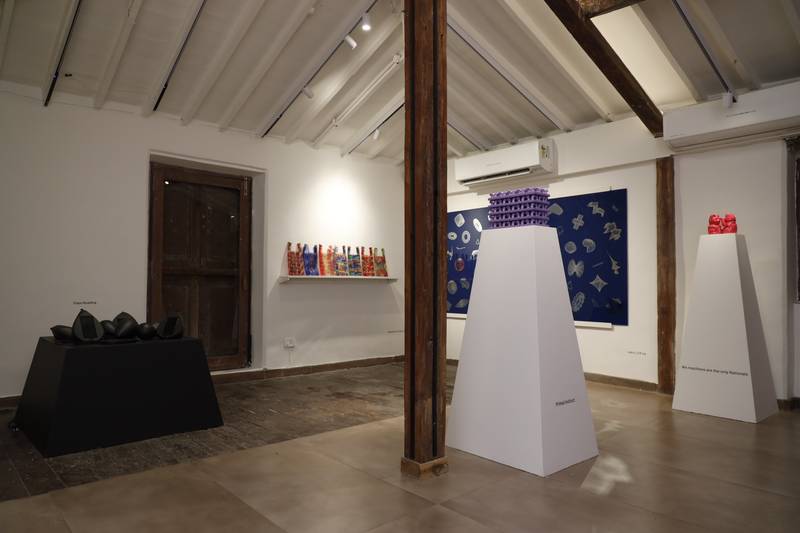
Installation view of Yogesh Barve’s Tayen Tayen Fish, 2026 at Art and Charlie Gallery, Mumbai
Let us begin with the Menaki-Neko, or the beckoning cats hitting each other. It is funny at first, but the repeated movement becomes uncomfortable. What interested you in that mechanism?
When feng shui objects became popular in India, everyone wanted good fortune. I saw these beckoning cats in shops and homes everywhere. I liked the mechanism of the moving hand, and I placed two of them facing each other so their arms would strike. It was funny to watch them hitting each other. But can they bring fortune now? There is nothing emotional between them. In that act, the machines appear to be the rational ones. And then it turns on us: are we rational? That is where the discomfort arrives. We keep trying to make sense of the world, but our judgement is clouded by systemic hierarchies. I only had to reposition the objects to speak about where we stand today. The work is an iteration of one I made in 2015; the question still remains.
You work with satire rather than offering an image of suffering or a straightforward denunciation. Why does humour matter when the structures you address, including caste, are so serious?
Caste lives in our minds. It extracts a heavy psychological, social and economic toll from individuals and from society as a whole. But unlike caste, satire occupies us and lives within rent-free.
In art history and among fellow artists, I have seen many individual and collective efforts to address systemic failures. But at some point it starts being romanticised instead of invoking a discourse. To reach that moment of conversation, it needs to feel unsettling. I think what stays with the viewer most is the form of satire. That humour speaks of the irony of caste, class, race and gender. Today, when so much stratification has become hypernormalised, maybe humour can be that unsettling feeling that provokes change.
We all share one common ground by being human, but our lived experiences reveal the differences between us. How do I convey that to someone? Humour, as a form within satire, is one way. If it makes someone confront the hierarchy they occupy, then we have arrived somewhere.
I want people to acknowledge the wrongs that have been done, and be accountable for them. Whether that translates into the real world is a different matter, but the aim is to create that uncomfortable emotion.
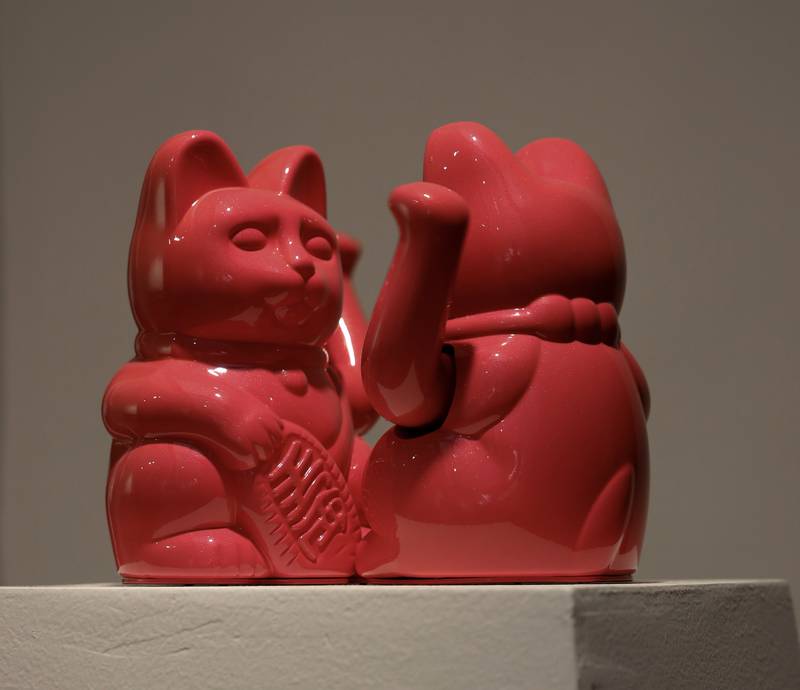
We Machines Are the Only Rationals
Does humour also let you refuse the expectation that an artist must explain everything, especially to viewers who may not share the experience behind the work?
That depends. Sometimes humour does let me refuse. But to what extent should I explain an artwork, or defend it, just for the sake of it? Often, explaining could be exploiting. It can flatten the idea of the work into a message, and it can ask the artist to unpack their own experience, caste included, for viewers who have never had to carry it. The attempt is to address what we see.
When will we learn to reflect our thoughts honestly in conversation? Maybe we can share solidarity, or speak about the privileges you and I hold. If we don’t have somewhere to meet, we can build it. It shouldn’t arrive through guilt. It should come through speaking, listening and thinking collectively.
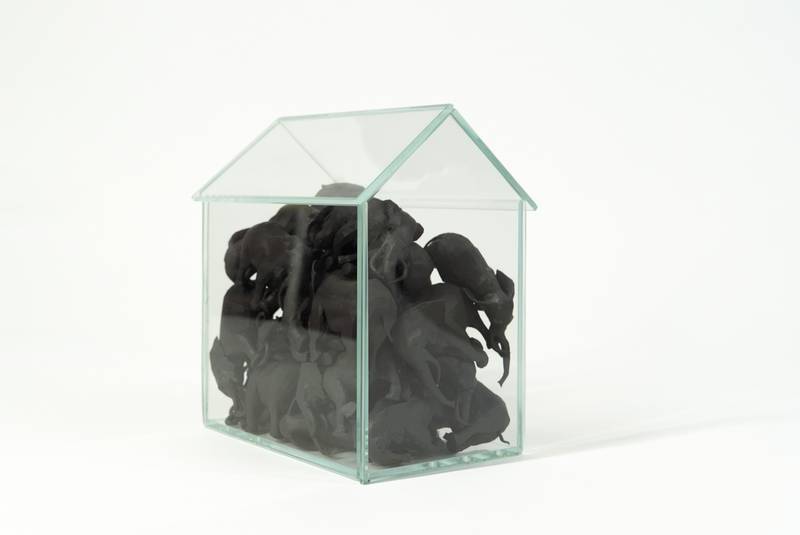
Elephants in the Room
Your objects are precise, but their meanings are not fixed. In Elephants in the Room, why put several elephants in one glass enclosure rather than illustrate one identifiable problem?
Identifying one problem means acknowledging the other faults in the system that paved the way for it. These fall into what designers call wicked problems: problems where people disagree even on what the problem is, so we all have to address them together. It takes an enormous amount of time and energy for an individual or a collective to decide which problem to name, and before that sinks in, another problem has been identified. Which means they have been there for a long time. Thinking about this led me to put many elephants in one room. The elephant as an object stays precise, but this is not a herd; it is a pile-up, and so the understanding of it changes. The meaning of an object shifts depending on where you are positioned in the hierarchy, and it has to stay in flux. And addressing one problem does not excuse us from ignoring the rest.
The cloud is also enclosed in glass, though its association with freedom seems almost the opposite of those crowded elephants. How did that work develop?
For me, containing a cloud in a glass cuboid was like imprisoning freedom, the thought itself. I enjoy watching clouds. They resemble hope and freedom to me, but someone in another place may not see them that way. A cloud can mean relief in one place and a flood in another. Something that enormous cannot really be contained, and yet artists have long tried to paint and sculpt clouds, from miniatures to the Renaissance to installation art. Some have even made them artificially, in real time.
With the crowded elephants, I am trying to make something visible: a problem that stays invisible because we choose to ignore it. The cloud is the opposite. It is a free-floating entity, trapped on purpose, to speak about the greed we have programmed ourselves into. The title, कर लो दुनिया मुट्ठी में (“hold the world in your fist”), was an advertising tagline from the Indian telecom company Reliance Infocomm. The work grew from a sketch in an old diary, to a painting, to a digital render, and finally to something small enough to hold in the hand.
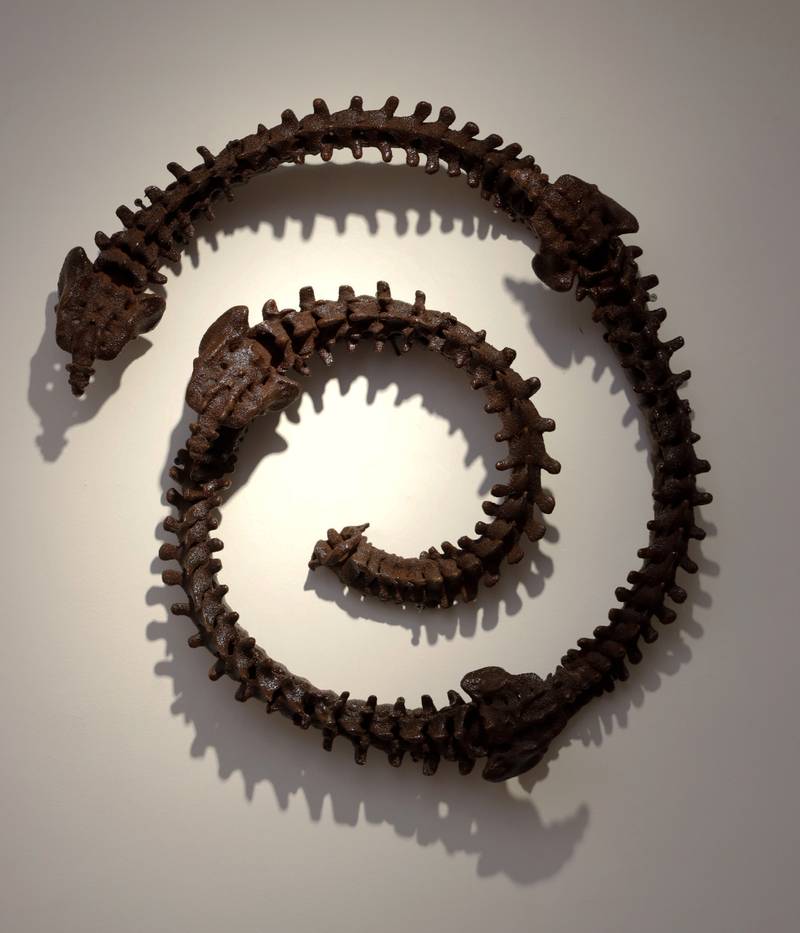
Social Scoliosis
Social Scoliosis moves from a familiar demand to keep one’s spine straight to the reality of bodies bent by work and authority. But those are not the same kinds of bending, are they?
No, of course not. Some bend because they have no choice, others because it is safer or pays. Objects carry multiple readings, and their meaning stays in flux. In Marathi literature, Kusumagraj’s poem “कणा ” (backbone) praises the spine as the thing that stays unbroken when everything else is lost. Yet I see people bending, often unconsciously, before caste, power and authority. I also think of the People’s Archive of Rural India, and its photographs of women doing agricultural labour. Their bodies have bent from sheer durational work, while the men from the same community stand straight. The human spine became the starting point for these nuances, and an object to work with. The title mentions scoliosis, but not only as a medical condition. It also addresses how minds and bodies are contained, bent at labour and before authority.
There is a common saying, “तुझ्या डोक्यात भूसा भरला आहे ”(your head is filled with sawdust), about the conditioning of our minds. Sawdust became the material that coats the object. The spiral is a reminder of a situation that never ends. Maybe there is still time to correct the bend, and not wait for it to break.
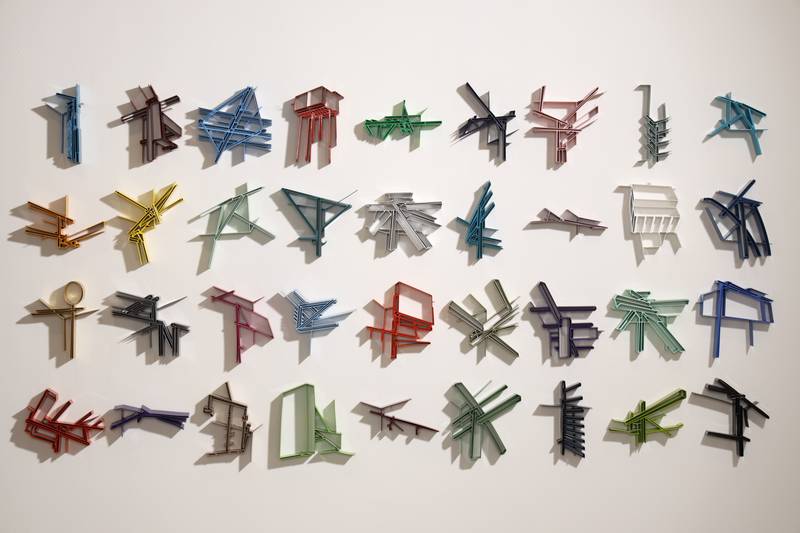
Extensions
Extensions start with the city, not a symbolic object. What do the strange structures you found in Mumbai reveal about who has space to improvise?
The city is itself a kind of symbolic object, and documenting it has been part of my practice for the past fifteen years. Extensions begin with observing unusual structures in the overlooked spaces of Mumbai: improvised supports, projecting frames, makeshift additions through which inhabitants adapt their buildings and livelihoods to everyday needs. These forms emerge from use, yet their strange geometries suggest sculptural impossibilities within the familiar cityscape.
When you isolate one of these structures from a photograph, it can look abstract. I turned them into linear vector drawings and then into three-dimensional forms. Selecting, drawing and reconstructing each one involved interpretation, with the drawing marking a threshold between documentation and invention. The sculptures are presented without their origins, so viewers meet apparently abstract forms without knowing that their geometries come from practical constructions in the city.
The project questions how we recognise, value, and explain form. Whose spatial decisions count as design, and whose labour remains unseen? What role does language play in giving sculpture meaning and authority? Why do we see these makeshift structures in low-income neighbourhoods, but not in elite ones?
So unequal access to space also produces the absurdity?
I don’t think it is absurd. It is design. Design by choice, because those who plan cities and decide who has room make that choice. Unequal access to space leads to these strange structures we see around us. The absurdity lies in what I do next: making this work, which shows how images and forms are made within art systems. I draw from reality and then make it abstract, just to prove the absurd point itself.
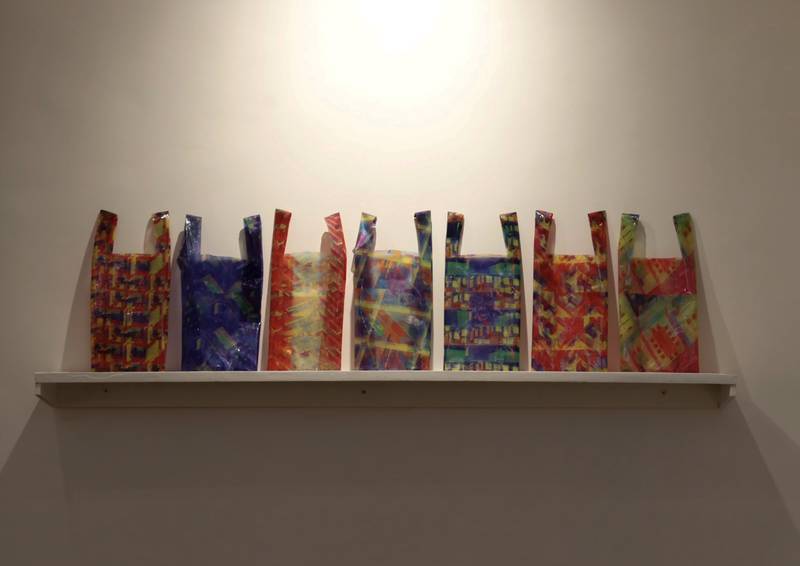
Aspiration as Hope, is Bogus
In Aspiration as Hope, Is Bogus, plastic bags with images of empty corporate offices carry a different kind of promise. How do your experiences in an alternative art space and in corporate employment meet in that work?
I began in an alternative art space as an intern and, much later, became its director. We aspired to change things through art. During MeToo in India, there were warnings and attempts to address issues. Attempting for that change went bogus and we suffered the repercussions.
Post pandemic, I worked at Tata Consultancy Services as an artist. In the corporate world, there is internal politics and hierarchy to maintain, and often no resistance, and I understand why: families need breadwinners too. This is where the hope of creating change can become bogus.
Plastic works the same way. Our hope for a plastic-free world remains, but it isn’t going away, and neither are corporate offices. The empty offices are printed on seven everyday shopping bags, one for each day, because the office comes home with you. They are empty on purpose. Perhaps all the employees have gone to protest. Because in protests I have not seen corporate employees in numbers large enough to empty their offices. Aspiration requires active agency, which I did not see much of in either space.
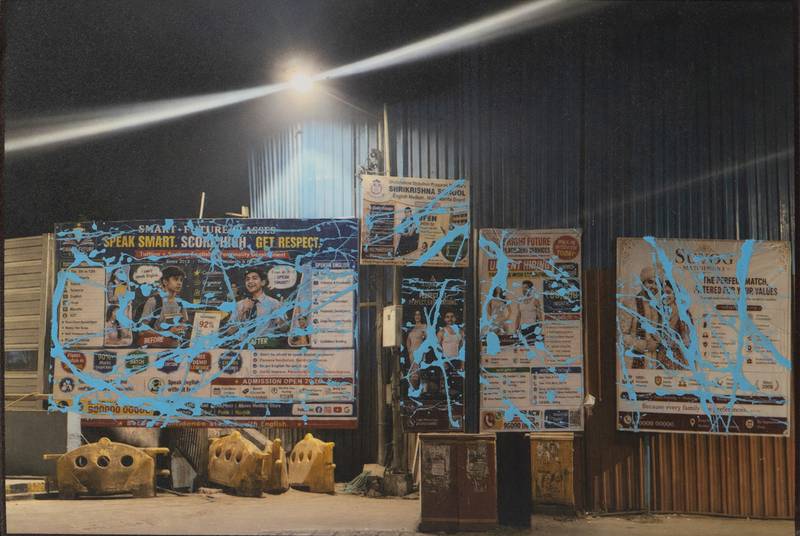
From the series, Pichkari Gang
The aspiration and hope you describe also circulate in public space as imagery, and they appear in Pichkari Gang too. What interests you in the promises printed across the city?
For seven or eight years, wherever I travelled in Bombay, I documented banners and posters in public spaces. They carry messages and hollow promises that never materialise. I am interested in what these images say and what unfolds around them. Some are advertisements that lure people into greed. Some display pseudo-support. Some objectify women and make it feel normal, right under our noses. And some are propaganda that fills the pockets of capitalists.
Addressing this was challenging. Then I looked at paan pichkaris, (betel-leaf spits) that stain walls across the city being normalised. That turned into the inspiration, as satire: if that is ordinary, why not paint over the facade of capitalism, propaganda and the state with a pichkari of our own?
You have assisted artists, used workshops and vendors, and worked with interns. Where does the artwork begin or end when its production depends on so many people?
As an art student, I assisted artists who, as it appeared to me, made everything themselves in their studios. Over time I realised that this was not the whole truth. Many more people are involved in production, and it also means negotiating time, resources and budgets.
Within the hierarchy, we are asked to give meaning to what we do in a rational way. But how rational can we be?
When you work with people, you listen to them. I also draw on the aesthetics of chance to let the particular event of making, shape the outcome. That makes interesting results possible.
An artwork begins when the artist formulates an idea, and it ends when the artist believes it has landed as intended. But whether it is one artist or several people behind it, the cost is always paid by the bodies that do the labour. Crediting people is a small part of production if it is made possible with their help.
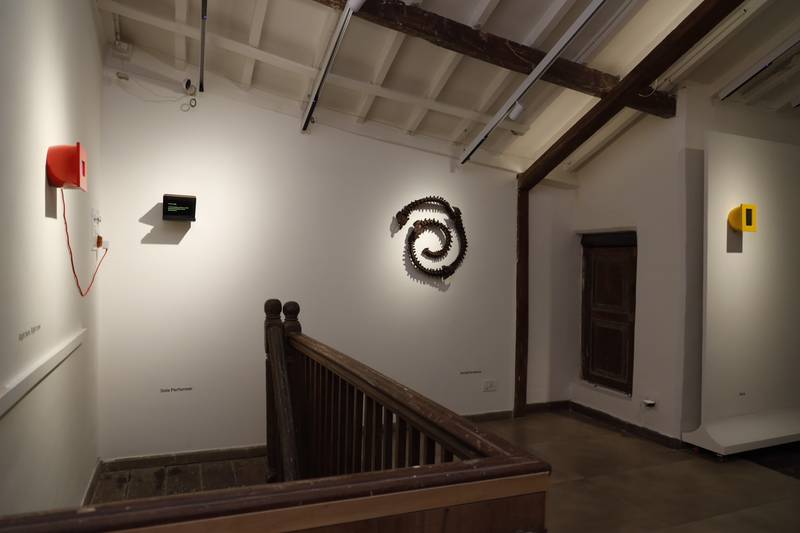
Installation view of Yogesh Barve’s Tayen Tayen Fish, 2026 at Art and Charlie Gallery, Mumbai
That question becomes sharper with internships. Art schools and institutions increasingly make unpaid experience part of professional training. How do you reconcile learning and friendship with the need to pay people for their labour?
During my first month as an intern, I received some amount. Post that, I received nothing. But I learned immensely. I came from a Marathi-medium education. I gradually overcame my fear of conversing in a language that had previously felt foreign to me and started consuming and speaking in broken English. Now, the people who work with me are my peers. I learn from them, and they learn from me. That exchange matters.
You can’t measure a value system in currency. What I learned, I still carry. What I earned is gone. Just like the title of the show, Tayen Tayen Fish.
It’s also tricky because interns arrive with their own skills. What they usually lack is an understanding of the structure we are in, and how it evolves and functions. Sharing that reality does no harm. It exposes something hollow about the systems we are trying to deal with. Transparency is important.
Sometimes, friendships can make it harder to refuse unpaid work. But the problem is taking that relationship for granted and exploiting your own friend. Avoid being pretentious; maybe lower your guard and be vulnerable. Share where you come from and what you are going through, and maybe that becomes a starting point for being transparent.
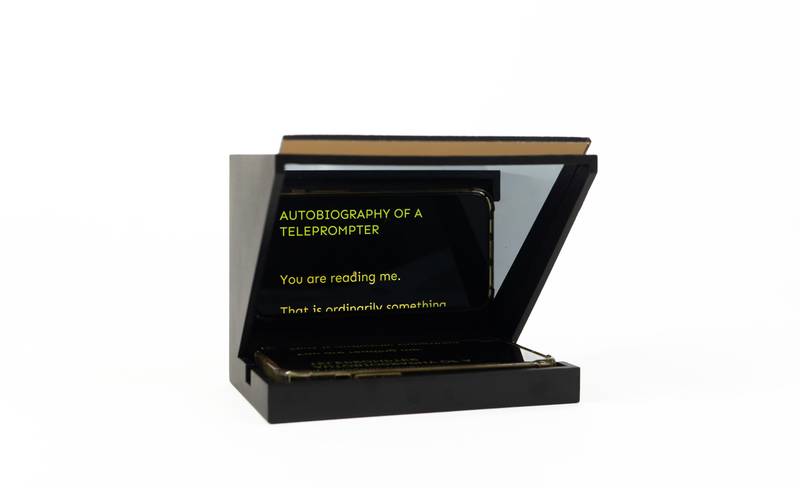
Solo performer. Photo by Kundan Shanbhag
You worked with Saviya on the exhibition text. Why invite someone who knows your practice closely rather than ask for a conventional curatorial explanation?
I wanted someone who knew me personally and had seen my practice grow. From around May, Saviya and I were in constant conversation about my overall thoughts, the different works, and how they developed. She was also a critic throughout, and we did not always agree. The text came from the emotions and processes, not simply descriptions of artworks. We decided not to use heavy academic language; I wanted people to be able to enter the exhibition. The text also questions the work and does not explain everything. It’s a very specific text, meant to stimulate viewers to position themselves in the reality we are part of.
Saviya, your text begins with human hunger and the things we consume without acknowledging. How did your long familiarity with Yogesh shape the writing?
SAVIYA: I have been a direct witness to his work ethic, his observations, and the ideas that failed or never made it to an audience. But familiarity does not mean I am here to offer uncritical praise. We have been in an ongoing conversation for so long. The writing naturally evolved into a mix of testimony and an open query rather than a standard essay or report. It functions as a supporting written document. It intentionally positions his work within the broader discourse his practice seeks to engage. It’s not a fond overview.
We never really know who or where our audiences come from. Human hunger is something we can recognise, although we experience it differently. I wanted readers to be able to ask questions. And importantly, I wanted my voice to stand distinct. When a woman writes about a male friend, her work is too easily misread through the intimacy of that relationship rather than judged on its own.
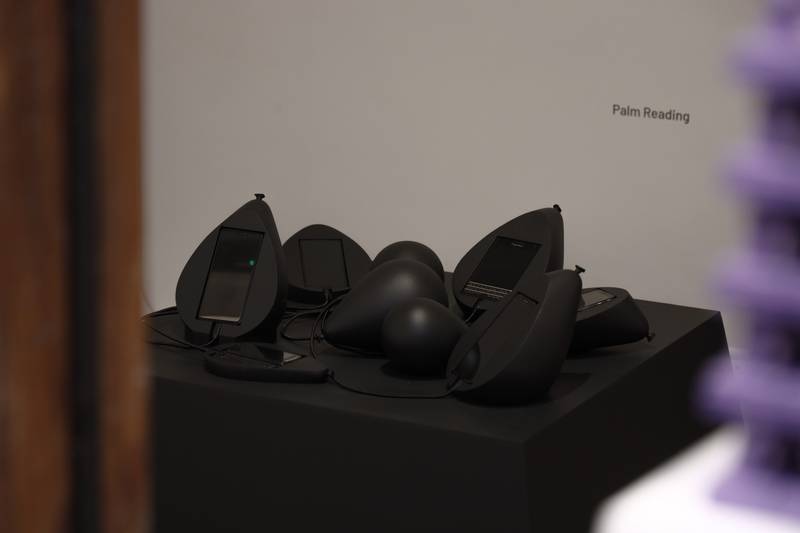
Palm Reading.
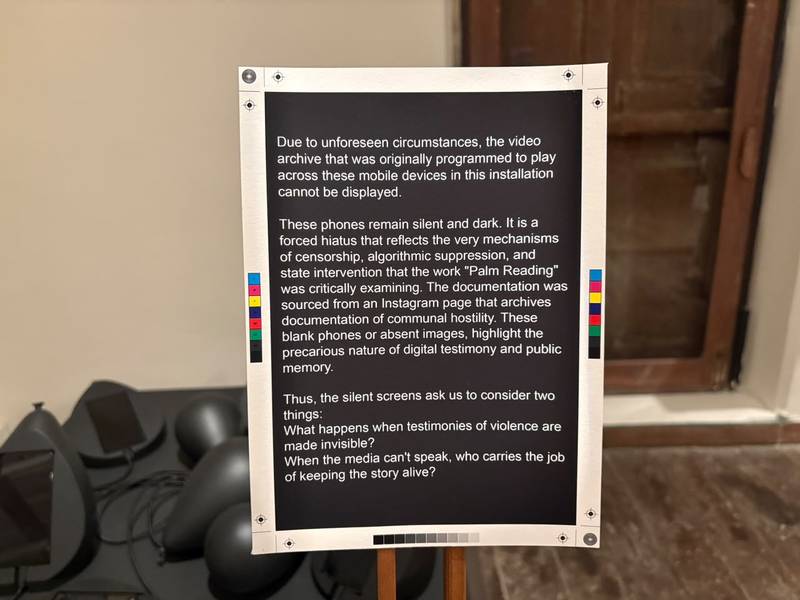
Notice during the installation of Palm Reading
You were also a critic during production. Was there a work on which your disagreement remained unresolved?
SAVIYA: We debated many ideas during production. So, much of my criticism happened then. But I had serious concerns about the work, “Palm Reading”. The installation had found-footage of videos and images that were too violent to rewitness. We do not know who will encounter a work, or what it might bring back for them. A viewer crying does not tell us whether the response is coming from empathy or sympathy. I did not want the work to be presented without thinking through that position.
And when the videos are no longer accessible, another problem emerges: who controls what can be seen?
SAVIYA: Exactly! What happens when the media is stopped? How do we access information? It reflects the very mechanisms of censorship, algorithmic suppression and intervention that the work spoke about. It is pretty much the precarious nature of digital testimony within public memory.
You have observed the humor in his practice. Does the laughter conceal difficult feelings, or does it enable a different kind of confrontation?
SAVIYA: Of course it does. He has used satire in his thesis work too. I have seen women around us using humour to deal with serious experiences, partly because direct confrontation has consequences. Humour can lead to a simple question: why did you laugh? There is nothing funny about what is being discussed. But the laugh opens a conversation, and sometimes people may become defensive because their ego is being questioned. It’s also the paradox that has existed in Yogesh’s practice along with the irony of such conversations. But the emotional labour behind it all makes these questions much harder.
Finally, what remains unresolved for you after bringing these works together?
Visual art is connected to reality, but it is also somehow detached from it. Everyone may be giving a hundred percent, but that is still not enough. Where is the change? We are still struggling for the basic right to protest. People are dead due to systemic failures. How do we deal with this? I have no answer. And there is no accountability. That gap remains.
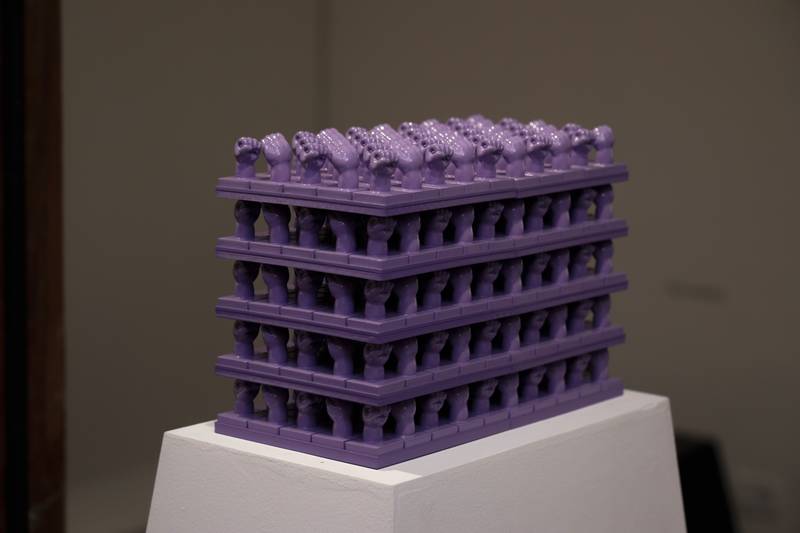
Primal Instinct. Photo by Kundan Shanbhag
Considering the gap, what drew you to organize the discussion on Dr.Anand Teltumbde’s Iconoclast and then screening of “Namathu Chinnam?”, along with a panel discussion on the film. Did you see these events as extending the exhibition’s concerns or opening up questions the artworks could not fully address?
Filling that gap is important. Work that is critical and creative at the same time can come across as superficial to an audience, so I wanted to ground the exhibition. I invited Dr. Anand Teltumbde, in conversation with the history researcher Sandesh Awdan, to discuss his book Iconoclast: A Reflective Biography of Dr Babasaheb Ambedkar. It took serious preparation.
For me, it is important to talk about Ambedkar as he was, in flesh and blood, and not the iconised version that people have made for their own profit. Teltumbde spoke at length about Ambedkar, drawing on his research, and about why a biography like this is needed: so that future generations can understand where things failed and learn from it.
I was drawn to the film “Namathu Chinnam?”(Our Symbol is?) due to its subject. It looks at how dominant castes appropriate cultural symbols in parts of Tamil Nadu, and how those symbols were contested and used in the campaigns around the 2024 general elections. Even though the film is set in Tamil Nadu, for me it felt like something happening in all the states.
When I saw it, I could easily relate it to many works in the exhibition. The thinking behind both events was to build a better understanding of where the artworks come from, and to address caste hierarchy from every angle: creatively, critically, satirically, academically, culturally and politically. I see them as extending the exhibition’s concerns, and as opening up questions the works cannot answer alone. It is one interconnected system, and it has to be addressed from every side. The event worked well in the exhibition. It felt like an extension of it.
All images in the interview are courtesy of Art and Charlie Gallery, unless specified.
-
 READ
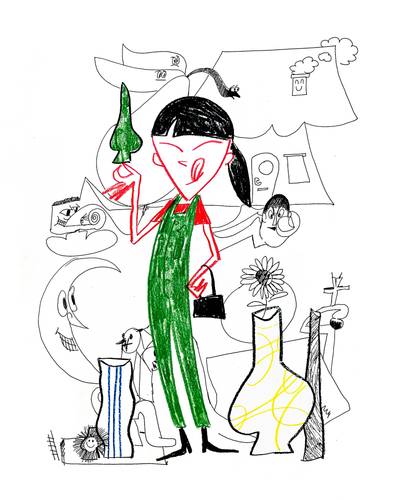
Craftsmanship that leaves a polished finishing and evocative historical notions hidden underneath the fine details. Man Yau’s work with ceramic installations arrests the viewer, while encouraging to revisit and contemplate the uncanny contemporaneity that the artworks embody. In this interview, we discuss artistic processes, practices and labour as well as the intertwining of the personal and the thematic in Yau’s two exhibitions from the spring 2021: M.Y. Chinoiserie at Kuvan Kevät, Exhibition Laboratory, and Dried flowers last forever at Boy Konsthall.
On “The Feeling of Being on Display and Under Pressure” — a Conversation With Man Yau
-
 READ
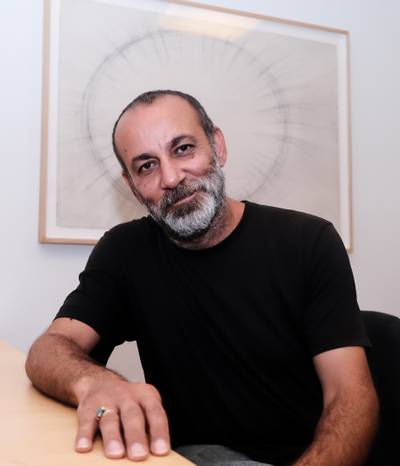
Hiwa is interested in research, participatory working, and collective action, but he is also interested in making it, for lack of a better word, fun. Previously written texts and press articles on Hiwa have called him an “extellectual”, someone who gains knowledge from ‘the streets’, through conversations and the exchange of books. Despite the risk of repeating pre-published information, I find it critically important for the sake of reading the following interview to point out that the qualities of humour and satire—to neither take oneself too seriously nor wallow in the miseries of the world—occupy a central position in Hiwa’s work.
On Recognising the Moment of Hope: Speaking in Echoes With Hiwa K.
-
 READ
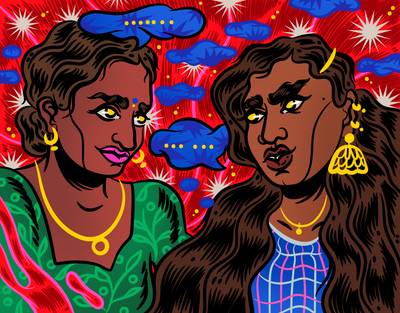
Abinaya and Vanessa reflect on their experiences in the Tamil community and discuss the pressure to represent Tamilness for non-Tamil audiences. Abinaya discusses her work with Tamil Guardian, which sought to combat Sri Lankan government propaganda and elevate the voice of the Eelam Tamil polity. Vanessa discusses her role in editing Tamil Futures, a creative arts magazine aimed at the global Tamil community, which prioritized creative archiving and documenting underrepresented histories.
Writing Tamilness: Perspectives From Tamil Futures and Tamil Guardian
-
 READ
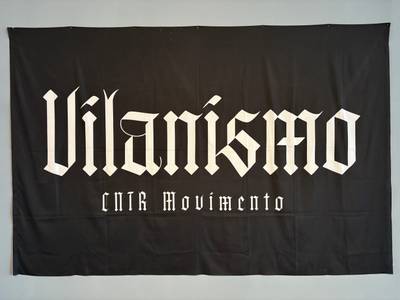
Everyone in Vilanismo is someone I met and grew close to within the contemporary art circuit. Some even earlier, through graffiti, like Robson, or São Paulo’s pixação scene. The idea was to understand how their practices could move forward collectively, while also allowing me to be part of that vehicle, amplifying one another. So the starting point was affection and mutual admiration.
Vilanismo: An Ethics of Care and a Philosophical Framework Emerging from Afro-Paulistano Culture