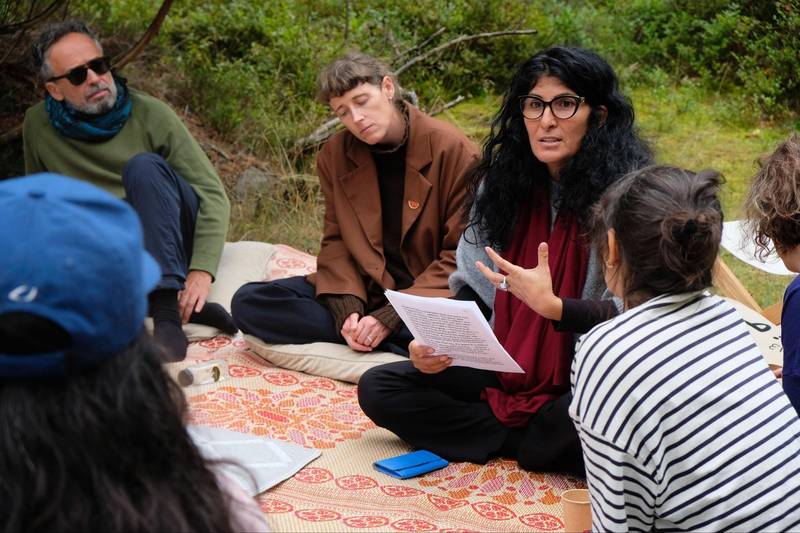
Sandi Hilal. Photo: Negar Latifian
Reyhaneh Mirjahani is an artist working at the intersection of visual art, curating, artistic research, organizing, and publishing, focusing on participatory art. She uses collaborative, interdisciplinary approaches to create dialogic spaces exploring agency, participation, counter-narratives, and spatial politics.
My connection to Sandi Hilal’s practice began in 2021, when a planned written contribution to an exhibition turned into a recorded conversation. That moment revealed something essential about her practice, and it introduced me to her method of approaching ideas through dialogue, relation, and lived experience.
From the beginning, I was struck by how she grounds her ideas. Although long engaged with academic and institutional contexts, Sandi does not present concepts as detached abstractions. She speaks from situations she knows intimately: her upbringing in Beit Sahour, her work in Palestine, and her encounters with communities in Sweden, Italy, and other contexts in which she lived. Political frameworks become tangible through personal anecdotes: a living room in Palestine, a yellow house in Boden, conversations under the tree, a burning facade in Sicily, a summer house in the Stockholm Archipelago. Since then, in our conversations, she returns again and again to questions of hospitality, displacement, care, and the right to inhabit space on one’s own terms. For her, the living room, the threshold, and the shared table are not metaphors but actual political sites where power, vulnerability, and collective life can be reimagined.
This interview grows out of that ongoing process of working, thinking, and speaking together. While it takes the form of questions and answers on the page, in reality, it unfolded as a dialogue: her narratives of Palestine, her frameworks of hospitality and self-determination, and her reflections on Sweden intertwined with my own questions, concerns, and the shared struggles I see myself as part of. What follows is a trace of themes central to her practice and the questions that have shaped my own engagement with them: how to build forms of togetherness in contexts marked by displacement, how to understand hospitality as something more than kindness, and how architecture can become a tool for collective imagination.1
In Palestine, this question is almost absurd because hosting is a necessity, not a choice. When the state apparatus is designed to crush you, when public space is militarised, your living room becomes your parliament, your kitchen becomes your commons. There, hospitality took form through residencies: opening our home, our terrace, turning private space into a common space of discourse.
REYHANEH: Our conversations have often circled around the relation between generosity, power, and commoning, and I feel that this has also been the ground for much of our collaboration. When we worked together in Bergsjön on Al-Madafa, I came to understand how you approach hospitality not simply as something private or domestic, but as a political practice that touches on belonging, agency, and as you specify it recently, self-determination. What struck me in that process was that hospitality was never only about welcoming others, but about asking: who has the right to host, and under what conditions? In Sweden, where there are already established structures and institutions for everything, hospitality can feel like a symbolic gesture of inclusion – but in your work, it became something far more radical, connected to questions of survival, collective life, and the possibility to decide one’s own place in the world. I would like to start there: what does hospitality mean in your practice?
SANDI: Your question touches on something fundamental that has shaped my entire approach to working in Sweden. In Palestine, this question is almost absurd because hosting is a necessity, not a choice. When the state apparatus is designed to crush you, when public space is militarised, your living room becomes your parliament, your kitchen becomes your commons. There, hospitality took form through residencies: opening our home, our terrace, turning private space into a common space of discourse.
But in Sweden, where the state creates the illusion that everything is under control through what can be described as “bureaucratic care” along with integration courses and language classes, the act of hosting suddenly becomes subversive in a completely different way. Then it feels natural to follow the rules, because the state already provides. But this has a particular form of violence, a stripping away of political agency that is almost invisible because it comes wrapped in care. Specific people remain in the position of guest, which also means in the position of passivity.
Architecturally, hospitality has always been central to our practice, not only conceptually, but also spatially. In Sweden, I began with my own living room, designing it with carpets and pillows embroidered with Arabic words. Later, we created Living Rooms in museums and public institutions, experimenting with thresholds between private and public, between the host and the guest.
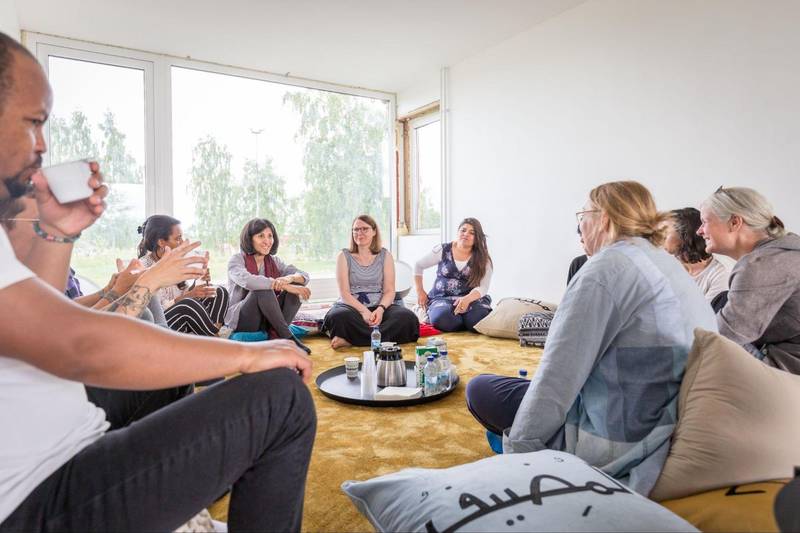
Al Madhafah/The Living Room, Boden, 2018, Photo by Andreas Fernandez
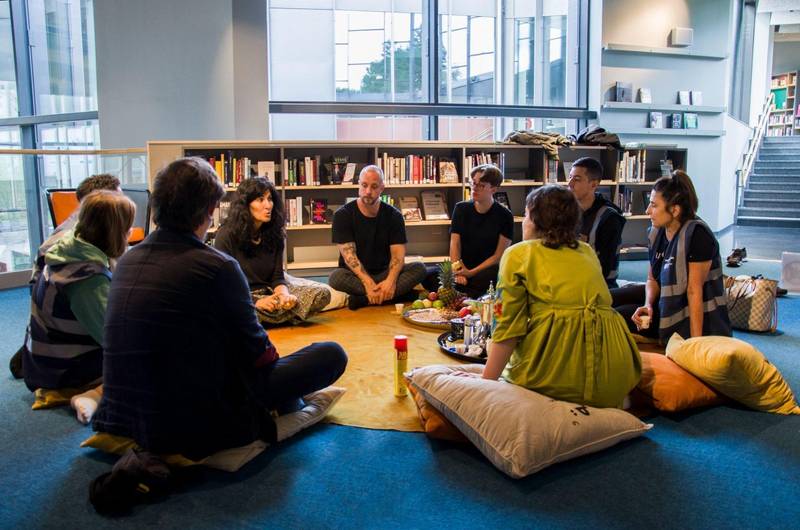
Al Madhafah/The Living Room, Bergsjön Kulturhuset, Gothenburg, 2022, Photo by Reyhaneh Mirjahani
This architectural dimension you mention – moving from your own living room to institutional spaces – seems crucial. It was one of the driving forces in Al-Madafa, wasn’t it? Even in Bergsjön, I felt that the work was less about staging an artwork and more about creating conditions for people to step into the role of host.
In 2018, shortly after moving to Sweden, I was commissioned by the Public Art Agency to do a project in northern Sweden, in Boden. What I discovered there was that many refugees had been reduced to what I call “professional guests.” They were constantly being hosted – by the state, by well-meaning organisations, by integration programmes – but never given the chance to host back.
When we opened Al-Madafa, we weren’t just creating a space for people to gather. We were insisting on the right of people who had been categorised as “in need” to become agents of welcome themselves. Yasmeen and Ibrahim, who live in the area, took on the role of hosts. For me, that was radical – to let go of driving the process, to allow others to embody hosting. It also meant that I myself had to become a guest. The elderly Palestinian women who began hosting tea ceremonies there weren’t just sharing their culture – they were claiming political space. They were saying: “I decide who enters, how we gather, what we discuss.” The same happened in Bergsjön, and other places where the living room got activated.
Inclusion is often presented as generosity, but it is always framed by the host — by the institution, the state, the majority. It says: “You are welcome, but on my terms.” Here, speaking about the right to host is central. It is about practising belonging on your own terms.
I remember how the space shifted in Bergsjön, when a teenage boy took over whilst we went for lunch, and after we came back, although he didn’t know us, he welcomed us amongst others and became the host. Same as when Yasmeen and Ibrahim began hosting, it was no longer about you facilitating an encounter – it became their living room, their rules. I also saw how that challenged the conventional idea of “inclusion,” where institutions invite people in but keep the frame intact. Here, the frame itself was being redefined by those who hosted.
Yes, exactly. Inclusion is often presented as generosity, but it is always framed by the host — by the institution, the state, the majority. It says: “You are welcome, but on my terms.” Here, speaking about the right to host is central. It is about practising belonging on your own terms. What happens in Al-Madafa is something different. When Yasmeen and Ibrahim hosted, they weren’t simply being included into someone else’s frame. They were establishing their own. That is why I often say that hospitality, in this sense, is not about being nice. It is about self-determination. It is the possibility of saying: I am not only a guest in your narrative; I am the one who decides how we gather, how we speak, how we belong.
This connection between hospitality and self-determination is fascinating, especially how you trace it from Palestine to Sweden. You’ve often connected this to your memories of Palestine, of the living rooms that became classrooms, of communities creating parallel structures when official ones were closed down. For me, that connection is very powerful: to see hospitality as commoning, as building spaces together in the absence or even in defiance of state structures. This resonates with my own experience in Iran, where our access to and mobilising in public spaces are limited by the state, so we turn to private spaces and common them. In Tehran, I’ve been part of book clubs, gatherings, and self-organised spaces that don’t necessarily work under the terms of charity, but facilitate space for commoning and resisting. But I’m curious about this distinction you make between individual and collective self-determination. How does this play out specifically in your work in Sweden?
When I speak about hospitality in Sweden, I cannot separate it from the question of self-determination. In Arabic, the phrase is ḥaqq taqrīr al-maṣīr (حق تقرير المصير). It is usually translated as “the right to self-determination,” but in Arabic it means something more: the right to decide your becoming. And in Arabic, the self is never only the individual. Ḥaqq taqrīr al-maṣīr is always collective. It is about how we decide our becoming: where we live, how we live, what values we hold, what futures we imagine.
In Palestine, this right has always been tied to colonialism, and often confused with the right to resist. Of course, the two intersect. Resistance is often the condition for deciding your own becoming. But they are not the same. The right to self-determination is not only about resistance; it is about building, shaping, deciding life together.
This collective understanding of self-determination clearly shapes how you approach commoning. DAAR has a long history of working with commoning, and in many ways also of commoning the private. What interests me in your work is how it moves in and out – inside and outside museums, inside and outside institutions. The form changes, but the core stays: hospitality as a practice. And now, in the Summer House, hospitality seems to be folding into something else: into commoning, into the politics of redistribution.
For me, this shift raises questions. In Palestine, commoning appeared almost organic, inherited, embedded in everyday life. But in Sweden, with its highly organised public systems and rigid social codes, commoning had to be re-imagined. I think about Boden – how the project was commissioned as a public artwork but then after three years of activation by locals shut down by the Migration Office, before later being acquired by Moderna Museet. That contradiction revealed the limits of the so-called public. I remember you telling me about your exhaustion with this myth of the public in Sweden. And from there, you turned towards the private – specifically, the summer house as an iconic, almost romanticised Swedish space. By moving there, you did so not to privatise further, but to explore how the private itself might be commoned, how it could become a place for reclaiming hosting and exercising agency.
The real turning point was Boden. In Palestine, we were always clearly the hosts. There was no question about it: we opened spaces of commoning, and we held them. Looking back, I see that this came from confidence – maybe also from necessity. We could not afford to step back from hosting. But it also left me exhausted. When we left Palestine, I carried that exhaustion with me, even if I had not yet conceptualised it.
In Boden, I did not have the energy to be the strong host anymore. And I realised I didn’t want to approach the project in the way socially engaged art is often expected to be – planned, directed, orchestrated. You control everything, make sure the audience comes, sits in the right place, behaves correctly. But that is exactly what I wanted to escape from. So when Yasmeen and Ibrahim took over, I let them. In fact, I was never really the host in Boden. From the very beginning, Yasmeen claimed that role. I entered as a guest, and that was radical for me.
Living through that reversal made something else possible. It opened the way toward the Summer House. I began to wonder whether there could be a space where the line between host and guest was softer, where these roles could move rather than cling to one person. This question felt especially charged in the context of a summer house, which in Sweden is often treated as an emblem of rootedness and belonging. Could a piece of forest allow us to move beyond those roles, even temporarily? That was my hope: that the Summer House could become a place where people arrive without invitation, where they narrate their own stories of belonging, and where agency circulates instead of being concentrated in the figure of the host.
But that is a challenge. We discussed together different ways of commoning the space, such as distributing the keys, amongst other possibilities. For example, a community of women from Tensta – who even left their coffee machines and plates in the house – still expected me to be there as the host when they wanted to visit. It was as if they could not enter the space without me carrying that role.
But then, in moments, something shifted. Like during our first public event at the summer house in the last week of August – the first day I felt like I was being a guest, and I could even feel the familiar exhaustion of hosting in you. But the second day, things flowed differently. We were all moving together, and the roles of host and guest blurred. For me, that was a glimpse of what commoning might mean in practice: not a fixed distribution of roles, but a shared holding of space. It felt closer to neighbouring – a form of being together that goes beyond the performance of hospitality, and includes the sometimes more difficult work of living side by side.
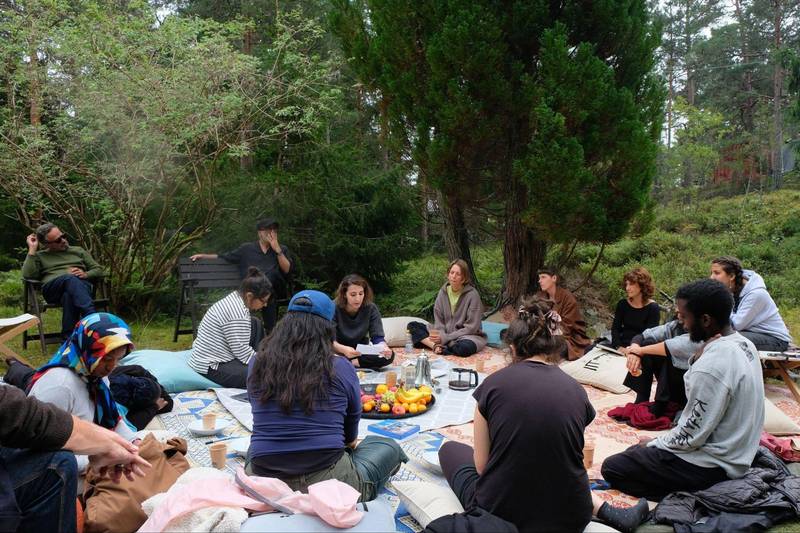
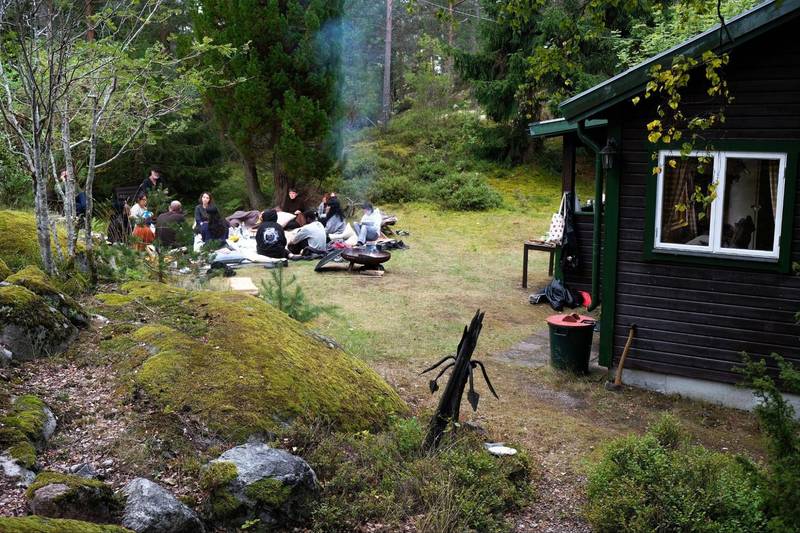
The Right to Host: Commoning the Private - August 2025 co-curated by DAAR, Hosting Lands (Dea Antonsen, Ida Bencke and Aziza Harmel), and Reyhaneh Mirjahani. Photo: Negar Latifian
This idea of neighbouring as something beyond performance really strikes me. There’s something about the Summer House that seems to embody this – not trying to fit into prescribed roles, but continuing from what exists and allowing new stories to emerge. What I also realised through our work together is how much personal story played a role in this shift. Each of us brought our own stories to the Summer House during those discussions. During the shared talk I had there with Aziza Harmel, we tried to share what that space meant to us, how we could relate to the summer house, and what tensions, desires, or doubts it evoked. By voicing these stories aloud, we each claimed a form of ownership – not of the property itself, but of the narrative surrounding it. In that moment, the Summer House stopped being “your” house. It became layered with multiple narratives, overlapping and sometimes contradictory, but still coexisting. In that sense, storytelling itself became a kind of hosting.
Absolutely. Architecture and narrative are inseparable. For a space to become common, people must be able to inscribe their own stories into it. Narration is its own form of ownership. In Islamic cities, for example, there was the “right of precedence” (حق السبق): you could not erase what came before you, but you could add your voice, your story, and negotiate space with your neighbours. That, for me, is the foundation of commoning: not erasing, not subsuming, but multiplying narratives.
That is a different kind of ownership: not about possession, but about narration. If you sit in the Summer House and tell your story – how you relate to it, what questions it raises for you – then you are already hosting. You are already shaping the meaning of the place. The summer house became a shared journey for agency to be distributed differently. That, to me, is the deepest form of commoning: not just opening space, but redistributing power so that others can host, organise, decide, and narrate. In this way, the Summer House extends the trajectory of the Living Rooms. It shows that hospitality can evolve: from hosting to neighbouring, from private to common, from one story to many.
-
 READ
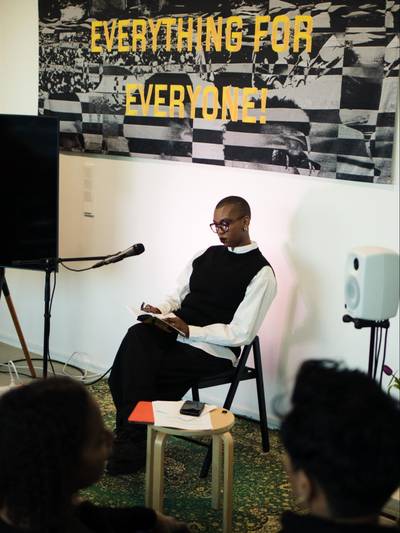
READI think of how many people are not able to be involved in social movements because of their own disability or their caring responsibilities, or the way that forms of social violence take away their capacity, or their ability to fight that social violence, because they’re simply trying to stay alive.
Dreaming of Liberation: An Interview with Lola Olufemi
-
 READ
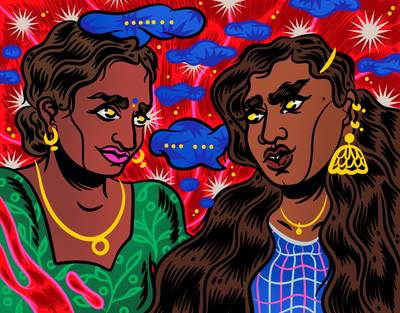
READAbinaya and Vanessa reflect on their experiences in the Tamil community and discuss the pressure to represent Tamilness for non-Tamil audiences. Abinaya discusses her work with Tamil Guardian, which sought to combat Sri Lankan government propaganda and elevate the voice of the Eelam Tamil polity. Vanessa discusses her role in editing Tamil Futures, a creative arts magazine aimed at the global Tamil community, which prioritized creative archiving and documenting underrepresented histories.
Writing Tamilness: Perspectives From Tamil Futures and Tamil Guardian
-
 READ
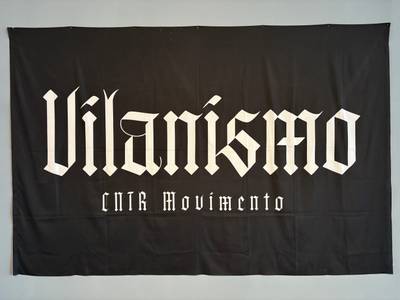
READEveryone in Vilanismo is someone I met and grew close to within the contemporary art circuit. Some even earlier, through graffiti, like Robson, or São Paulo’s pixação scene. The idea was to understand how their practices could move forward collectively, while also allowing me to be part of that vehicle, amplifying one another. So the starting point was affection and mutual admiration.
Vilanismo: An Ethics of Care and a Philosophical Framework Emerging from Afro-Paulistano Culture
-
 READ
READCraftsmanship that leaves a polished finishing and evocative historical notions hidden underneath the fine details. Man Yau’s work with ceramic installations arrests the viewer, while encouraging to revisit and contemplate the uncanny contemporaneity that the artworks embody. In this interview, we discuss artistic processes, practices and labour as well as the intertwining of the personal and the thematic in Yau’s two exhibitions from the spring 2021: M.Y. Chinoiserie at Kuvan Kevät, Exhibition Laboratory, and Dried flowers last forever at Boy Konsthall.
On “The Feeling of Being on Display and Under Pressure” — a Conversation With Man Yau