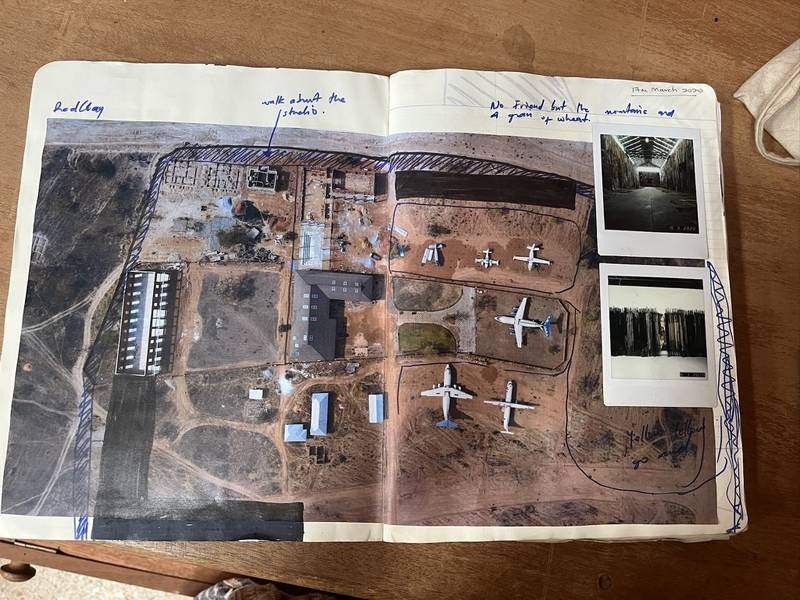
Aerial view of Red Clay in Ibrahim Mahama’s notebook, on display at Red Clay.
Mawadah Nofal is an Egyptian curator, writer, and multi-disciplinary artist working on contemporary art from Africa and the Arab world, cultural practice, and institutional critique. Her writing has appeared in Dazed MENA, Kohllective, Rusted Radishes, and ICON MENA, among others.
Five airplanes sit on red soil at the edge of Tamale, Ghana. Train carriages, speed boats, and vintage cars are scattered across a red and green terrain. Goats and chickens wander in from neighboring farms and occasionally drift through exhibition halls. When I first arrived at Red Clay, I felt small against the scale of it all. The land stretches wide with red earth, and the works rise monumentally against it. Red Clay resists easy categorization. Founded by artist Ibrahim Mahama, it is at once a studio, archive, exhibition space, school, community center, and home. Driven by the ambition of creating an art infrastructure within Tamale and the wider region, Red Clay is fundamentally an experiment in new infrastructures. Alongside its sister institution, the Savannah Centre for Contemporary Art (SCCA), it forms one of the few contemporary art platforms in Ghana’s northern region.
Before coming to Tamale for a month-long residency at Red Clay, I had been immersed in museum discourse in the West. In graduate school for visual and museum anthropology, we were trained to critique institutions, their colonial genealogies, their architectures of authority, and their funding structures. Over time, however, I began to feel that the institution had contained and absorbed critique itself. The structures invite critique so long as it does not threaten their own continuity; after all, the master’s tools will never dismantle the master’s house. So when it came down to conversations about decolonizing or reimagining institutions, it felt to me that, both within academia and outside it, artists, curators, and writers have spent so much time theorizing about their limitations that imagination has been rehearsed endlessly yet never materialized, not as a failure of the industry but as a result of its very design.
I began to wonder what it would mean to stop refining critique and to start building something outside of it. What would it mean to move towards modest ruptures? I was (and possibly will always be) hungry to be somewhere where critique felt like the first step of a rearchitecting instead of the final resolve, and somewhere to lay ground for new modalities and ways of relating to art, knowledge, and each other.
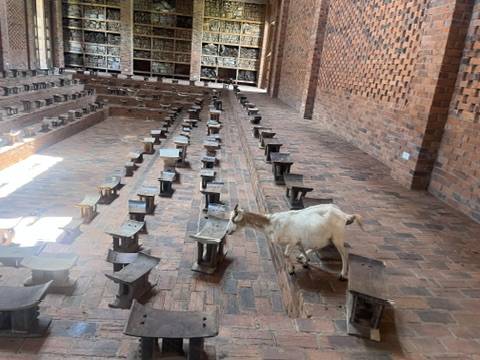
Ibrahim Mahama’s Parliament of Ghosts. Photo: Mawadah Nofal.
One afternoon, I sat on one of the chairs from a work titled Parliament of Ghosts, watching visitors move through its wooden benches that were organized in a “parliament” order. The chairs are decades old and brought in from households all over the country—they were once signifiers of stature and patriarchal power within the home. Children ran between rows. A goat climbed onto a chair. Nothing was cordoned off. Nothing was too precious to touch. Mahama told me, “It’s all about repair. If a chair breaks, we repair it and we don’t cover up the trace. The object becomes something new as part of its natural life.” The ghosts are remembered and made visible but also make space for new gatherings and new arrangements. The ghosts are invitations to use historical objects to bring new life. Where the Western ethnographic museum sends objects to die on vitrines, Red Clay invites visitors, human and non-human, to engage, play, and build—giving the objects a second life. Additionally, the studio challenges totalizing narratives of history, and many of the works and displays act as nexuses for historical strands, resisting single historical authorship.
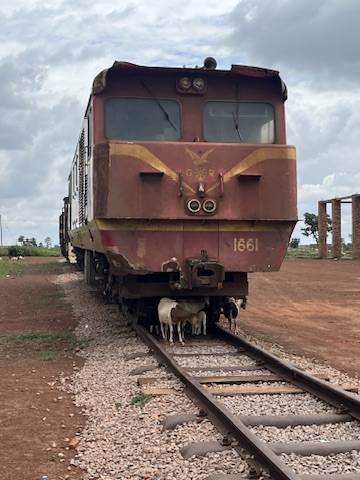
A locomotive rehomed in Tamale, where goats from neighboring farms shelter under the carriages. Photo: Mawadah Nofal.
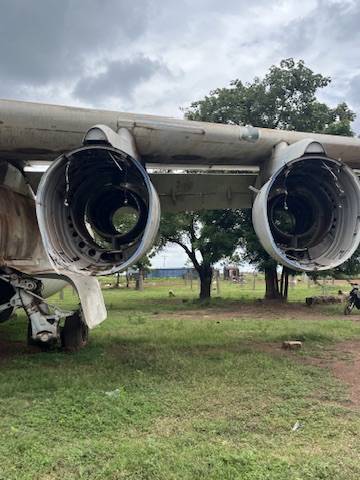
An airplane resting on the grass at Red Clay. Photo: Mawadah Nofal.
Much of the work of the studio focuses on themes of labor, production, and colonial history, speaking directly to the history of Tamale. Between 1898 and 1918, the rail network the British built across the Gold Coast, from Sekondi to Tarkwa, Kumasi, and Accra, was laid to move gold and cocoa to ports, and it was never connected to the northern region of Ghana. While the trains did not go to the north, the labor behind them was almost entirely from the north. Colonial administrators treated the northern region as a labor reserve, explicitly and by policy: engineering underdevelopment, keeping schooling sparse, and withholding infrastructure investment, on the calculation that a literate, developed northern population would migrate south less readily and threaten their labor stock. Recruitment for railway work was frequently forced, and mining companies fought colonial administrators over access to the same laborers, treating the men as an extractable resource. Among many other reclaimed structures, Red Clay works with train seats, railway sleepers, airplanes, old cars, sewing machines, and more, pulled from the south and rehomed in Tamale, gesturing to a more expansive form of restitution taking place. Mahama spent years tracking down the trains and navigating the bureaucracy of acquiring them, convinced of the importance of highlighting Tamale’s labor history and that art can bring about new ways of relating to it. Red Clay is repeatedly asking itself, what is the agency and role of artists and cultural practitioners in times of crises? What does it mean to work with, not just about, the conditions of our times? And can art and cultural practice give rise to a particular agency in navigating these conditions?
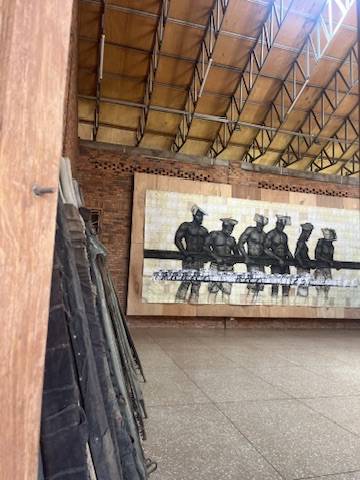
Installation view of Ghana Mann (2023–24) by Ibrahim Mahama at Red Clay. Photo: Mawadah Nofal.
For many local visitors, this experience is their first time stepping inside a train. I often found families walking through compartments or children climbing across the metal frames. What was once the infrastructure of extraction becomes, here, a site of encounter. The trains are not just a spectacle or even an instance of material restitution, but their presence in space extends beyond that. They gesture not only towards making violent and extractive histories visible but also towards breathing new life into these objects and allowing for an infrastructure of repair. This is intrinsically tied to Mahama’s work; for example, the space’s permanent collection includes the artist’s My Dear Comfort and Ghana Mann, large-scale charcoal drawings depicting laborers carrying the machinery into the space in 2023. The labor that was once made invisible is now made central. Often, Red Clay hosts classes or workshops inside the trains, and Mahama told me he hopes to one day convert some of the carriages into short-term free boarding for visiting artists or students. Similarly, one of the airplanes has been converted into a classroom where children are taught technical skills such as how to use PCs and write code. Old structures are repurposed to generate new social space and new understandings of the role of art in our social lives. Instead of sanitizing and adhering to industry standards of conservation, the structures are used in ways that do not alienate the people who live around them and instead become usable and valuable additions to their lives.
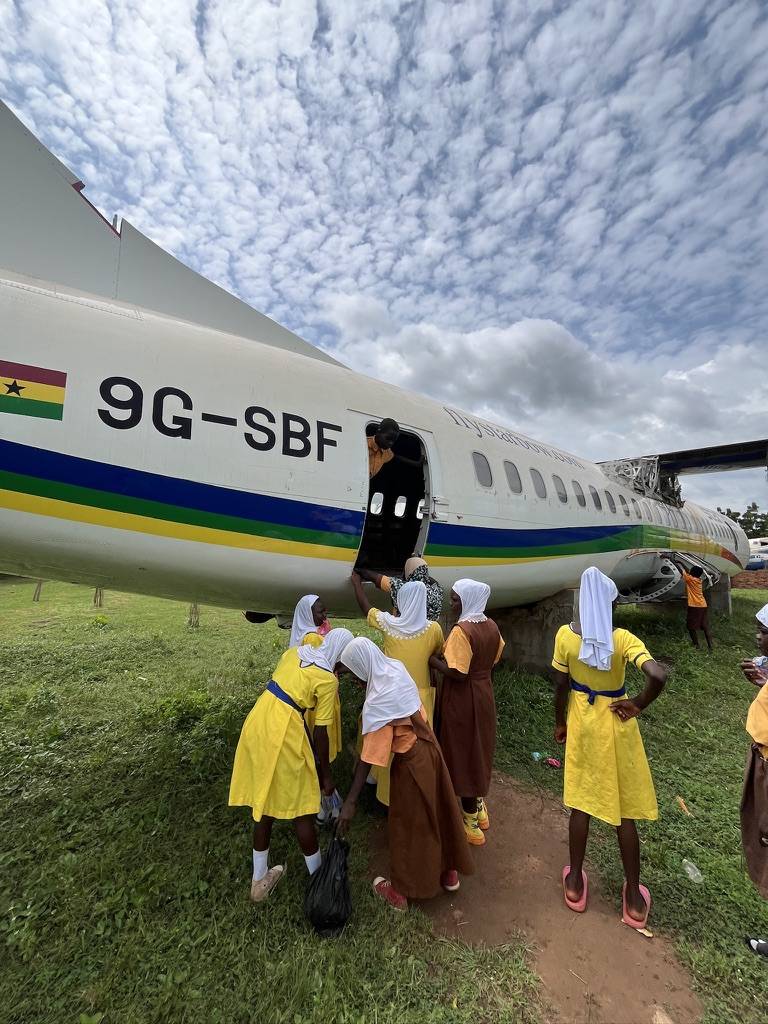
A school group at one of Red Clay’s airplanes, where old structures become sites of play and learning. Photo: Mawadah Nofal.
At Red Clay, repair illuminates histories of labor, colonialism, and migration while simultaneously building conditions and skills to support new possibilities. I spent much of my residency with Selom Kudjie, artistic director of both Red Clay and SCCA, who prompted me to think of these activities not as expressions of philanthropy or as isolated from the role of art, but to ask how art and its interventions can work with old and new material to build, immediately and tangibly, the better worlds we theorize about. These activities are attempts both to find ways to engage audiences who have no exposure to contemporary art and to use contemporary art as a means of world making. This curatorial approach does not think around the economic, infrastructural, or other difficulties in the region but rather uses the conditions of life as the driving force in doing the work.
Throughout the month I spent there, staff from all levels of the institution expressed to me how they felt personally invested in sustaining the space, despite the many financial dry seasons. Employees often went a month or two without salaries, corners had to be cut when it came to exhibitions, and it was nearly impossible to plan anything even a week in advance due to the unpredictability of cash flow.
It was striking how naturally children occupied the space. They hid beneath trains, greeted staff by first name, and hosted birthday parties in the yard. When schools are invited for workshops, Red Clay covers transport and snacks and even brings programming directly to them. Children are at the heart of Red Clay, which understands that there is no future without nourishing them—their imaginations, their joy, their education, and their relationship to the world. This ethos permeates the space, standing in quiet opposition to the sterile, rule-bound institutions I had grown accustomed to that often exclude children and young people altogether or view their participation as peripheral. Red Clay remains open to visitors of all kinds, and however the community chooses to inhabit the space, it becomes part of the institution’s practice: children playing, meals cooked and shared, trees planted, or people learning critical life skills inside airplanes. Rather than importing the “don’t touch, don’t make a sound” of the white cube, Red Clay is a multigenerational space for play, intellectual encounter, and lingering in a city scarce in third spaces.
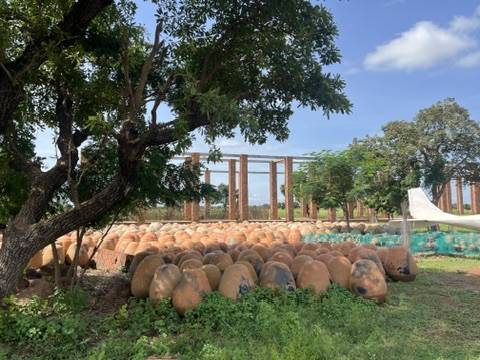
Artwork by Ibrahim Mahama. Photo: Mawadah Nofal.
Simultaneously, my time at Red Clay also revealed to me the precarity of such structures. It quickly became obvious to me how insecure it is to want to build something on the continent that doesn’t rely on foreign investment and that is committed to all of these values. The space is entirely financially sustained through the sales of Mahama’s works and commissions abroad, and it has committed to not charging even for hiring the space, meaning it often finds itself in a dry season. It is a model that refuses the usual dependencies of the sector, the grant cycles, the donor priorities, and the reporting frameworks that so often shape what an institution is to become. Yet it carries its own dependency. The institution’s survival is tied to one artist’s market and to the pace at which international buyers (usually other institutions) and commissioners choose to pay.
Moreover, I witnessed people make a great deal of personal sacrifice for the space. Throughout the month I spent there, staff from all levels of the institution expressed to me how they felt personally invested in sustaining the space, despite the many financial dry seasons. Employees often went a month or two without salaries, corners had to be cut when it came to exhibitions, and it was nearly impossible to plan anything even a week in advance due to the unpredictability of cash flow. I couldn’t help but hear the histories of labor echoing through space: the northern hands that once built so much of the country’s infrastructure and were forgotten by history and the hands that now labor to build better ways of living and knowing. The art world runs on many hands, most of them unnamed. At Red Clay, the people doing that work were not only sustaining the institution but also showing me what it means to have an absolute conviction that a place needs to exist and how to act accordingly, while holding and working through the many contradictions of the space. I was also forced to confront my own discomfort with the unpredictability of the space; it was tricky to understand where the boundaries of anything lay or how to plan for anything, and everyone’s emotional stakes were high. To most of the staff, Red Clay is their life. The mere idea of working specified hours or weekends made many of them chuckle when I would ask, and their responsibilities were porous and often extended yards beyond what one would expect. Additionally, because so many of the staff consider the work of the institution an extension of their own creative practices, the work is both precious and fragile. And although the space is in many ways committed to a non-hierarchical structure, much of the institution’s money comes in directly through Mahama’s work or connections, complicating the democracy of its decision-making processes.
The lines between personal life and work at Red Clay were not just blurred but nonexistent, and I came to see that as both its generosity and its risk. Beyond being an art space, it is the home and studio of Mahama, and that home is extended regularly to all sorts of visitors by the artist and his wife, the food researcher and chef Khadija Iddi Yusuf. Khadija, known warmly as Chef Dee, develops recipes that use only local produce, hosts immersive food experiences at Red Clay, and makes sure every guest is fed. During one of my first days in Tamale, she walked me through the fields around the exhibition halls and showed me the hundreds of trees they had newly planted, from baobab to mango to shea. This, too, is central to Red Clay: working with the land rather than against it or merely from it, as a quiet refusal of the extractive relationship that had been imposed on the region for so long. Just across the road is Chef Dee’s own small farm, with more trees meant to supply a restaurant she dreams of opening. Trees take years to bear fruit. To plant them is to act on a future the institution cannot yet guarantee, and I could not separate that faith from the dry seasons I had watched the staff absorb. It is both what makes Red Clay feel so alive and what makes it feel so exposed. Everyone at Red Clay is part of an ecology, planting and tending to the dreams, desires, and cultural and structural needs of the space it occupies. There is an invaluable trust in the fertility of the land and a commitment to tending it to bring something better tomorrow.
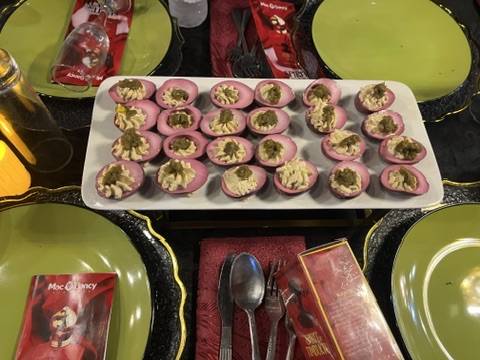
Dinner by Chef Dee at Red Clay, where every guest is fed. Photo: Mawadah Nofal.
Perhaps something else lay in my discomfort that I hadn’t reflected on earlier: so much of the problem with the institutions we center is that they refuse to be porous, are inflexible, and assume a certainty around themselves. I was used to a certainty, or at least a performance of it. At Red Clay, staff had told me different iterations of “There is no reason for Red Clay to be able to exist, but here we are.” I now know it is an honest answer to the question I arrived with: what does it look like to move towards modest ruptures? At Red Clay, I learned that a rupture is rarely clean and rarely easy and that often the break and the repair happen together, with the trace left visible.
-
 READ
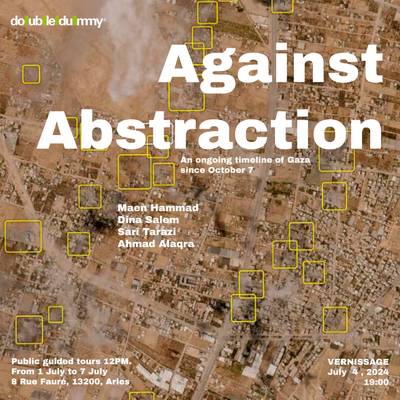
An activation by Palestinian artists Maen Hammad, Dina Salem, Sari Tarazi, and Ahmad Alaqra was hosted at DoubleDummy, Arles, between July 1-7, 2024, during the opening week of the Rencontres d’Arles. It conveys a timeline of the ongoing genocide in Gaza using information shared via alternative messaging platforms like Telegram.
Radical Re-imagining of Visual Order Amid the Ongoing Genocide of Palestinians: A Review of ‘Against Abstraction’
-
 READ
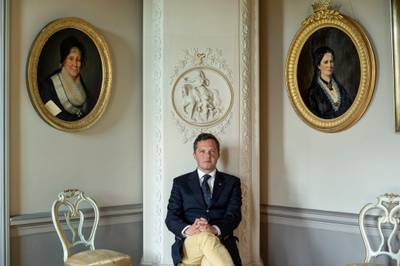
The wealthy are equated with such minorities as if being wealthy were a specific cultural phenomenon or even an identity based on a form of discrimination. Veering through notions of whether wealth improves mental well-being or is taboo in Finnish society, Eetu Viren peruses the exhibition’s banality and ridiculousness to expound on questions of wealth and power and why the Finnish National Museum hosted an exhibition that characterizes the wealthy as a “minority group.”
The Poor Rich People: A Review of ‘The Philosophy of Wealth’
-
 READ
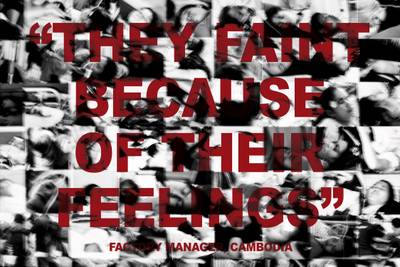
If the problems that individuals face in their personal lives are rooted in systemic issues, then it is unrealistic to expect them to find lasting solutions solely through individual self-improvement efforts. Individual change is not simply a matter of personal effort but is also shaped by the broader social conditions that individuals find themselves in. Abril’s work highlights this hypocrisy of the oppressor in a perverted patriarchal society in which women are blamed and ridiculed for showing symptoms of distress—Mass Hysteria.
Our Bodies Protest on Our Behalf: A Review of ‘Laia Abril – On Mass Hysteria’
-
 READ
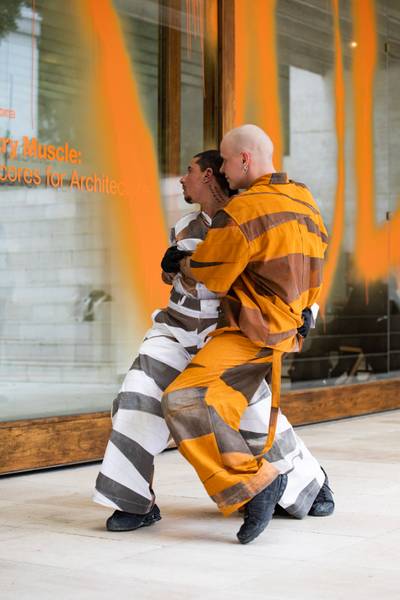
There is no universal ‘the’ trans body. Where does this article ‘the’ come from and what does it do? To us it seems that to look at something through the lens of ‘the trans body’ is claiming to know something that is situated in some imagined universal trans body – ultimately projecting one’s own body as that universal human in the trans context; the same universal human that the work claims to critically dismantle. White, non-disabled, thin, masculine and middle-class.
The Trans Body in Venice: A Critique of Universalising Transness