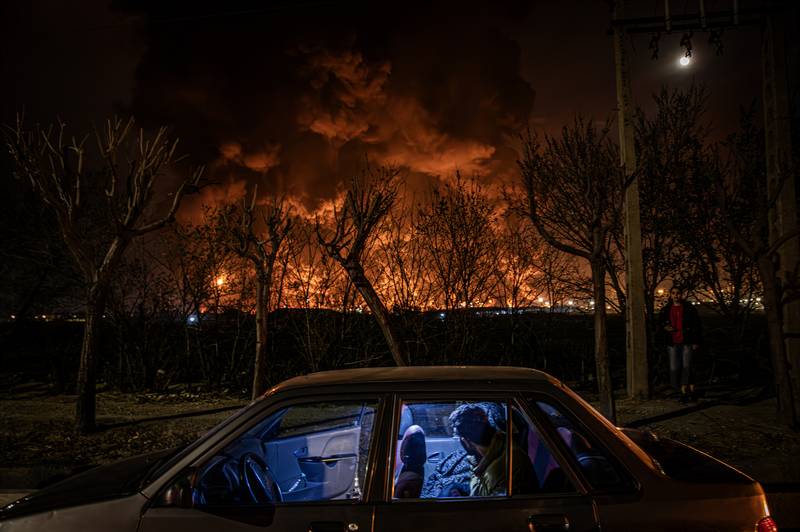
Photographed on the night of March 7, 2026, when US and Israeli strikes targeted oil storage facilities in Tehran and Karaj. Oil tanks burned for hours, sending thick columns of smoke into the sky. Toxic pollutants spread through the air, settle on the soil, and threaten the health of those living nearby. The consequences extend far beyond the immediate destruction, affecting the environment, energy supplies, and everyday life. Photo by Erfan Kouchari
Sahand Saadatmandi is a writer and translater based in Tehran, Iran
سهند سعادتمندی نویسنده و مترجم ساکن تهران، ایران است
On my computer, there is a folder called “War.” It holds the photographs I have published over the past nine months. When the United States and Israel launched their war of aggression on Iran on February 28, for the second time in a year, international internet access was cut off. Local news outlets, which I usually turn to only when the internet is shut down, became my sole source of news. In those circumstances, photography became one of the most direct and honest ways to follow the war: a way of seeing what was happening on the ground, beyond the analyses and competing narratives surrounding it. The photographs brought me face to face with the war itself.
A few days later, after struggling to get around Iran’s internet restrictions, I began sharing photographs from my War folder alongside the texts I posted on social media: plumes of smoke rising from explosions, half-destroyed apartment buildings, injured civilians, and the tireless work of Red Crescent and civil defence workers. These images showed what was happening more powerfully than I could express in words.
When the situation began to settle somewhat, I started looking up the photographers behind the images I had collected. One name kept appearing: Erfan Kouchari1. He seemed to know where to position himself and which moments to capture without turning people’s suffering or scenes of atrocity into images for easy consumption. When I began following him on Instagram, I realized there was more to his work than the courage required to operate independently in a war zone. His photographs offered more than a record of events: they told a story of the suffering and resistance of the Iranian people, bearing witness to their lives as they unfolded under fire.
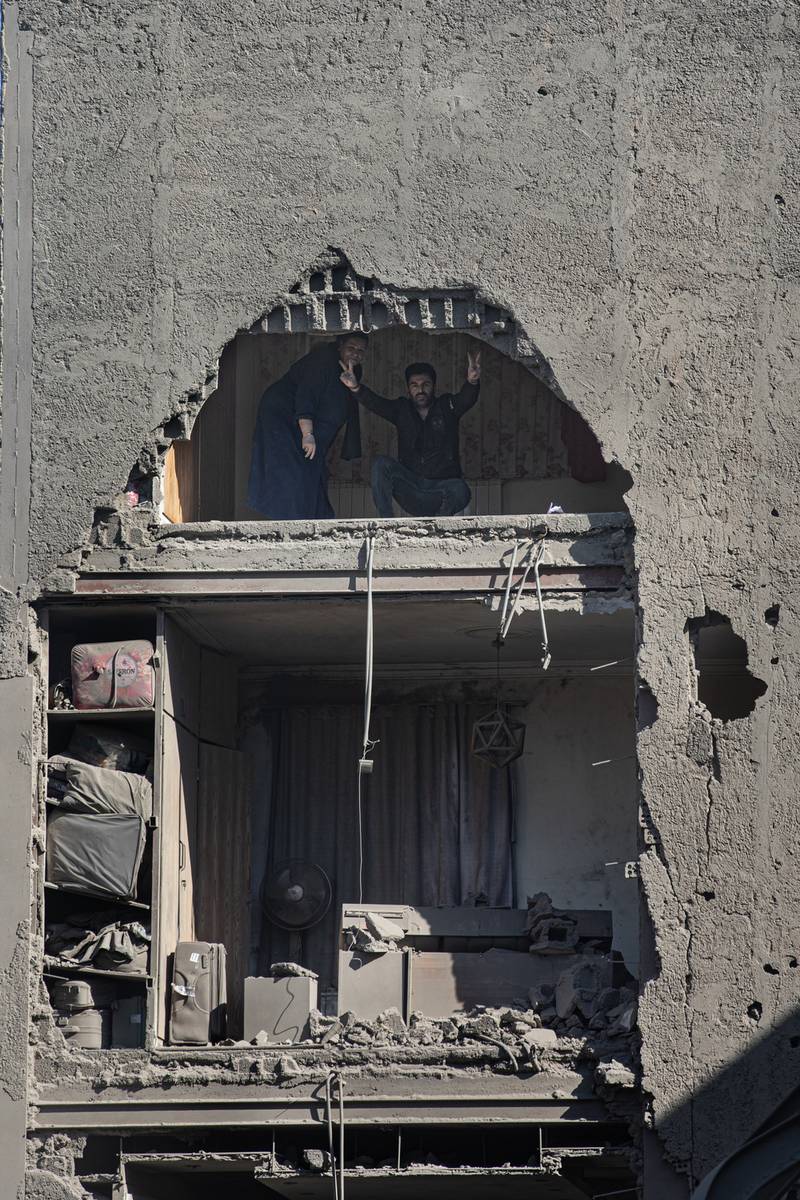
Police Station No. 5, Zanjan Street, Tehran, 8 March. Photo by Erfan Kouchari
SAHAND SAADATMANDI: Before we turn to the war, I’d like to ask about your path into photography. How did you move from mechanical engineering to photojournalism?
ERFAN KOUCHARI: My father was interested in photography, and he taught me the basics, things like shutter speed and aperture. I developed an interest of my own, but I didn’t have a camera. In 2012, I asked my father to buy me one. Money was tight, but he bought me a Canon 500D anyway. Until then, I’d been a good student with high grades. After I got the camera, I was put on academic probation for two consecutive semesters. Everyone said I was either addicted or in love. The truth was, I’d fallen in love—with photography.
Gradually, I found my way into photojournalism. I worked with several news agencies over the following years, and for about a year now I’ve been working independently.
Your photographs often do more than document a news event. In some, the way you look at people and situations seems to carry something beyond the record itself. How would you describe your approach to photography?
I don’t consider my photography art. I see myself more as a good operator than an artist, though others may see it differently. What matters to me is knowing what I’m photographing and why. I don’t simply arrive at the scene of an event, take a few pictures and leave. The subject matters enormously to me: how people appear within the frame and how we choose to present them to an audience.
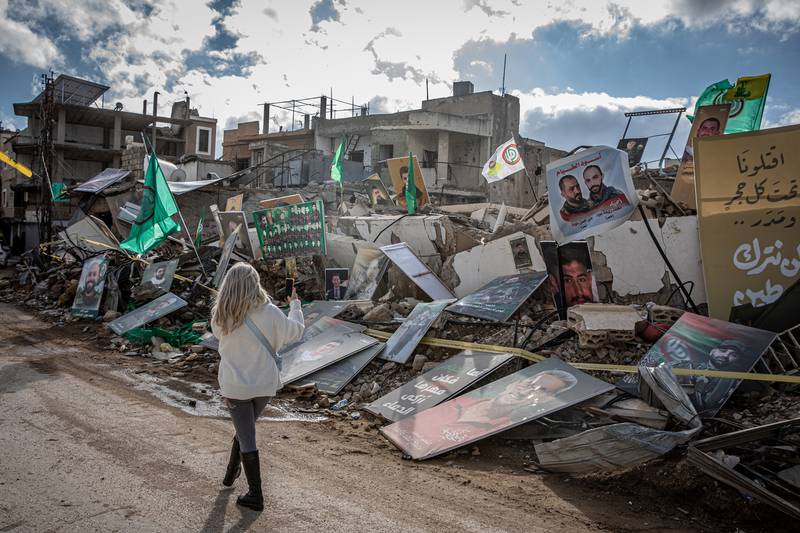
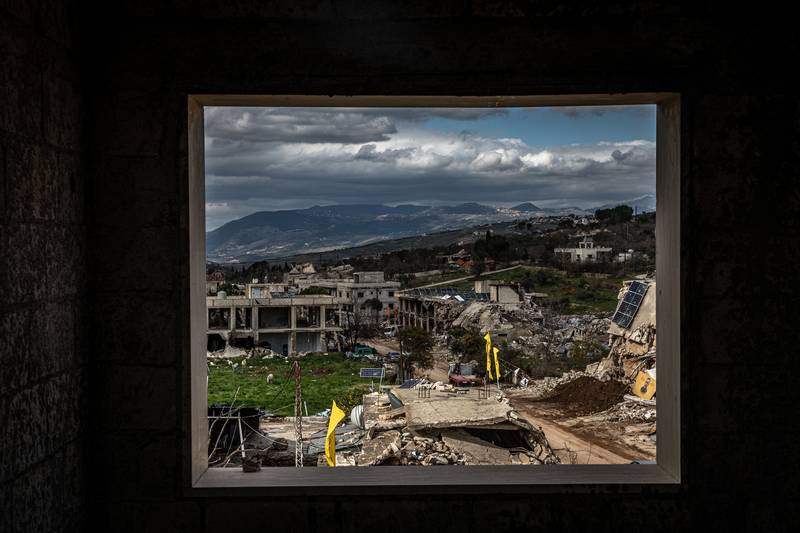
Views of the destruction in the Lebanese border villages of Kfar Kila and Khiam following Israeli airstrikes and a ground offensive. After the ceasefire, some residents returned to their homes. Photo by Erfan Kouchari
In No Way Out, you documented the forty days of the war that began on February 28: from the first hour, when you rushed to your children’s school to bring them to safety, through the aftermath of some of the most severe bombings, to accompanying members of the Iranian Red Crescent on their rescue missions. Two roles are at work in the project: the photographer responsible for documenting the war and the civilian caught up in it, worried about his family’s safety. When did these roles come into conflict? And what happens to the idea of bearing witness when the photographer is also part of the catastrophe?
Kaveh Rostamkhani, an essayist and media critic, wrote the project’s title and text. We’re close, and we influence each other; he also knew what I was going through. We tried to convey my situation in a way that would draw the audience in. The truth is that I was a father and a husband, as well as a photographer.
In the first few days of the war, I slept for only five or six hours over three or four days. I was either looking at photographs, taking pictures or checking the news to find out which places had been hit. We had never experienced anything like this before. Our home was in eastern Tehran, an area that was repeatedly targeted. Whenever I heard a fighter jet or news of an explosion, I worried about my family. Eventually, I asked my wife to take the children to my parents’ home in Qazvin. After I dropped them off and returned, I slept for eight hours for the first time in days.
I had a similar experience during the twelve-day war. I was at Shohada Square when my wife called, her voice trembling, and asked if I was safe. I could hear the children screaming in the background. We got on a motorcycle and headed home. There was smoke rising near our house. Even so, I first went to the site of the attack on a police headquarters, then returned to my children.
On the final day of the war, I went to work first. Afterwards, I hugged the children and made a safer place for them. I have a photograph from that moment: they are sitting on a bunk bed, and I have arranged things around them to protect them from broken glass.
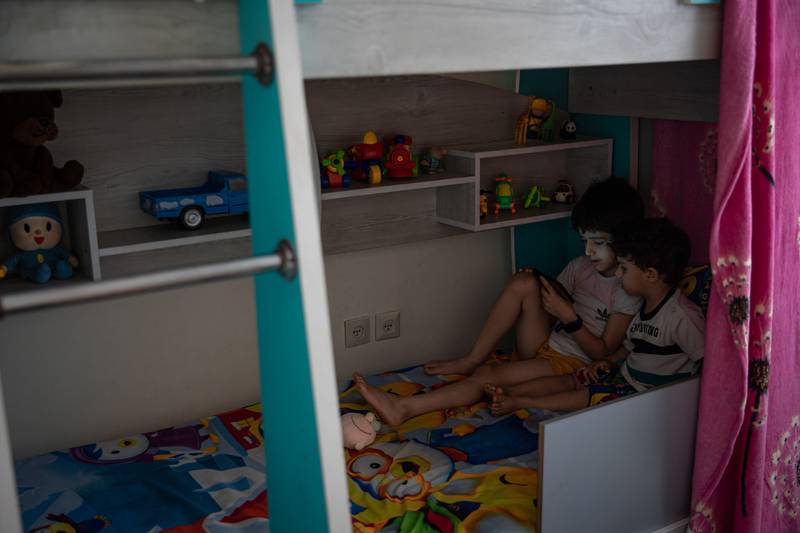
On the final day of the war, I went to work first. Afterwards, I hugged the children and made a safer place for them. Photo by Erfan Kouchari
You once described arriving at the site of the bombing near Niloofar Square before emergency responders had reached it. Instead of taking photographs, you went to help the injured. How do you negotiate the tension between your responsibility as a human being and your duty as a war photographer?
Human life comes first. If I see someone who needs help and I can do something that might save their life, I would rather help, whether or not they are my compatriots. I’m an Iranian Muslim photographer, and my first priority is Iranians in Iran, followed by Muslims outside Iran, then the oppressed around the world, and humanity as a whole. I think everyone should have such priorities, provided they still have some humanity in them and haven’t become genocidaires.
Of course, every situation is different. Someone may be injured, but whether I take a photograph may have no bearing on their survival. In that case, I might decide differently. But if my help could genuinely save a life, I can’t keep my camera in my hands just because I am a photographer.
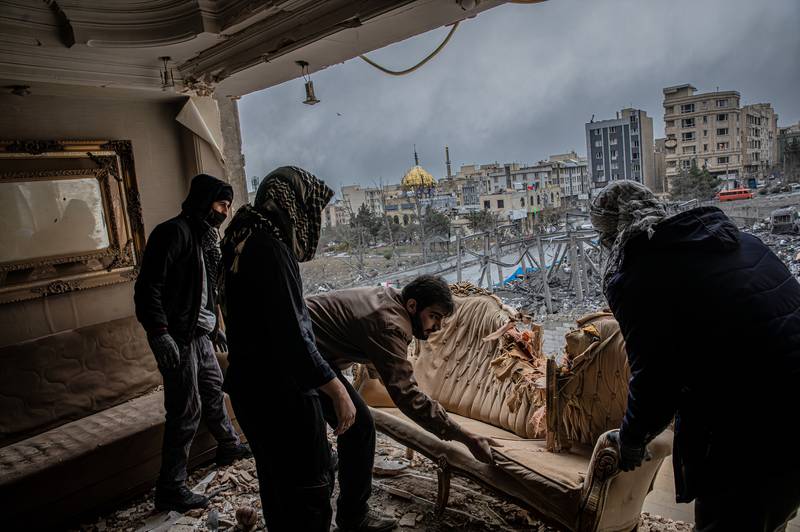
The tale of imperial aggression and the wound on the flesh of my people. 10.03.2026. Photo by Erfan Kouchari
A photographer has a camera and the ability to publish an image. The person being photographed may be experiencing one of the worst moments of their life—grieving a loss, suffering an injury or standing amid the ruins of their home. This asymmetry creates a power relationship. Where do you draw the ethical line? And how much weight do you give to a subject’s consent when they are in the middle of a crisis?
I still don’t have a definitive answer. We’re not accustomed to being injured, standing among ruins or losing people we love, so no single answer fits every situation.
In a society sensitive about privacy and dress, a photographer has to take those concerns seriously. Sometimes you must enter someone’s home. I try to gauge consent through eye contact, but it’s complicated: if you ask permission, you may miss the moment; if you don’t, you may later doubt whether the person agreed. I ask myself whether I would want someone to photograph and publish images of me, or of someone close to me, in that situation.
It was God’s will that I took the photographs at Niloofar Square. They mattered because, at the time, Western propaganda insisted that ordinary people were not being harmed by the war, and the photographs showed that civilians had been killed and injured too. The ethical line is a fine one. At the scene, a woman challenged me and asked why I was taking photographs. I told her I was documenting a crime. Later, I photographed her as well.
Not every situation ended that way. Near Resalat Highway, a building owner refused me entry. In Tehranpars, I saw a man sitting on a balcony beneath a brightly coloured umbrella, everything around him grey and devastated, the scene almost surreal. I asked his permission. He wanted to know where the photographs would be used, said he would not allow IRIB or other local outlets to publish them, and agreed once he learned I did not work for one. By then the moment had passed, and the photograph was not what I had imagined.
I don’t always make the right decision. Occasionally I miss a photograph; at other times, I question later whether I was right to publish it.
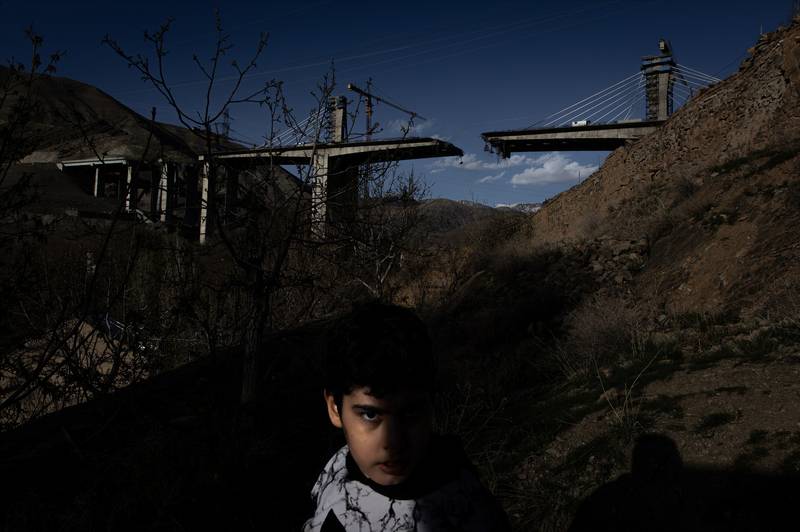
The unfinished B1 bridge in Karaj, one of the tallest in the Middle East, was struck in two waves of US-Israeli attacks on 2 April 2026. At least eight civilians were killed and more than 100 injured. They had gathered beneath the bridge to celebrate Nature Day, the final day of Nowruz. Photo by Erfan Kouchari
I want to distinguish between producing breaking news and bearing witness to a war. Breaking news responds to a specific event, but a photograph can endure in public memory and help people understand what happened years later. How do you decide what to photograph and what to publish? Do you also consider a picture’s potential to become a historical record?
Photojournalism is generally considered a branch of documentary photography, so a news photograph is a form of testimony, whether or not the photographer intends it. I don’t believe in neutrality; it is impossible. You can photograph a scene from one angle and make it look beautiful, or from another and draw attention to something else. What I record depends on my lived experience, my perspective and what I want to show.
A photographer has to manage themselves in the moment, making decisions and taking pictures despite the adrenaline, stress and excitement. Even after twelve or thirteen years covering numerous crises, my legs would shake whenever I prepared to leave home during the war. Sometimes I didn’t even feel motivated to go out. My wife would tell me to get up and go to work; someone might have been hurt.
Ultimately, photographs form part of a larger narrative. When I arrive somewhere, I see it as one piece of a puzzle I may later present as a series or a book. You can’t show only suffering or only resistance; you have to photograph different aspects of what happened. A single photograph may be powerful and serve as future evidence, but I tend to think in terms of a series, and I’m careful about which photographs I select and how I sequence them.
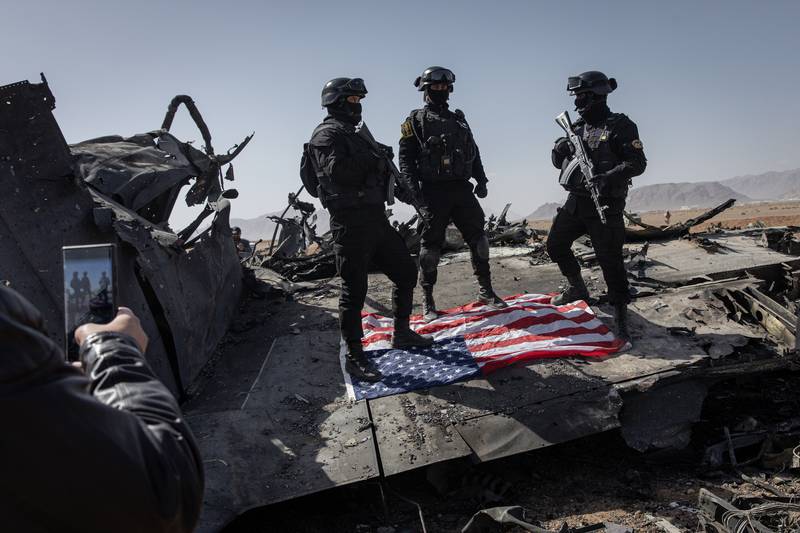
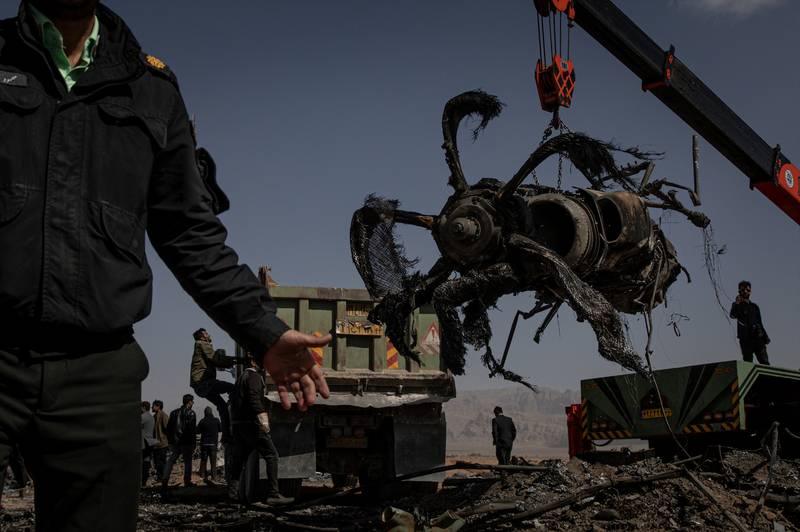
Following the failed U.S.-Israeli operation in Shahreza County on April 5, U.S. forces destroyed their own aircraft and helicopters in friendly-fire strikes before withdrawing from Iran. The wreckage was later collected for a museum commemorating what became known in Iran as “Tabas Operation 2.” Photo by Erfan Kouchari
I’d like to dwell on the difference between documenting suffering and documenting resistance. In visual narratives of war, people can become symbols of victimhood, as though Muslim subjects must continually display their suffering to Western audiences before their experiences are considered legitimate. Resistance, too, can be reduced to familiar images and clichés. How do you avoid these two traps?
It depends on a person’s lived experience and what they want to achieve through photography. I’ve lived here, experienced what has happened and consider myself personally implicated in it. My priority is to show my people’s resistance, not their suffering. I believe that people are resisting an aggressor, a hollow superpower that imagines it has the right to rule the world, and that resistance needs to be seen.
That doesn’t mean I refuse to show suffering. Sometimes I photograph situations an audience can relate to more readily so that people can connect with what Iranians are experiencing. Someone who has never lived through what we have may struggle to understand our resistance, but they may recognize the image of a child, a burned notebook or a destroyed home and think, “This could have happened to me or to my own child.”
The point is not to portray Iranians solely as victims and reduce them to their suffering. In my series, I also photograph details whose connection to the war may not be immediately apparent but which acquire meaning within the larger narrative.
One of your photographs doesn’t directly depict the destruction caused by the war. It shows a tree that appears to be covered in ash or snow. How did you take that picture, and why is it important to you?
I was tired that day and had taken a break from photography. On the way back from shopping with my wife and children, an attack took place near a police station in the Imam Hassan Square area. Our neighbour had a motorcycle, and I asked him to take me towards the smoke.
Near the site, I came across a women’s park, fenced and locked. They wouldn’t let me in, so I climbed over the railings. An officer wanted to send me back, but when I explained that I had permission to work there, he let me stay. That was where I photographed a tree with ash and pieces of paper scattered across its branches.
I’ve placed this photograph in different orders across various iterations of the series. In one version, the penultimate image is of the Islamabad Memorandum of Understanding, followed by this photograph of the tree.
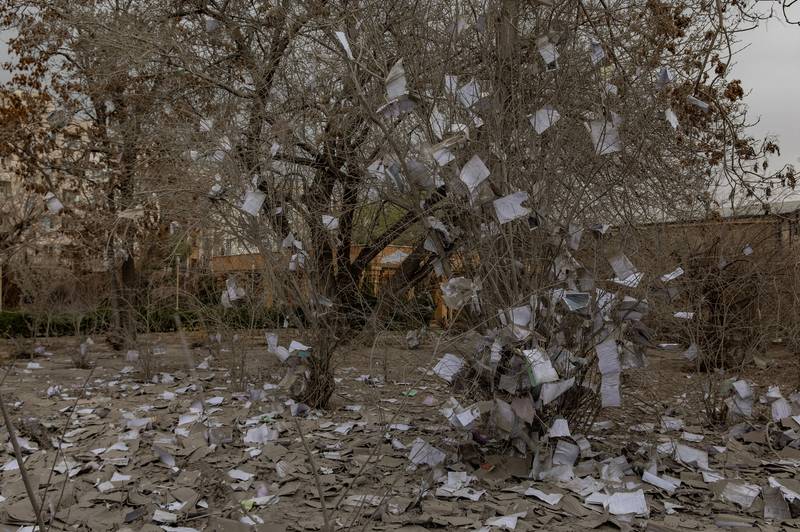
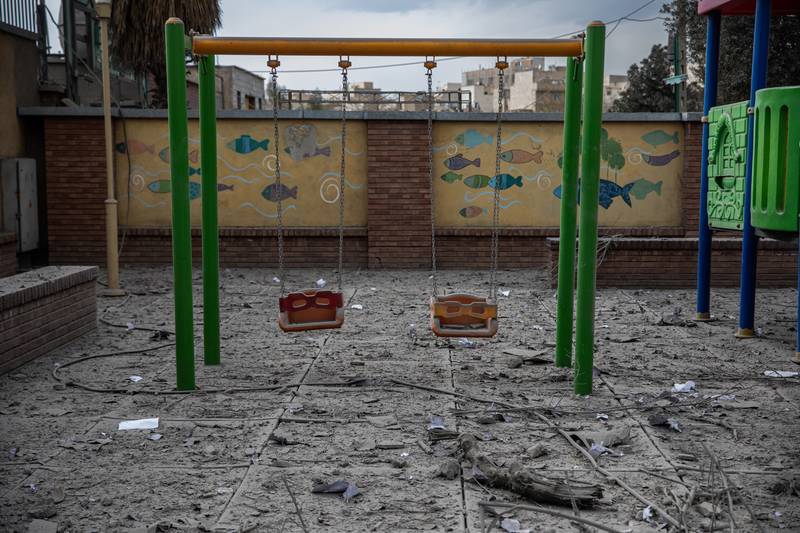
Women’s Park, Basij Square, 3 March. Photo by Erfan Kouchari
During the recent military assault, photographs by Iranian photographers appeared in international media. Such exposure can be an important professional opportunity, but it can also gradually shape the way a photographer sees and works. When powerful media organizations control the dominant visual conventions, narrative frameworks and award systems, how can a photographer maintain their independence rather than becoming a human rights photographer working for someone else’s agenda?
The importance and track record of major media organizations cannot be dismissed. They have more experience, greater financial resources and more extensive professional structures. In local media, you sometimes encounter managers with no writing experience who don’t understand the difficulties photographers face in the field, so they may fail to provide the conditions needed to do the work properly. Competing with agencies such as the Associated Press takes more than excellent photographs. An Iranian photographer may work for much less money, hoping to be published by a major agency, but that hope can lead them to accommodate the agency’s standards and forms of censorship.
When you want to be seen within that system, you may gradually adjust your work to its expectations, not just aesthetically. Even what you repost on social media can influence an outlet’s decision to work with you. During this war, an Associated Press editor who had seen my photographs suggested that I apply to work with them. But after a senior manager reviewed my Instagram page, their decision changed because of things I had reposted.
Also, once you hand a photograph over to an agency, you no longer have full control over it. An outlet may publish it with a headline or caption that changes its meaning. I worked with an agency only on the Niloofar Square photographs. I disliked one outlet’s headline because I wanted to convey the vulnerability and suffering of my people, but the headline took the story in a different direction.
A local photographer’s income is nowhere near that of a staff photographer at an international agency, so the prospect of working with a major organization is tempting. But you have to ask what you might have to give up in exchange.
Given that, should a photographer consider the intended outlet from the outset? Should the narrative be shaped with its audience in mind so that the image has a better chance of reaching people?
I think you have to consider your audience. If you want to communicate with people outside Iran, you need to understand where they are coming from and how they might connect with the subject. You can’t assume they already know everything or share our assumptions.
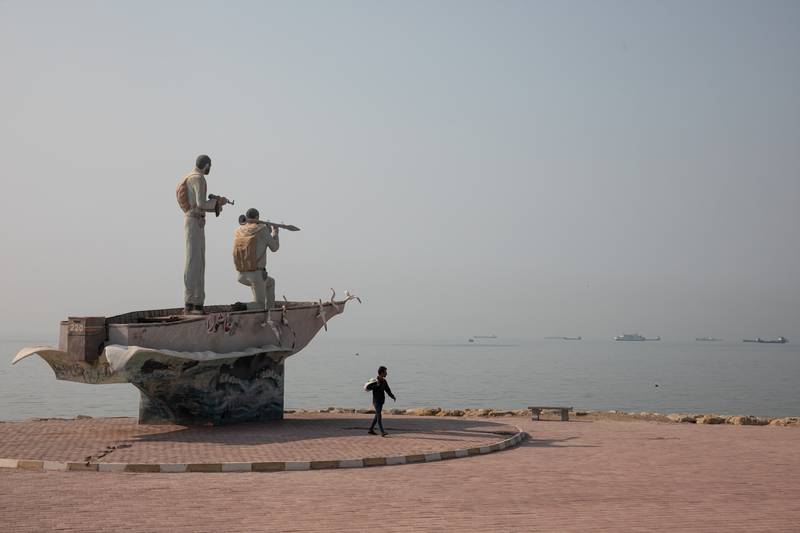
In southern Iran, the scars of war are everywhere: in destroyed bridges, bombed homes, and the graves of children. Photo by Erfan Kouchari
Images of destruction can be visually striking, even beautiful. Composition, light and form can make a photograph memorable, but they can also shift the viewer’s attention away from the subject’s experience and towards the image’s own aesthetic appeal. How do you negotiate that tension? Have you ever taken a photograph that was visually powerful but that you later decided not to include in a series?
Composition and visual structure matter. If I want to communicate something, I can’t disregard the principles of photography. I try to pay attention to both the subject and the composition.
Abbas Attar (Iranian photographer) made an interesting point: given a camera and four or five years of practice, anyone could learn to compose a good frame. But for him, that wasn’t the main issue. He wanted to understand what was happening in society and what he could reveal through his work. That approach matters to me too.
Kaveh Golestan (Iranian photographer) made another point I find important: a photograph should hit the viewer like a slap in the face. That impact doesn’t come from composition alone. The subject and what is happening in the image are fundamental, though composition can intensify the effect. You can’t sacrifice one for the other.
I’ve never looked at a scene and thought it was too beautiful to photograph. But I might leave an image out when editing a series because it draws too much attention to itself. Every photograph needs to earn its place.
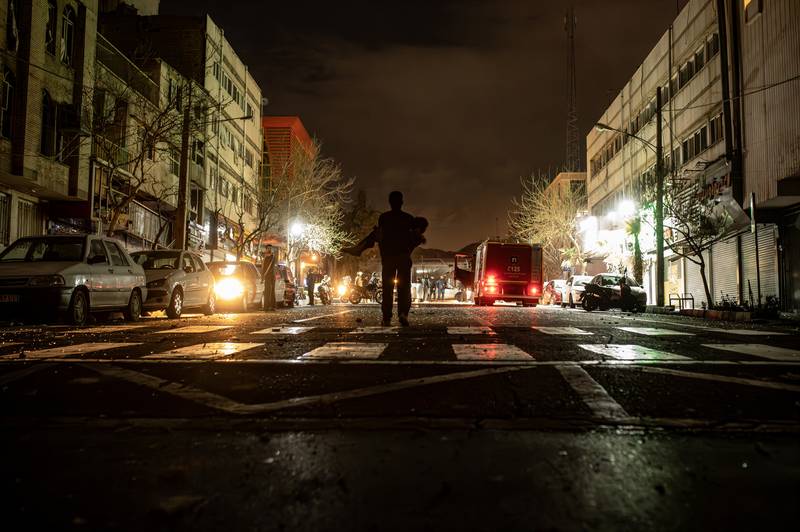
Niloofar Square, Tehran, March 1st. Photo by Erfan Kouchari
One final question. If, twenty years from now, people were to turn to your photographs to understand what Iranians experienced during this war of aggression, what would you want the images to preserve? Which stories should endure?
I want the truth of what my country has lived through to endure, to preserve what people truly experienced. To me, the essential facts are clear. There was an act of aggression; people resisted; people lost loved ones; and war crimes were committed that cannot be ignored.
I want my photographs to show what people went through. We still don’t have a complete account of those who were killed or injured, or of those who suffered financial losses. Minab, Lamerd and Koohestak are among the places that deserve much more attention. These are experiences people anywhere in the world can relate to, because everyone understands what a school is, what a children’s playground means, and what a wedding or ordinary daily life looks like.
We’ve done a reasonable job of documenting the immediate moments of war, but less so what happens afterwards. Where did patients go? How have families who lost their homes and were put up in hotels been getting by? What has happened to their daily routines and relationships?
War’s consequences can emerge much later as an economic or family crisis. An attack that partially halts a factory’s production may force its owner to lay off workers. Someone who loses their job may have to move to another city to find work, leaving their family behind. This chain of events begins with the war, even if its effects unfold over time. Documenting them requires time, research and sustained contact with the people affected.
A body of photographs reveals some aspects of reality and leaves others untold. A photographer’s responsibility doesn’t end with recording an explosion. We must also follow what happens to people afterwards and how their lives change. An archive of the war should preserve the complexity of that experience: the suffering and loss, the resistance, and people’s efforts to rebuild their lives.
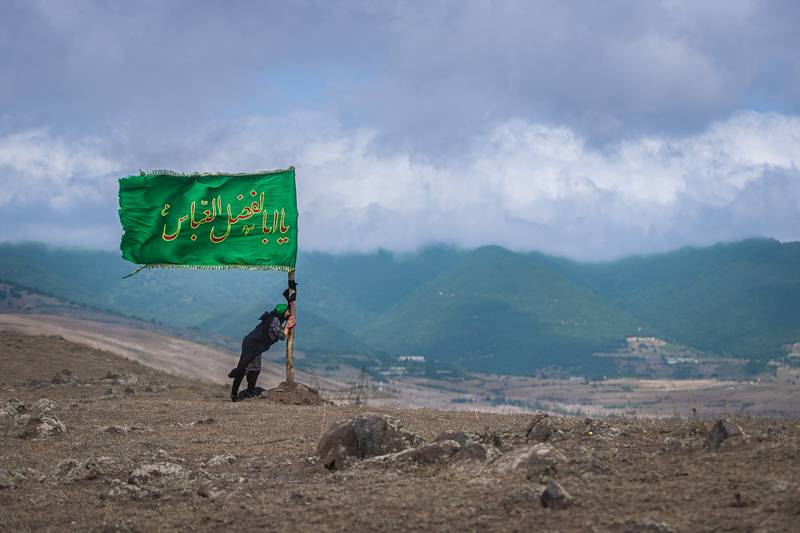
An elderly woman kisses the base of a flag bearing the name of Hazrat Abbas ibn Ali during Ashura mourning ceremonies in the highlands of Rudbar County, as a gesture of disavowal (tabarri). Photo by Erfan Kouchari
-
 READ
Dr. Aiswarya Rao on navigating hostile spaces for people-particularly women- with disabilities through the organization ‘Better World Shelter for Women with Disabilities’, building safe spaces, changing policies, and tying art into livelihood, fun, and friendship.
Blending Art, Friendship & Advocacy: A Conversation With Dr. Aiswarya Rao
-
 READ
I think of how many people are not able to be involved in social movements because of their own disability or their caring responsibilities, or the way that forms of social violence take away their capacity, or their ability to fight that social violence, because they’re simply trying to stay alive.
Dreaming of Liberation: An Interview with Lola Olufemi
-
 READ
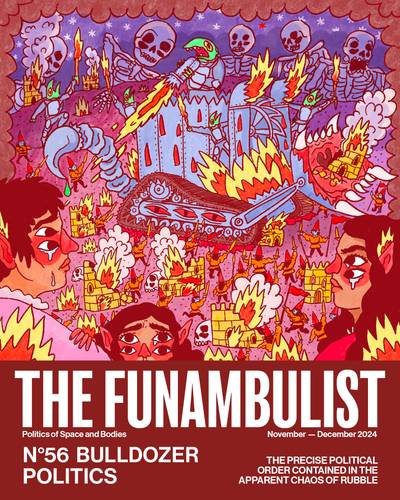
Bulldozers, often seen as neutral tools of industrial demolition, are instruments of territorial domination, urban redevelopment, and political suppression. Yet within these acts of destruction, counter-narratives emerge—poetry, mourning, and collective remembrance—that reclaim agency in the face of state-sanctioned ruination. If ruination is a strategy of power, it is also a site of resistance.
On Bulldozer Politics: An Interview with Léopold Lambert & Shivangi Mariam Raj
-
 READ
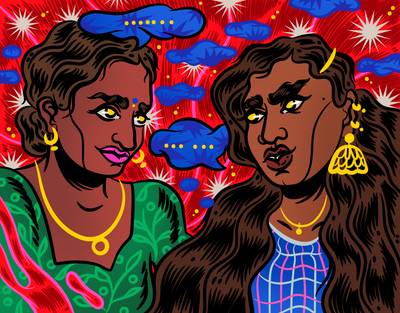
Abinaya and Vanessa reflect on their experiences in the Tamil community and discuss the pressure to represent Tamilness for non-Tamil audiences. Abinaya discusses her work with Tamil Guardian, which sought to combat Sri Lankan government propaganda and elevate the voice of the Eelam Tamil polity. Vanessa discusses her role in editing Tamil Futures, a creative arts magazine aimed at the global Tamil community, which prioritized creative archiving and documenting underrepresented histories.
Writing Tamilness: Perspectives From Tamil Futures and Tamil Guardian