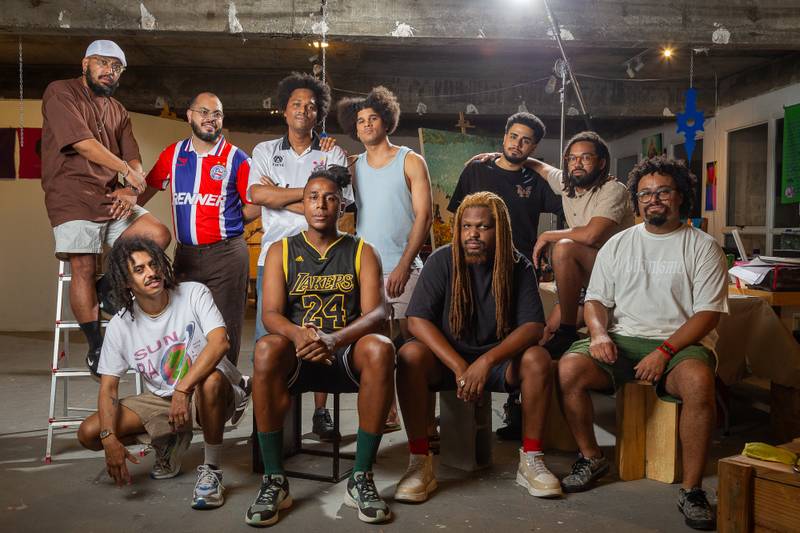
Vilanismo members: Ramo, Renan Teles, Guto Oca, Rodrigo Zaim, Robson Marques, Rafa Black, Diego Crux, Denis Moreira, Daniel Ramos, and Carinhoso. Photo courtesy Vilanismo collection/ Jardiel Carvalho.
Beatriz Ferro is a journalist and reporter for celeste magazine
A way of working? A collective effort? A technology? A language? A device? A manifesto?
Vilanismo is a political gesture of occupying spaces. A device for constructing territory and for claiming the right to land. It is also a studio. It was there, at the shared studio in the Bela Vista neighbourhood, in central São Paulo, amid glasses and plates scattered in the corners – signs of their Monday meetings – that we sat down with Ramo and Daniel Ramos. Alongside Denis Moreira, Diego Crux, Guto Oca, Rafa Black, Renan Teles, Robson Marques, Rodrigo Carinhoso and Rodrigo Zaim, they form what they call the Brotherhood of Black and Favela Men in Contemporary Art.
This brotherhood sets out to hack the very notion of the “villain” as a peripheral Black man. Drawing from an encounter between the circuits of contemporary art, graffiti and São Paulo’s “pixação” scene, they reshape and radicalise political engagement within the visual arts. The group does not organise itself as a collective; instead, it foregrounds a plurality of practices anchored in a shared ethic: art as political practice and a pact of brotherhood.
Within a Vilanist framework, an exhibition can be as political as reading a manifesto or even taking part in a procession to a cemetery – such as a walk led by the “villains” to the grave of the abolitionist Luiz Gama (1830–1882) in December 2025. For them, even a conversation with an art magazine – like this one, for NO NIIN and Celeste – is itself a political act. Far from a caricature of the enemy, the villain re-emerges here as “a philosophical concept rooted in an Afro-Paulistano culture,” as Ramo, an artist and cultural manager, puts it. It is with him and Ayọ̀kàndé – the name adopted by Daniel Ramos following his initiation into Candomblé – that we discuss this artistic-political practice, born as a process of healing from the “villainisation” of Black men from the periphery.
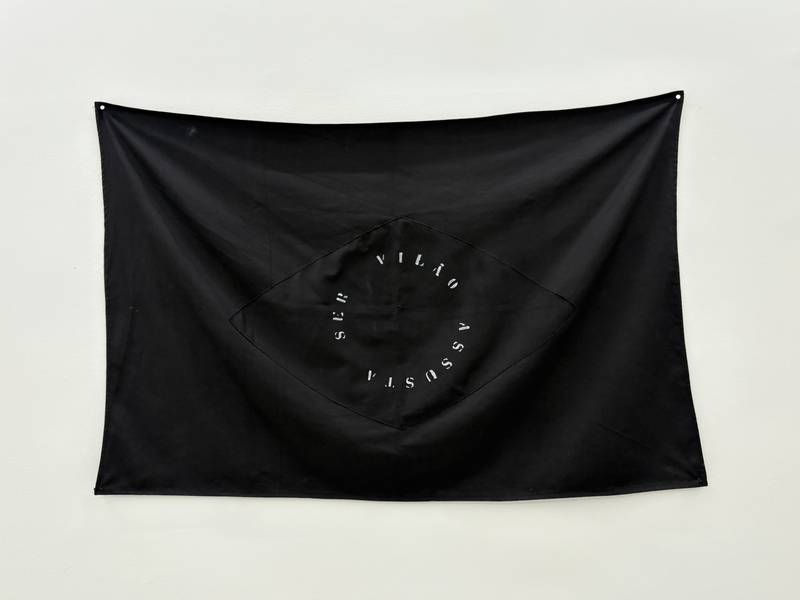
Ser Vilão Assusta - Bandeira Preta (2022), by Guto Oca. Photo by Celeste.
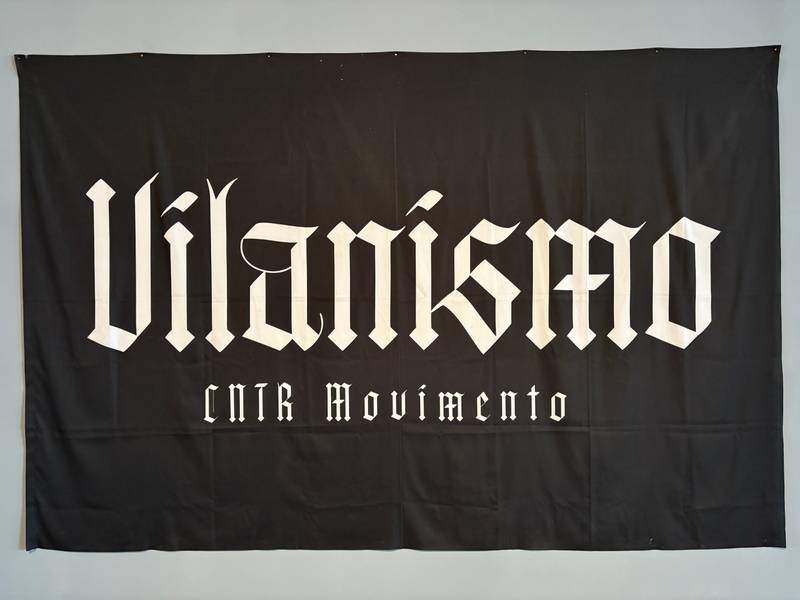
Vilanismo CNTR Movimento flag. Photo by Celeste.
BEATRIZ FERRO: How do you define yourselves: as a collective or a brotherhood? What’s the difference?
DANIEL RAMOS: The main difference lies in political radicality. Brotherhood is a very ancient technology within the African diaspora. Many communities have organised themselves through brotherhoods since the beginning of time. It’s quite common to think of platforms like Freemasonry, whose roots lie in ancient Egypt, in Kemet, the “black land”, where it functioned as a brotherhood of builders and specialists in architectural development: the people who built the pyramids, calculated stone cuts, and worked with rammed earth. In Nigeria, there were other forms of brotherhood, as well as women’s sisterhoods like the Ìyámì, very present in Candomblé, and the Ogboni, brotherhoods in that region and beyond.
These traditions crossed over through the transatlantic slave trade and unfolded in multiple ways: Black social clubs in the 20th century, which enabled leisure and care as political rights; the Sisterhood of Boa Morte; the Brotherhood of Our Lady of the Rosary of Black Men; and many others. Particularly in the 19th century, these brotherhoods and sisterhoods were highly organised groups working collectively for civil rights and the restoration of Black humanity. They fought for dignified burials, pooled resources to buy members’ freedom, and trained new professionals: tailors, shoemakers, seamstresses, lace-makers.
A collective, on the other hand, is usually tied to labour, structured around a shared economic or political platform. It often leans towards a unified aesthetic, without much plurality of language, and doesn’t necessarily operate within a radically political tradition. Even though the Western left is closely tied to cultural labour, brotherhood goes further left, as Sueli Carneiro (philosopher, writer and anti-racism activist, born in 1950 in São Paulo) puts it, and radicalises it.
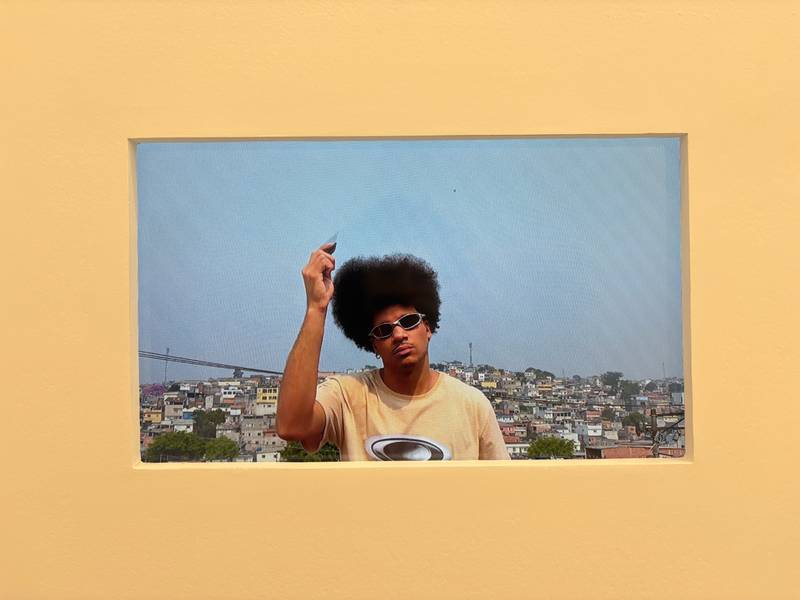
Se armando (2024), by Rafa Black. Photo by Celeste.
That model of predatory masculinity is something Vilanismo directly confronts, both poetically and materially. The consequences of that mindset are right here: a city that expels people. We love and hate São Paulo. It’s a toxic relationship in many ways. So how do we invent other ways of being in the world?
How does each artist’s individual voice reinforce the idea of brotherhood?
DANIEL: In a way, the artists work from a poetics shaped by the perspective of Black men from the periphery – from different territories but with a shared ethic. That’s powerful because it avoids the idea of a bloc while allowing for a rich aesthetic diversity grounded in lived experience. Take our installation at the 36th São Paulo Biennial. The title The Boys, I Don’t Know What Fraternal Oaths They Made [Os Meninos Não Sei Que Juras Fraternas Fizeram] was suggested by Rafa Black, who at the time was reading Conceição Evaristo (writer, novelist, and poet, renowned for her focus on race, gender, and class discrimination, born in 1946 in Belo Horizonte) and referenced a passage from Olhos d’Água (2014), where male characters make a pact not to die.
Denis Moreira and Diego Crux are our filmmakers, so there’s a strong cinematic layer in our work. When building the installation, we referenced Dogville (2004), creating a kind of headquarters that evokes the idea of a house, but one that almost exists on a conceptual plane. The foundations are there, but there are no walls, much like the film, where houses are drawn as floor plans on the ground. All these inputs come together like a mutirão – a collective building effort common in our communities, whether putting up a house; organising a Cosme and Damião celebration, a June festival, or gatherings in the terreiro or church.
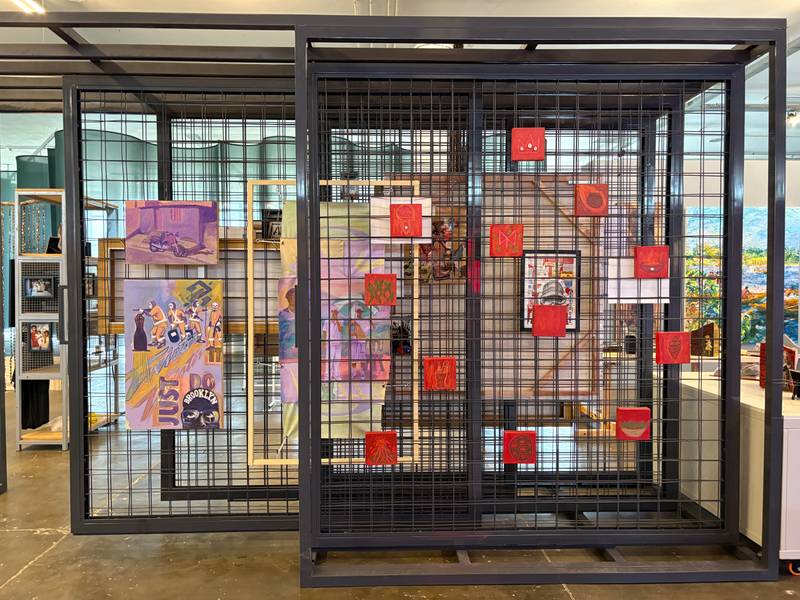
View of Os meninos não sei que juras fraternas fizeram (2025), by Irmandade Vilanismo, for 36ª Bienal de São Paulo. Photo by Celeste.
Is brotherhood a form of mutual care and protection that goes beyond language and art?
DANIEL: Absolutely. The idea of “guarding the body” underpinning our exhibition Guarda-corpo (Zielinsky Gallery, São Paulo) isn’t just about a construction or architectural element; it’s about an ethic of care. It allows us to imagine not only different masculinities but different futures. We’re entering a moment where we need to rethink our relationship with the planet, to move beyond extractivist logic. Caring for the body, for affection, for one another – these are technologies of response. When it comes to masculinity, there’s a whole destructive imaginary at play.
Take the Bandeirantes (explorers in colonial Brazil who, from the early 16th century, participated in inland expeditions to find precious metals and enslave indigenous peoples) for instance. A powerful narrative in São Paulo’s culture. That model of predatory masculinity is something Vilanismo directly confronts, both poetically and materially. The consequences of that mindset are right here: a city that expels people. We love and hate São Paulo. It’s a toxic relationship in many ways. So how do we invent other ways of being in the world?
How did your individual trajectories intersect to form Vilanismo?
DANIEL: Everyone in Vilanismo is someone I met and grew close to within the contemporary art circuit. Some even earlier, through graffiti, like Robson, or São Paulo’s pixação scene. The idea was to understand how their practices could move forward collectively, while also allowing me to be part of that vehicle, amplifying one another. So the starting point was affection and mutual admiration. It also emerged at a very particular moment in our recent history – the pandemic and the experience of isolation. Alongside writing the manifesto, we created a WhatsApp group and began meeting regularly on Mondays. We’ve kept that going, nearly five years now, every Monday at 7pm, we meet to talk, sort things out, structure ideas, dream, and be together. After lockdown, those exchanges expanded into shared spaces of sociability: feijoadas, pagodes, gatherings.
(We hear the lift chime as it reaches the sixth floor. Ayọ̀kàndé arrives and joins the circle. Dressed in loose, all-white clothing, his presence immediately draws attention in the room.)
It’s a pleasure to meet you. We were just talking about collective practice in a field that tends to individualise artistic processes.
AYỌ̀KÀNDÉ: When we started meeting, that was exactly the challenge: how to bring all these different practices together without limiting one another. It’s important that everyone remains free to move in different directions, but there’s always a kind of “Vilanismo” that provides conceptual grounding. It gives us a shared ground we can all stand on, in a way.
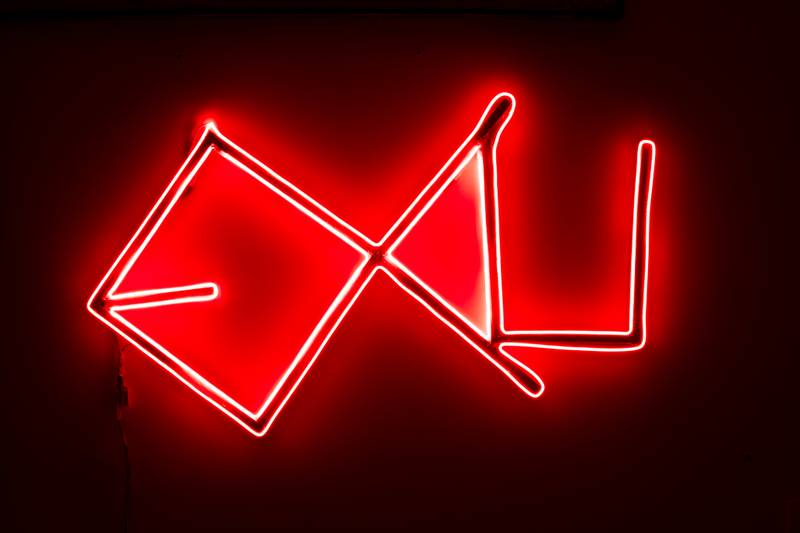
Exu é amor (2024), by Ayọ̀kàndé. Photo courtesy Levi Fanan / Museu Afro Brasil Emanoel Araujo.
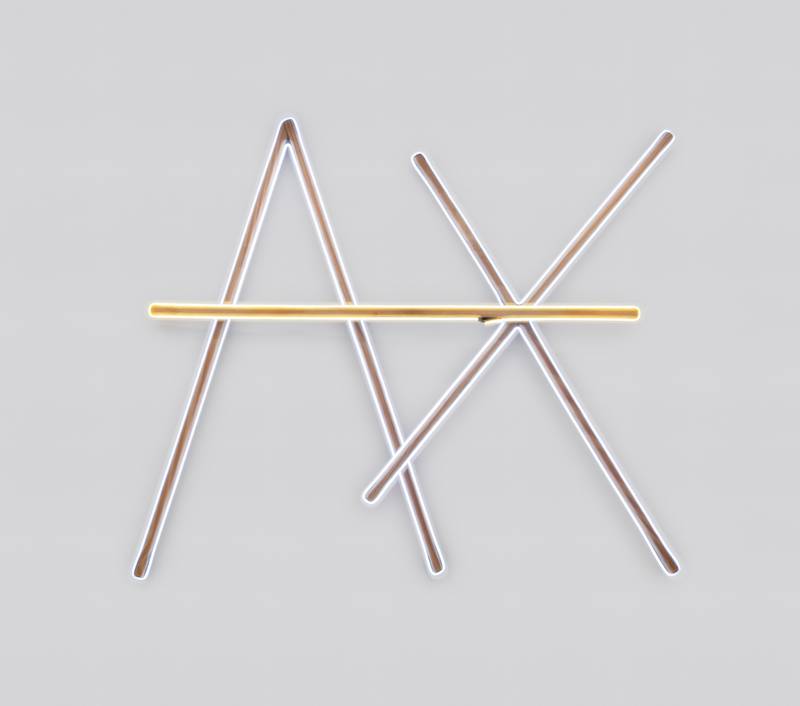
AXÉ (2024), by Ayọ̀kàndé. Photo courtesy Filipe Berndt / Zielinsky.
The installation at the 36th São Paulo Biennial engaged with this idea of building a shared space, both in terms of access and as a site of affection. Does affection also operate as a politics of presence and affirmation?
DANIEL: For a long time – and still, given the pace of São Paulo – we’ve had this habit of messaging in our WhatsApp group to say we’ve made it home safely. That simple gesture became the basis for an exhibition — When They Get Home, I Feel Happy (Quando eles chegam em casa eu fico feliz, Galeria Luis Maluf, São Paulo, 2023), curated by Aline Bispo and Rodrigo Carinhoso, one of our members. It made us think about how a small act of care and affection can become poetic material. In the Biennial installation, that expands even further. For me, there’s no clear boundary between what is poetic, what is affection, what is political, and what is celebration. It’s all interconnected. The workspace becomes a place where those lines blur completely. Sometimes it’s a party, sometimes intense production, sometimes care, sometimes rethinking masculinity among ourselves and with others; sometimes it’s shelter, sometimes research. We’re constantly asking: how are we acting? How have our references been acting? Black women, in particular, have been crucial references for us – Nacional Trovoa (a collective of racialised visual artists and curators from across Brazil’s five regions), for instance. And sometimes it all turns into celebration, the good part: a barbecue, a beer, a bit of banter.
AYỌ̀KÀNDÉ: When people with no prior contact with Vilanismo came to see the installation, I’d always say: start with the photo albums [which were part of the installation at the 36th Biennial]. Before diving into the works, immerse yourself in our daily lives, the studio, in how we built things together. Because that’s where it all begins: letting each other know we got home, going out for a feijoada, sitting down to talk. That’s what nourishes us, not just as artists, but as people. And when we go back to the work, we’re fully fed by that. The works gain strength from that place of affection.
DANIEL: That poetics also helps introduce contemporary art to those who aren’t familiar with it. We’ve always been interested in creating something that speaks both to the art circuit and to our grandmothers, something accessible to everyone. The photo albums offer a kind of gradual entry point into artistic, market and political production.
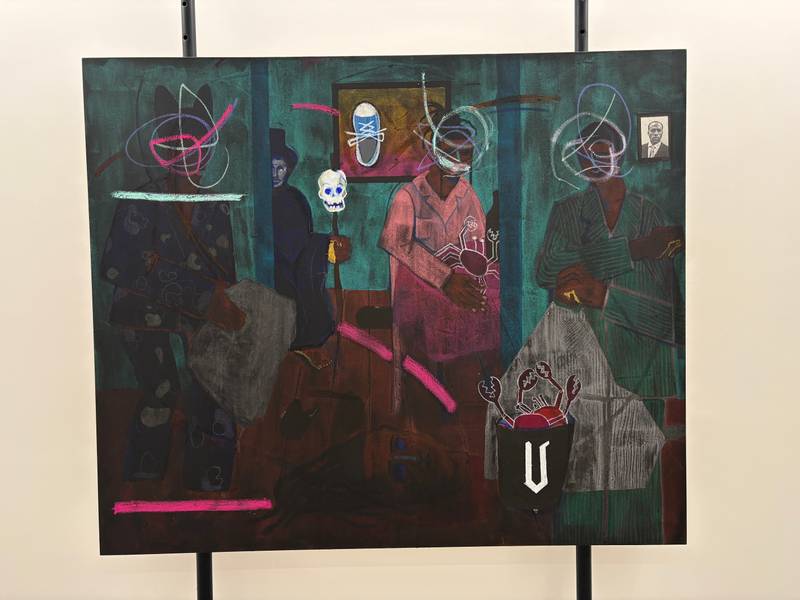
O gurufin de Abel ou os pretos que pensam como caranguejo em um balde (2024-2025), by Ramo. Photo by Beatriz Ferro / Celeste.
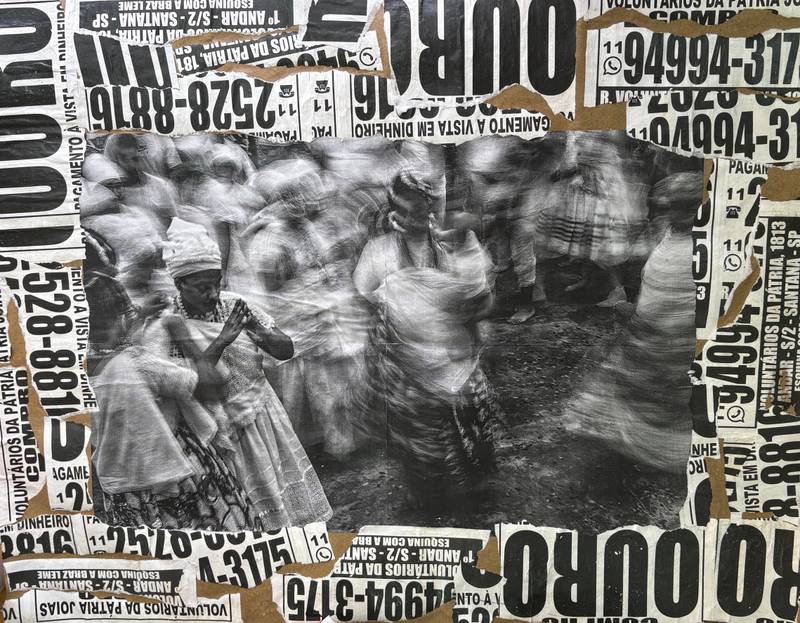
Loose page from Rodrigo Zaim’s sketchbook. Photo by Beatriz Ferro / Celeste.
How do these practices contribute to educational processes, particularly in expanding forms of self-representation in the visual arts?
DANIEL: All ten members have strong ties to education, across different levels and fields – formal and informal – whether connected to cultural institutions or not, or working in photography, design… it’s a very diverse group. Early on, we came together to share what we call the “secrets of the circuit”, which in itself has an educational dimension. Within the brotherhood, there are artists at different stages in their careers, with different understandings of the system, and that’s incredibly rich. We’ve created both internal and external dynamics to share that knowledge, and over time this has crystallised into a sense of community. For us, that’s essential, especially when thinking about the poetics of contemporary art that might guide the future. This relational aesthetic, so widely theorised today, has in many ways been central to the Biennial’s own curatorial framework.
We talk a lot about expectation. People look at us and want to put us in a box – and to box in our work as well, as “activism”, for instance. But we’re not “doing activism”; we’re simply expressing something that comes from within and needs to be communicated. I look at one of Rafa Black’s paintings – three kids just hanging out, living – and it can be read as militant art. But there’s just a beautiful scene unfolding there. Still, everything we do tends to get framed as “transgressive”. It’s not transgression, it’s life.
AYỌ̀KÀNDÉ: And education is actually how we first met, isn’t it?
DANIEL: Yes, that’s true, we met through that. I worked with Dani at Sesc Pinheiros [Founded in 1946, the organization Sesc – Serviço Social do Comércio – Social Service of Commerce, is a private, non-profit Brazilian institution funded by business owners to provide social welfare, culture, sports, leisure, and health services to workers in the commerce sector and their families].
AYỌ̀KÀNDÉ: It was wild, actually. We had designed a set of activities to discuss contemporary art with children, expecting 15 or 20 kids. When we got there, there were 50. He just said, “No problem, sort something out, make the table bigger.” And we did it for 50 kids. I thought, “You’re mad.” (laughs)
All these discussions around education, democratising access to knowledge and to art, they’re part of what we do. Whether through the Acadêmicos do Vilanismo, or defining concepts like CuradoTRETA — a triad of Care, Cultivation and Conflict — or other community initiatives, there are many offshoots. Art becomes a vehicle for many other things. We think about the circuit, yes, but also about ourselves as people. One thing we’ve learned is: if there’s no space for us, we create one. If an institution has a room full of clutter, we clear it out. If we’re invited to take a minor role in a project, we say: “We have a programme, a plan, a long-term vision.” We can participate, of course, but we’re thinking about longevity, about building something solid, not just for ourselves.
How can we imagine forms of masculinity where violence is not a defining element?
DANIEL: It’s not common, socially, to associate Black men from the periphery with care or tenderness. That’s simply not part of the dominant imaginary. Instead, we see hypersexualisation, anger, or the idea of a disposable body, especially when young. So breaking that expectation from the outset, taking on the archetype of the “villain”, typically seen as an adversary, and making it porous to care, love and affection, that’s a move that really interests us. The members embody this as a way of life: men who operate from love, care and solidarity, both among ourselves and within our communities.
We enjoy playing with these ideas, hacking them, subverting them, finding other strategies. For me, at least in my practice within Vilanismo, education is the first support structure for affirming this radical love. It means recognising the complexity of others’ timelines, being attentive, sensitive. Sensitivity itself is a way of undoing dominant forms of masculinity. It’s not something often associated with Black men in stereotypical representations, but if you look at certain artists – Djavan, Milton Nascimento, Cartola – you find deeply sensitive, profoundly human models of masculinity.
AYỌ̀KÀNDÉ: We talk a lot about expectation. People look at us and want to put us in a box – and to box in our work as well, as “activism”, for instance. But we’re not “doing activism”; we’re simply expressing something that comes from within and needs to be communicated. I look at one of Rafa Black’s paintings – three kids just hanging out, living – and it can be read as militant art. But there’s just a beautiful scene unfolding there. Still, everything we do tends to get framed as “transgressive”. It’s not transgression, it’s life.
So thinking about education, not necessarily formal or instructional, as a way of learning to read the world differently might be far more valuable than following an overly instrumental approach to education.
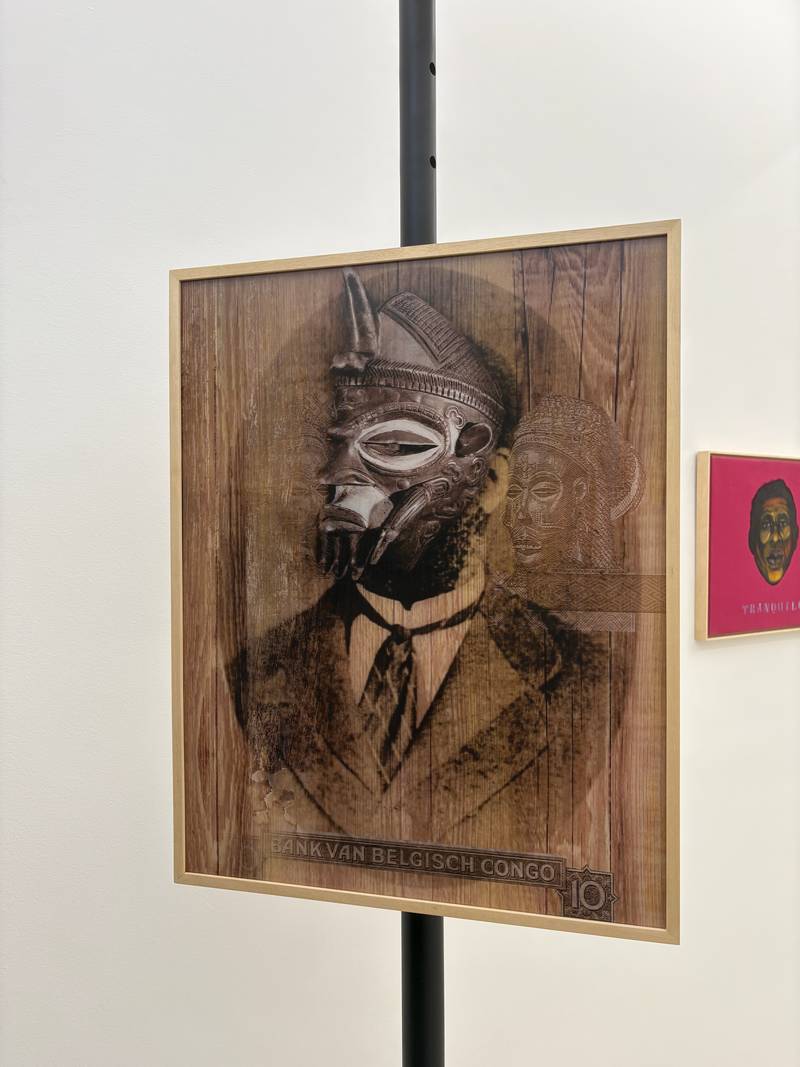
Luiz Gama Lwlua (2023), by Denis Moreira. Photo by Beatriz Ferro / Celeste.
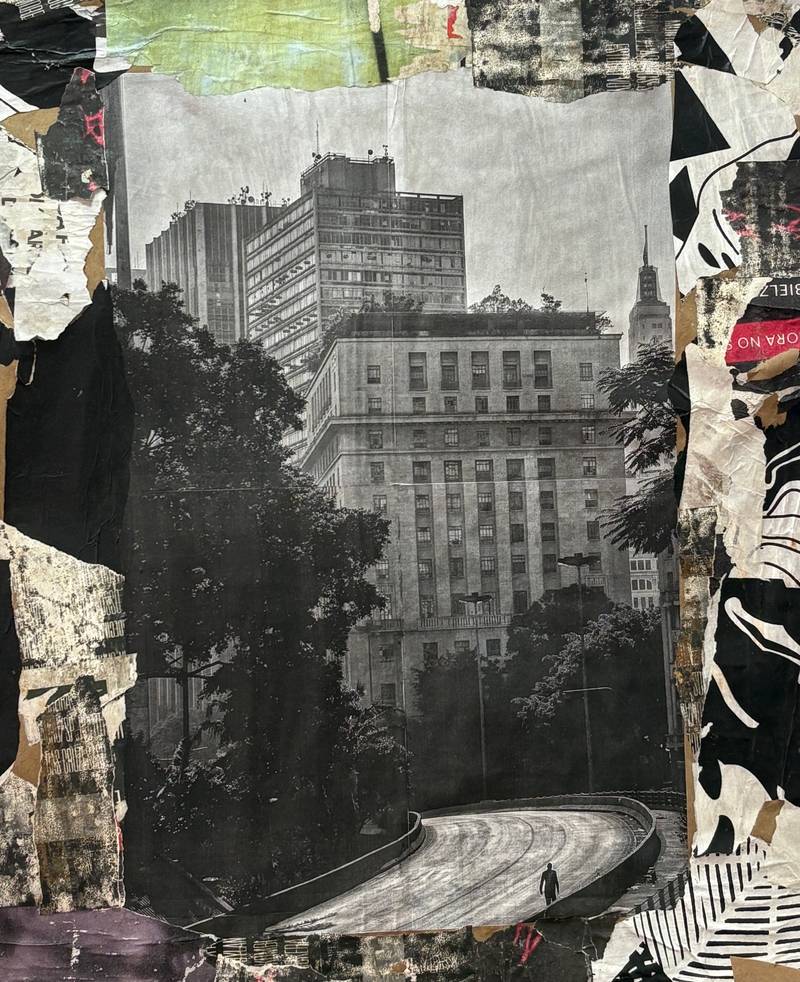
Loose page from Rodrigo Zaim’s sketchbook. Photo by Beatriz Ferro / Celeste.
-
 READ
READAbinaya and Vanessa reflect on their experiences in the Tamil community and discuss the pressure to represent Tamilness for non-Tamil audiences. Abinaya discusses her work with Tamil Guardian, which sought to combat Sri Lankan government propaganda and elevate the voice of the Eelam Tamil polity. Vanessa discusses her role in editing Tamil Futures, a creative arts magazine aimed at the global Tamil community, which prioritized creative archiving and documenting underrepresented histories.
Writing Tamilness: Perspectives From Tamil Futures and Tamil Guardian
-
 READ
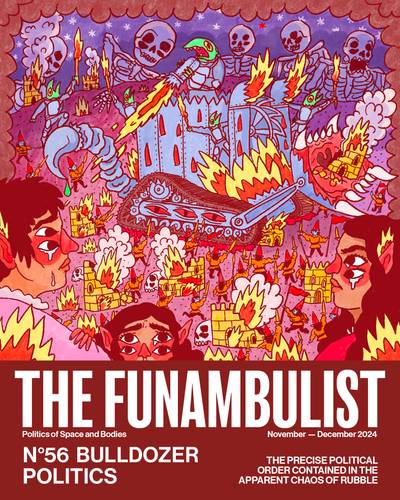
READBulldozers, often seen as neutral tools of industrial demolition, are instruments of territorial domination, urban redevelopment, and political suppression. Yet within these acts of destruction, counter-narratives emerge—poetry, mourning, and collective remembrance—that reclaim agency in the face of state-sanctioned ruination. If ruination is a strategy of power, it is also a site of resistance.
On Bulldozer Politics: An Interview with Léopold Lambert & Shivangi Mariam Raj
-
 READ
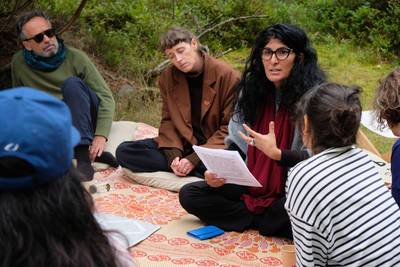
READThis interview grows out of that ongoing process of working, thinking, and speaking together. While it takes the form of questions and answers on the page, in reality, it unfolded as a dialogue: her narratives of Palestine, her frameworks of hospitality and self-determination, and her reflections on Sweden intertwined with my own questions, concerns, and the shared struggles I see myself as part of.
Commoning Private Space: An Interview with Sandi Hilal
-
 READ
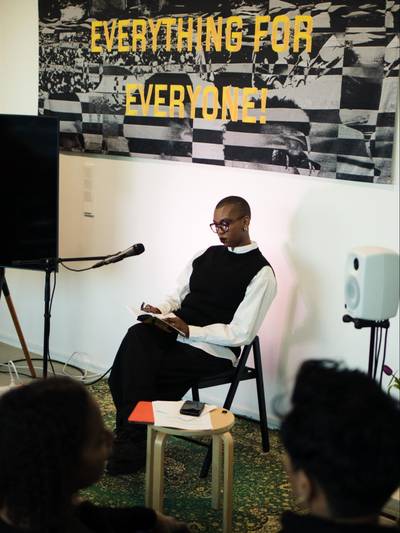
READI think of how many people are not able to be involved in social movements because of their own disability or their caring responsibilities, or the way that forms of social violence take away their capacity, or their ability to fight that social violence, because they’re simply trying to stay alive.
Dreaming of Liberation: An Interview with Lola Olufemi