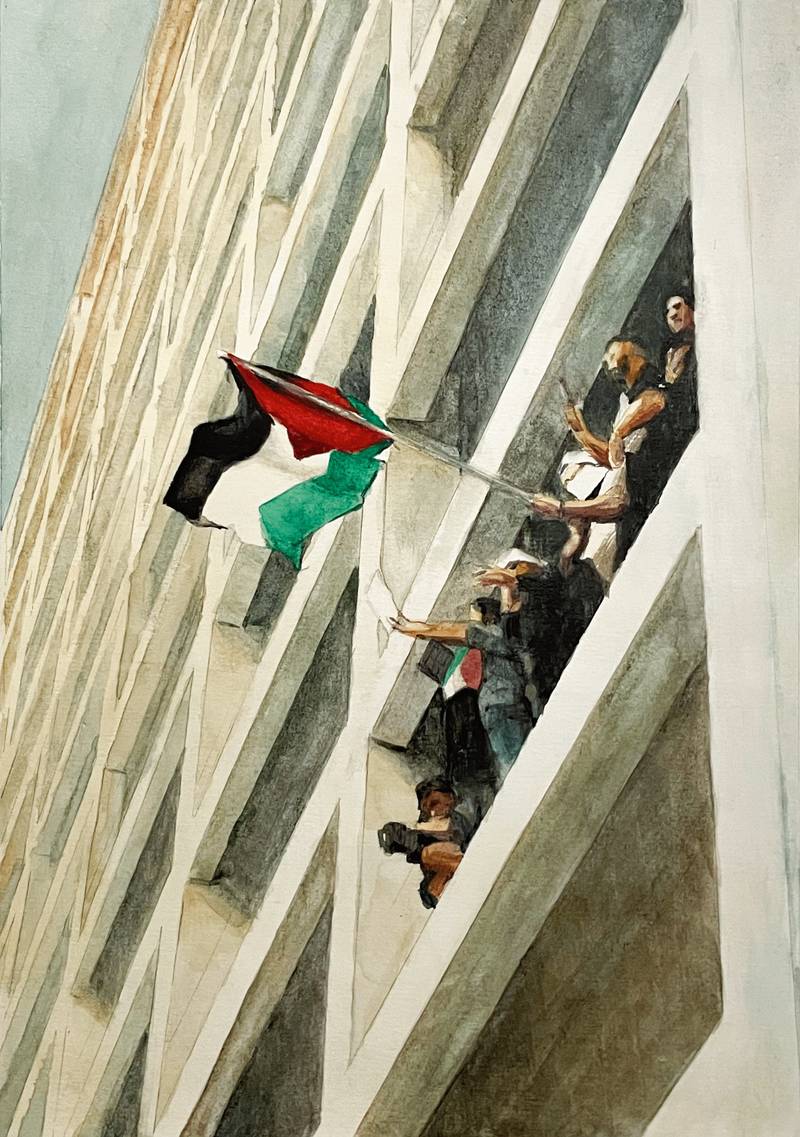
Poster by Ahn Bui
Heba Dbaa is a teacher from Gaza, Palestine.
As the war approaches almost half a year, I look back at what happened to me and my family and wonder: How does the world allow genocide to happen? When I first saw the news about the 7th of October operation, I thought we were getting our Palestine back. I did not realize that this was the beginning of the Israeli barbarity in Gaza.
I can’t exactly recall the first month of the war because it seems blurry to me. I can only remember seeing bruises on my father’s hands and legs. My father was working in Rahat and got restricted there until, a month later, Israel sent him back to Gaza with wasted eyes and a pitiful body. We never talk with my father about this subject. We only have general details about what occurred to him. The bruises are enough to describe what happened to him.
I used to say that I survived four wars in Gaza. But in this genocide, I survived three massacres. My family and I escaped death twice, and I am not sure if I will make it next time. When they started bombing our area, I kept telling myself that this would be the last rocket, but the bombing did not stop. We had to flee from our house when all the houses were flattened to the ground. That moment, when the windows smashed and my little sister screamed, we started running for our lives. We then escaped to our relative’s house.
Before this Israeli attack, it was hard to make a living. I used to earn money by teaching kids at a local centre. Once this genocide started, we were left with nothing. I had to sell my clothes and family belongings to get some money. My father and I were the sole breadwinners in the family. Ironically, I kept searching for jobs to be able to provide flour. And since the prices became costly, I was left with no choice but to buy low-quality canned food. This caused my 11-year-old brother, Obida, to suffer from hepatitis because of the polluted water and food.
I am exhausted. Every night I look at my family and think of how to survive the next day. But a rocket gave me the answer that surviving is a mere thought. The heavy bombing forced my family to flee again to my sister’s Bisan house in the Al Sultan area. We were lucky to cram ourselves in a small room.
I feel good that my family did not end up in a tent like my other sister, Taghreed, because I simply can’t afford to buy one. I have accepted that I have to carry water every day. I have accepted that I should endure the smoke that suffocated me and my mother while making bread. I have accepted that I must pay 10 shekels to get into a donkey cart. I have accepted that I have to wait hours to charge my phone. I have accepted all of this since my family is fine and alive. But misery loves company. Israel bombed the Ali mosque in the Albalad area. This area is active and has a market. My father was passing by when the bombardment happened and got injured in his head.
On the 23rd of March, Israel bombed my sister Taghreed’s apartment and killed her brother-in-law and his family. Only their four-month-old son, Omar, survived. He was found alive next to a pole in the street. Omar suffers severe injuries to his body.
And if this was not enough, Israel killed my uncle with sixteen members of the family. Sometimes I feel that my heart is going to explode any minute from sorrow. I have accepted everything Israel put me through, yet it was not enough. It was my fault to accept such inhumane treatment from land thieves. I know that I can’t stop Israel. But the hell Israel put me and my people through proved to me that my existence in my homeland is resistance. I must plant my roots in my country and document every atrocity Israel commits so history will not be forgotten.
-
 READ
READEducational institutions, just like all other institutions, can be considered microcosms of society, where prevailing attitudes and values manifest. Consequently, as racism permeates Finnish society, it also seeps into Finnish daycares.
Microaggressions & Everyday Racism in Finland’s Daycare System
-
 READ
READIs it problematic to mix friendships and professional connections, emphasising the benefits of helping friends since they will eventually feel obliged to help in return? How did such a neoliberal manipulative trick that openly instrumentalizes intimacy become acceptable? Is “friendly, warm hearted” corruption and favouritism legitimised? Am I abusing my position of power by preferring to work with friends? How does the professional environment change if a friendship ends abruptly and unpleasantly?
Against Friendship: On the Dark Side of Professional Intimacies
-
 READ
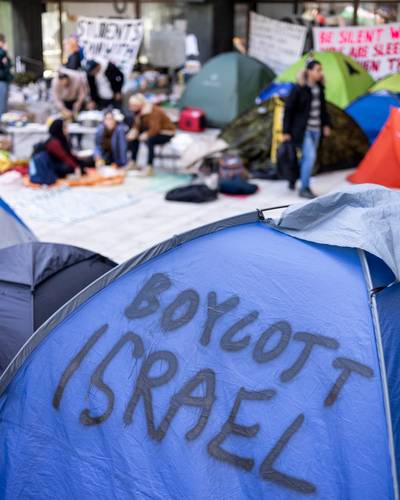
READThe opposition is not only between institutions and student activists—it also exists within our movement, manifesting in differing strategies. Should we focus on direct, visible actions or institutional processes? Should we shame the university publicly or appeal to its conscience? These approaches are not mutually exclusive—they reinforce each other.
Disrupting Complicity: Students Organising for Palestine in Finland
-
 READ
READA conversation with Isabel and Carl Gakran about the Zág (Araucaria), an indigenous tree threatened with extinction. We talked about their project (Instituto Zág), Indigenous climate justice and the intersection between the Palestinian and the (Brazilian) Indigenous struggles.
Zág Trees, Forest Spirits, and the Settlers: A Conversation with Xokleng Kin