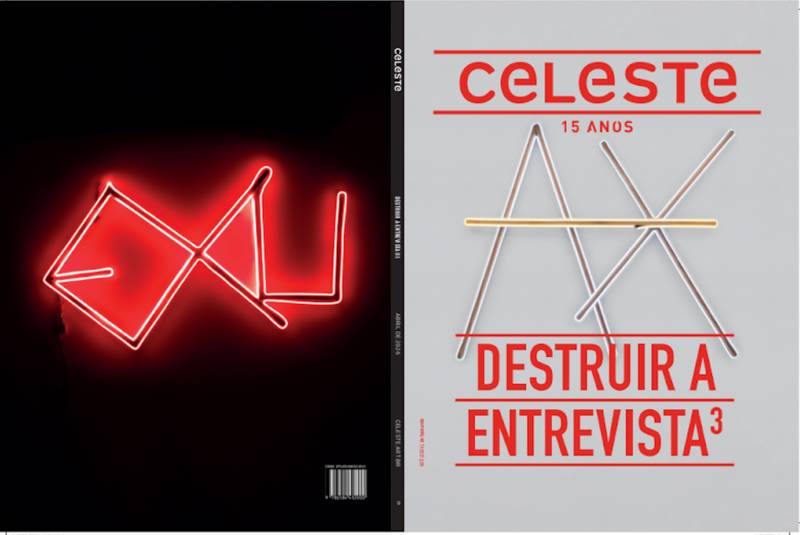
Cover and back cover of the 15th anniversary edition
Paula Alzugaray is an art critic, editor, and curator. She holds a postdoctoral degree in History, Criticism, and Theory of Art from School of Communications and Arts of the University of São Paulo (ECA-USP). As a thinker working across the relational fields of communication and visual arts, she engages in multiple formats of artistic, filmic, documentary, and written production.
Juliana Monachesi is a journalist specialized in culture and art criticism.
To begin with, Celeste is a woman’s name. A relatively popular name in countries with Latin-based languages, such as Brazil and its South American neighbors. Celeste is also a color, azul-celeste [sky blue]: a light shade of blue like the clear daytime sky. More specifically, celeste is the name of an art, criticism, and cultural journalism magazine published in Brazil. Because it relates to the air, we understand it as a name that reflects what we aspire to and pursue as a magazine: to be a platform for ideas and dialogue, a forum for debate, a field open to possibilities and communicative experimentation, a space for invention and collective action.
Amid the complete precarization of language on social media, celeste is a cell of resistance. A large circle of journalists, artists, researchers, and writers who share a commitment to Brazilian visual culture and its relationships with history, politics, social life, and contemporary subjectivities. And we, we are the curators who safeguard, care for and insist on the relevance of this place. After all, what exactly is a magazine?
JULIANA MONACHESI: Paulete, looking at the 15th-anniversary issue of celeste, with “axé” in neon on the cover—a work by Ayòkàndé, a Black artist from the outskirts and a member of Vilanismo—and comparing it to the earliest issues, whose covers featured works by white artists from the elite, how do you see this transformation in the magazine’s editorial agenda?
PAULA ALZUGARAY: To begin with, it is worth noting that the cover AXÉ (2024) and the back cover Exu é amor [Exu is love] (2024), both works by Ayòkàndé of Vilanismo, in celeste #9, affirm the importance, relevance, and resonance of the interview given by members of **“**the Brotherhood of Black and Favela Men in Contemporary Art” for the collaborative project between celeste (Brazil) and NO NIIN (Finland).
At the invitation of the Iranian artist and editor Elham Rahmati—who visited the celeste editorial office in October 2026, on the occasion of the 36th São Paulo Biennial—I am co-editing this issue of NO NIIN, which presents an overview of the Brazilian artistic context. It is an honor, a pleasure, and a major recognition to be able to celebrate the magazine’s 15th anniversary through this international partnership, with an artist and editor as incisive and politically lucid as Elham Rahmati.
So yes, Elham and I agree that this project of directly confronting systemic racism in Brazilian life and art, undertaken by the artists of Vilanismo, is among the most representative and powerful works being produced, thought, and proposed in Brazilian art today. The roundtable “Vilanismo: An Ethics of Care and a Philosophical Concept of Afro-Paulistano Culture” is being published consecutively in both magazines, in Brazil and in Finland.
Brazil has also undergone major shifts in its agendas over these past 15 years. Does the magazine follow culture and society, or does it anticipate awareness of relevant aspects within them?
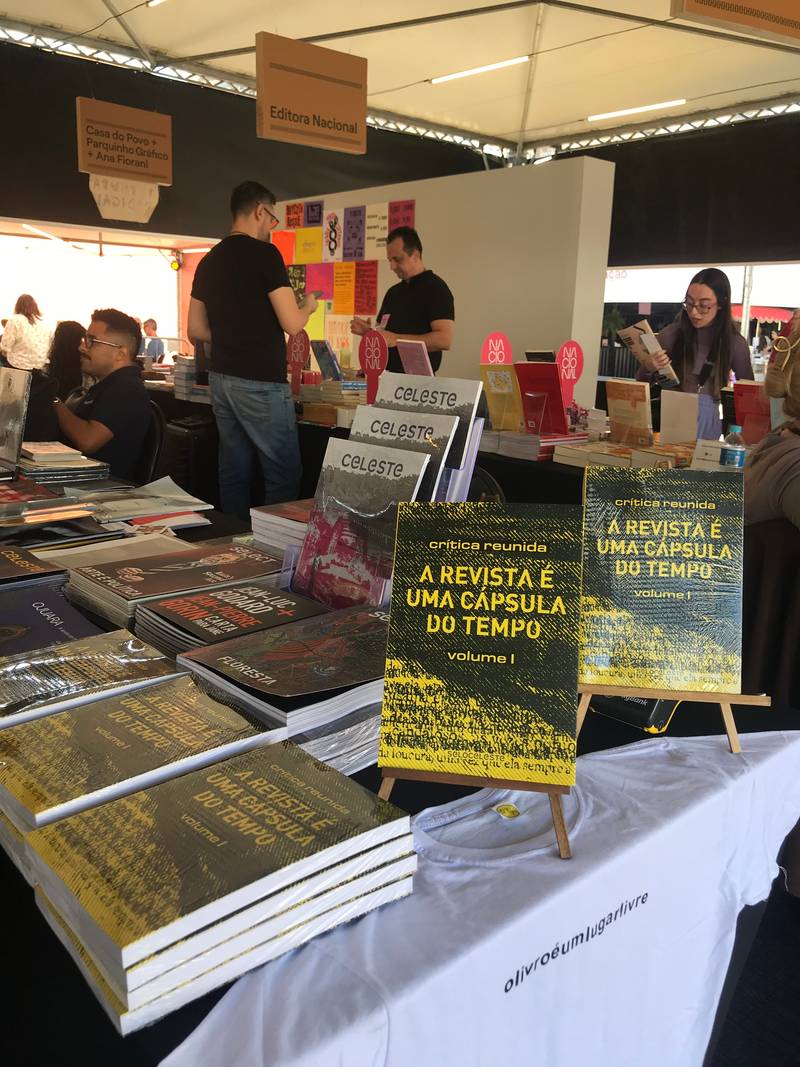
Well, last year we began a process of reviewing and re-editing our archive of critical texts published in the magazine. In the book Collected Criticism – The Magazine as a Time Capsule (volume 1), which we published through the newly created seloceleste, as you rightly note in your introductory text to the 2011 publications (the magazine’s inaugural year), MASP, the Museum of Modern Art of Rio, and the Pinacoteca do Estado de São Paulo were not yet decolonial museums. Decolonizing the museum, culture, and society was not yet an issue for the main artistic institutions—neither in Brazil nor globally I would say. Nor was it for the magazine, which emerged at a moment of the digitalization of life and positioned itself as a space for demystifying virtuality and the digital technologies of speed, entertainment, and spectacle; asserting that the virtual belongs to the realm of the real.
The magazine was born somewhat Debordian, with a critique of capital, globalization, and spectacle. In this sense, I would highlight, for example, Ana Maria Maia’s review of Golpe de Graça (2013), an installation by Matheus Rocha Pitta at Pivô, in São Paulo, published in seLecT #14. In the text “Affective Surplus Value,” Maia points to the paradox between a work that begins from the devaluation of a building—demolished and whose debris are sold as scrap—and its installation in Copan, a building designed by Oscar Niemeyer in the 1950s, stigmatized in the 1980s and fetishized in the 2010s, when it came to house cult venues such as a bookstore, bars, cafés, and Pivô itself.
Both the magazine and the institutions were largely oblivious to the insurgencies and revelations that Brazil and the Global South would come to lead in the following years. But as you point out, the artists present in Brazilian institutions – both in its exhibition spaces and collections— and on the covers of seLecT were white and from elite backgrounds. Matheus Rocha Pitta is an engaged artist, with strong and critical positions, as in the work Um campo de fome [A Field of Hunger] (2019). But he has not experienced hunger.
The social upheaval in Brazil takes shape with the June 2013 protests—the year Ana Maria Maia’s text was published. The wave of demonstrations was triggered by an increase in bus fares and quickly expanded to encompass many other causes, spreading across the country “in a virulent and viral way,” as Ivana Bentes wrote in an article for seLecT #17. It was “a political radiation that intensifies and generates events,” one of which was precisely the beginning of the magazine’s political shift. So, returning to your question, I would say these are concomitant movements: the magazine is attuned to and follows culture and society. Its role is to bring to light, to make visible phenomena that not everyone can perceive in the heat of the moment or in the midst of the crowd.
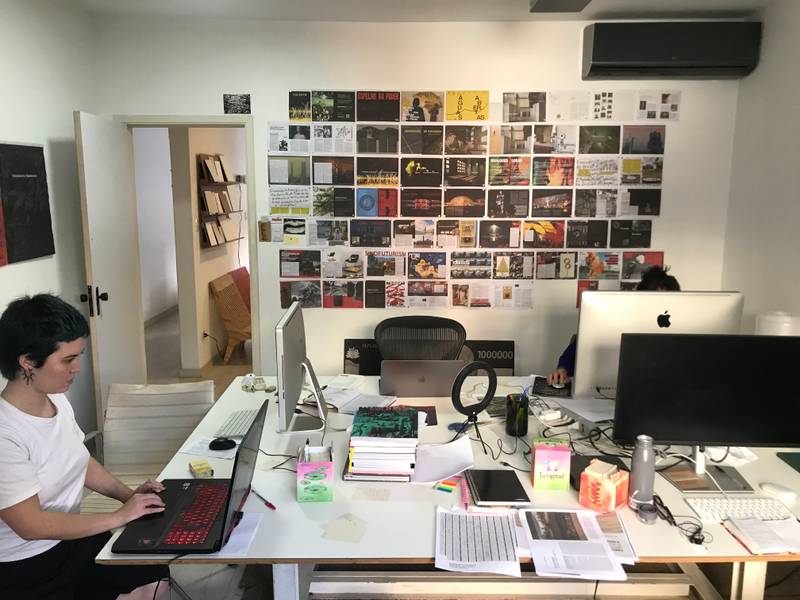
Interior of the magazine’s editorial office
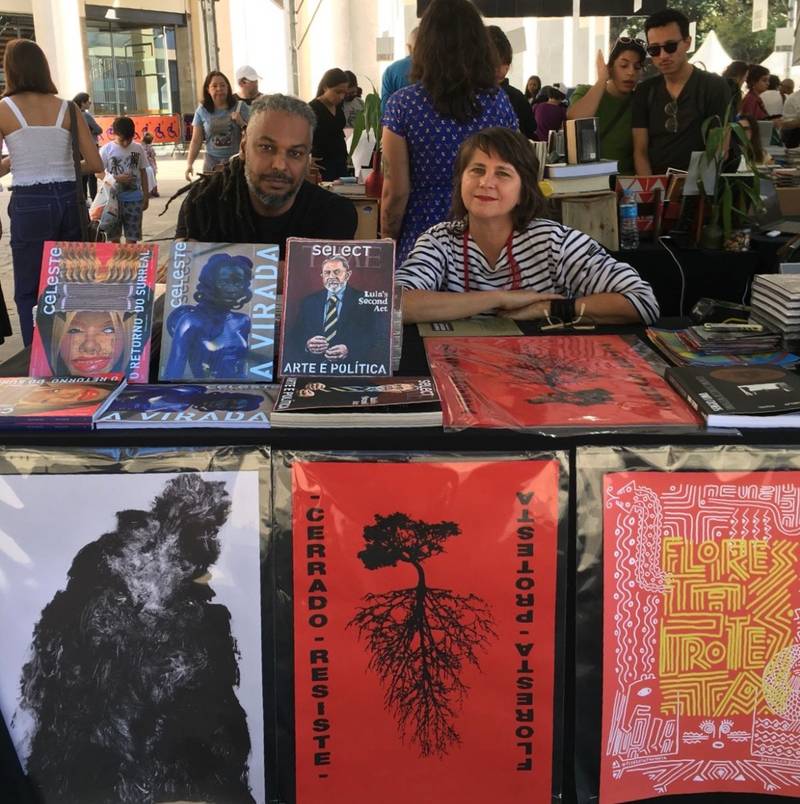
Artist Helô Sanvoy, author of the poster “Floresta Protesta / Cerrado Resiste”, edited by Paula Alzugaray, at A Feira do Livro bookfair, São Paulo, 2023
Lula was on the cover of the 2022 bookzine, sampled by the artist Evandro Prado from a Time cover: does the magazine here also embrace politics, beyond its long-standing engagement with politically committed art?
After witnessing the emergence in Brazil of a range of new political subjects, with the strengthening of new urban movements and social groups from the so-called minorities—shaped largely by affirmative policies and decolonial theory—which gained ground and voice by putting an entire system of values into crisis and pressing for structural reform in the arts… we came to understand that the decolonial agenda should guide the magazine’s work. “Decolonize” was the first of four issues in 2022 dedicated to the relationship between art and politics. Yes, the magazine embraced politics.
We had come out of a series of issues in 2021—the second year of the Covid-19 pandemic—in which we deepened our research into Indigenous art, as well as the poetics, cosmogonies, and epistemologies of communities in the northern and Amazonian regions of Brazil. So, as we wrote in the editorial of the bookzine (book + magazine, or a magazine edited as a book) Art and Politics: one of the legacies of 22 was the need to rethink which dates, gestures, and cries should be considered heroic—and for whom—and which are truly worth being immortalized in granite and marble across Brazilian cities.
We pointed out the need to recall other milestones: why not evoke the ten years of the quota law, which democratized access to higher education in Brazil by allocating 50.6% of places in federal universities to self-declared Black, Brown, and Indigenous students, as well as low-income applicants? Why not remember the 200th anniversary of the birth of Maria Firmina dos Reis (1822–1917), who was not simply the first Black woman to publish a novel in Brazil, but the country’s first woman novelist?
So, after four grueling years under a far-right government exercising necropolitics, 2022 became a year of struggle against fascism. The magazine thus began to position itself as a vehicle for action—bringing political stance and engagement into alignment with its original functions of documenting the art scene and curating the information and production of its time.
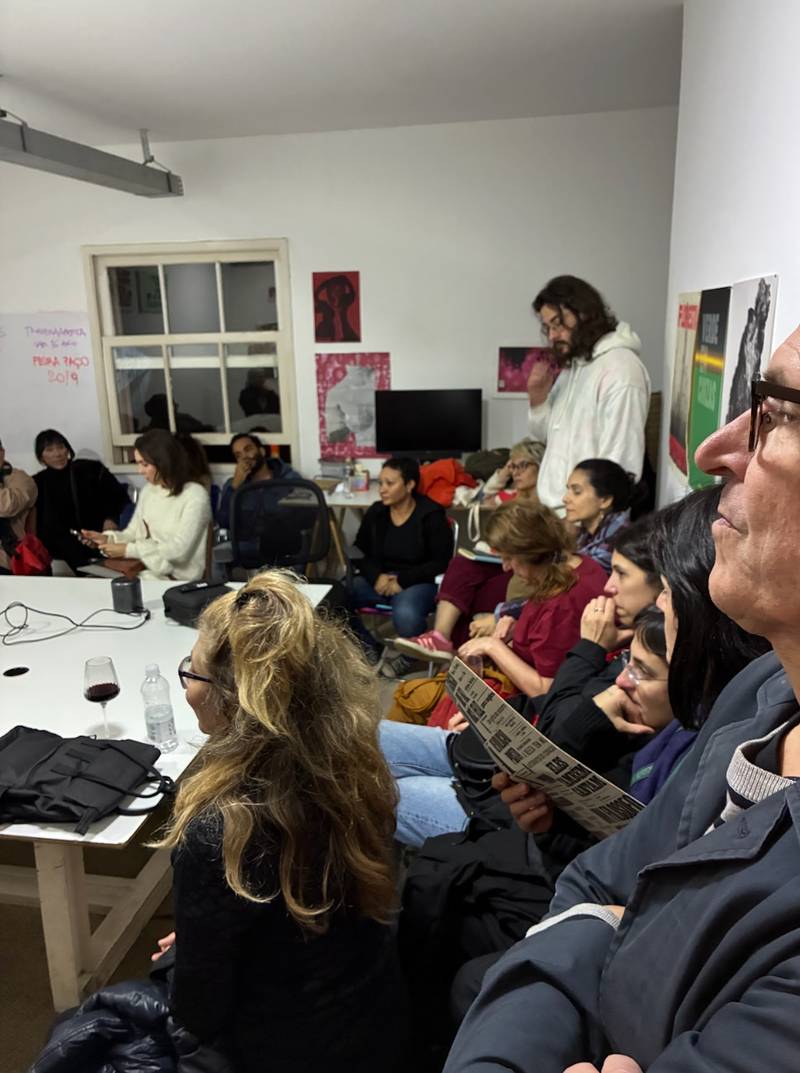
Talk at the magazine’s editorial office, 2024
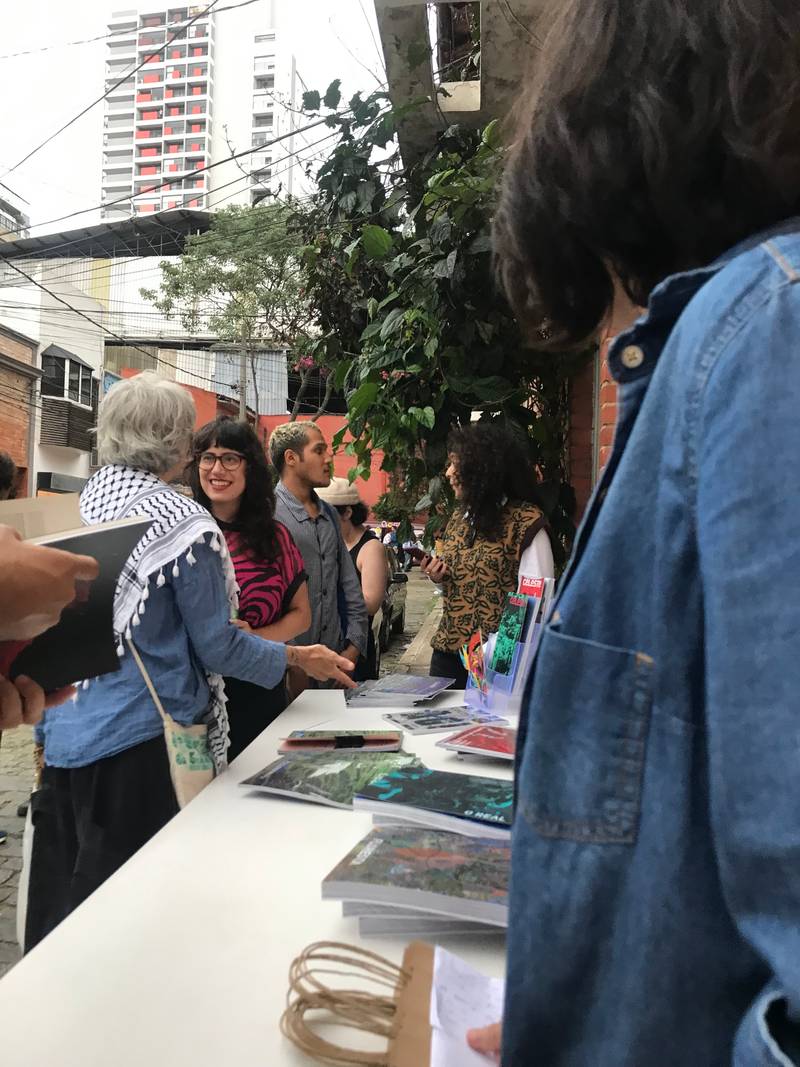
Fair on the street where the magazine’s editorial office is located, 2025
Could you talk about how the shift from a quarterly to an annual theme at celeste came about? What doesn’t fit into three months, and what fits into twelve?
Actions require time for transformations to take place. “Decolonize,” “inform,” “fight,” and “empower” were the four phases of our intervention during the election year that ultimately led to the election of Luiz Inácio Lula da Silva to a third term—ushering in a period of civilizational recovery and the rebuilding of what had been dismantled during years marked by politics of hatred, ignorance, and intolerance.
But the shift in the magazine’s research temporality—from quarterly to annual—actually happened earlier, in 2021, the second year of the pandemic, when we believed the world was about to change. That year, we devoted twelve months to communicating remotely with artists, curators, critics, journalists, and researchers from the Amazonian region in order to produce the issues of the dossier “Forest.” In the course of this process of transformation and ongoing decolonization, the magazine ultimately transitioned from seLecT—a title that emerged in response to a 2010s culture of information curatorship—to celeste, a word associated with sky, air, and oxygen, carrying the sense of fresh winds of cooperation, inclusion, and expansion.
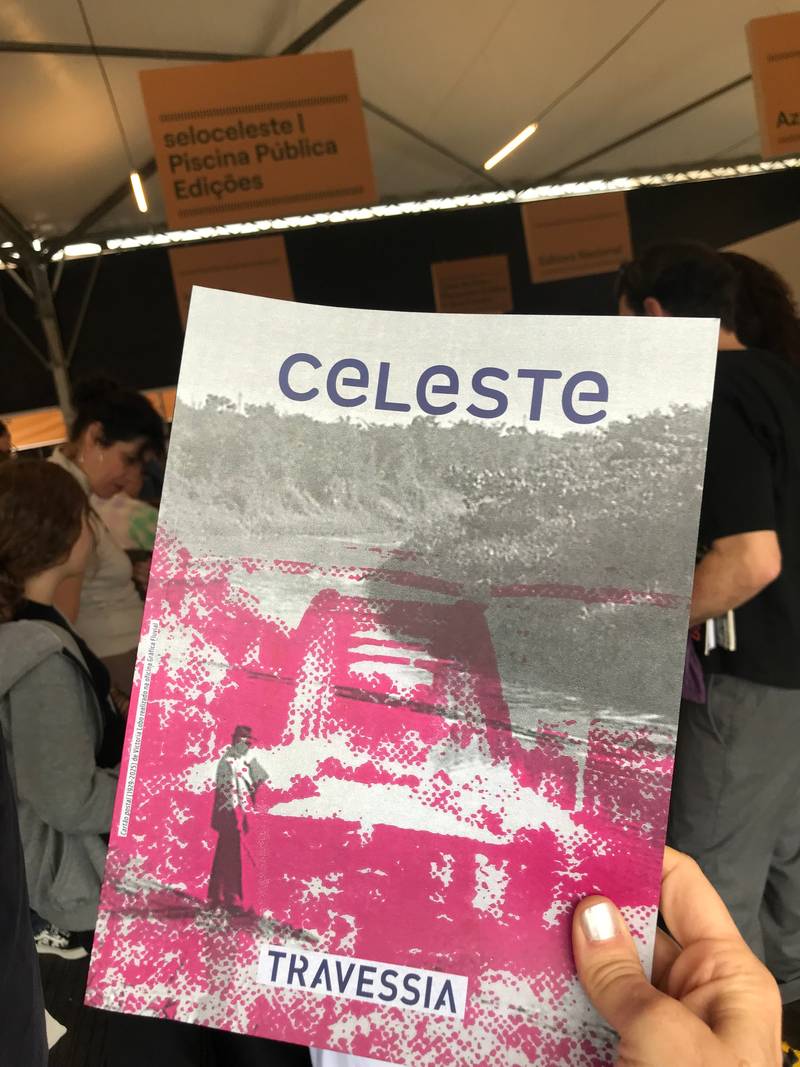
The cover of celeste #6, June, July, August, 2025
You often say that periodicity—the commitment to continuity and regularity in a publication—delimits journalistic practice: how does time shape the meaning of a magazine?
In contrast to the digital world, which, as the Argentine sociologist Néstor García Canclini writes in Cultural Emergencies: Institutions, Creators, and Communities in Brazil and Mexico (Edusp and IEA—Institute of Advanced Studies at USP, 2022), “fosters, rather than continuity, innovation and the intermittence of behaviors,” the cultural periodical is an organism anchored in the principle of periodicity—therefore of duration and regularity.
The cultural periodical is a means of collectively organizing ideas, of practicing and cultivating political and artistic education, and of intervening in concrete situations. None of this is possible without duration, continuity, and organization. Paradoxically, the conditions for duration and continuity in artistic and editorial activity are virtually unviable within a neoliberal context marked by the precarization of artistic labor and the fragility of public cultural policies. As a result, art publishing often has to operate as a cultural project with a limited lifespan, and therefore rarely surpasses a dozen issues. Publications that manage to exceed this threshold in Brazil—and indeed, I would say globally—depend on acrobatic skills.
Another maxim of yours about editorial temporalities is that “the magazine is a time capsule”: here, the periodicity and temporal stretching of thematic dossiers meet the longue durée of history, right? Does the magazine follow history, or does it take part in it?
I often say that, through our work of writing, editing, and publishing criticism, reportage, and reflection on art, we provide a service to the art historians of the future. Our archives are photographs of a time. I’m very fond of the definition you give to the function of journalistic criticism in your introduction to our book of collected criticism, Periodicity and Memory. I always quote it in the critical writing courses I teach:
“Characterized by agility in production and dissemination, journalistic criticism is necessarily more concise, which contributes to a maximum concentration of ideas per word— the-tried-and-true power of synthesis. This characteristic also lends the text a photographic angle, one that chooses a focus and, from that framing, projects a reading of the world that is quickly grasped but endures as a pulsating image and, with luck, a memorable one.”
That is who we are. That is how we become part of history—and make it.
Celeste witnessed the intersection of art and new technologies and the rise of social media culture; recently, the magazine’s focus turns to the Northern region, to Indigenous art, and to forest cultures: did you already sense that the future would be ancestral?
We realized that the future would be ancestral when, in early 2018, we received a letter from Jaider Esbell (1979–2021), a Macuxi Indigenous artist, writing on behalf of several Indigenous communities and questioning the claim that the Tupinambá people had become extinct—a statement published in issue #39 of seLecT (June/July/August 2018), in the text “From the Tupinambá to the Huni Kuin: Brazilian Contemporary Art at Risk,” by Ana Gonçalves Magalhães and Ana Avelar. With Esbell’s letter, what was revealed to us was not only a movement of reclaiming life, visibility, and dignity for cultures silenced and erased over 500 years, but also the emergence of an important contemporary Indigenous art movement. celeste took part in this movement by publishing Esbell’s text “Contemporary Indigenous Art and the Great World.”
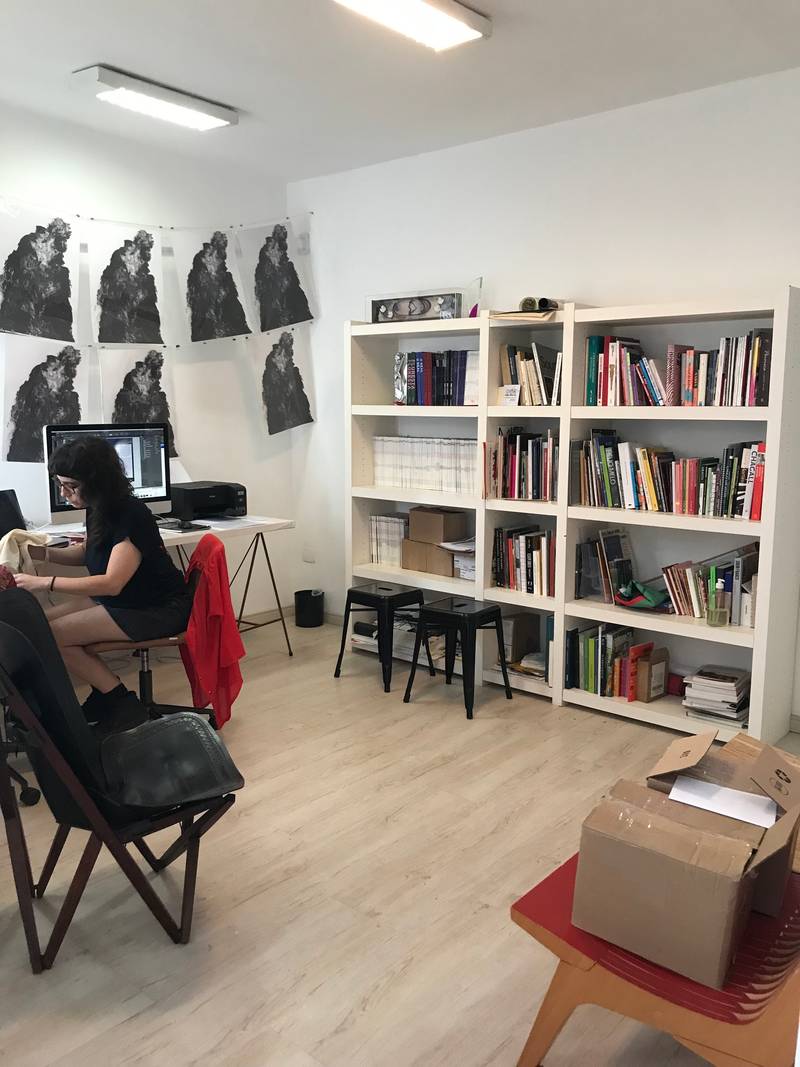
Interior of the magazine’s editorial office
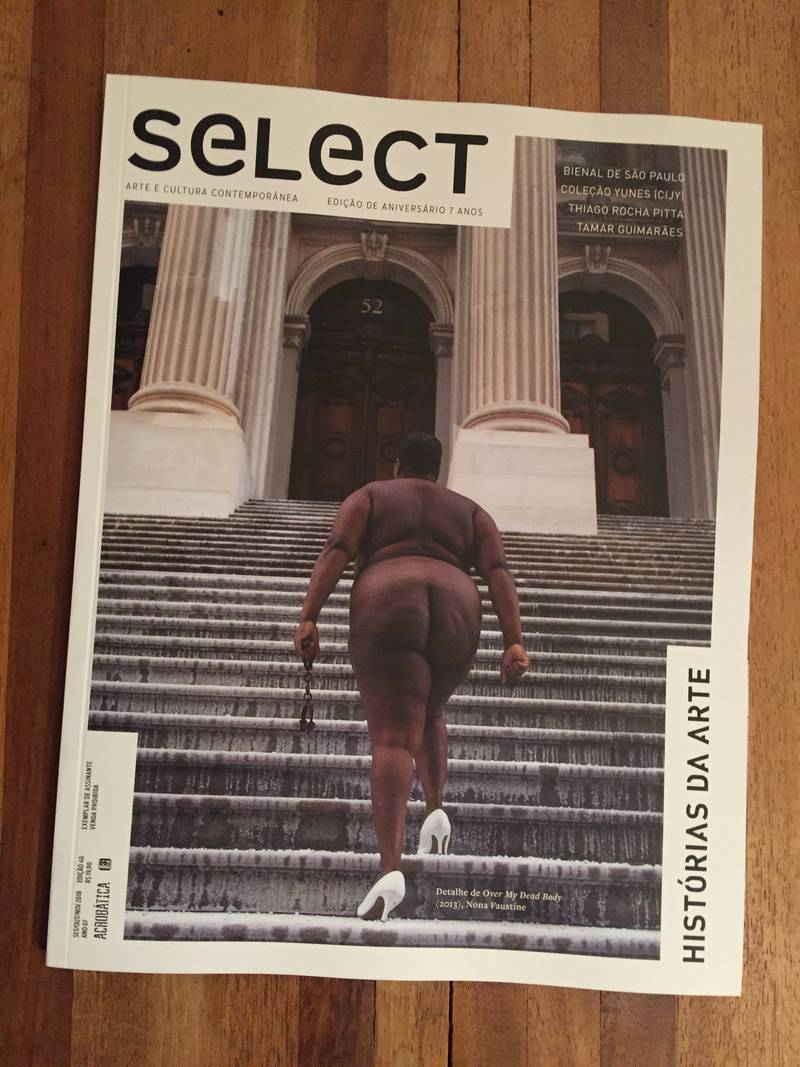
The cover of celeste #40 (September, October, November 2018)
The cover of celeste #40 (September, October, November 2018), featuring an image from a performance by Nona Faustine—was that an encounter with the future?
It was. The image of the body of a Black, nude woman on the cover of an art magazine in a structurally racist country like Brazil was explosive. It cost us a major sponsor that had provided a certain sense of security—which, of course, after that episode proved to be more fragile and cynical than we had imagined.
A native of Brooklyn, New York, Nona Faustine (1977–2025) confronted a facet unknown to most of its inhabitants, even among progressives: a city built on enslaved labor. I strongly believe that the circulation in Brazil of her 2012 self-portrait series White Shoes, which brings into focus sites that—despite bearing no visible markers—are shaped by a history of slavery, was important at a moment when struggles for reparation and reclamation were beginning to take form, in 2018.
I take pride in the decision to place this image on the cover—an image that challenges the place of women, and of Black women in particular, and that fosters debate on art and society—whatever the cost. Our political and social mission is a commitment we have taken on in our work, from the present into the future.
-
 READ
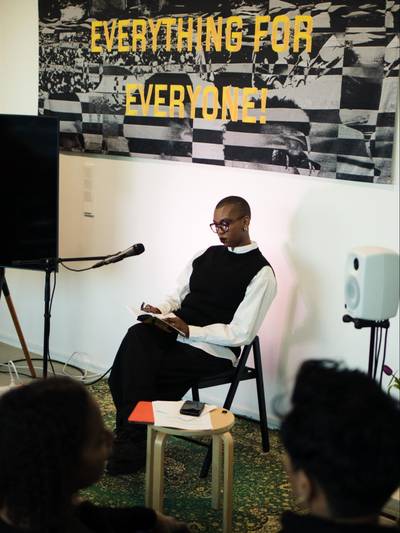
READI think of how many people are not able to be involved in social movements because of their own disability or their caring responsibilities, or the way that forms of social violence take away their capacity, or their ability to fight that social violence, because they’re simply trying to stay alive.
Dreaming of Liberation: An Interview with Lola Olufemi
-
 READ
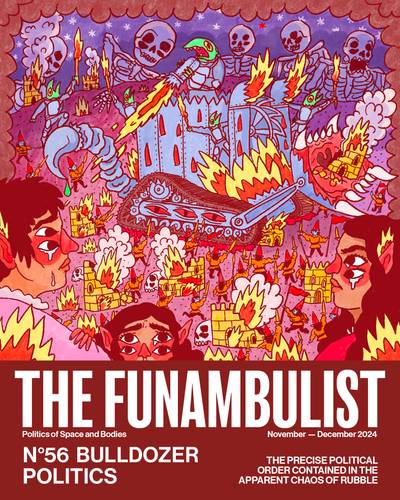
READBulldozers, often seen as neutral tools of industrial demolition, are instruments of territorial domination, urban redevelopment, and political suppression. Yet within these acts of destruction, counter-narratives emerge—poetry, mourning, and collective remembrance—that reclaim agency in the face of state-sanctioned ruination. If ruination is a strategy of power, it is also a site of resistance.
On Bulldozer Politics: An Interview with Léopold Lambert & Shivangi Mariam Raj
-
 READ
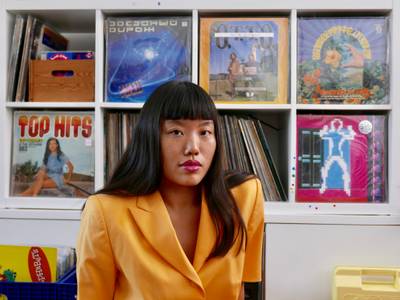
READI felt we were living in a crisis within a crisis. I’m not very optimistic about the current systems that we’re living in and how much progress we are making in terms of getting out of this system. Still, the way that I deal with my disappointment and my despair is that I turn to music, underground art, and artist-activist communities.
Dancefloor is a Radicalising Kind of Moment: A Conversation with Ani Phoebe
-
 READ
READCraftsmanship that leaves a polished finishing and evocative historical notions hidden underneath the fine details. Man Yau’s work with ceramic installations arrests the viewer, while encouraging to revisit and contemplate the uncanny contemporaneity that the artworks embody. In this interview, we discuss artistic processes, practices and labour as well as the intertwining of the personal and the thematic in Yau’s two exhibitions from the spring 2021: M.Y. Chinoiserie at Kuvan Kevät, Exhibition Laboratory, and Dried flowers last forever at Boy Konsthall.
On “The Feeling of Being on Display and Under Pressure” — a Conversation With Man Yau