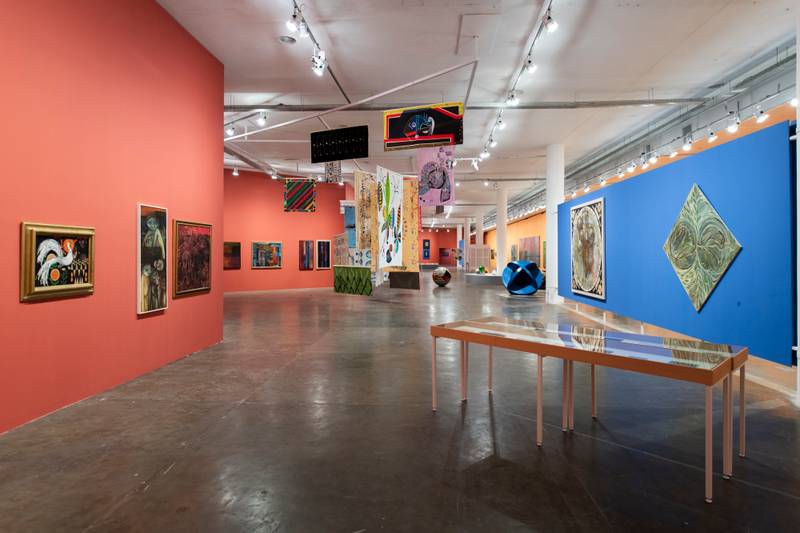
Installation view of the 36th Bienal de São Paulo – Not All Travellers Walk Roads – Of Humanity as Practice © Levi Fanan / Fundação Bienal de São Paulo
Joonas Pulkkinen is a freelance art worker, curator, critic, and journalist. He has a long interest in biennials as a sites for site-specific art and their role in exploring questions of globality.
Postcolonial Venetian Model – São Paulo Bienal1
The São Paulo Bienal’s significance within the network of international biennials lies in its long history. Founded in 1951, it is the second-oldest ongoing biennial after the Venice Biennale (founded in 1895). It is also considered to be one of the largest biennials in the world in terms of visitor numbers. What many people do not know is that, since its 26th edition in 2004, the Bienal has had a free admission policy.
The São Paulo Bienal has always held a strong educational role. São Paulo was the first international biennial which really succeed to gain the archetype of Venice, but it was also first modern and modernist biennial which realized in a geopolitical location outside Northern Hemisphere and “Western” context in Cold War context.2 It is at once local and global, and it has created important bridges between South America and other continents within the broader network of biennials.
The São Paulo Bienal is often described as following the “Venetian Model”, a concept that can also be seen in the naming of its pavilion. The Bienal was founded in 1951 by Ciccillo Matarazzo, an entrepreneur of Italian heritage and the son of millionaire Andrea Matarazzo. Ciccillo, who served as the Bienal’s president until its 13th edition in 1975, visited the Venice Biennale several times and intentionally adapted the Venetian model to São Paulo. Since the 4th edition3 in 1957, the Bienal has been held in the Ciccillo Matarazzo Pavilion, located in Ibirapuera Park. Ibirapuera Park and its buildings were inaugurated during the 400th anniversary celebrations of São Paulo in 1954. The park and its structures, including the Ciccillo Matarazzo Pavilion, were designed by Oscar Niemeyer (1907–2012), a key figure in the development of Brazilian modernist architecture.
The Venetian Model in this context refers to the Bienal’s foundation on the idea of national pavilions and national representation. On the other hand, the São Paulo Bienal’s early editions offered a platform for newly independent nation-states—such as Lebanon, the Philippines, Taiwan, and Vietnam—to demonstrate their sovereignty. These editions included non-Western nations, and as Oliver Marchart has noted, the Bienal lent the Venetian model “a postcolonial note.” 4
However, the “Venetian Model” is, of course, too simplistic a framework for understanding the Bienal’s complex history, which has undergone multiple phases. The Bienal has been divided into exhibitions organized by continent, practiced self-censorship under Brazil’s repressive military regime after the 1964 coup, faced an international boycott in 1969, regained international interest and private-sector support, and refined the role of the new kind of curatorship during the 1980s.5
Since the 1950s, biennials in Latin America and the Caribbean—as part of broader Southern and Western critiques of the biennial format—have experimented with diverse typologies, curatorial approaches, and funding models. The continuity and transformation of the São Paulo Bienall across its different phases form an important part of this history.6 The 28th edition (2008), curated by Ivo Mesquita and Ana Paula Cohen, even took the biennial format itself as its theme. The 35th edition, curated by Diane Lima, Grada Kilomba, Hélio Menezes, and Manuel Borja-Villel, explored the theme “Choreographies of the Impossible,” considering possibilities for radical imagination.
Biennials have their roots in universal exhibitions such world’s fairs so it’s understandable their scale turns them also universal.7 With universalism I mean the tendency to build their thematic ground for European art history continues to mediate ideals of humanity, democracy, and freedom—and the degree to which these ideals are fulfilled globally.8 The represented idea of globality is based on these values but from completely Eurocentric perspective.
Within the context of the São Paulo Bienal, having “humanity” as a theme might appear paradoxical, as the very idea of humanity is inherently universal. In the Enlightenment tradition, history was conceived as the progressive rationality of humankind.
The problem of universalism is embedded in the biennial format and its Eurocentric hegemony, despite as analyses of the “exhibitionary biennial complex”, as Ronald Kolb observes, situate themselves within contemporary, complex constellations of worldviews shaped by post- and decolonial thought, through diverse practices and representations.9 The idea of “global village” enabling cultural exchange and art’s role as mutual cultural understanding10 is on its ruins.11
Biennial format needs alternatives for Venetian model and western hegemony. But I am skeptical the potentiality of universal perspective.
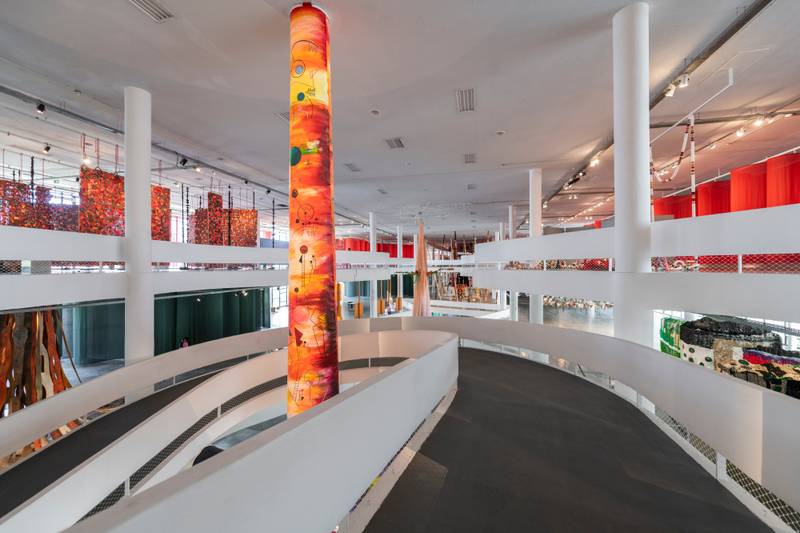
Installation view of the 36th Bienal de São Paulo – Not All Travellers Walk Roads – Of Humanity as Practice © Levi Fanan / Fundação Bienal de São Paulo
Humanity as Practice
Bonaventure Soh Bejeng Ndikung, director and chief curator of Haus der Kulturen Welt (HKW) in Berlin and founder of SAVVY Contemporary (Berlin) invited an impressive conceptual team for the 36th edition of the Bienal. The conceptual team includes as co-curators Alya Sebti (director of ifa-Galerie in Berlin), Anna Roberta Goetz and Thiago de Paula Souza (curator of 38th Panorama of Brazilian Art with Germano Dushá), co-curator at large Keyna Eleison (director of Research and Content for the Bienal das Amazônias) and as strategy and communication advisor Henriette Gallus (former Deputy Director of HKW).
In the world full of stories 36th São Paulo Bienal aims to be grand story where art could give us the possibilities, the sensibilities, and tools to reconsider the world. But why to use humanity for building this story?
36th Bienal de São Paulo’s concept, “Not all Travelers Walk Roads of Humanity as Practice” 12 is, according to Ndikung, “not about identities and their politics, not about diversity nor inclusion, not about migration nor democracy and its failures…”. 13 Instead this “disclaimer” Ndikung states Bienal to be about “humanity as a verb and a practice, about encounter(s) and negotiations upon the meeting of varying worlds, it is about dismantling asymmetries as a prerequisite for humanity as a practice, it is about joy and beauty and their poeticalities and the gravitational forces that keep our worlds on their axes…for joy and beauty are political. It is about imagining a world in which we place an accent of our humanities.”
What is essential for Ndikung’s style, or what have had no doubt big influence for his practice, is storytelling and poetry: This can also be noted in the concept which t is partly inspired by poetry from diverse scale of wonderful and overlooked world literature like Etel Adnan, Abena P.A. Busia, Rodney Saint-Éloi, Rumi, Nam Le and Conceição Evaristo, which poem has also been inspiration for the name of the exhibition concept.
In the world full of stories 36th São Paulo Bienal aims to be grand story where art could give us the possibilities, the sensibilities, and tools to reconsider the world.14 But why to use humanity for building this story? Ndikung notes our era of deep political and social crisis where looking ourselves in the mirror becomes even more important. We should see a multitude in it instead ourselves which is constructed for instance by nation-state.15
Ndikung and curatorial team have been of course aware of possible interpretations of universalism. Bienal was invitation to artists, scholars, and people from all walks of life to imagine submerged worlds. Ndikung also explicitly denied, based on Evaristo’s poem, universalist perspective of the Bienal due “more than half of the world wasn’t considered human enough” 16. I am sure the intention of curatorial team hasn’t been creating alternative, universal perspective of humanity, or support existence of nation-states. But why build grand story based on humanity?
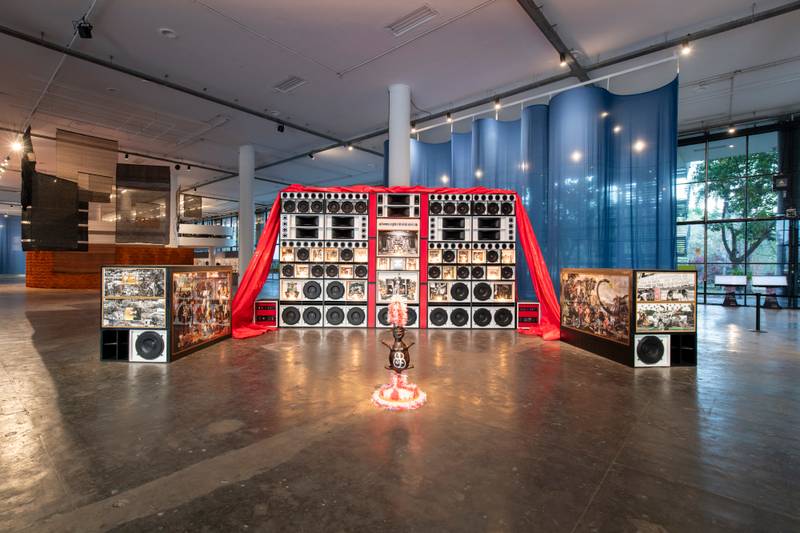
Installation view of A colheita de Dan, by Gê Viana, during the 36th Bienal de São Paulo © Levi Fanan / Fundação Bienal de São Paulo
On the Path of Practice of Humanity
36th São Paulo Bienal featured 125 artists, including individual and collective works. Around half of the work is new commissions. The exhibition path and the scale through six different chapters was considered considering exhibitions visual expression and exhibition architecture. Though exhibition architecture divided opinions during the opening weekend of the Bienal. I think it’s obvious that conceptual team has decided to create impression how to cover the white dominance of the Ciccillo Matarazzo Pavilion building. In press conference of the Bienalconceptual team emphasized the vertical and horizontal axis of the Bienal and how art is spread in its all means in the pavilion.
I understood that the exhibition architecture aim was to present the idea of the concept as storytelling and how “humanity as practice”, illustrated with colors of humanity. However visually impressive architecture didn’t serve mediation of the exhibition. . It was difficult to “follow the story”—in other words, to recognize when one chapter ends and another begins. Wall texts and artwork labels were sometimes missing or placed illogically far from the works. To make sense of the exhibition, one must rely heavily on the catalog.
I agree that some works do resonate with human life and its threats, like overconsumption, exploitation of natural resources and human rights. I would be disappointed in any biennial if there wouldn’t be even some works which couldn’t say anything about even one of these themes.
Some works indeed resonate with fundamental human conditions and its threat—such as overconsumption, the exploitation of natural resources, and human rights disappointed in any biennial if there wouldn’t be even some works which couldn’t say anything about even one of these themes. However, the six chapters do not always clearly communicate how they relate to “humanity as a practice” or “as a verb”. I felt that they functioned as subheadings under which humanity could mean almost anything. This is also the reason why I think the scale of the Bienal creates a universal impression and maintains the logic of biennials as mega-scale exhibitions.
In some cases, the connections between chapters and artworks were noticeable. I understand how first section was created literally for “frequencies of landings and belongings”, kind of easy welcome for entering the Bienal. Precious Okoyomon’s Sun of Consciousness. God Blow Thru Me – Love Break Me (2025) represented the idea of humans connection and dependency of soil17, A colheita de Dan (2025) by Gê Viana, big sound system exploring the vibrations of lack and Indigenous communities, represents idea of frequencies.
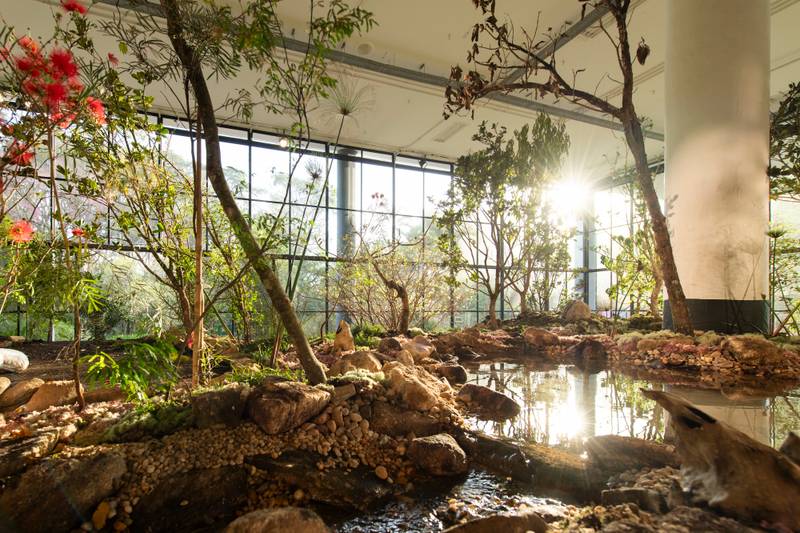
Installation view of Sun of Consciousness. God Blow Thru Me – Love Break Me, by Precious Okoyomon, during the 36th Bienal de São Paulo © Levi Fanan / Fundação Bienal de São Paulo
The second chapter, Grammars of Defiances, could be read as a meditation on resistance to all forms of dehumanization.18 Aline Baiana’s Ouro negro é a gente effectively addressed environmental injustice, particularly the oceanic consequences of industrialization.
Chapters 3 and 4—Of Spatial Rhythms and Narrations and Currents of Nurturing and Plural Cosmologies—were conceptually broad. They include artists who, as the curators describe, “engage with patterns of movement or of simply being in different spaces and geographies at varying times19” and who explore “possibilities, philosophies, and practices of nurturing that are decidedly non-patriarchal, generous, reciprocal, non-exploitative, and matriarchal.” 20
The 36th edition’s artist list was genuinely diverse, non-white, and non-Western in focus. Notably, the sixth chapter, which functioned as a kind of sub-exhibition, was dedicated to the late Koyo Kouoh, artistic director of the forthcoming 61st Venice Biennale (2026), who passed away in May last year. Kouoh was master of building alternative art histories against western canons and I think it’s obvious this was also 36th Bienal’s aim.
Even with conceptual challenges, there were numerous outstanding works that resonate deeply with the notion of humanity. Sharon Hayes’s five-part video series Ricerche (2019–2024) portrays economically and politically vulnerable groups in the United States, engaging in dialogue with BIPOC athletes and LGBTQ+ families to reveal new perspectives on everyday life.
Wolfgang Tillmans’s new commissioned video work Watching Minute for a Minute (2025) wass a brilliant piece that distills key themes of his career in a post-COVID context. Korakrit Arunanondchai’s Unity for Nostalgia (2025) offered a powerful meditation on the connection between death and memory, while Tuấn Andrew Nguyễn’s two-channel video Amongst the Disquiet (2024) explores intergenerational understanding within a Vietnamese American family. Kader Attia’s La Valise oubliée (2024) intertwines three personal narratives connected through forgotten suitcases, confronting collective trauma and the legacies of resistance. Sara Sejin Chang’s (Sara van der Heide) Dismemberment (2025) critically engages with the legacy of the European Enlightenment through a multidisciplinary installation.
However, not all works seem to align meaningfully with the exhibition’s concept or its chapters. For instance, Leiko Ikemura’s and Richianny Ratovo’s paintings, as well as Rebeca Carapiá’s sculptures, felt disconnected from the Bienal’s stated themes. At times, the more abstract pieces struggle to resonate with the idea of humanity—though this may be less a fault of the artworks themselves and more a consequence of weak mediation.
Don’t get me wrong, I didn’t expected the user manual for humanity. I was missing stronger articulation why the focus was on humanity and how the art works and artists resonated with the theme how humanity could be practiced. Bienal relied strongly hard to follow story and let art works speaks themselves.
My main critique is focused on this, how the exhibition can be understood as a re-creation of the exhibition complex of Eurocentric universal exhibitions, in which the sense of a world exhibition is produced quantitatively through the presentation of an innumerable number of things. In the context of the Bienal, these things—artworks that I greatly enjoyed—were not organized by national states. Yet I do not see how the Bienal fundamentally questioned the existence of these self-evident structures of states or proposed alternative conceptions of “humanity” that might meaningfully bring people together.
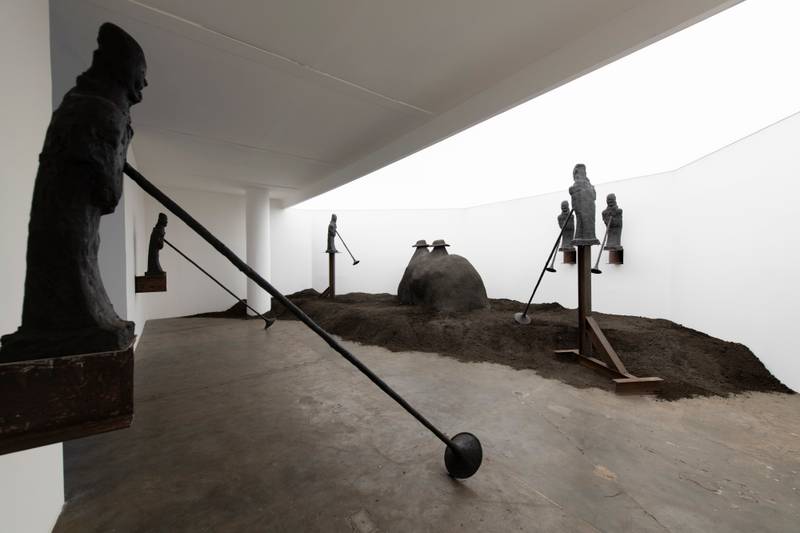
Installation view of Someone’s Child, by Pol Taburet, during the 36th Bienal de São Paulo © Levi Fanan / Fundação Bienal de São Paulo
A Multitude Version of Universalism
During the press conference, questions raised about the relatively small number of Brazilian and local artists featured in the exhibition. This of course opens the question of the local aspect and importance of the Bienal. Many of them were stick in mind in good light: Marlene Almeida’s large installation Terra viva (2025) employs strips of fabric and natural materials to evoke a “cabinet of curiosities” of raw matter; the artist collective Vilanismo presents works through the lens of Black Brazilian masculinity and critical perspectives on gender; and Juliana dos Santos explores the blue pigment derived from the Clitoria ternatea flower, linking color, materiality, and the Afro-diasporic experience in Brazil.
It’s important to note that there are alternatives for São Paulo Bienal in Brazilian context which as federal republic and multicultural colonized country is a problematic concept, and one the Bienal intentionally avoids engaging. Exhibitions such as Panorama and Bienal das Amazônias offer potential spaces for reimagining national representation and for foregrounding the multitude of Brazilian artistic voices.
I found more of that liveliness and openness in the local than in Bienal’s context—for instance, in Casa do Povo, which is also involved as a site in the Bienal’s performance program. Casa do Povo, former underground theater which operated from 1960s until the late 1990, is an autonomous Jewish-Brazilian art space and platform where different associations such like boxing club and chess enthusiasts can have community space for their activities.
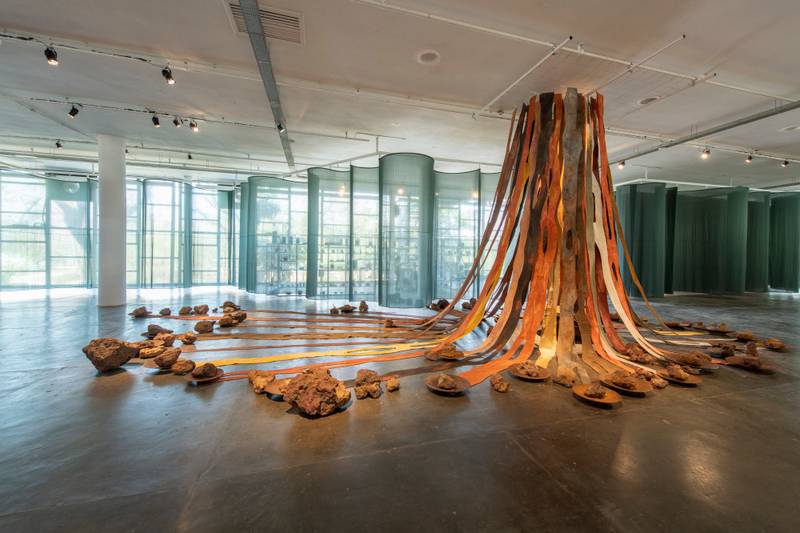
Installation view of Terra viva, by Marlene Almeida, during the 36th Bienal de São Paulo © Levi Fanan / Fundação Bienal de São Paulo
The bigger question is whether the 36th São Paulo Bienal — however brave and sincere its proposal — can actually shift what the Bienal is understood to be. Within the Bienal’s history, this edition stands out as predominantly non-white — nationally significant, directly challenging the white dominance of the Brazilian art world. Yet the Bienal could have been more explicit about the fundamental differences between people and the structural inequalities that follow from them; this was a conceptual absence I felt across the exhibited works.
If we are meant to encounter a multitude within ourselves — as the Bienal proposed — what I found instead was a multitude of artworks that ultimately reproduced the Bienal’s own universal perspective, particularly in its framing of humanity as a shared horizon.
If we interpret the Bienal as intending to argue for a universal standpoint emerging from difference or from Black universalism it did not include a broader critique of European humanism and universalism, nor did it engage with the “reinvention of [universal] community” by constructing what a shared community could mean from the perspective of humanity.
This brings me to three critical arguments against universalism in the biennial format. First, the distance between “humanity” and “humanism” is semantic rather than substantive. Humanism can be thought in plural terms, extended to include more-than-human perspectives — but it cannot be thought without its history of oppression: from the Crusades to the Enlightenment, each moment of humanism has carried its own architecture of exclusion.
My second argument is based on how I interpret the conclusion of Cameroonian historian and political theorist Achille Mbembe’s Critique of Black Reason (2017): “What we must imagine is a politics of humanity that is fundamentally a politics of the similar, but in a context in which what we all share from the beginning is difference. It is our differences that, paradoxically, we must share. And all of this depends on reparation, on the expansion of our conception of justice and responsibility” 21 According to Mbembe only radical difference can articulate dis-enclosure of the world is impossible, “universalism of the name ‘Black’ ”. 22 If we interpret the Bienal as intending to argue for a universal standpoint emerging from difference or from Black universalism it did not include a broader critique of European humanism and universalism, nor did it engage with the “reinvention of [universal] community” 23 by constructing what a shared community could mean from the perspective of humanity.
Thirdly, as Mansi Kashatria noted in the 33rd issue of NO NIIN, even the ideas of reimaging or building alternative realities in exhibition context are rooted in euro modern bias which leads us “being spatially and temporally locked” 24. Arguing for a fundamental difference between people—or even directly declaring that this Bienal is not for everyone—might have been a potentially more radical way of approaching the question of humanity.
-
 READ
READI could see a lot of love. But I was still trying to find the anarchy that breaks through and what it breaks through. I wondered if I should write about the positionality of the festival in what can be termed as its cultural intervention into events and processes that affect us today.
Finding Anarchy: A Review of Helsinki International Film Festival
-
 READ
READClose Watch exhibited at the National Finnish Pavilion at Venice Biennale, 2022, is a multimedia installation that, at its core, utilises the artist themself as an embodied intervention within a focused area of artistic research and apparent critique. In the context of this work presented as an exhibition at the national pavilion and its implications of somehow representing Finnish Art, this text seeks to question whether issues pertaining to embodiment and social intervention – and by extension, research conducted and artistic practice developed through it – can ever be free of the power relations implicit in the political, identity-driven understanding of society today.
Who Watches Whom? Ruminations on Power, Gaze, and Field Through Pilvi Takala’s Close Watch
-
 READ
READThe wealthy are equated with such minorities as if being wealthy were a specific cultural phenomenon or even an identity based on a form of discrimination. Veering through notions of whether wealth improves mental well-being or is taboo in Finnish society, Eetu Viren peruses the exhibition’s banality and ridiculousness to expound on questions of wealth and power and why the Finnish National Museum hosted an exhibition that characterizes the wealthy as a “minority group.”
The Poor Rich People: A Review of ‘The Philosophy of Wealth’
-
 READ
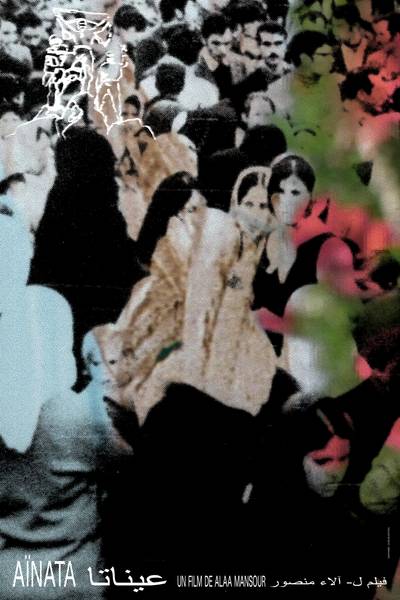
READAïnata (2018), shot in South Lebanon, is the debut documentary by the Lebanese research-based artist and filmmaker, Alaa Mansour. The memories being reconstituted in the film are those of Aïnata, a town in South Lebanon nestled within olive and tobacco farms, plagued for decades by Israeli occupation and violence.
Memory and the Fractured Image: A Review of Alaa Mansour’s ‘Aïnata’