Sedeer el-Showk is a writer and activist based in Helsinki. Trained as a biologist, he has worked as a science journalist for over a decade. He has been involved in activism and political work in Helsinki since 2021, oriented mainly towards addressing climate change and colonialism.
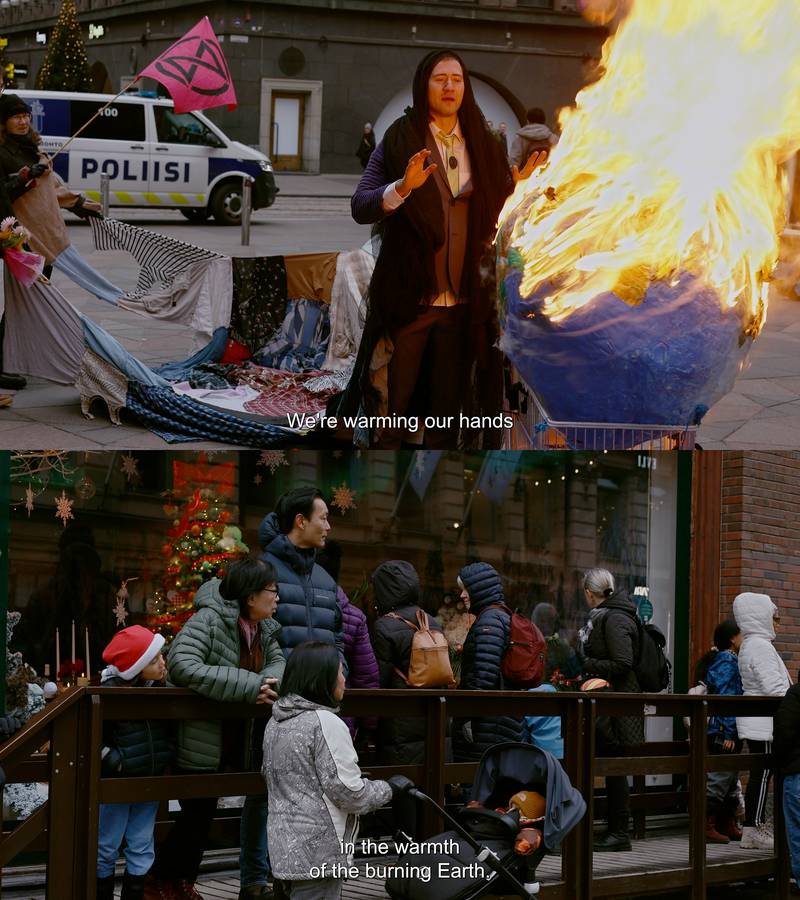
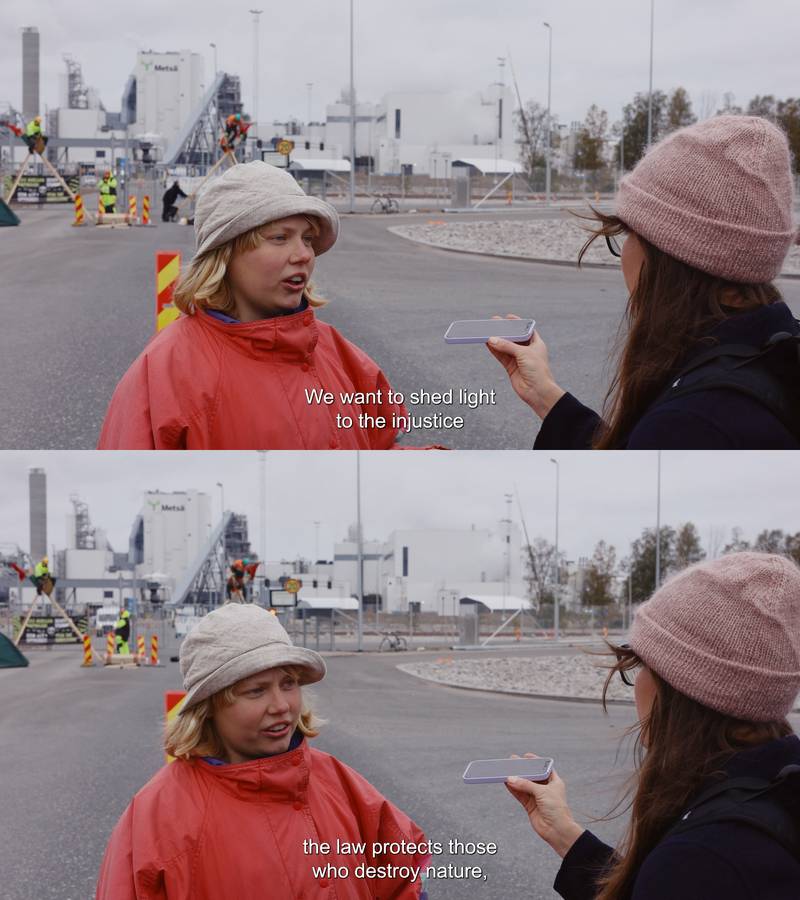
Rebellion for Future opens by taking the viewer into a climate protest. A close camera follows an activist biking to join an Elokapina demonstration in the heart of Helsinki. A similar perspective is primarily used throughout the documentary; the film has very few wide shots, so the viewer is embedded in events rather than watching them from a distance. This framing brings a sense of immediacy to the film’s events, but it also—consciously or not—reflects the dominant political culture in activism in Finland, a culture which forfeits a broader, deeper understanding for a sense of authenticity and connection.
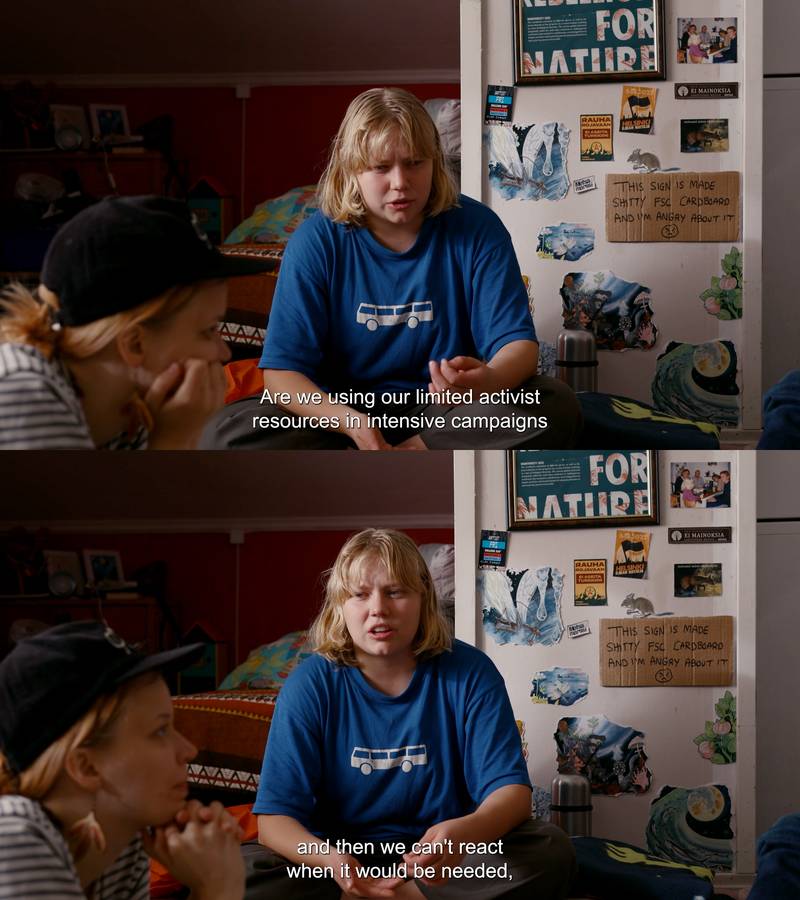
The documentary continues with an Elokapina roadblock outside a UPM mill at Kuusankoski in Kouvola. After an establishing shot, the camera takes viewers into the heart of a protest, showing activists discussing with each other, managing the protest, and staying calm while irate employees tear up their signs. One of the activists also has an extended discussion about the protest with the mill manager. Conversations like this are the documentary’s main tool for giving information to the audience. As the activists present their views to other people throughout the film, we listen in, an invisible presence over their shoulder. As they reflect together, we’re quietly part of the group. As they cry in frustration and despair, we watch in silence.
Some of Elokapina’s actions have certainly been disruptive, but their overall effect is debatable. Even when they engage in disruptive civil disobedience, the main consequence is delay or inconvenience. Activists often go slack when being detained by the police, slowing things down by making it harder to move them—but the police eventually remove and detain them.
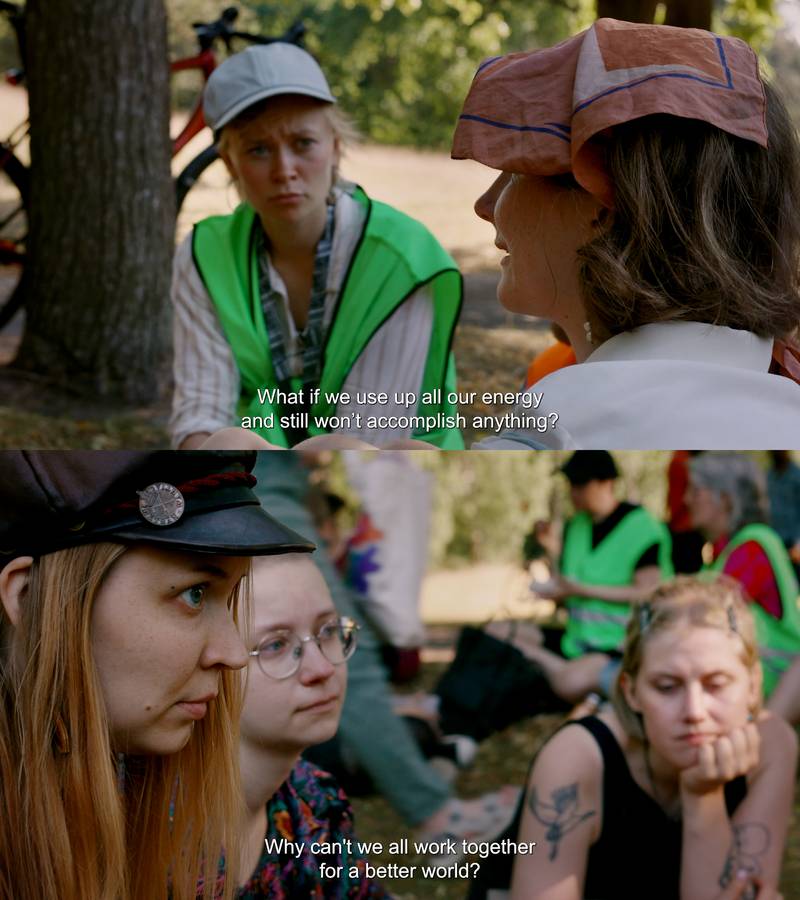
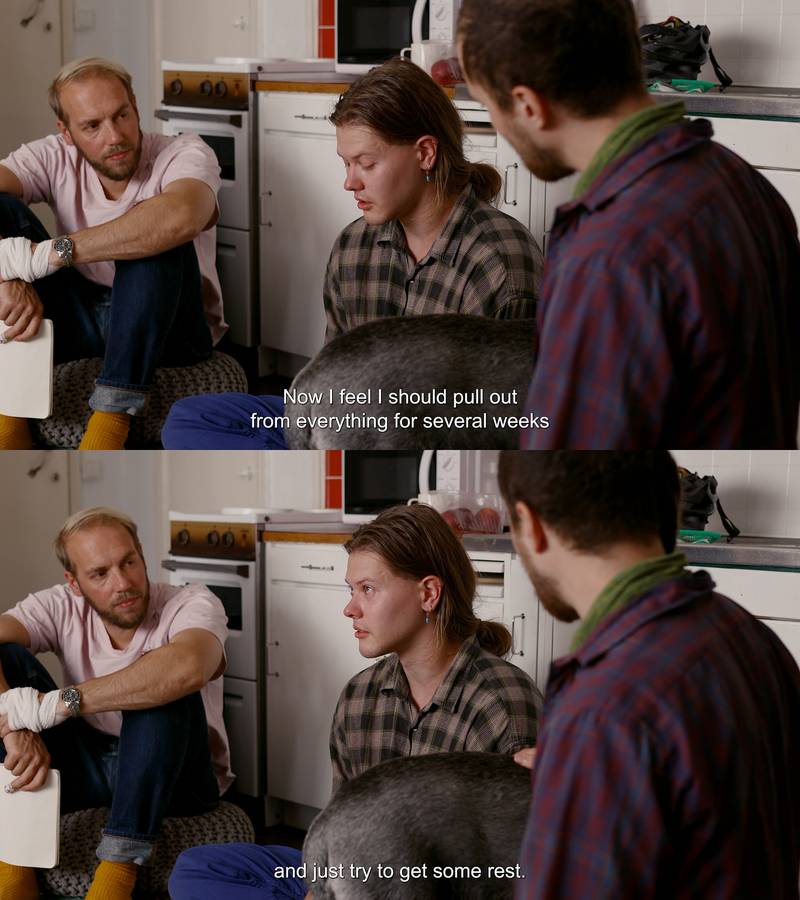
This framing is an effective choice by director Saku Soukka. Putting the viewer inside protests alongside the activists creates a sense of empathy, and taking us into the debriefs, discussions, and support circles extends that into a kind of intimacy. It’s clear that those feelings are just a faint echo of what the activists themselves feel—the camaraderie that comes from protesting together—and that awareness might even prompt some viewers to think about joining the movement.
The embedded viewpoint doesn’t just humanize the protesters; it also demystifies the protests. Viewers coming from outside of activism circles get a sense of how things work. We get to see how decisions are made, how activists work together, how they negotiate with the police, and how they cope with the reactions of other people. But what struck me, as someone who’s been heavily involved in activism in the past few years, was how familiar it all was.
There’s some comfort in that familiarity—the warmth of group identity and of seeing people I know and have worked with. But there’s also dismay. The protests and acts of civil disobedience that I saw throughout the documentary have become routine. Everyone—the police, the activists, the media—knows their part and plays their role. For me, watching these events unfold throughout Rebellion for Future felt like watching actors perform a play that I love. Each performance brings its own interpretation, but I already know the script, and the performers don’t deviate from it.
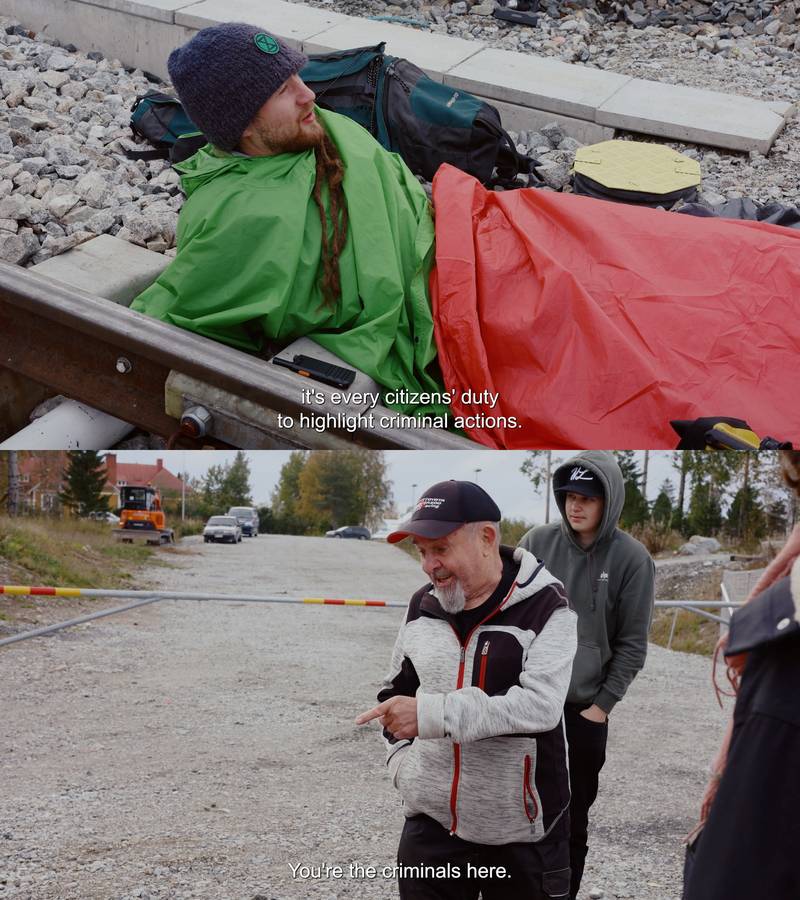
Some of Elokapina’s actions have certainly been disruptive, but their overall effect is debatable. Even when they engage in disruptive civil disobedience, the main consequence is delay or inconvenience. Activists often go slack when being detained by the police, slowing things down by making it harder to move them—but the police eventually remove and detain them. In one scene in Rebellion for Future, activists are perched in trees to prevent logging in Stansvik, Helsinki. Negotiations with the police and the need to carefully remove the activists delay the process, but once the site is cleared, the logging goes ahead.
The strategy seems to be based on generating public awareness and sympathy—or even outrage— the idea being that convincing the public will lead to change. Other activist movements here have taken a similar approach, though often without civil disobedience. For example, the Palestine solidarity movement has organized regular demonstrations in downtown Helsinki since the start of Israel’s genocidal assault on Gaza in October 2023 but has rarely engaged in civil disobedience.
What does that mean for these protest movements? Where does it leave activism that appeals to power instead of building power of its own?
But for Elokapina and the Palestine movement, that strategy hasn’t worked. Even though 60% of the Finnish public opposed Israel’s actions in Gaza in 2024, Finnish policy remained supportive of the genocide. Likewise, seven years of Elokapina activism across the country doesn’t seem to have shifted the Finnish state’s approach to climate change.
What does that mean for these protest movements? Where does it leave activism that appeals to power instead of building power of its own?
The politics of appeal ignores the fact that the Finnish state acts according to its internal structure and its place in the world. Sympathetic outpourings cannot change that.
Finland is not only a fervently capitalist state, racing eagerly into neoliberalism, but also an imperialist state, with our well-being built on extracting material and labour from countries that are kept poor and underdeveloped for our benefit. When you buy a shirt or a phone, the Finnish government collects more in VAT than the workers in Bangladesh or India get as salary. That money goes towards our healthcare, roads, and schools instead of towards the well-being of those workers and their families. We can afford to pay that VAT because we get relatively high salaries—our cut of the spoils of paying Global South workers as little as possible and taking their cotton and minerals as cheaply as possible, no matter the brutality and destruction required.
As a capitalist state, Finland is structurally unable to tackle the climate crisis. As an imperialist state, it will not oppose colonialism and genocide.
The theatricality that I sensed while watching the documentary is what happens when activism persists in appealing to power despite these realities. Sometimes it’s explicitly performative—for example, as the logging at Stansvik goes ahead, Rebellion for Future shows a member of Elokapina’s Red Rebel Brigade theatrically mourning the forest, pouring sawdust onto their red turban and curling in grief over a tree stump. It’s a potent emotional moment in the film, as it no doubt was in life, but I’m left wondering how such actions lead to change.
Even protests that aren’t explicitly theatrical become reduced to performances when they rely on appeal rather than aiming to build power. The Palestine protests over the past few years—many of which I helped organize—were generally choreographed events, aiming to make noise and be visible but always careful not to transgress. Elokapina is far more willing to cross lines and be disruptive, but the fundamental approach is still one of appeal, and the civil disobedience is a theatrical event to make that appeal.
Like the activism it documents, Rebellion for Future is theatrical—and like that activism, it has a troubled relationship with its theatricality. The visual framing from an embedded perspective gives a sense of genuineness and honest representation—of immediacy. But this is simultaneously an attempt to deny the mediated nature of film, its theatrical re-presentation of reality through choices like viewpoint and composition. The camera’s presence is never acknowledged in the documentary. Even in the aftermath of police aggression or violence, we learn about the activists’ fear and anger by watching them talk to each other, not into the camera.
The intimate point of view and apparent immediacy create a particular kind of emotional connection between viewers and the activists, one that lends itself to identifying with the people on screen. The same denial of theatricality underlies the commercial success of reality TV and the propaganda value of embedded journalism. Its use in Rebellion for Future makes the documentary effective at motivating the audience to join Elokapina, but it leaves open a crucial question: what are people being mobilized for?
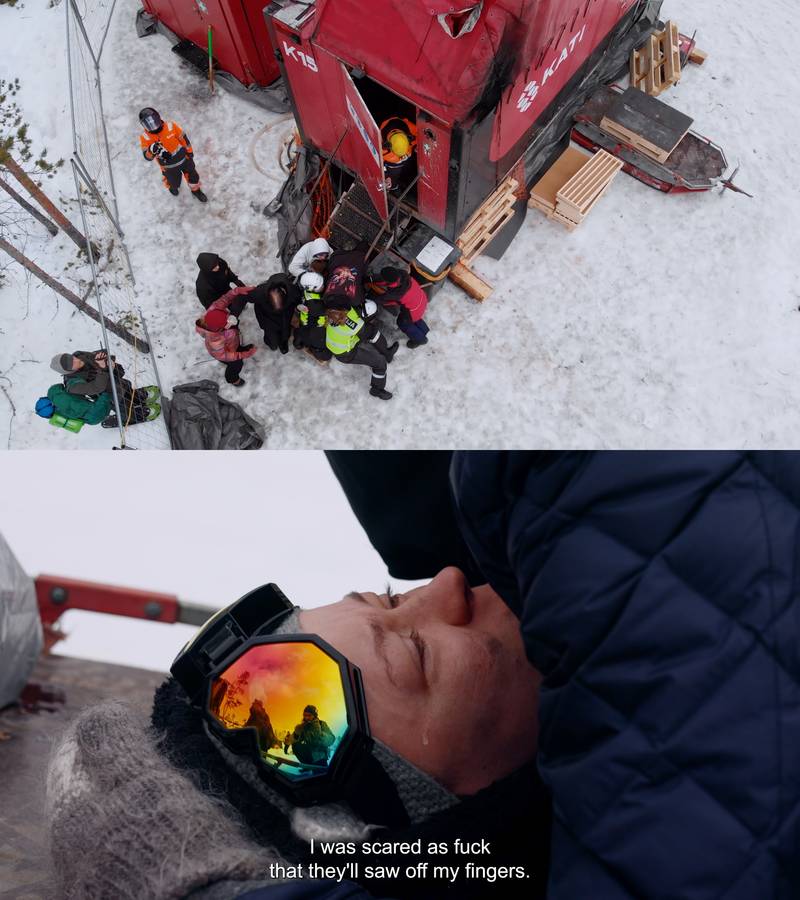
The answer to that question is, to a certain extent, outside of what the documentary can show with its framing, outside of the topics it can address. The film takes for granted that viewers oppose climate change, as well as their understanding of the climate crisis. Likewise, Rebellion for Future doesn’t present or interrogate Elokapina’s model of activism and the strategic logic underlying its actions.
Both topics are discussed by activists during the film, but viewers are left to learn about them via this “inside view.” For example, in a potent reflection about halfway through the documentary, an activist speaking with How To Resist Radio says that even though Elokapina (and Extinction Rebellion more broadly) hasn’t succeeded in forcing political change, mass mobilization is a valuable skill to keep in the repertoire for when “some totally horrible [climate or biodiversity] event [happens] with thousands of lives threatened, the media full of the news and people shocked.”
Without a narrator, the documentary can only leave these comments to stand for themselves. A narrative voice could have raised and addressed important questions related to this discussion. For example, why was Elokapina then slow to mobilize against the genocide in Gaza? Was there resistance within the movement because activists didn’t see it as a “climate event”? If so, how is that consistent with the organization’s decision to support the “Woman, Life, Freedom” protests in Iran? What do these differing stances and the dynamics around them say about Elokapina’s politics? What does it mean when a climate movement doesn’t understand the connection between capitalist imperialism and climate collapse?
Of course, it’s important to listen to people who have a more direct, intimate understanding of a situation and have a stake in it. But if the requirement to listen is left at that level, it mirrors the illusion of unmediated access and neutral perspective offered by the camera in Rebellion for Future. There’s no consideration of which Iranians or Palestinians we are listening to, and the politics that guide the decision of whose voices to accept and amplify become invisible.
The documentary’s aesthetic of immediacy means there is no narrative persona to ask such questions, to guide viewers through what they’re seeing and provide context or critique. This means that viewers only have their own immediate knowledge with which to evaluate what they see; they don’t get the benefit of the expertise and extra facts that can be brought in by narration. Of course, narration also brings bias—but so does the supposedly unmediated, neutral view of embedded documentary.
The framing choices in Rebellion for Future also reflect a problematic ethic in activism in Finland: the primacy given to listening to the people who are from a place facing a crisis (Palestinians, Iranians, Kurds, Venezuelans, etc). Of course, it’s important to listen to people who have a more direct, intimate understanding of a situation and have a stake in it. But if the requirement to listen is left at that level, it mirrors the illusion of unmediated access and neutral perspective offered by the camera in Rebellion for Future. There’s no consideration of which Iranians or Palestinians we are listening to, and the politics that guide the decision of whose voices to accept and amplify become invisible. Just as the embedded camera disguises the perspective chosen in Rebellion for Future by making it seem authentic and natural, the demand to elevate oppressed voices offers an illusion of authenticity, hiding the selection we make from the diverse viewpoints and politics within these groups.
Likewise, the absence of narration echoes the apparent absence of context and historical awareness in the political analyses of activists. Even if we assume that Elokapina understands the fundamental link between capitalism and the climate crisis, that understanding isn’t reflected in their demands, which call for action by the government of Finland, a capitalist state.
As I write, the US is building towards yet another illegal and unprovoked attack on Iran, and activist discussions are trying to balance between opposition to imperial aggression and concern about oppression by Iran’s government. These abstract discussions ignore a concrete history stretching through Syria, Libya, Afghanistan, Iraq, Yugoslavia, and beyond, a history in which US-led attacks have massacred millions and shattered countries for imperial profit. The discussions also ignore the context in which the activists act: in Finland, an imperialist country that is part of the aggression against the Iranian state and which profits from US-led wars.
This discussion of the framing choices in Rebellion for Future is not a criticism of the documentary. Taking a different approach would have fundamentally changed the film, transforming it into something different than what Soukka presumably wanted. Rebellion for Future is both a documentary and a form of activism, and the immediacy of its (re-)presentation reflects and enacts that. Mobilization is also an important element of the film’s visual narrative. The documentary opens by following a single activist going to a protest which is heard in the distance, and it closes from within a group of activists standing in protest together, united in song.
Mobilizing people for activism is vitally important. But in order to change the world, we first must understand it. When mobilization and action happen without understanding and reflection, they fall into theatricality—and, worse yet, they run the risk of becoming tools of the system they should be opposing.
Just as Rebellion for Future takes opposition to climate change as a given, activism in Finland rests on an assumption of a shared liberal worldview and abstract values detached from a concrete context. The embedded perspective in Rebellion for Future creates a sense of authenticity and immediacy, and in the same way, the focused attention of traditional media and social media direct activists towards certain oppressions and perspectives and away from others. Without historical knowledge and a situated analysis, this results in a reactive activism shaped by an unacknowledged political ideology. The (re-)presentational choices of Rebellion for Future make the documentary effective as an extension of Elokapina’s activism, but the invisible operation of similar framing mechanisms in Finnish activism lead to it unknowingly serving the agendas of global imperialism.
-
 READ
READThere is no universal ‘the’ trans body. Where does this article ‘the’ come from and what does it do? To us it seems that to look at something through the lens of ‘the trans body’ is claiming to know something that is situated in some imagined universal trans body – ultimately projecting one’s own body as that universal human in the trans context; the same universal human that the work claims to critically dismantle. White, non-disabled, thin, masculine and middle-class.
The Trans Body in Venice: A Critique of Universalising Transness
-
 READ
READAïnata (2018), shot in South Lebanon, is the debut documentary by the Lebanese research-based artist and filmmaker, Alaa Mansour. The memories being reconstituted in the film are those of Aïnata, a town in South Lebanon nestled within olive and tobacco farms, plagued for decades by Israeli occupation and violence.
Memory and the Fractured Image: A Review of Alaa Mansour’s ‘Aïnata’
-
 READ
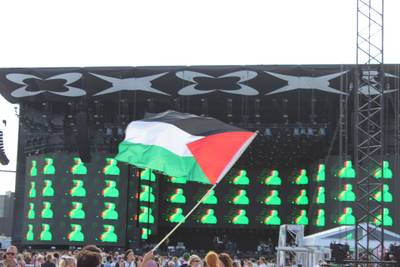
READHow will Flow Festival respond to criticisms about its relationships with its free workforce, security contractors, Helsinki Police and its Zionist holding company? Will it align with or distance itself from the actions and affiliations of its financial backers?
Flow Festival: A Retrospective
-
 READ
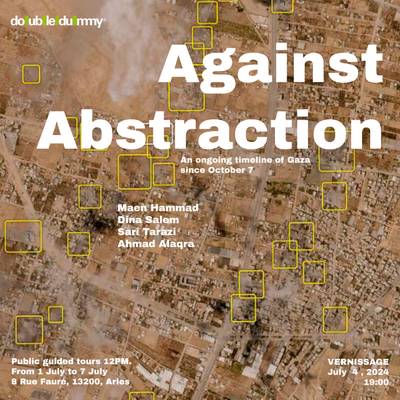
READAn activation by Palestinian artists Maen Hammad, Dina Salem, Sari Tarazi, and Ahmad Alaqra was hosted at DoubleDummy, Arles, between July 1-7, 2024, during the opening week of the Rencontres d’Arles. It conveys a timeline of the ongoing genocide in Gaza using information shared via alternative messaging platforms like Telegram.
Radical Re-imagining of Visual Order Amid the Ongoing Genocide of Palestinians: A Review of ‘Against Abstraction’