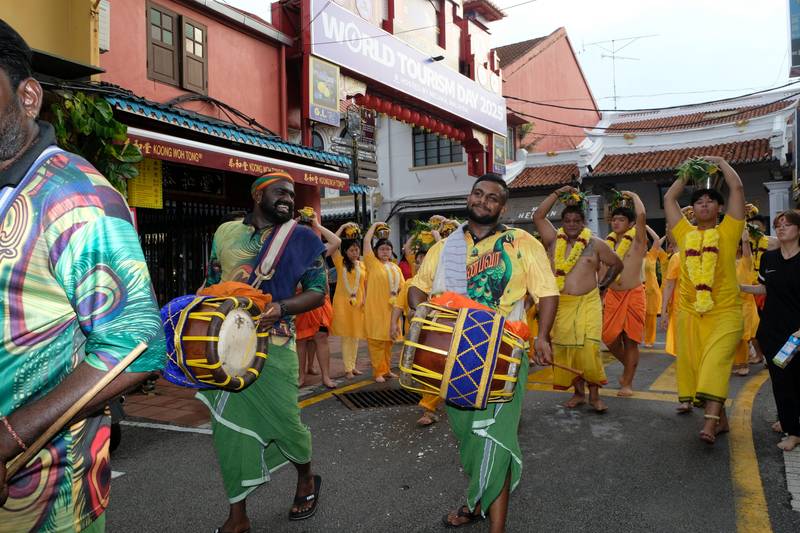
Photo: Mogan Selvakannu
Miriyam Ilavenil is an investigative journalist, editor, researcher, and translator. She writes political analysis and cultural criticism centering indentureship, revolutionary movements, counter insurgency, fascism, and imperialism. She is currently the Associate Editor at South Asian Avant-Garde.
Nestled in Brickfields, the Indian/Tamil-dominant area known as “Little India”, between commodified “South Indian” style restaurants, wedding card printer stores, and car mechanic sheds, Sree Vinayaka Indian Traditional Music Resources (one of five branches across the peninsula) sells and repairs for traditional Tamil folk musical instruments.
“Ask me to let go of anything and I will – except the Urumi.” Hari, a 22-year-old full-time worker at Sree Vinayaka, tells me with playful conviction. Hari, a native of the colonial tin-mining region of Rawang, is a Tamil folk artist in addition to working at the store. He has been a member of the Magamayee Urumi Melam Rawang band since he was 12, performing at Batu Arang estate’s Aaagasa Mariamman temple, falling in love with the art form he grew up witnessing in the Hindu temples where he prayed as a child. A black ink tattoo of the name ‘Magamaayee’ (an incarnation of Amman) is etched across his dark-skinned arm, an emblem of his devotion to his art and his faith.
Ragu, owner of Sree Vinayaka, has run his store for 15 years. The 42-year-old native of Semenyih has played the urumi since 1998, when he began performing with the band Sri Agilanda Athimuniswarar Urumi Melam Ampang. Since 2003, he has been a part of Chinarasa Urumi Melam Maasanakali KL. Throughout his business, he has devoted himself to mastering the construction and musical evolution of Tamil folk instruments, learning from folk musicians and craftsmen from the subcontinent. “I source wood from Trichy, Chennai, Thanjavur, Jaffna and goatskin from Pakistan’s Sialkot.” He has spent nearly RM40,000 (10,000 USD) to learn from the masters. “It is a business, not an education for them.” He travels to the subcontinent at least once a year to learn how to manufacture the instrument better and to develop his skills as a folk musician.
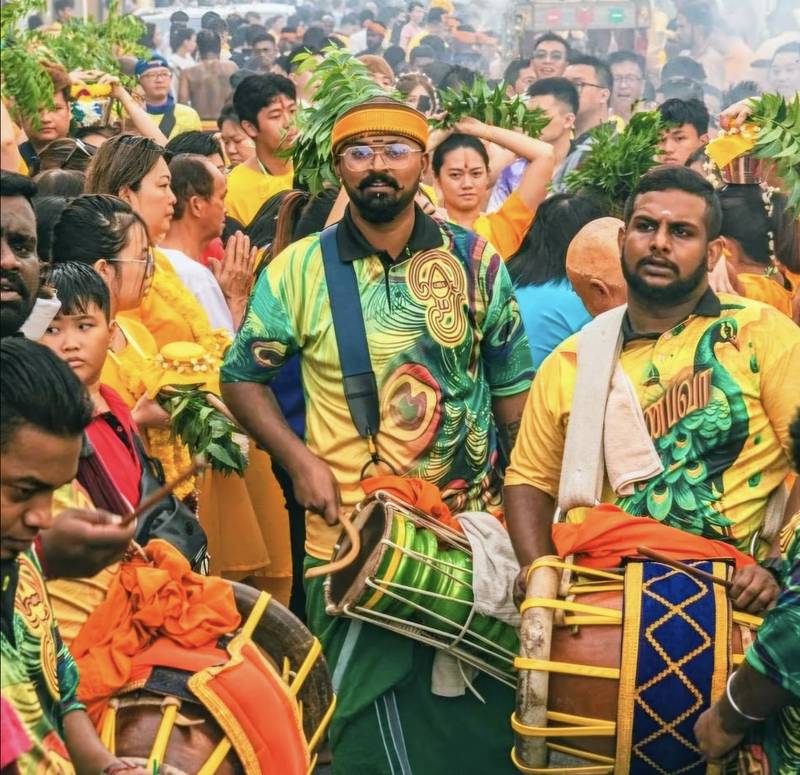
Photo by Tamilarasu
Folk musicians like Tamilarasu also source their own materials, like wood and screws from Tanjavore; goatskin from local Malaysians, to build the instruments themselves. “It’s hard work; sometimes the goatskin doesn’t always fit against the wood properly. But only when we make the instrument ourselves can we get the pitch we’re looking for.” Tamilarasu, 34, is a native of Johor’s transient state and has been part of his family’s urumi melam band, Om Muruga Urumi Melam Johor, since age six. The band has been performing since 1995. Like hundreds of thousands of other Malaysians in Johor who commute hours to work in Singapore, he spends nearly three hours every day getting to Changi Airport, where he works as an aeronautical technician. He has played the same urumi since he was 13. “If you take care of your instrument, it can last forever.”
Like Ipoh Suppiah, who popularised the urumi melama in Malaya in the 1970s, Tamilarasu’s two maternal uncles, Yoganathan and Saravanan (also known as Raju), pioneered urumi melam in Johor and across the peninsula. Now in their 50s, they still play in their family band, with Yoganathan passionately performing with the 8 kg pambai he carries at each gig. Performing in an urumi melam band requires considerable strength because of the instrument’s weight and the performance’s length, which can last hours. “I have calluses on my hands from years of performing,” Tamilarasu says with pride. “When I go to work the day after a performance, the ache stays in my body.”
Tamilarasu’s family has influenced the growth of folk musicians across Johor and Malaya, helping create Singapore’s first urumi melam band, Singai Adi Urumi Melam, in the 1990s–2000s. Artists from Johor maintain close ties with those in Singapore and across the peninsula, where they often perform. Each state has its own distinct style; musicians teach and learn from one another, inspiring sonic inventions while staying competitive and supportive. Within each band, everyone contributes to the composition, mastering their own instrument and bringing new perspectives to sound.
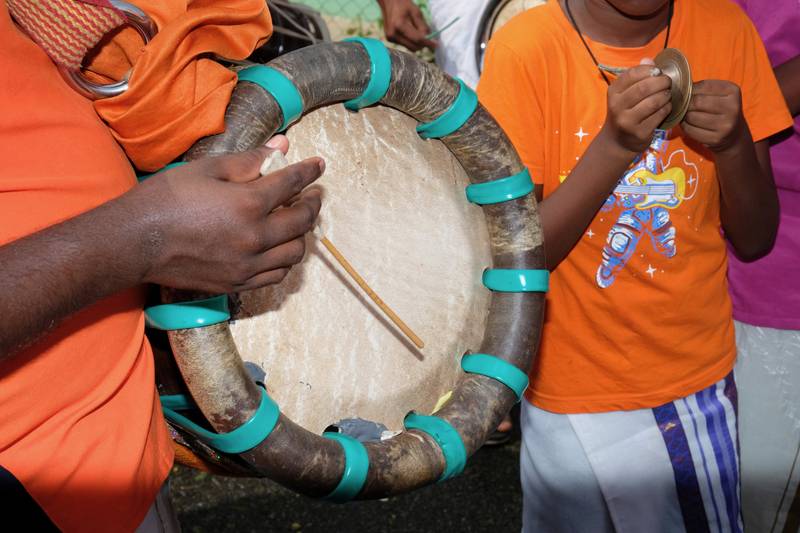
Photo: Mogan Selvakannu
Tamilarasu shares that he places the urumi on his prayer altar, next to pictures of his gods. “Every day I pray to the urumi, I thank the urumi for being with me, for giving me strength.” The urumi has been a constant in Tamilarasu’s life; through unemployment, breakups, loneliness, and alienation, the music breathes life into his spirit. He advises other urumi artists to respect the medium as a deity. “After every performance, I kiss both sides of the urumi”. He views the art form not as work, but as religious servitude. He particularly loves performing in front of the chariot processions his band leads every year during Thaipusam. “I feel closer to god when I play, like I am speaking to god; when someone’s in a trance and blesses me, I feel content.”
The urumi is a physical medium of wood, metal, and skin, created by the hands of working men, metaphysicalised by the Tamil folk artists who, uprooted from political struggle by imperial counter-insurgency, endure the hell of neocolonialism through their mystification of art. Their soul – Tamil soul of Tamil soil – are a decreation of caste, colonialism and capital. Their music is a dialectical (de/re)generation of materiality into immateriality. The spiritual power the artist gains through his performance is not artificial divinity, but his Natural Self, the earth of his soul, the flesh of his consciousness.
What the Music Carries
I borrow Simone Weil’s vaguely described ‘Decreation’: as the emptying of the Self to reach God, as a substitute word for Marx’s alienation: the emptying of the Self by Capitalism (“The more man puts into God, the less he retains in himself.”). Appropriating Weil’s mystical decreation for a Marxist’s materialist decreation. Capital is labour decreated, caste is kinship decreated. Malaysia is revolution decreated.
The sonic sentience of the urumi melam, birthed by the post-indentured Tamil community, aggravates Malaysian neocolonialism and the caste-feudal structure that has transmuted with the imperial base, of which the sound, the instruments, and, most importantly, its musicians are prisoners of. Emancipating the urumi melam from reductions to metaphysical religious absolution and feudal ethno-cultural expression unearths the rhizomatic spiritual relationship between the urumi melam and the Tamil people, as a medium for materially expressing their political reality.
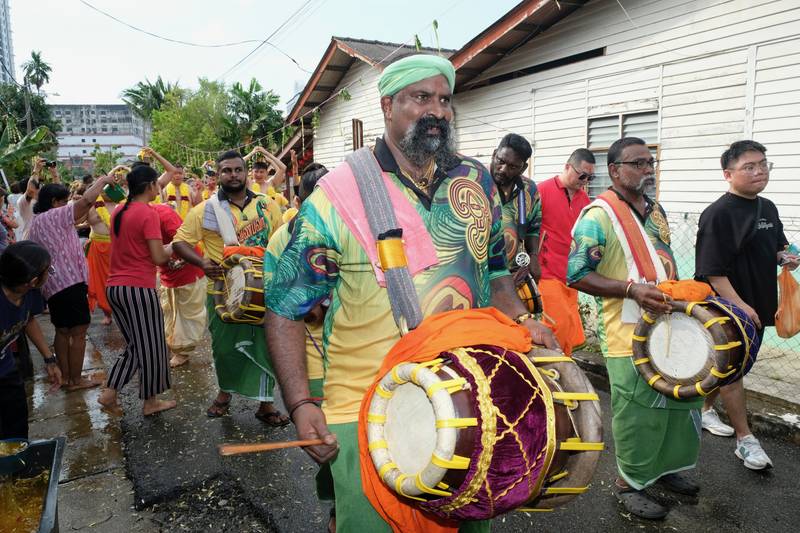
Photo: Mogan Selvakannu
The urumi melam, called naiyandi melam in Tamil Nadu, consists of the instruments urumi, melam, tavil, pambai and tappu (parai). Tamil Nadu’s naiyandi melam uses the same instruments as urumi melam, plus the nadaswaram and salangai, and it emphasises song. While Malaysia’s urumi melam is almost exclusively an art form rooted in religious expression, Tamil Nadu’s naiyandi melam, dictated by god, caste, and temples, includes performances rooted in secular creativity. Tamil Nadu’s naiyandi melam artists and Malaysia’s urumi melam artists are caste-oppressed Tamil men who must fight for the dignity of their art form. Tamil folk art is made peripheral by comprador states and imperialism because the Tamil people exist in the periphery of power, wherever they are. Tamil primitive communism decreated into proprietary privatisations of caste, class and later colonial occupation. This was the first act of sonic decreation: the dehumanisation of the Tamil soul and Tamil soil. This decreation follows the post-indentured Tamil folk artists who have not dealt with this primordial decreation of their art, their history, and themselves.
While the Malaysian state continuously vilifies Tamil men as violent and beastial, the urumi melam artist, many of whom come from the socioeconomics that catalyses suicide in Tamil men, reveals a different Tamil masculinity, one that is creative, philosophical, emotional, disciplined and immersed in kinship.
The musicians in urumi melam bands are predominantly working – and middle-class Tamil men, ranging from teenage boys to men in their 30s. A small number of Tamil women and girls, along with non-Tamils like the Malayan Chinese, also perform this Tamil folk art. These Tamil men and boys are mostly descendants of displaced plantation Tamils who were forcefully brought to Malaya (West Malaysia) during the late 19th century by British imperialists.
The urumi melam’s arrival in Malaya remains historically undocumented; some say it travelled with indentured workers, while others say it began only in the seventies; most contemporary urumi melam artists trace their musical lineage to Perak’s Ipoh Suppiah, who popularised the art form in the 70s-80s. This also coincided with the National Economic Plan (NEP), when Malayanisation was at its height; Tamil workers were exiled from plantations nationalised for Malay comprador capital. Perak was also a volatile space for anti-imperialist guerrilla warfare, which the colonial authorities violently suppressed. The imposition of a reactionary Kollywood art form, the decline of materialist Tamil folk songs, and the killing of the revolutionary movement formed the world in which the urumi melam was born into.
Folk artists describe that period as a time when Tamil society viewed the art form with repulsion; Ipoh Suppiah’s legacy defied that. While historicising urumi melam in Malaya remains a task, Tamil folk music was always a part of indentured Tamils’ cultural lives. Prominent Tamil scholar Dr. Dhandayudham’s compilation of Plantation Tamil folk songs documents indentured experiences of labour exploitation, caste violence, and colonial alienation through their lyricism. Imperial-comprador asphyxiation decreated the materialist lyricism of plantation folk song into a mythological liturgy through the urumi melam; the struggles of the labourer, subtextualised within the servitude of the devotee.
Tamil men have one of the highest mortality rates in Malaysia; they struggle through poverty, unemployment, underemployment, police brutality, alcoholism, and political alienation. While the Malaysian state continuously vilifies Tamil men as violent and beastial, the urumi melam artist, many of whom come from the socioeconomics that catalyses suicide in Tamil men, reveals a different Tamil masculinity, one that is creative, philosophical, emotional, disciplined and immersed in kinship.
Across Ethnic Lines
When I called the number listed on the Pangkor’s Sri Karumariamman Tappu Melam Instagram page, I introduced myself in Tamil, and a teenage boy nervously responded in Malay: Please speak in Malay; I don’t understand. It was Hong, a 17-year-old Malayan Chinese boy and leader of this tappu melam band, which has 17 members, only three of whom are Tamils; the rest are Chinese. His band was entirely made of teenagers aged 16 to 18, girls and boys. He grew up immersed in Chinese-Tamil cultural syncretism in Pangkor, an island off the coast of Perak. Chinese Buddhists often prayed at Tamil Hindu folk temples and even took part in Tamil-Hindu folk rituals. He grew up listening to the urumi melam at religious events and has been transfixed by it ever since. When I asked him what his religion was, he said Hindu-Buddhist. “Tamils have been mostly encouraging; some might say negative things, but most of the time I get a lot of compliments”, Hong said about how Tamils in Pangkor perceive his passion for folk music.
Nearly all the urumi melam musicians I spoke to express unconflicted devotion to religious faith, a driving force for their art. The music and the faith have a syncretic, symbiotic relationship, each informing the other and actualising the musician’s ideological basis, which dictates the art form. All the while, he himself is a slave of the Malay-Islamist State. Their music is the un/conscious materialist expression of their political reality, which is in constant denigration into idealism by the comprador state and caste-feudalism. The genesis of the urumi melam is a post-indentured community’s earnest reclamation of identity, history, and power.
Contesting Caste Hierarchy and Social Prejudice
Two types of “Hindu temples” exist in Malaya: the agamic temple, owned and operated by the upper-caste bourgeoisie, and the non-agamic temple of the caste-oppressed landless proletariat. Agamic temples are strictly Vedic, vegetarian, employing migrant Brahmin priests from India, while non-agamic temples venerate folk deities that are also caste signifiers, practice animal sacrifice, and employ non-Brahmin priests. Although the two conflict, non-agamic temples often assimilate into agamic traditions to legitimise themselves as ‘Hindu’. In this space, the urumi melam is usually welcomed without caste constraints.
Folk musicians are spiritually attached to the divine, but the architecture of the divine, the temple and its devotees, views the musician as sacrilege. The musician must seek the answer for himself: why his art and he contradict the faith he finds solace in. Political emancipation for the Tamil folk artist will begin only when he ruptures the negation between his faith and his art.
Thaipusam is the largest soundscape, where urumi melam occupies the ceremonial womb of devotional expression – the festival’s beating heart. “We are busy during panguni, karthigaitheebam; almost every week there will be a thiruvizha (festival) at a temple- our main event is Thaipusam”, Tamilarasu said. Thaipusam, despite its glorification as a “Tamil” religious festival, is another cultural exercise in caste expression, precisely because Tamilness itself is still enslaved by caste. Tamilarasu shared that certain temples vehemently denied them the opportunity to perform the urumi melam on their premises, “No matter how many times I have asked, I have still not gotten an answer on why some temples won’t let us perform there”. Yogandran Rajathurai’s research details how religious expression during Thaipusam is segregated by caste, and how the types of urumi melam performances and the caste of urumi melam musicians actualise and perpetuate the worshipper’s caste identity.
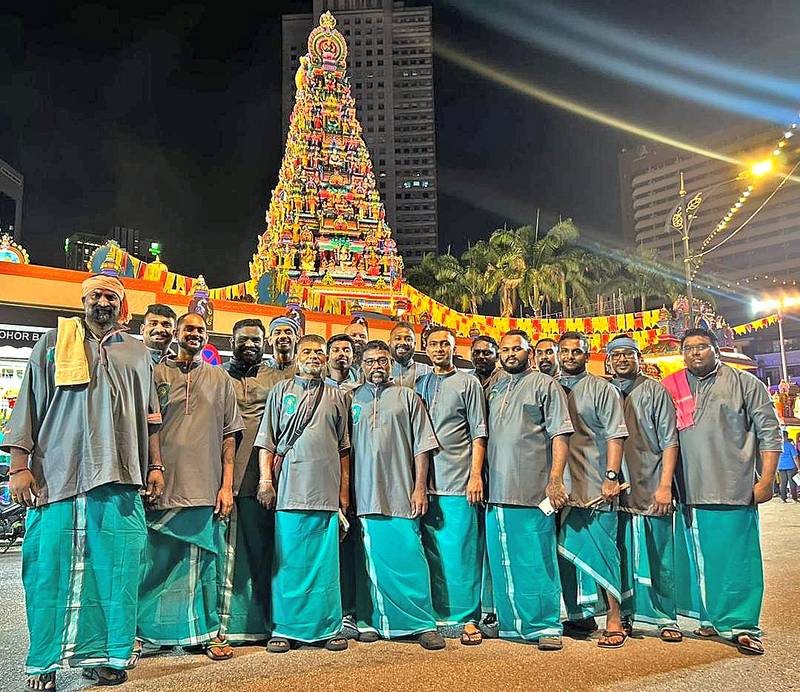
Members of the ‘Om Muruga Urumi Melam’ band. L to R, Yoganathan, Raju, Pasupathy, Kumar, Valavan, Sundara Kumar, Kesavan, Raja Kalidass, Chandra Dass, Tamilarasu, Syam Sundher, Visagan, Mathi, Uthaya, Selva, Letchu, Mogan, Vijay, Mohan, Sakthivel, Yogen, and Thanesraj
Tamilarasu posts regularly on TikTok and Instagram, and his content has amassed a loyal, adoring following of young people inspired to learn the folk art. He uses his social media presence to inspire people to respect the urumi as a legitimate musical tradition, as much as they do other classical instruments like the tabla. He added that the social stigma once attached to these instruments has decreased in recent years. “When I was younger, I would hear people say: why are you playing with these instruments? They are for lesser people.” Even his family discouraged him from playing the urumi. Now, people come to his father, speaking proudly about Tamilarasu’s talent and how inspiring he is to other musicians. “Now my father encourages me too, all because of the urumi – it is the urumi that has given me an identity.”
Tamilarasu shared his frustration that some people view urumi melam artists as gangsters and delinquents; he has a urumi tattoo on his arm and chest. “They look down on us; they call anyone who has a tattoo a gangster. Post-plantation poverty and employment uncertainty forced some Tamil men into gangsterism – a predicament that still haunts them, where racist Malaysian society equates loud or flashy dark-skinned Tamil men with violence. “Some tattoos have the names of their fathers, their children – these people never come close enough to see that.”
Folk musicians are spiritually attached to the divine, but the architecture of the divine, the temple and its devotees, views the musician as sacrilege. The musician must seek the answer for himself: why his art and he contradict the faith he finds solace in. Political emancipation for the Tamil folk artist will begin only when he ruptures the negation between his faith and his art.
Sanskritisation and Cultural Erasure
The casteism and racialisation masquerading as ignorance and distant judgment experienced by urumi artists is not merely a collection of individual prejudices; it is the modern symptom of a deeply rooted historical process known as Sanskritisation. The Indian and Tamil upper-caste bourgeois have sought to dictate the parameters of Hindu identity and culture since the colonial period. Their vision of Hinduness was always antithetical to the cultural expressions of the caste-oppressed Tamil Hindu proletariat, whom they tried to distance themselves from religiously and politically.
Sanskritisation erases caste markers and forcefully assimilates non-agamic practices and oppressed caste Tamils into a unified agamic Hindu identity. Yet, it does not eradicate caste; it protects and maintains it through insidious erasure, denying its very existence.
While the Tamil proletariat was violently against colonialism, the Tamil bourgeoisie was pathetically lapping at imperialism’s feet. Through the weakening of class consciousness of the Tamil proletariat, through the killing of Malaya’s anti-imperial movement, counter-insurgency has strengthened the hegemony of the Tamil Hindu bourgeoisie. The disillusionment of class consciousness among the working-class Tamil Hindus has allowed the Tamil Hindu bourgeoisie to impose and incarcerate them with a Sanskritised identity and culture.
Sanskritisation erases caste markers and forcefully assimilates non-agamic practices and oppressed caste Tamils into a unified agamic Hindu identity. Yet, it does not eradicate caste; it protects and maintains it through insidious erasure, denying its very existence.
This assimilative practice has accelerated as the presence of the RSS, Indian’s pan-Hindu fascist organisation, has grown in Malaya. By exporting a homogenised narrative, they drive caste-oppressed working-class Tamils into rigid caste identities identical to those of Tamil Nadu – with casteist terms like Vanniyar Kula Kshatriyan becoming popularised in Malaya. This movement ruptures post-indentured Tamils from a material understanding of their political alienation – an alienation which was catalysed and contained through the alliance of caste feudalism with imperialism. By deluding them with a “Pan-Hindu” identity, history, and culture, it disconnects them from their specific origin as exploited landless workers who used distinct folk arts to navigate oppression.
The Physical Erasure of Tamil Spaces
This ideological restructuring of Tamil identity directly complements the physical vulnerabilities faced by working-class spaces in Malaya.
Apart from being exploited for plantation labour, Tamil proletariats made up the overwhelming bulk of Malayan railway workers. Riding the KTM (Malayan Railway) across the Peninsula reveals not just paddy fields, palm oil plantations, mountains, forests, and rivers, but also remnants of Tamil railway workers through the architecture of the temples they built. These temples, the only relics of labour history the landless workers have, are most vulnerable to demolition by the comprador state and imperial capitalists. Some Malay supremacists have taken it into their own hands to destroy the temples they have derogatorily termed “kuil haram” (illegal/blasphemous temples).
The temple of the working-class Tamil Hindus is contested not solely because “Hindu” devotion is contested, but because, the corporal existence of the Tamil proletariat is a negation of the comprador Malay Muslim ethno-religious supremacist national project.
“They demolished the Muneswaran Railway temple in Johor; my family used to go there sometimes when I was a kid”, laments Tamilarasu, who expressed that whenever he hears about Hindu temples being demolished in Malaya, his heart gets heavy.
Institutional support for these communities remains scarce. “What has Hindu Sangam done to protect these temples – nothing!” said Tamilarasu. While operating as an NGO, the Malaysia Hindu Sangam, since its inception by upper-caste imperialist-aligned Hindus, has frequently been in service to the comprador Malay Muslim state and Western tourists, often facilitating the sanskritisation of Tamil folk music and rituals to appease caste, compradors and foreign capital. As Tamilarasu observed, “We neither have the support of the temple or the government – we sustain ourselves through our hard work, through our love for the art form”.
The Spirit and the State
Malaysianisation
The physical vulnerability of Tamil working-class spaces reflects a larger ideological project driven by the neocolonial state. The neocolonial liberal project of assimilation wants the feudal cultures of Malays and non-Malays to be the basis of the national culture. The comprador class wants the nationalities of Malaya and Borneo stagnated by feudalism, rendering them malleable to assimilation for continued imperialist exploitation. It demands the commercialised, uncomplicated variants of culture from Malays and non-Malays. This is because a revolutionary cultural consciousness would mobilise against imperialism and provide a philosophical and political basis for radical sovereignty, outcomes that a stagnated feudal culture cannot produce.
Tamil culture is, for the most part, a caste-feudalist culture. In Malaya, this caste-feudalist culture is refracted to assimilate politically with the comprador nationalisms of the imperial base. Urumi melam is an attempt by the landless, displaced Tamils to reconnect with ancestral culture; in doing so, they adopt a feudal culture and emulate it within their neocolonial political circumstances, infusing it with the neocolony itself. This is not unique to the Tamils; a parallel can be drawn with how Chinese folk artists reconstructed the 24 Seasons Drum post-NEP as a reaction against Malayanisation, which forcefully assimilated minorities into the counter-revolutionary Malaysian national identity.
Malay-Islamisation
This volatile liminalism, incestuous friction between the state and the temple, uproots the urumi melam musician. Tamil folk music – the music of the masses, played and protected by the working people – is a contradictory sentience against the reactionary constructs of Malaysia and Hinduism. Having secular roots, the urumi melam had no choice but to be theologised within the Malay-Muslim supremacist neocolonial landscape, as the imperial base armours itself in fundamentalist metaphysics, protecting itself against revolutionary consciousness.
Islamisation in Malaya, and now Malaysia, has always been reactionary: the ideological marrow of oppression, dehumanising the indigenous from Malaya to Borneo. First operating through Malay feudalism in Malaya, the occupation of British imperialism allowed Malay Islamisation to stretch its tendrils to Borneo. From its liberal variants during Tunku’s presidency to its insidious authoritarianism during Mahathir, Islamisation in the imperial base has evolved monstrously. It threatens the existence of not just non-Muslims but also non-Malays in Malaysia, including the natives of Borneo.
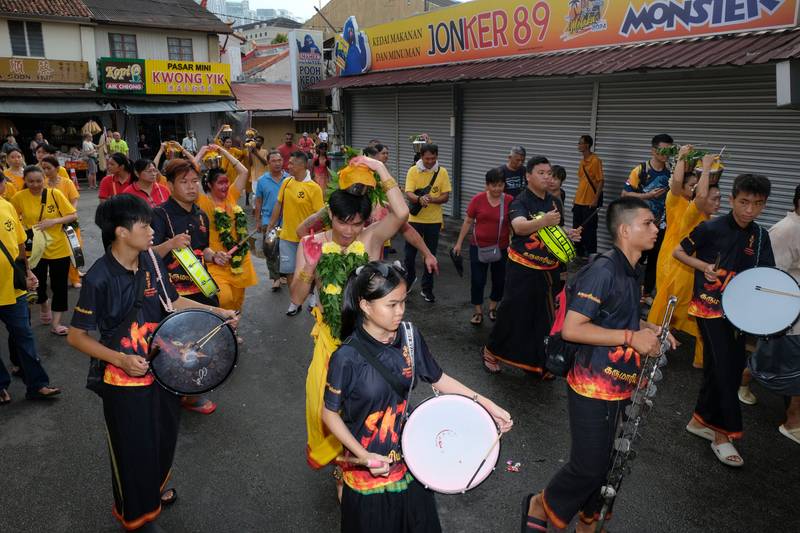
Photo: Mogan Selvakannu
While Malay Islamisation has led to the decline, threat, and loss of many Malay folk arts, especially in PAS (Malay Islamist party) dominated states like Kelantan and Terengganu, it simultaneously catalyses non-Muslims, like the Tamil Hindu urumi melam musicians, to hold onto their faith even more radically. It has also provoked non-Malays in Malaya, like the Tamils and Chinese, to become more resolute in their religious and cultural expressions, remaining uncritical of its feudal basis. Ultimately, this pressure pushes them towards finding, inventing, and reconstructing an essentialised indigenous culture to emancipate them from the wound of colonial displacement and neocolonial alienation.
Fascism is rapidly galvanising at the Straits of Malacca, from US imperialism to Chinese social imperialism, to Indian-Hindu fascism, to Malay-Muslim ethnoreligious supremacy. When this mutant chaos becomes more imminent for the Tamils and Chinese proletariat, their art and ideology will once again decreate: History will force them to choose between god and guerrilla warfare.
From Alienation to Revolution
Unlike within India, where caste-oppressed people attempt to reform or uproot their cultures, for the displaced indentured Tamil, there is the added pressure of their culture being the last remnant of identity before their displacement; to reform or radicalise it would betray the essence of their perceived root self.
Tamil folk art evolves with her people, and her children’s creative genesis knows no bounds. If this art form could shift from secular origins to religious objectification, then, under a radical political struggle, the urumi could just as easily become an instrument of revolution.
Post-indentured Tamil society in Malaya has not been given a moment to reconcile with displacement from a feudal culture, and its alienation within a comprador capitalist neocolonial culture. Navigating the pressures of elite sanskritisation and state temple demolition, the sonic politics reverberating from the urumi melam screeches with defiance, anger, and desperation. The musician’s misdirected quest for spiritual absolution is their quest for political emancipation. The musician and the instrument are an amalgam, as blood and bone. It was rare to meet an urumi melam artist who wasn’t enraptured and transformed by it – a medium of alchemy, the mercurial music of the Tamil masses.
Tamil folk art evolves with her people, and her children’s creative genesis knows no bounds. If this art form could shift from secular origins to religious objectification, then, under a radical political struggle, the urumi could just as easily become an instrument of revolution. History is already setting the stage for the Tamil folk musician to confront the realities of fascism, to face the realities of his exile by imperialism, asking him if he truly wants to remain in servitude or to become a sovereign. The artist will witness for himself whether theology can defeat his oppressor, or whether he can, through his art, weaponise Marxism to emancipate himself, his art, his land, and his people, once and for all – the final decreation.
-
 READ
Where the striped hyenas are is not only a place in the imagination or in the past. Where the striped hyenas are is also a possibility for what the future could bring. It’s where they lie, waiting for their turn to return from their exile. Where the hyenas are is also where the ghouls and the djinn are, behind seven mountains, dreaming and chasing their world into being again.
Where the Striped Hyenas Are, or, A Tale Is a Map and a Compass: Some Fragments on the Fantastical, Land and Remembrance
-
 READ
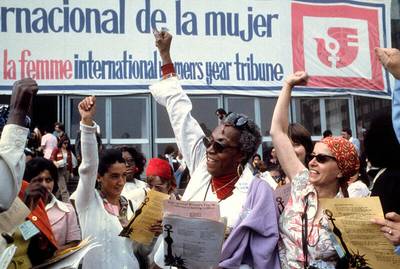
Amidst this uprising, several feminist film collectives emerged, adding to this momentum by making films and videos that disrupted the representations of women on screen, challenged their seclusion from the public sphere, and both fuelled and documented feminist campaigns and events. Despite the magnitude and significance of feminist cinema, its influence remains largely unspoken.
Women’s Uprising and the Latin American Film Collectives of the 1970s and 1980s
-
 READ
Is it problematic to mix friendships and professional connections, emphasising the benefits of helping friends since they will eventually feel obliged to help in return? How did such a neoliberal manipulative trick that openly instrumentalizes intimacy become acceptable? Is “friendly, warm hearted” corruption and favouritism legitimised? Am I abusing my position of power by preferring to work with friends? How does the professional environment change if a friendship ends abruptly and unpleasantly?
Against Friendship: On the Dark Side of Professional Intimacies
-
 READ
Educational institutions, just like all other institutions, can be considered microcosms of society, where prevailing attitudes and values manifest. Consequently, as racism permeates Finnish society, it also seeps into Finnish daycares.
Microaggressions & Everyday Racism in Finland’s Daycare System