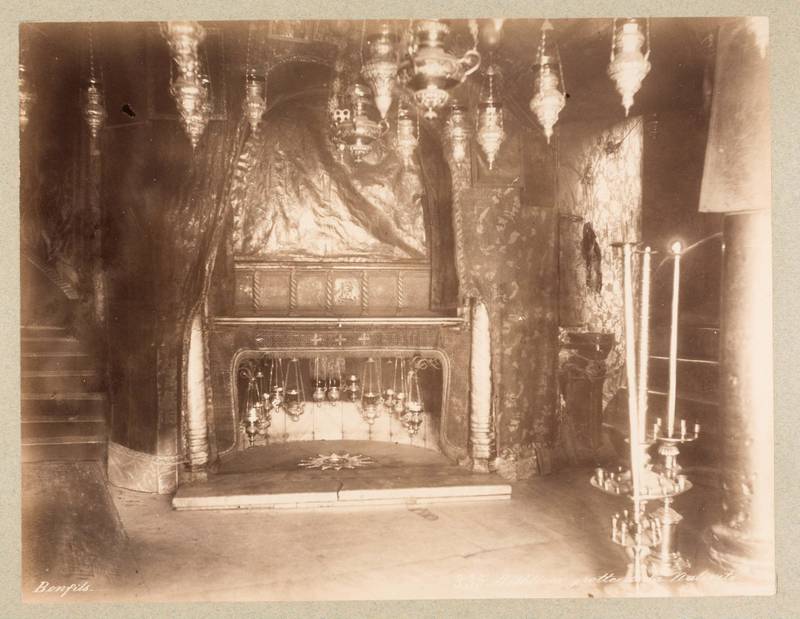
Bethlehem, Grotto of the Nativity
Sanabel Abdel Rahman is a postdoctoral fellow at MECAM/Tunis University. Her research focuses on magical realism in Palestinian literature. She completed her doctoral degree at Philipps-Marburg Universität and her Bachelor’s and Master’s degrees at the University of Toronto. She is interested in cinema and visual arts. She is a writer of fiction and essays.
Over the past few days, my mind has been returning to the Arabic verb yaṣdaḥ. This present perfect form comes from the three-letter verb ṣadaḥa. English’s shortcoming in translating Arabic poetics begins with the absence of a direct, encompassing translation. Yaṣdaḥ means to raise one’s voice in song; also, to scream loudly in truth, to confess, to surround, to echo, to resound, to inundate, to chant. Voices fulfill this by traveling, transgressing, penetrating, and otherwise destabilizing the status quo.
I linger here on the voice of the future traversing the present and the seemingly insurmountable past. I linger on the impressions, the animated images and sounds that have managed to arrive from the future to find us here and now, not militant yet but prepared to answer to that voice. ‘Yet’ is the operative word in this text. This text is a series of fragmented thoughts and impressions—both nascent and whole—attempting to relay an elusive but powerful force. I linger here on the geography of the post-poetic, the post-imaginal, the post-knowable. I linger on the voice of the Palestinian resistance in its myriad tones.
The Sheikh Jarrah events spelled out a moment of magnanimous hope despite many already anticipating Israel’s violent retaliation, which was promptly unleashed.
I experienced the full effect of the verb, ṣadaḥa, viscerally when, during the height of the Gaza Genocide, I came across an Instagram reel showing a slow-motion video of Palestinians resisting Israeli tanks. The caption said in both Arabic and English, “I love watching cute people do things I dream of doing.” The 15-second video is accompanied by a section from a lo-fi song. The reel was removed a couple of days after. I remember the reel evoking something far beyond the image of the real and what it tried to convey. It moved beyond the spatiotemporality of the fighting men and their spectator—me. It performed something that was not mine, that did not belong to me, but which I recognized so inherently and vividly, with every sense. The unrelenting digital resistance implicated by this simple reel, which borrows extensively from contemporary materials, conveyed an experience beyond space and time, one that was not simply ‘poetic’ but moved far beyond it.
I had another similar experience at the height of the Sheikh Jarrah events in 2021. Everyone I spoke with then confirmed this, noting a form of collective witnessing worldwide, happening in real time. Images finally reflected what Palestinians have been enduring for decades. For the first time, these images were being seen. The poisonous terms that have been shoved down Palestinians’ throats for generations concerning Israel—settler-colonial violence, ethnostate, catastrophe, massacres, genocide, and white supremacy—have taken visual form. The Sheikh Jarrah events spelled out a moment of magnanimous hope despite many already anticipating Israel’s violent retaliation, which was promptly unleashed. The hope that electrified my body in that period was not mine alone: it did not belong only to me, and it extended beyond my body.
I was in Berlin then, as reality unraveled at the seams in Palestine and the rest of the world. Wherever I was moving in Berlin, I had one song on repeat. A song with coarse language and militant imagery, ‘Amrikkka’. Listening to it, I could not but think of, and experience, a breeze coming from the far-away country into the hallways of my mind. I was certain that this experience was not mine alone. The breeze evoked a collective hope and sustained images of liberation in that secret place in the mind that Palestinians know so well. It was an invigorating, transmaterial experience that defied definition and the very parameters of reality. The hope carried through the defiant lyrics and the melancholic, forceful tunes delineated something I recognized at an intrinsic level.
The song expresses the loss of the waṭan, the homeland. It calls out the United States of America (or AmriKKKa) as the most violent culprit in the death and destruction in Iraq and the Arab World. The song’s narrator is sad and defeated. He begins by recounting the amorphous shapes that surround him, the extent of his drunkenness, barely making it to his home, dropping his keys in the dog bowl, and having to sleep on the stairs. He sleeps soundly; that, he also tells us. What was the song evoking? And why was this evocation so intense and unparalleled?
I tried to dissect this poetic ‘impression’ using my tools as a literary scholar, a writer, and a woman who likes to linger on things. I analyzed the song. I wrote an academic text about one of its main figures, Sindbad1. I contextualized it and situated it within a broader Arabic music landscape. Yet, something was amiss. The way the song painted a future reality, a reality that my body recognized so willingly and inherently, was what I could not articulate. And because I could not articulate it, I could not analyze it. Being a scholar of Palestinian magical realist worlds could not serve me then. I had to look hard for something beyond that, something more elusive, transgressive, and impossible to pin down. I was looking for something that reveals itself rarely, something that cannot be discerned using the academic’s tools.
I will say this: listening to the song evoked the same feeling I have when I think of the heroines in my novel, especially when the angels among them fly over Palestine. It is the same potent, melancholic solitude that translates something larger than the singular life in exile. Something that transgresses the materiality of things but also the imagination. I wondered about the deeply poetic image that translates something beyond itself; beyond the very medium that carries it.
I have been in a long conversation with a dear friend of mine, Samara Sallam2, about Palestinian life and its manifestations. We exchanged long recordings about the geography of Palestinian exile and the long-lasting effects of the traveling pain that conscious Palestinians are inflicted with. Samara posed a question that challenged me. She asked, What do we call an entity that is both material and immaterial? I mentioned to her the term that she already knows, the term that people who know me have heard me utter repeatedly: tammadī, with its English translation being ‘concretization’. As I have often noted, tammadī appears briefly in an introduction to an anthology of Palestinian folktales collected by Ibrahim Muhawi and Sharif Kanaana titled Speak Bird, Speak Again.
Samara is not convinced by this terminology as an answer to the powerful question that she posed. Instead, she is concerned with entities that are both material and immaterial, carrying features of both worlds. Tammadī, for her, is a state of movement, an exit from the idea to a material form. “It ceases to be an idea and becomes a material thing, incapable of being both material and immaterial at the same time. This is because tammadī is a verb, the action of moving from a state to another,” she tells me. She gives an example: when we experience a certain feeling, it takes material form in our body; this doesn’t negate the feeling once it takes on a bodily presence: the feeling would still be there, like the pain in the heart or the chest. Samara seeks another form of knowledge that emerges from everyday life, from certain moments that require tremendous energy, to bypass the classical modes of knowledge, moments that permeate our bodies, dreams, and interactions. For Samara, this expends a lot of energy, especially when we fixate on deciphering this knowledge and building on it. She notices this in the space of folktales, admitting that it is difficult to explain. This ‘thing’ that thus far is missing a coherent definition, that is, both material and immaterial, can be found in the narrative of folktales, which contain transitions from human to animal, from human to object, and other transitions of states. This, to her, alludes to the other forms of knowledge that contain these processes of shape-shifting, which can be activated through practices like hypnosis, a transition of not only bodies but consciousnesses as well.
Samara’s defense of this state inspires me. It opens up new possibilities for the very definition of reality. With no other tools in my writer’s hands yet, I content myself with tammadī: the transformation of a wish or desire into material form, which has been integral to my research and pedagogical work, as well as my writing practice. I often pair this term with a similar one from Latin American Indigenous theology: mística. Within Brazilian social science literature, the term refers to “the representation through words, art, symbolism, and music of the struggles and reality of [a] social movement…the more abstract, emotional element, strengthened in collectivity, which can be described as the feeling of empowerment, love and solidarity that serves as a mobilizing force by inspiring self-sacrifice, humility and courage.”3
Daniela Issa argues that the manifestations of mística can be traced in Brazil’s Landless Movement (MST), the largest social movement in Latin America. Rooted in national liberation, agrarian reform, and religious syncretism, MST enabled thousands of poor Brazilians to reclaim lands seized for capitalist purposes, fight for their space, and assert their right to communal use and benefit. By infusing mística with dominant Christian beliefs, including the representation of Jesus as a marty4, the movement “calls for idealizing and materializing the utopia of the Kingdom of God in the here and now,”5 thus creating a compelling “mística of resistance."6
Here, time becomes malleable and responsive to indigenous will. The future turns into a panoply of choice rather than a ‘real’ history of continued postcolonial suffering. In predicting the future, the artist becomes a prophet for their people, the true soothsayer, the real indigenous oracle.
I read this praxis as involving the social, collective ‘feeling’ of mística, offering alternative futures that Brazilians can materialize through their agency. Not only that, but the concept of utopia, prevalent in religious contexts concerning the afterlife and deferrals toward a post-death state, can be forced, materially, into the not-so-utopian present. Exercising such collective agency replaces the ‘real future’ (to evoke Andy Merrifield’s interpretations around Sartre7) with an ‘imagined future’ (championed through mística) that better reflects Brazilian agency and justice. This demonstrates the possibilities of transforming ‘feelings’ or thoughts, at social and political collective levels, into material futures that would not have otherwise existed without this form of Indigenous-informed praxis. Here, I note that ‘conjuring’ imagined futures into the present through a species of magical-realist thinking is comparable to Indigenous writers’ tactic of referring to Turtle Island as ‘what is currently Canada’ rather than ‘what is now Canada’. This highlights the practice of opening more liberated indigenous futurisms within the text8, or the song.
I find a compelling account of understanding possible, liberated futurisms in Chelsea Herr’s reading of the literary and art productions of Puebloan artist Virgil Ortiz. In “The Evolution of Revolution: Virgil Ortiz’s Pueblo Revolt 1680/2180 as an Assertion of Native Presence through Indigenous Futurisms”9, Herr focuses on Ortiz’s time-defying metaseries, Pueblo Revolt 1680/2180, that operates within an asynchronous timeline. The work centers on two events: the real Pueblo Revolt in 1680 and an imagined one in 2180. “Through a synthesis of science fiction tropes, Western popular culture, and traditional Cochiti pottery materials and techniques, Ortiz imagines a cyclical pattern of history in which the Pueblo Revolt of 1680 resurfaces 500 years later.”10
That Ortiz combines a real event that happened in history and an imagined one that will happen in the future within a single work implies the conflation of a past time with a future one within the same realizable—and possible—narrative. This exposes a vast and innovative space for Indigenous peoples whose lives and collective experiences have been threatened by Western settler-colonialism in the past that still protracts into the present. The artist’s imagining of another revolt (or a repeat of the past one) in the future buttresses this agency. It also breaks the ‘reality’ of postcolonialism and plants in its geographies seeds of dissent and (possibly) violent takedowns of imperialism and colonial systems. Here, time becomes malleable and responsive to indigenous will. The future turns into a panoply of choice rather than a ‘real’ history of continued postcolonial suffering. In predicting the future, the artist becomes a prophet for their people, the true soothsayer, the real indigenous oracle.
The continuum is a vital element in this work that arrests Herr’s attention. She reads “the metaseries as a complex continuum of historic events spanning five centuries.”11 She continues: “comparable to the malleable notion of time, Ortiz’s futurism renders space as a continuum of enmeshed physical places with spiritual and preternatural power.”12 Herr bases this reading of Ortiz’s works on important Indigenous perceptions of time that could apply to Palestinian time and to potential futurisms within magical-realistic thinking and manifestations. She references Mark Rifkin’s paradigm of “temporal multiplicity,”13 in which “there is no singular unfolding of time, but, instead, varied temporal formations that have their own rhythms.”14 This rendering of time is coupled with an explanation of “Native slipstream,”15 a “primary tool used in Indigenous futurisms,”16 where past, present, and future coexist and move together. This interpretation of Indigenous times and futurisms is akin to the notion of the palimpsest17 that Indigenous futurisms may evoke.
These approaches to time (and therefore futurisms) present Ortiz’s metaseries as an example of beyond ‘poetic’ applications of indigenous times, temporalities, chronologies, and futures. In the metaseries, time’s free movement recalls the fluid yet complex process of experiencing time within Palestinian cultural productions whose space is potentially futuristic despite having emerged before the breaking moment of the Nakba. Stasis, or withholding the unfolding of the present into (any) future, occurs through repetition—a recurring narrative common in folktales. In Palestinian folktales, heroes and heroines are stuck in a repeating loop of identical presents until they break the cycle. Often, breaking the repetition is tied to the plot’s resolution.
I return to my conversation with my friend. Samara believes in forms of knowledge that transgress colonial positivism. I share that belief as well. We discussed the locations and evocations of these inherent forms of knowledge, while remaining cognizant of the precipitous effects of romanticizing autoethnography. During my conversation with her, I mention my text on al-maʻrifa al-inṭibāʻyya ‘impressionistic knowledge,’ where I trace a potent but highly elusive form of signifiers and worldmaking tools that exists within Arabic poems. I argue that these signifiers linger behind certain imagery and evoke the experience of other worlds in a deeply visceral, material way. I argue that these ‘relics’ of future lives can be experienced through certain impressions. I also argue against the dismissal of this form of impression-based knowledge—which is intricately and laboriously crafted by the poet—as a facile or surface-level engagement with the text and its repercussions. For that, I look at Antara bin Shaddad’s piercing. mu’allaqa (hanging poem18), and Ibrahim Nastallah’s ‘the martyr,’ Salah Abd al-Sabour’s ‘The Sad Thing,’ and Amal Dunqul’s figure of the lone traveler. I look at these texts to delineate the potentiality of these ‘impressions,’ especially in the poets’ use of ‘traces’ (echoes, footprints, tremors, shadows) to contain entire collective experiences.
Needless to say, I have been fixated on exploring experiential mediums and collective repertoires of experiences that have not yet taken place in the real world. As a Palestinian in exile constantly searching for ‘a way out’ of the colonial tunnel, this much is obvious. Many times, I thought this unearthly, overpowering, impressionistic, transmaterial experience was something I experienced alone. This changed a few summers ago when, during a workshop, I mentioned a video I’d been going back to.
If trauma could be so forceful that it alters the DNA for generations, then why not other materials: memories and the powers of tammadī that inspired hundreds of Palestinian folktales?
The short video shows elderly Palestinian women—most of whom are living in exile—talking about flying to Palestine in their dreams. Their testimony, which they communicated smilingly, did not describe a mere ‘dream’. They all swore that they would, in fact, fly to their favorite spots in Palestine, implying that they could navigate their trip and set their own routes. One said that she would go back to her childhood home and roam its empty rooms. Another said she would keep flying until she reached her beloved tree and sleep under it. The young women in the workshop had much to share about the video. To my surprise, each one of them narrated a shockingly vivid dream in which she would ‘experience’ specific places in Palestine that she had never seen. Most of the women in the workshop were exiled Palestinians who had never been to Palestine. In their dreams, the young women reached villages*,* caves, and ancient wells. This oneiric ‘conjuring’ of Palestine transgressed the corporeality and materiality of exile. This exchange made me think of speculative returns to Palestine and the magnanimous synergy that is collectively poured into the place’s future experiences from positions of exile and severance from the land.
I will later come back to this exchange when, a couple of years later, I come across an article that introduces a first-of-its-kind study suggesting that “women who have been directly affected by war-related violence and trauma indicate altered epigenetic markings—but so do their grandchildren, even if they had no direct exposure to warfare.” The study, which focuses on Syrian women, made me think of the Palestinian grandmothers who experienced the horrors of the Nakba. I thought of them passing down this knowledge of terror and unrest to the daughters and granddaughters through their wombs. The Nakba DNA becomes an integral part of those yet to be born.
If trauma could be so forceful that it alters the DNA for generations, then why not other materials: memories and the powers of tammadī that inspired hundreds of Palestinian folktales? The women’s testimonies of their oneiric flights to Palestine made me think of the migrating memory of the place, which takes on a corporeal dimension in Palestinian bodies, their memories, and their sense of space. How could a Palestinian know—that is, intimately recognize and authentically experience—a place in which their grandparents lived for centuries? A place so close to them, so embedded, that the trauma of being forced out of it distorted their genetic material?
Liberated Palestine thus ceases to be a ‘rupture’ between reality and fantasy, the present and the future, the practical and the impossible, the pragmatic and the unattainable. Instead, it becomes a form of knowledge constructed and communicated outside the parameters of colonial experience and temporality.
I argue here that this knowledge is passed through a form of Palestinian impressionistic knowledge, one that trespasses not only the parameters of positivist reality and phenomenal experience but also the corporeality of the body and the materiality of the place of exile. A form of knowledge that roams and rejects constraints: linguistic, temporal, geographical, corporeal, and even imaginal: the post-poetic. I look beyond these impressions as simple byproducts of a poetic expression but as a real—and expansive—experience of arriving at a place. Though certain impressions and traces evoke this experience, the post-poetic image goes beyond simply relaying a feeling and instead allows flights into the future, achieving a tammadī, or concretization, of future days of liberated Palestine that are yet to be lived. Liberated Palestine thus ceases to be a ‘rupture’ between reality and fantasy, the present and the future, the practical and the impossible, the pragmatic and the unattainable. Instead, it becomes a form of knowledge constructed and communicated outside the parameters of colonial experience and temporality.
The Palestinian saying that is closest to my heart is “hawā birrud al-rūḥ”: a breeze that brings back the soul. Though it usually describes the dewy, life-giving breeze that roams Palestine and its neighboring sisters in al-Shām (the Levant), I always wondered what it means to utter this from a place of exile. Does this mean the soul is there, in Palestine, waiting to return to its body when a heavenly breeze carries it along? If so, then what does the body do in these intervals of waiting to connect with its soul? I now think that in its waiting, the body experiences those post-poetic iterations that transcend its materiality, mortality, and alienation. It prepares for its future life in a post-poetic Palestine.
-
 READ
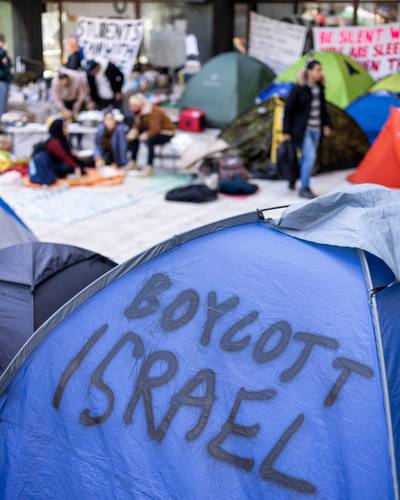
The opposition is not only between institutions and student activists—it also exists within our movement, manifesting in differing strategies. Should we focus on direct, visible actions or institutional processes? Should we shame the university publicly or appeal to its conscience? These approaches are not mutually exclusive—they reinforce each other.
Disrupting Complicity: Students Organising for Palestine in Finland
-
 READ
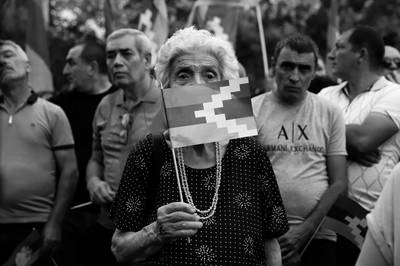
While azerbaijan was bombing Armenians with israeli and turkish UAVs and paying bonuses to turkish-backed Syrian mercenaries for beheading Armenians, the “international community,” whatever that’s supposed to mean at this point, expressed lousy words of “concern,” and displayed a nauseous stance of both-sideism, devoid of any tangible action. The existence of this unrecognised republic and its indigenous population wasn’t legitimate enough for world powers to lift a finger.
Violent Septembers: An Armenian Perspective Amid the Ongoing Occupation
-
 READ
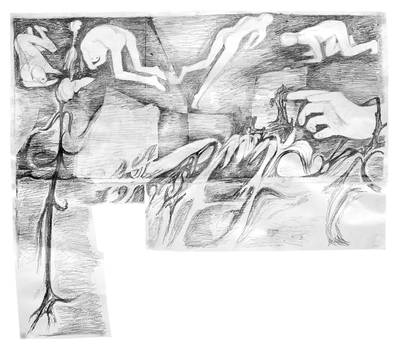
Is it problematic to mix friendships and professional connections, emphasising the benefits of helping friends since they will eventually feel obliged to help in return? How did such a neoliberal manipulative trick that openly instrumentalizes intimacy become acceptable? Is “friendly, warm hearted” corruption and favouritism legitimised? Am I abusing my position of power by preferring to work with friends? How does the professional environment change if a friendship ends abruptly and unpleasantly?
Against Friendship: On the Dark Side of Professional Intimacies
-
 READ
A conversation with Isabel and Carl Gakran about the Zág (Araucaria), an indigenous tree threatened with extinction. We talked about their project (Instituto Zág), Indigenous climate justice and the intersection between the Palestinian and the (Brazilian) Indigenous struggles.
Zág Trees, Forest Spirits, and the Settlers: A Conversation with Xokleng Kin