Activities of the EScola Por Vir [School to Come] at the Pedro Ernesto Warehouse
Mariana Pimentel is an Associate Professor in the Department of Theory and History of Art in Rio de Janeiro State University (UERJ). She is a faculty member in the Graduate Program in Arts (PPGArtes/UERJ) and in the PPGCA at Fluminense Federal University (UFF). A theorist-activist with the Coletivo 28 de Maio, she carries out actions in partnership with UFF professor Jorge Vasconcellos in art and academic spaces, where they articulate contemporary minority struggles with the practice of theoretical production.
Coletivo 28 de Maio (C28M) is a university-based academic group working in the field of the arts and political activism, connected to minority struggles, especially those advocating for Black, Indigenous, feminist, and trans agendas. It is characterized by carrying out aesthetic-political actions that challenge the art system through propositions and practices of counter-conduct. C28M is composed of Professor Jorge Vasconcellos (UFF) and Professor Mariana Pimentel (UERJ), who describe themselves as theorist-activists (teóricxs-ativistⒶs).
The Associação Cultural Lanchonete<>Lanchonete constitutes a contemporary art proposition/activation situated within a territory marked by Black and Indigenous ancestry in the city of Rio de Janeiro, more precisely in the neighborhood of Gamboa, in the region known as Pequena África [Little África]. Its activities spanning art, education, and clinic are directed toward children, adolescents, and women living in informal occupations in Gamboa. However, Lanchonete proposes itself as a studio with radically open doors. This openness not only allows access to those historically excluded from contemporary art spaces in Brazil but, more importantly, enacts a critique of the colonial character of the dispositif. The term “colonial” here does not refer to the colonial style within Brazilian art history (the colonial period), but rather to the colonial character of the art institution/system in Brazil, which cannot be conceived outside the processes of territorial and epistemic colonial violence against Indigenous peoples and enslaved African populations.
We must address Brazilian contemporary colonial art. This must be both the point of departure and the horizon guiding conduct, or rather, counter-conduct within the Brazilian contemporary colonial art system.
To produce a critical fold within the dispositif – in this case, the set of practices and technologies mobilized by the Brazilian contemporary art system – is a sine qua non condition for any attempt to install this same dispositif, particularly within a territory of Indigenous and Black diasporic memory. Indeed, the first step is to break the narcissistic pact of whiteness in relation to the art institution, that is, the belief that contemporary art practices in Brazil are exempt from such radical critique. Yes, we must address Brazilian contemporary colonial art. This must be both the point of departure and the horizon guiding conduct, or rather, counter-conduct within the Brazilian contemporary colonial art system.
Only under these conditions can an alliance with the historically rooted Black population of the region be imagined. A two-way dynamic is thereby established, making it possible for the triggering dispositif – Brazilian contemporary colonial art – to be continuously put into question. It is the art system itself that becomes tensioned: its practices, its exclusions, and its cynical, fashionable modes of occupying territories inhabited by populations rendered vulnerable precisely through the violent processes of colonization of which the art institution is a part. Thus, opening doors is not an act of charity, but a fundamentally political and activist gesture whose primary action is to question the very conditions of possibility for the existence of a contemporary colonial art space within an Afro-diasporic and Indigenous territory (all American territory is ancestrally Indigenous).
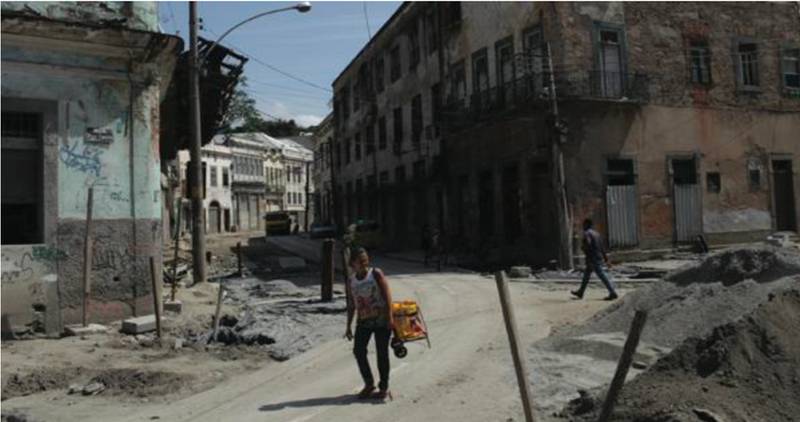
The neighborhood of Gamboa, in the port region of Rio de Janeiro became the stage for a major urban intervention, in 2009
The region known as Pequena África is located in the central zone of Rio de Janeiro and currently comprises the neighborhoods of Gamboa, Saúde, Santo Cristo, the hills of Providência, Pinto, and Conceição, as well as Praça Mauá, including Pedra do Sal and Rua Marechal Floriano. The term was coined in the early 20th century by the samba musician and visual artist Heitor dos Prazeres (1898–1966) to designate the port area, particularly around Praça Onze. Between 1850 and 1920, this region was predominantly inhabited by African descendants and emerged as a key locus for Black artistic and cultural production, notably samba, capoeira, and candomblé. Among its regulars were Machado de Assis, Pixinguinha, Aniceto do Império, Sinhô, Donga, João da Baiana, Tia Ciata, and the babalorixá João Alabá. Heitor’s designation highlighted the concentration of Afro-descendant culture and community in contrast to the Europeanized city of the period.
Counter-images
It is important to emphasize that in the first decade of the 20th century, Rio de Janeiro underwent a profound urban reform. Under the motto “O Rio civiliza-se,” [“Rio civilizes itself”] and inspired by Baron Haussmann, Mayor Pereira Passos sought to build a “Paris of the Tropics.” Under the pretext of modernizing and sanitizing the then Brazilian capital, a sweeping demolition campaign was undertaken in the central area, with European-style buildings erected at the cost of the mass displacement of the local population. Major interventions included the opening of Avenida Central (now Rio Branco), Avenida Beira-Mar, the remodeling of the port, the creation of Praça Mauá, and, most emblematic of all, the construction of the Theatro Municipal, symbol of a Europeanized and civilized city. What is taking place here is not only territorial cleansing but also an attempted cultural epistemicide: what did not enter the Theatro Municipal was not considered art or culture. It was precisely in this context that Heitor dos Prazeres coined the term Pequena África as a counterpoint, a form of Afro-diasporic cultural resistance. Pequena África thus emerges as the counter-image to the Theatro Municipal.
A century later, Rio de Janeiro, and particularly its port region, once again became the stage for a major urban intervention. In 2009, under Mayor Eduardo Paes, the Porto Maravilha project was launched as part of Olympic preparations. While Paes professed an appreciation for samba and carnival, he does not conceal his admiration for the achievements of Pereira Passos. During the inauguration of the first phase of the port revitalization (July 2012), he even installed a commemorative plaque honoring Passos in the renovated Jardim do Valongo. Although the circumstances differ across periods, both past and present removals disproportionately target low-income populations, predominantly Black. Alongside urban restructuring, two museums were inaugurated: the Museu de Arte do Rio (MAR) in 2013 and the Museu do Amanhã in 2015, marking the culmination of the region’s gentrification process.
Focusing on the inauguration of MAR, 2013 was also the year of the June protests, a popular movement that introduced new forms of political engagement, especially within minority struggles: gender, feminist, LGBTQIAPN+, anti-racist, Indigenous, and anti-ableist agendas. We find ourselves in a Brazil in the wake of affirmative action policies under the Lula (2002-2009) and Dilma (2009-2016) administrations. And while it is true that a far-right also emerged in this context, advancing agendas directly opposed to the gains secured by groups benefiting from such policies, a different way of doing politics nonetheless took hold in Brazil. The arts were directly impacted, becoming both targets of critique and sites for experimenting with a new “distribution of the sensible” (in Jacques Rancière’s terms), no longer governed by colonial, racial, and heterocispatriarchal codes. And if the insurrection made visible on bodies the marks of centuries of colonial and heterocispatriarchal violence, it also functioned as a crucial site for the affirmation and experimentation of other ways of living.
On March 1, 2013, the anniversary of city of São Sebastião do Rio de Janeiro, the MAR was inaugurated. While political and cultural elites gathered inside, a protest-happening outside produced a counter-image to the so-called fisrt cultural facility of Porto Maravilha. This heterogeneous crowd, comprising Black, trans, female and Indigenous bodies, art collectives, anarchists, punks, generated a cacophonous, improvised sonic environment that penetrated the museum’s interior, directly striking at the pomp and circunstance of the institutional celebration. A dress rehearsal for the geléia geral [“general jelly”]1] that would erupt in the June protests. Something happened… What we saw, heard, and felt: was it art? Perhaps not in the colonial sense. Was it political protest? Maybe not in the classical leftist sense. In fact, what was taking place there was an entanglement, a confusion, a profusion of actions articulating artistic and activist practices.
It is precisely this indiscernibility that we point to in the counter-manifesto O que é uma ação estético-política? [What is an Aesthetics-Political Action?] as well as in the articles and actions of Coletivo 28 de Maio, where we identify the aesthetic-political character not only of the 2013 protests but, even earlier, of a new way of doing politics that took shape in Brazil from 2010 onward. Or, more precisely, what we term the minoritarian turn in political and artistic practice over the past decade.
As we argue in our book, this minoritarian turn produced a two-way zone of indiscernibility between art and activism, making it possible, on the one hand, for activist agendas to enter the field of art, thereby putting its knowledge-power dispositifs into question through artistic actions and practices; and, on the other, for activist practices to appropriate aesthetic tactics and strategies proper to the field of art in order to act upon the social field. Likewise, what we observe in activist actions is not an imitation (mimesis) of procedures proper to the field of art, but rather an understanding that contemporary activism takes as its terrain of struggle the knowledge-power dispositifs that act upon bodies (biopower), or, as Jacques Rancière so incisively proposed, the conditions of possibility what presents itself to sense experience (the distribution of the sensible). If power targets the materiality of bodies and, in the Brazilian case, the colonial governmentality of bodies, then the terrain of dispute, the field of struggle, becomes the bodies themselves.
Therefore, as we argue, this minoritarian turn has brought to light a counter-system of artistic practices operating both beyond and beneath the heteropatriarchal and colonial institutional art system in Brazil. As Cripta Djan stated in an interview with journalist Felipe Blumen, for Tapume, in August 2014: Pixo (we use the spelling “picho/pichação” with an “x” to foreground its aesthetic-political character, as we argue in What Is an Aesthetic-Political Action? A Counter-Manifesto) is the most conceptual form of contemporary art. One must refuse the dominant concept of art not merely to make visible other modes of artistic practice in the present, but also and more importantly to recover the dissident character embedded in the very conceptualization of art in the Western tradition. In our context, Godard is culture, insofar as he is majoritarian, while the tree performance by José Guajajara at Aldeia Marakan’à (December 2013) is art. Among us, Marina Abramović is culture, while the act of going topless by Indianarae Siqueira’s – a travesti leader and a person with both breasts and a penis – is art. For us, Duchamp is culture; the reinvention of school life enacted by student occupations is art.
Commensality dispositif
Amid this insurrectional climate, artist Thelma Vilas Boas, in 2016, initiated a shift in her trajectory by installing a wood-burning stove among the debris of the Porto Maravilha works. As she recounts in an interview with the journal Arte&Ensaios (vol. 29, no. 46, 2024: Arte Território), the municipal government would unload stacks of paving blocks on wooden pallets at street corners, which were gradually abandoned as construction advanced toward Praça Mauá, leaving behind a trail of debris and materials in the Praça da Harmonia area, a site absent from the tourist itinerary, yet an ancestral Afro-diasporic and existential territory for the local Black population.
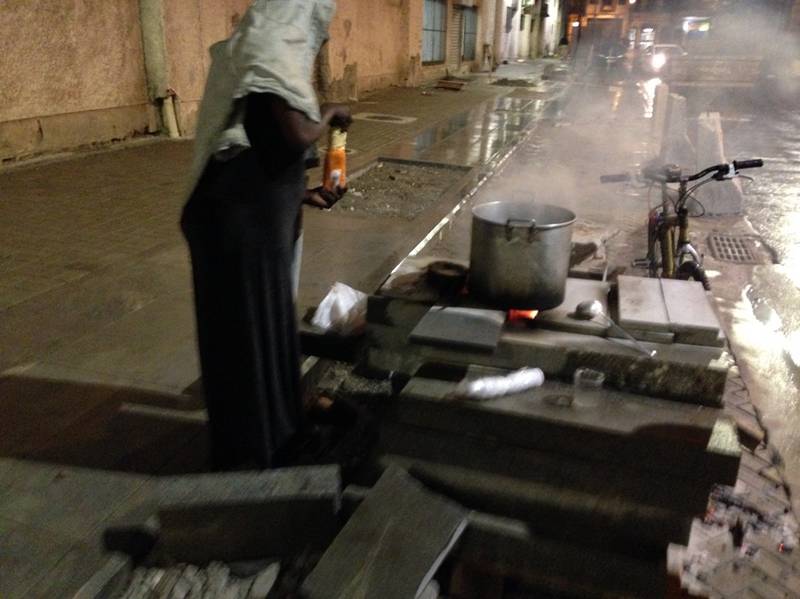
Where it all begins: One of the eleven stoves built with leftover paving materials during the revitalization of Porto Maravilha, in 2016
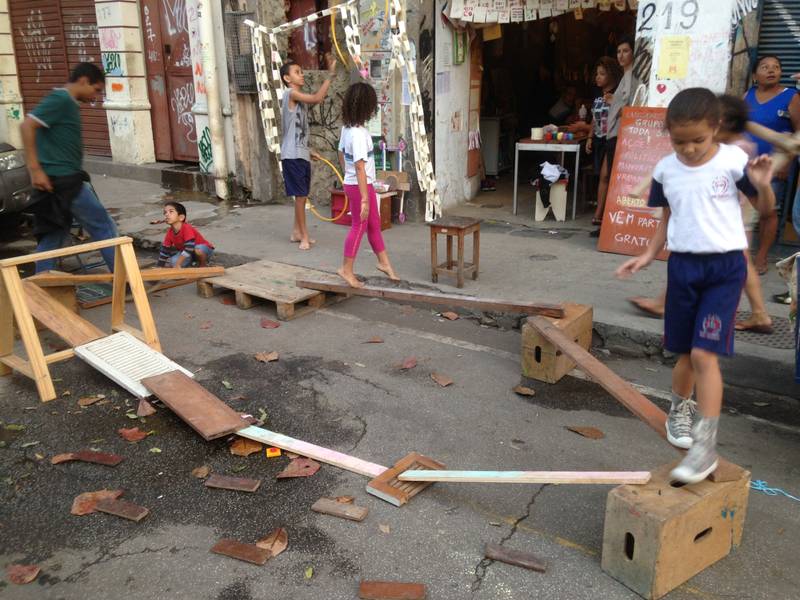
Actions on the street when Lanchonete<>Lanchonete was established in the garage of Espaço Saracura, at ground level, as a kitchen-studio, a snack bar, with doors open to the street and to those who pass by
The waste of materials, the exploitation of labor, and the neglect of the Praça da Harmonia area were evident. Making use of the discarded materials, Thelma then builds her stove, a commensality dispositif, and begins cooking for the local population, right there, as a way of entering into relation with the territory. As she stated in the interview: “It was with these people who have time, the slow man of Milton Santos (Brazilian Black geographer and thinker), precisely at ground level, within this other temporality that is not the time of the white man and of capital, that Beto and I sustained silence until there was something to be said.”
Several specific actions were carried out, such as C.A.L.D.O D.E. C.A.R.N.E, carne de quem? [B.E.E.F B.R.O.T.H, meat of whom?]. There was also the installation of the stove within an art space, the Saracura, which the artist described as um castelo de cartas por cair [a house of cards on the verge of collapse]. While the title referred, on the one hand, to the precarious structure of the stove, on the other it already posed the question that would guide the establishment of Lanchonete<>Lanchonete in that same territory: the colonial house of cards must be made to fall. Here, Thelma understands that, as a white woman, she must look in the mirror and break the narcissistic pact that sustains her position as an artist.
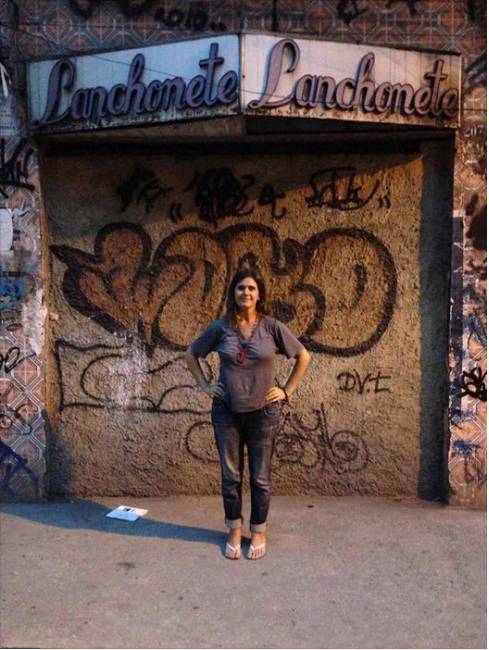
Thelma and the sign found on the street, which gave the project its name
What does it mean to be a white person in Brazil? How can one break both the pact and the impact of the art system operating within a territory of Black and Indigenous ancestry? Lanchonete<>Lanchonete is instituted through this very question. And, as with any meaningful question, what is at stake here is not the articulation of a solution (a white, salvationist mythology), but rather making visible and staying with the problem. To make the problem itself a horizon of conduct or, as we have already suggested, of counter-conduct in relation to the colonial art system. In this sense, the actions of Lanchonete<>Lanchonete can be understood as an ongoing process of questioning the conditions of possibility of making art in Brazil, and more specifically within a territory of Afro-diasporic memory.
Staying with the problem
It is from this question that Lanchonete<>Lanchonete is established in the garage of Espaço Saracura, at ground level, as a kitchen-studio, a snack bar, with doors open to the street and to those who pass by. A sign invites: “Come in, have a seat, let’s talk about the world.” And who comes in and stays? The children, Black children living in the area’s informal occupations, who spend their after-school hours in the streets, neglected by public authorities. It is this Black child presence that will henceforth guide the questions and actions shaping L<>L; the children announce the becoming of Lanchonete. As Thelma states in that same interview with Arte&Ensaios: “Hunger leapt over all the materialities of contemporary art.”
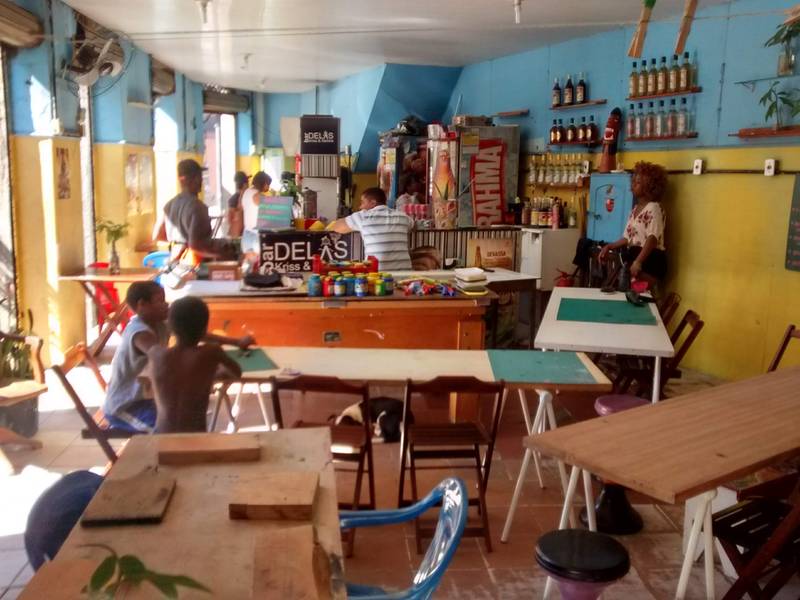
Lanchonete<>Lanchonete at Bar Delas, 2018
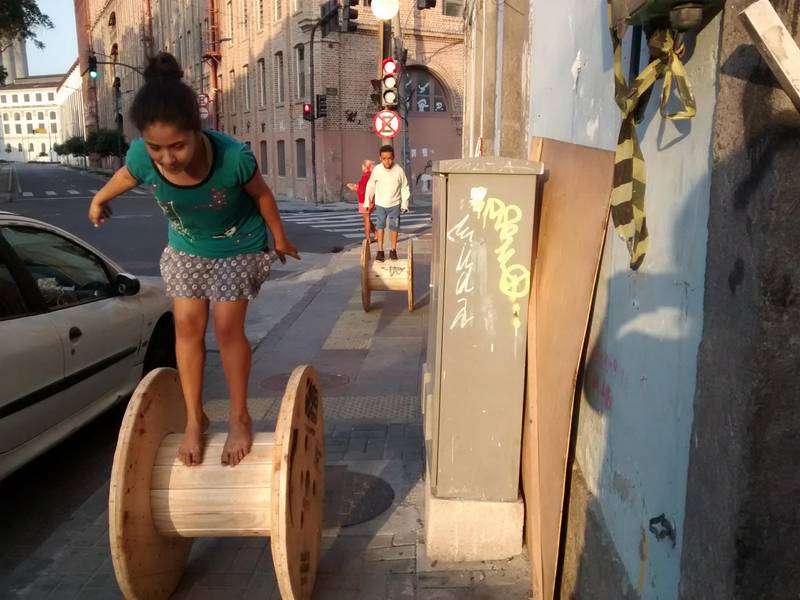
Activities with children at Bar Delas
The kitchen-studio would also become a school, a space of mutual teaching and of practices of learning and unlearning, a school that lays claim to new futures, a school named Por Vir [To come]. But before that, in 2018, it was necessary to move from a private art space (Saracura) and find a home in a bar, the Bar Delas [Their bar, in the feminine], run by a woman, Cristiane, known as Kriss Coiffeur, and operating within an occupation in Gamboa. There, beyond establishing itself in a space firmly rooted in the territory and in struggles for housing, other figures came to shape the everyday life of L<>L, pressing from within for a rethinking of its practices – including the process of gentrification that the presence of a white cultural dispositif inevitably produces, despite its intentions, in a peripheral and Black territory. Today, Bar Delas is a site of well-attended parties, a trendy spot within Rio’s nightlife scene.
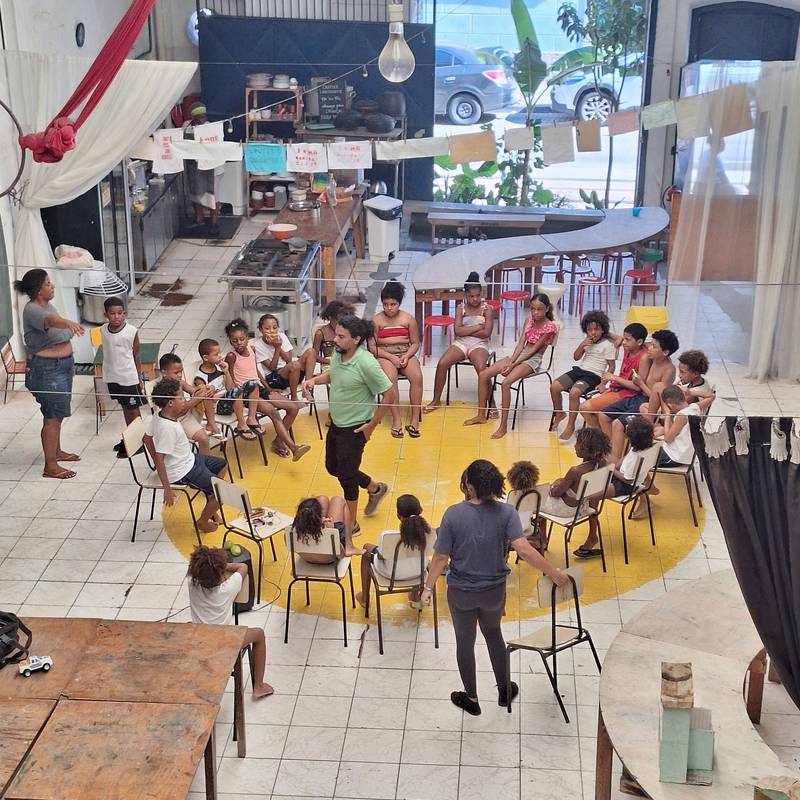
In 2019, L<>L was established in its own warehouse space, rented on Pedro Ernesto Street, which also houses, among others, the Instituto Pretos Novos (IPN) and the Museum of Afro-Brazilian History and Culture. It became the Associação Cultural Lanchonete<>Lanchonete and expanded beyond the kitchen to include other educational and sociocultural activities, capoeira classes, printmaking workshops, a community film club, a library, among others. The kitchen came to be run by women from the local area, themselves residents of the surrounding informal occupations. The Escola Por Vir begins to systematically engage children during their after-school hours. Numerous art projects, cultural initiatives, and actions from other fields find there a site of realization, provided they incorporate a critique of the dispositif they mobilize and situate themselves in relation to the local population. A collectivity, heterogeneous and complex precisely because of this, emerges there. What takes shape is a temporality and spatiality distinct from those of production for the art circuit, and for that very reason perhaps so difficult to perceive through the normalized gaze of the Brazilian colonial art system.
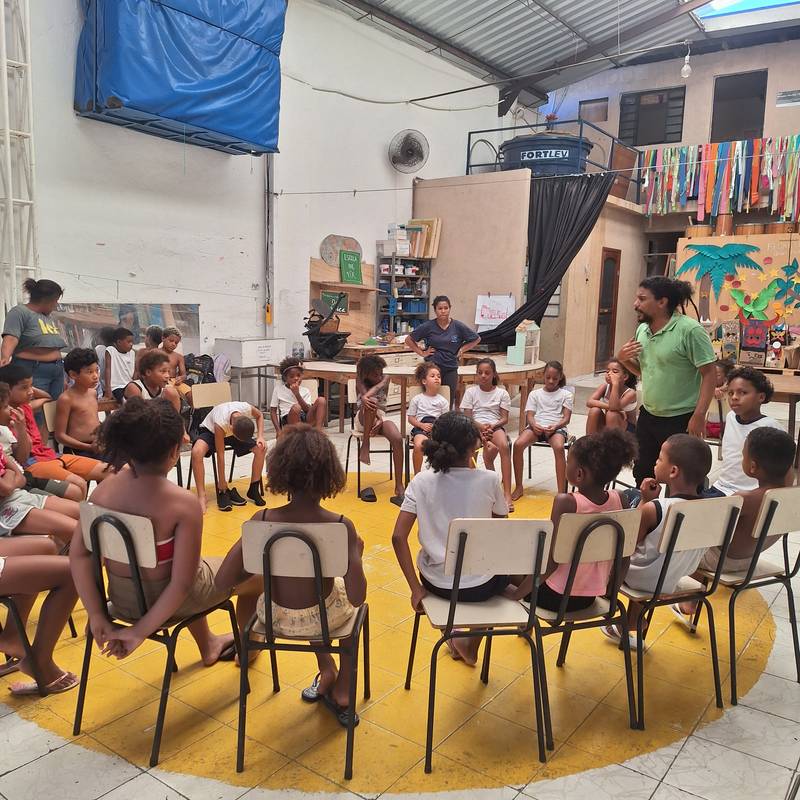
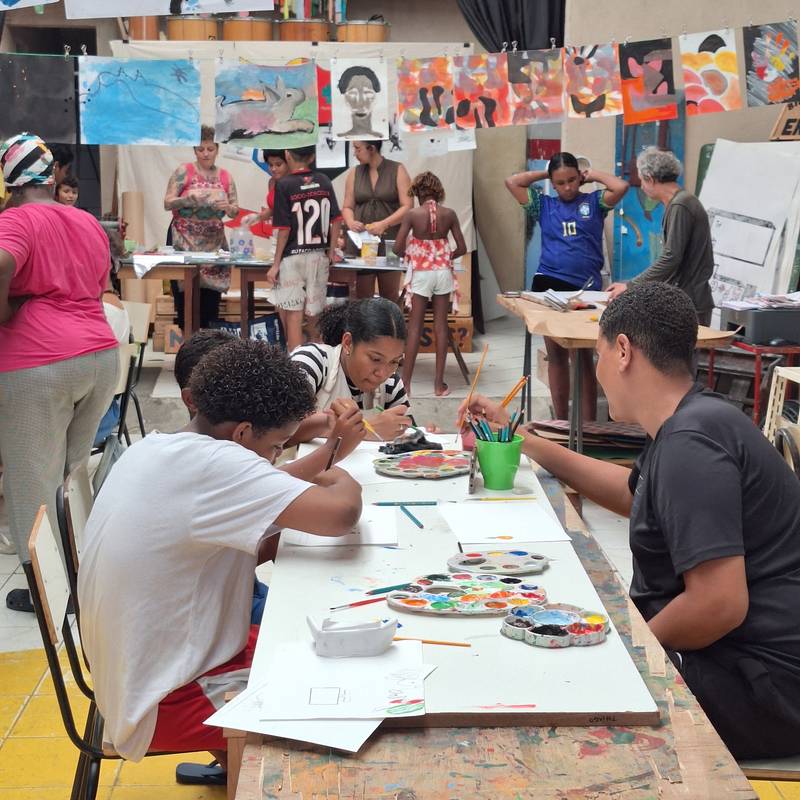
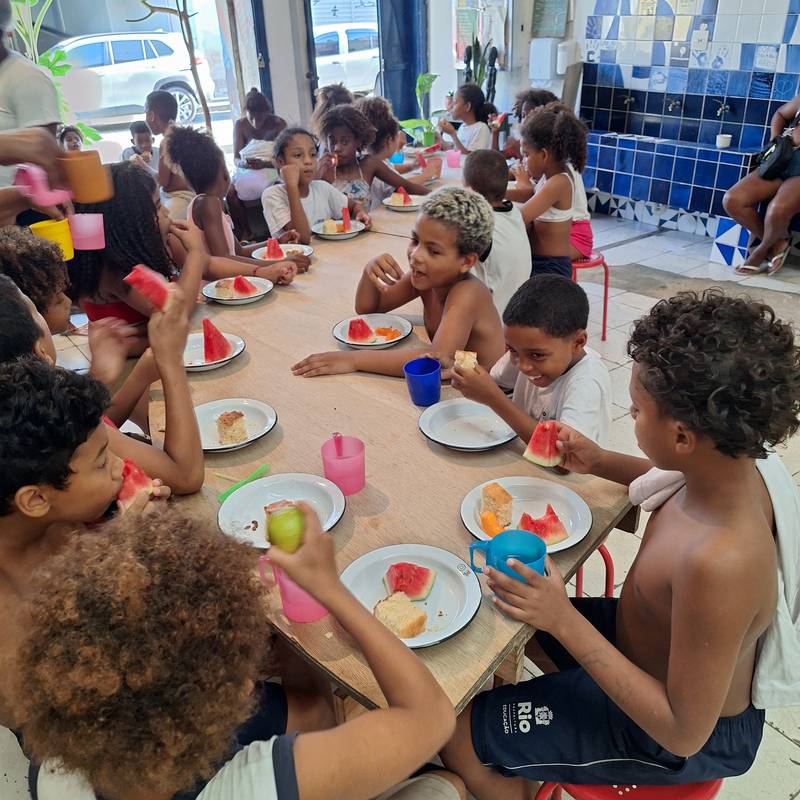
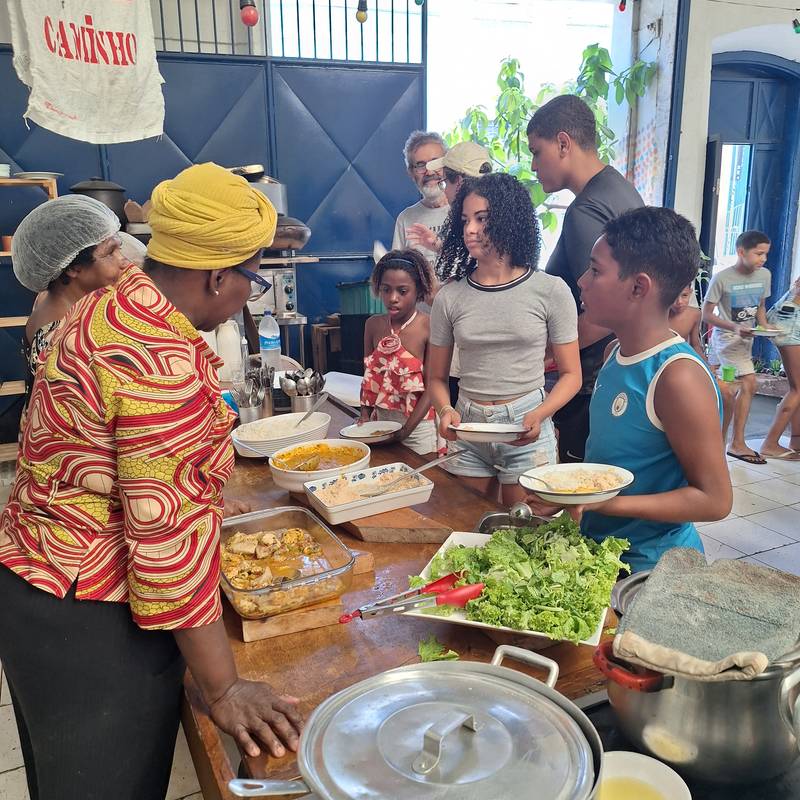
Activities of the EScola Por Vir [School to Come] at the Pedro Ernesto Warehouse
To understand Associação Cultural Lanchonete<>Lanchonete as a counter-colonial contemporary art project, rather than, as many would have it, merely a social project, is to understand that Brazilian contemporary art can decolonize itself and propose other modes of operation, in which the artist–institution–public triad dissolves in favor of a genuinely collective and complex construction that incorporates dissidence into colonial aesthetic practices. And dissidence here is the possibility of fabulating and enacting an alliance with those who have historically been systematically excluded from the spaces of Brazilian colonial art, through a practice of doing-with, a critical two-way relation.
Before an open door, the world appears and speaks. What remains is to know whether these doors are truly open or whether they amount to no more than a trompe l’oeil of the narcissistic game of the art system, as we see in many spaces that emerge in the wake of gentrification processes driven by that very system. We must remain alert and strong: we have no time to fear the end of Brazilian colonial art. It is in this sense that we argue that L<>L operates as a dispositif of counter-colonial art. One that, while exposing the colonial character, also moves toward a collective project of inventing a minoritarian becoming of artistic practices in Brazil.
-
 READ
READEducational institutions, just like all other institutions, can be considered microcosms of society, where prevailing attitudes and values manifest. Consequently, as racism permeates Finnish society, it also seeps into Finnish daycares.
Microaggressions & Everyday Racism in Finland’s Daycare System
-
 READ
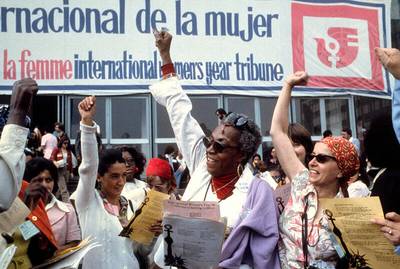
READAmidst this uprising, several feminist film collectives emerged, adding to this momentum by making films and videos that disrupted the representations of women on screen, challenged their seclusion from the public sphere, and both fuelled and documented feminist campaigns and events. Despite the magnitude and significance of feminist cinema, its influence remains largely unspoken.
Women’s Uprising and the Latin American Film Collectives of the 1970s and 1980s
-
 READ
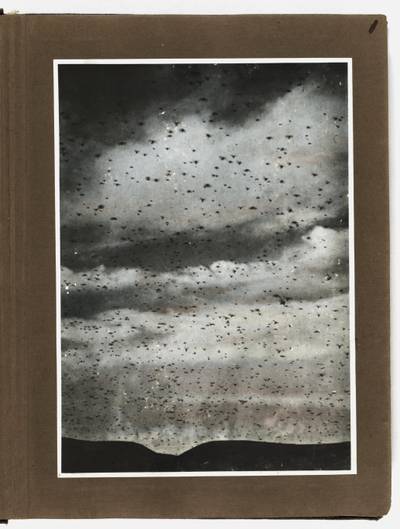
READTo revisit these images today—historical, archival, and contemporary—is to confront multiple temporalities: the gaze of missionary projection, the habitual and the foreseeable. These layers coexist, sometimes always in tension, revealing the land’s persistence beyond imposed narratives. Unbiblifying is not about erasure; it is about recognizing the sacred not as revelation but as habit, not as myth but as presence.
Theology of the Image: Unbiblifying the Sacred
-
 READ
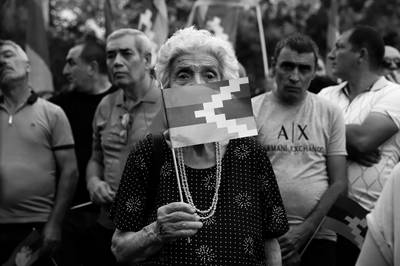
READWhile azerbaijan was bombing Armenians with israeli and turkish UAVs and paying bonuses to turkish-backed Syrian mercenaries for beheading Armenians, the “international community,” whatever that’s supposed to mean at this point, expressed lousy words of “concern,” and displayed a nauseous stance of both-sideism, devoid of any tangible action. The existence of this unrecognised republic and its indigenous population wasn’t legitimate enough for world powers to lift a finger.
Violent Septembers: An Armenian Perspective Amid the Ongoing Occupation