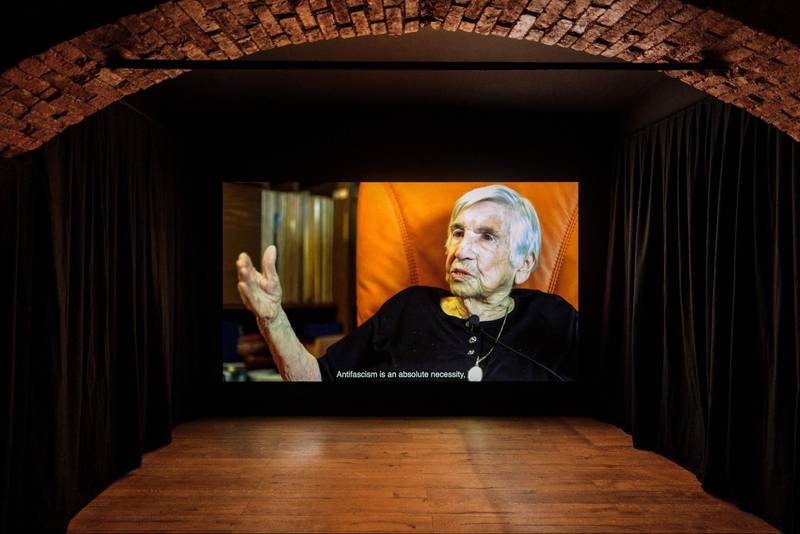
Candice Breitz, Dear Esther (2025), installation view, courtesy of the artist | Photo: steirischer herbst / kunst-dokumentation.com
Flóra Gadó (b. 1989, Hungary) is a curator, researcher and art critic based between Budapest and Brussels. She has been curator at the Municipal Contemporary Art Center Budapest Gallery between 2018-2025. She holds a PhD in Film, Media, and Cultural Studies from Eötvös Loránd University, Budapest (2021), and graduated in Spring 2023 from the MA Curatorial Practice Program at the University of Bergen, Norway.
The omnipresence of images of violence can make reality incomprehensible. So, what happens when we don’t turn away? How can art become a tool for actively engaging with the current state of society, and, if so, through what means and methodologies? How to lay the groundwork for an outspoken, hopeful environment? The curators of steirischer herbst 2025 incorporated these questions into their curatorial framework by inviting commissions that responded to the far-right tension in the city and across Europe. Under the curatorial team of Ekaterina Degot, David Riff, Gábor Thury, Pieternel Vermoortel, assisted by curators Beatrice Forchini, Tobias Ihl, and Lukas Michelitsch, reflected on the current state of the world: endless wars and the impossibility or unreality of peace as evidenced by the fact that even though there are different wars taking place, the motivations behind them – greed, oppression, xenophobia, nationalism – remain the same.
Founded in 1968, steirischer herbst began as an act of opposition to the resurgence of nationalist cultural initiatives gaining traction. Alongside the main exhibition, the festival features performances, theatre plays, dance events, cabaret shows, and concerts, with an emphasis on specific projects for that year. Each edition is of a different size, held in a different venue, and with a different profile. The festival reflects on the Styrian and Graz locations, a former Habsburg retirement capital and Austria’s second-largest city, highlighting the town’s hidden and forgotten history through locally commissioned artworks, site-specific projects, and institutional partnerships. Drawing on the notion of the “trigon” biennial, named after the polygon-shaped trinational border of Austria, Italy, and the former Yugoslavia, the festival connects local and international networks. Curator Ekaterina Degot, who has served as the festival’s director since 2018 and was reappointed for 2023-28, works with a team sharing responsibility for curating and commissioning new works for each edition. Commissioning and producing new works is risky, as there are no well-known artworks to “weigh” the exhibition in each edition. New projects whose outcomes could raise many questions require closer collaboration from the curators. Despite the difficulty of developing a cohesive curatorial concept in advance, the messiness and heterogeneity of the new commissions are a notable characteristic of the festival.
steirischer herbst 2025’s title, Never Again Peace, borrowed from Ernst Toller’s 1934-36 satire, Nie wieder Friede, that foresaw events that later occurred in the 20th century, resonates with the current geopolitical scenario and echoes the activist statement “nobody is free until everyone is free” by Fannie Lou Hamer. The title is also a reversal of the popular interwar slogan “Nie wieder Krieg”, the phrase chanted by Buchenwald survivors shortly after the camp’s liberation. It pays homage to the festival’s antifascist history. The title shakes us up from “watching” the war on our screens and reminds us to oppose the normalization of the war rhetoric amidst right-wing resurgence across the world. Toller’s title aims to “reactivate the past”, as is the theme and curatorial gesture of the festival.
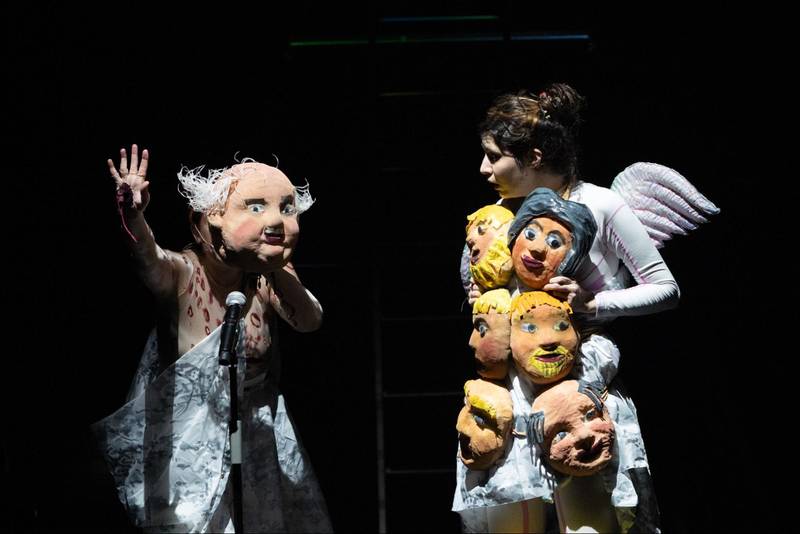
Helga Lázár, Never Again Peace (after Ernst Toller) (2025), Puppet Theatre | Photo: steirischer herbst / Johanna Lamprecht
Reflecting the festival’s interdisciplinarity, the curators organised a constellation of events that lasted for one month alongside the main exhibition and included a puppet version of Toller’s piece by Helga Lázár, as well as cabaret shows, a recurring theme at the festival and events (eg.: Ahmet Öğüt’s From Freedom Square to Freedom Square, a legal name-change ceremony reclaiming “freedom” from far-right abuse). During the festival, there were a total of 42 newly commissioned works, ranging from films, installations, and performances to theatre plays and concerts, hosted at partner institutions. The works revisited historical figures, events, and situations, reflecting critically not only on “global” history but also on micronarratives and local stories. One notable aspect was the location of the main exhibition. For every edition, the festival chooses sites from classical museums, abandoned, or out-of-use venues. In this edition, renamed ‘Bau’ from ‘Bauer’, an empty former distillery in the migrant-heavy Gries district of Graz served as the main exhibition venue, which the artists transformed into sites-specific interventions, with artworks mirroring the architecture or reflecting on the building’s history.
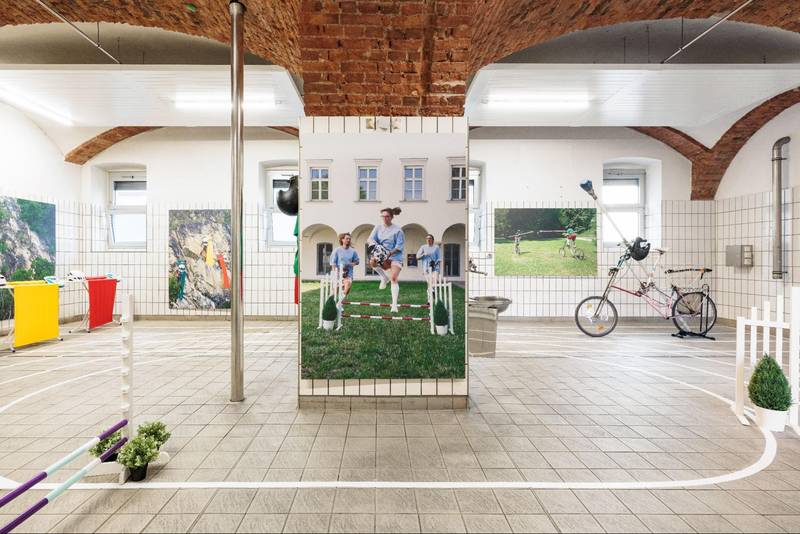
Ahmet Öğüt, Sports Club of the Forbidden Colours (2025), installation view, courtesy of the artist | Photo: steirischer herbst / kunst-dokumentation.com
By approaching Bau, visitors leave the picturesque inner town of Graz and enter a lesser-known side of the city. The venue also hosted several curatorial interventions evoking notions of exile, home, and belonging amid upheaval, including a model of the cargo ship Capitaine-Paul-Lemerle. This converted freighter evacuated roughly 350 civilians from Europe in 1941. It is always challenging to present works at sites outside the institutional system and without any predisposed infrastructure, but the team managed to retain the building’s labyrinthine character while making it a safe and wholesome viewing experience. “The venue is a hybrid of menacing industrial rooms, glass-door offices, and strangely several small police apartments. This bizarre assemblage of spaces, stairs, doors, and dead ends implies different ways of life and systems of value, but also different historical layers.” As most of the works responded in a site-specific way, some in dialogue with the space, some making a tension with it, I would argue that the curators were thinking about creating a constellation, where various positions support each other rather than contradict each other. This became both the strength and the weakness of the festival: it created a supportive atmosphere where solidarity was omnipresent, yet it bypassed contradictory and critical voices from other political and social perspectives.
These re-enactments collectively challenge linear progress narratives, revealing how unresolved traumas from wars and genocides resurface in contemporary crises, urging viewers to evaluate their complicities in ongoing violence. They engage in dialogue with projects that discuss present-day violence and war, highlighting the ever-present aggression in history as well as the parallels
During the opening weekend, in the theatre hall of Helmut List Halle, Manuel Pelmuș and Frédéric Gies reinterpreted Kurt Jooss’s 1932 modern ballet piece, The Green Table (Tribute to Kurt Jooss’s Green Table), which was on view at Bau. In this anti-war modern ballet piece that evokes the futility of peace treaties, caricaturing them step by step, Gies transformed the grandiose gestures into an uncanny choreography as he gradually shed all the characteristics we associate with human civilisation and fake politeness. Jooss’ ballet in its original form is still in the repertoire of many theatres across Europe; watching its 20th-century documentation at the Bau, the hypocrisy of political decision-making is evident, as the masked men are more interested in their own power play than in the well-being of the world. This transformation from a suitably formal stance to raw, fatigued vulnerability exposed the performative nature of peace negotiations in the contemporary version, mirroring today’s geopolitical charades in which leaders prioritise optics over resolution – Pelmuș’s cyclical approach underscores that history’s lessons remain unlearned, perpetuating cycles of conflict.
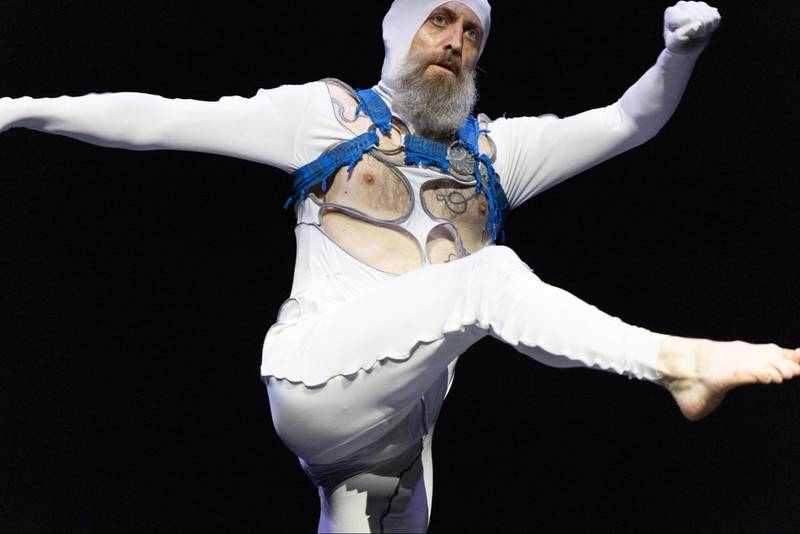
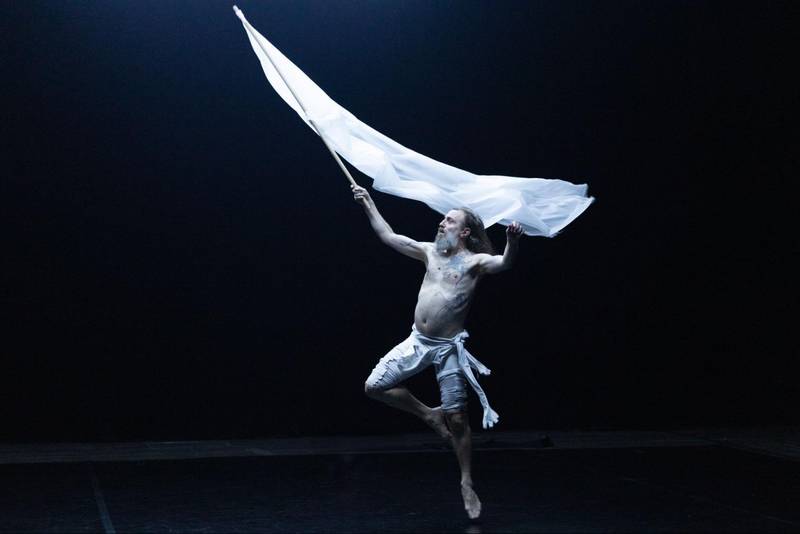
Manuel Pelmuș und Frédéric Gies, Tribute to Kurt Jooss’s, “Green Table” (2025), Tanzperformance, Foto: steirischer herbst / Johanna Lamprecht
In the re-enactment of The Green Table, it was refreshing to see an older-body stage performance by dancer and choreographer Gies. Pelmuș and Gies also explored the presentation of an ageing body as a critical engagement with ageism. First, the dancer embodied the ballet’s figures directly, “wearing” a suit and following the score of The Green Table. Slowly, he disintegrated into a long-haired, almost otherworldly man beneath the suit, as if the true spirit / inner feelings of the polite politicians were revealed. It is not clear if this was an homage, a critical reinterpretation of the original piece, or both. The strength lay precisely in this tension. As Gies’s movements disrupted the modern movements, he brought a white flag onto the stage, swinging it against the techno sounds of composer Fiedel, whose volume was rising. It could be read as a cry for help, a sense of hope, and a sense of urgency all at once. The running continued, the performer grew fatigued, coaxing the audience to ask: What is behind these symbols?
Manuel Pelmuș has re-enacted other artworks with socio-political significance, together with Alexandra Pirici, for example at the Romanian Pavilion in the 2013 edition of the Venice Biennale (An Immaterial Retrospective of the Venice Biennale), where they deconstructed and reinterpreted famous and lesser-known artworks that had previously been in the biennale. My argument is that re-enactments establish not a descriptive, teleological, and linear relationship with the past (and with time in general), but an embodied, cyclical one. In these works, the past is questioned and renegotiated.
Does an interest in the historical result in works that are too academic or conceptual, relying on the viewers’ previous knowledge, or presenting past events in isolation without forging connections with the present? Several artworks in the 2025 edition of steirischer herbst dealt with the activation of the past either as a re-enactment, a haunting memory, an homage, or a ready-made. Relying on the viewers’ active involvement and treating them as agents entering the artwork, the festival viewed time as a constant return, in which past, present, and future are in simultaneous dialogue, embracing an anachronistic understanding of time. These re-enactments collectively challenge linear progress narratives, revealing how unresolved traumas from wars and genocides resurface in contemporary crises, urging viewers to evaluate their complicities in ongoing violence. They engage in dialogue with projects that discuss present-day violence and war, highlighting the ever-present aggression in history as well as the parallels, for example, between the 1920s-30s fascist rise and the current populist and far-right turn. But after a point, most works in the festival ended up describing this state and offered little to no alternative imagination.
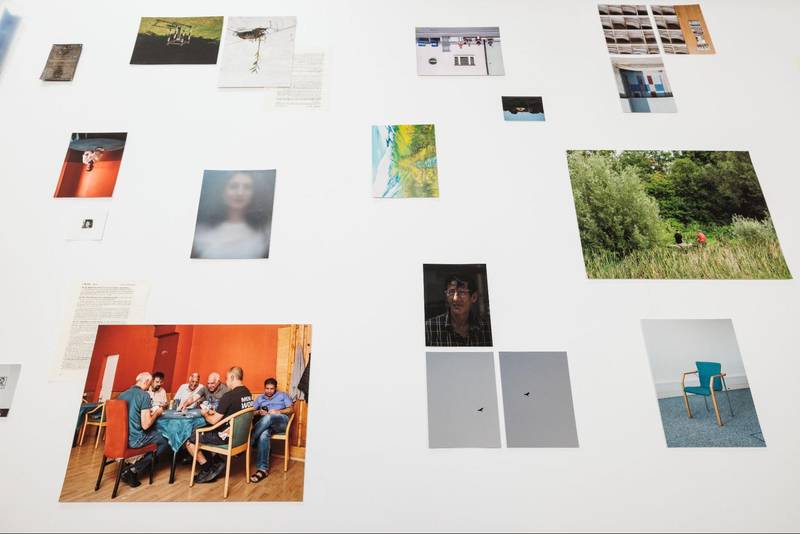
Elias Holzknecht, District 5 (2025), installation view, courtesy of the artist | Photo: steirischer herbst / kunst-dokumentation.com
Elias Holzknecht’s documentary-style photos of the neighbourhood’s diaspora communities, titled Bezirk 5, offered a sensitive “portrait” of the district, featuring individuals and groups engaged in everyday activities or at work, highlighting also the tension between communities in the neighbourhood who had arrived and settled from various conflict zones and the far-right Freedom Party (FPÖ) voters, who won the district’s last elections. The Archaeology of Absence, an installation by Carla Åhlander and Gernot Wieland, reflected on the absences in our knowledge of historical events. In the attic of Bau, formerly used as a police apartment, the artist duo envisioned a life that could have been without knowing the exact facts, evoking fragments of unknown lives through found photos from family albums. Here, the photos are missing; their titles allude to various personal/family, or collective memories, such as a family member returning from imprisonment in war. This way, the absence of images becomes as telling as their presence.
Turning the viewer’s attention to better-known events in history and the recent past, many works transported the audience to a bygone era. Sharing a sense of urgency and responsibility, the style and aesthetic varied from documentary realism to grotesque and the absurd. Candice Breitz’s video (Dear Esther) and Olaf Nicolai’s sound installation transported the viewer to the Second World War. Breitz’s work was a letter to Esther Bejarano, a Holocaust survivor, who emigrated to Palestine, yet due to witnessing the Nakba, returned to Germany. There, she actively advocated for the freedom of Palestine and was critical of Israel until she died in 2021. Candice Breitz never met Esther Bejarano, yet sensed a close connection to her. The letter establishes this connection in the “afterlife” by recalling Bejarano’s struggles and activities in relation to the artist’s own difficulties with censorship in Germany. The letter to this historical ally is presented through a play of sentences and words, spelt out as watermelons, a symbol of solidarity with Palestine. Breitz also learned to play a song on an accordion as an ode to Bejarano’s having survived Auschwitz because she was part of the Mädchenorchester (girls’ orchestra).
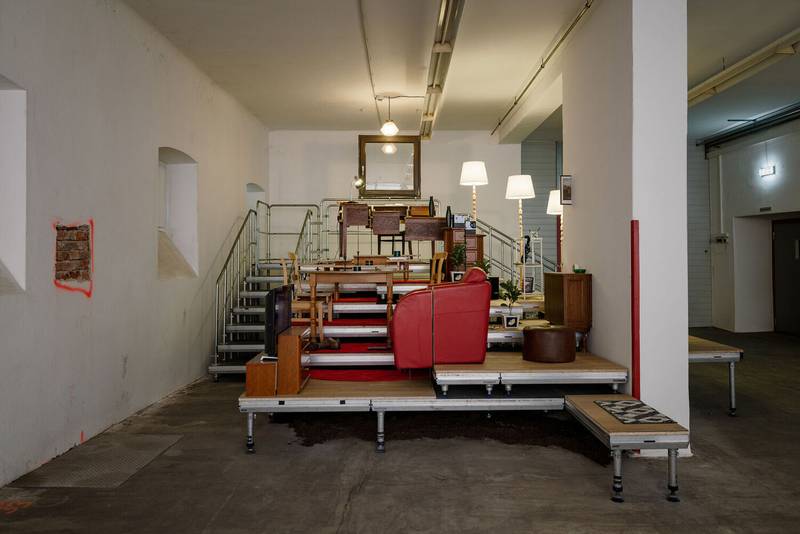
Pedro Gómez-Egaña, Night at Dawn (2025), installation view, courtesy of the artist, photo: steirischer herbst / kunst-dokumentation.com
Olaf Nicolai’s sound installation On Air was a reissue of a record, in which coincidence created a striking experience for British citizens living in the 1940’s. During the regular broadcast of cellist Beatrice Harrison on the 19th of May 1942, the sound of birds and nightingales was interrupted by 197 British bombers en route to Mannheim. The transmission was cut off to prevent the planes’ position from being revealed. Nicolai presented the recording (produced by the BBC as a double-sided record of the departing and returning planes) in a small, soundproof room. In the darkness, visitors can imagine what it felt like for radio listeners to witness such an intermission, evoking the atmosphere of bunkers and basements, where people are seeking momentary safety and shelter from bombs. The installation prompted visitors to speculate about the relationship between sound and power: how different soundscapes are used to manipulate and even torture people.
Pedro Gómez-Egaña’s installation Night at Dawn was intended as an homage to Thomas Mann’s Magic Mountain (1924). The artist used diverse materials, scaffolds, industrial platforms, and furniture to create a small “hill” within the exhibition space of Bau, similar to everyday domestic interiors, or rather, their empty skeletons. What places could there be today that can help us escape reality? Beyond the aesthetic and participatory aspects, the fragmented, haunted, torn-apart elements function more like an empty stage than a platform for questioning what support structures hold us today. Bringing a copy of Mann’s classic loosely prompted the audience to reflect on questions such as why the book’s protagonists left war-torn Europe and what The Magic Mountain can teach about exile, migration, and the effects of war, but the work didn’t utilize this opportunity to explore parallels with the novel’s time.
Other works dealt with history as a form of hauntology, a term coined by Jacques Derrida in his 1993 book Spectres of Marx and adapted and popularized by Mark Fisher in the mid-2000s, referring to the process by which unresolved questions and figures from the past return as metaphorical ghosts to haunt the present. For example, Pauline Curnier Jardin’s video work Jeanet Film Adulte took the motif of carnivals as its starting point. In 2019, the carnival in Aalst, Belgium, was removed from UNESCO’s list of cultural heritage sites due to its discriminatory aspects. Following its removal, the parade became more popular among far-right supporters, and unlike the medieval carnival, where the “upside down world” served as a space for positive disruption and the deconstruction of hierarchies, the current carnival featured derogatory costumes and racist character portrayals. Curnier Jardin’s video served as a haunting reminiscence of a so-called happy parade, which was inherently misogynistic. One of the characters subject to the carnival’s misogyny is “Vuil Jeanet” (Dirty Jeanet) - a cross-dressing man with strong makeup, wigs, huge fake breasts and dildos. In the parade, Vuil Jeanet represented all the stereotypical depictions of the mother, the wife, and the lover/sex worker. Curnier Jardin’s camera showed the carnival in close-ups, as if shot by a drunk man wandering the streets. As the film’s pace quickened, it became impossible to distinguish the masked faces, who gesticulated in mimicry and insult. Colours, textures, grins, and body parts flickered as the artist turned back the gaze of the participants to themselves, highlighting the underlying problems (such as exclusion) of such seemingly “harmless” events. The film ended with cleaners sweeping the streets, erasing the carnival’s remains.
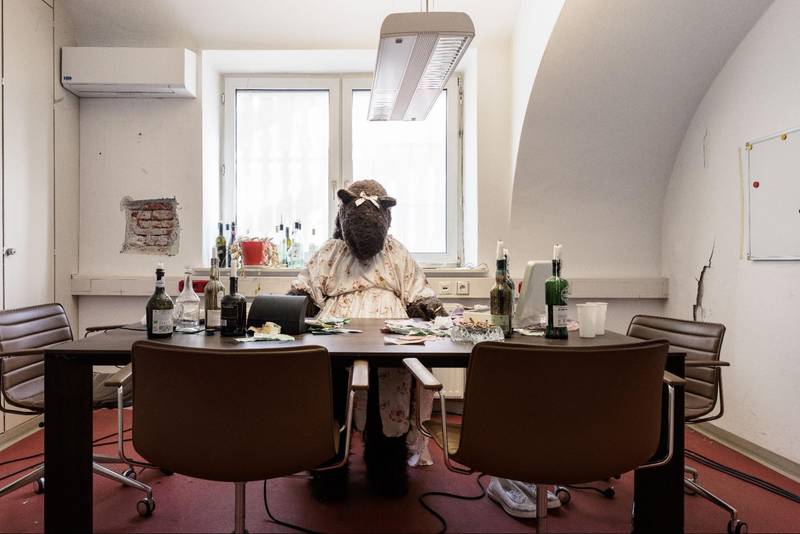
Angélique Aubrit & Ludovic Beillard, Better a healthy donkey than a sick horse (2025), installation view, courtesy of the artists, photo: steirischer herbst / kunst-dokumentation.com
Angélique Aubrités and Ludovic Beillard’s installation, Better a Healthy Donkey Than a Sick Horse, spanned multiple rooms, with larger-than-life, crafted figures of weasels occupying dirty office rooms, broken computers, and smoking, evoking burnout, anxiety, and the notion of endless productivity. In medieval bestiaries, weasels represented spiritual unity, deception and instability. In the installation, they appeared to have fallen into a different kind of “hamster wheel” of work, either procrastinating or, to quote David Graeber, doing “bullshit jobs”. They also seemed deeply lonely and alienated from each other – despite “being” in the same place, unable to connect. Even though there was a sound installation accompanying the piece, the visual environment was so strong that the dialogues about domination, disorder, or the people left out of the system of productivity seemed secondary. Aubrit and Beillard’s installation touched upon those uncomfortable questions of our present, such as loneliness, depression, and addiction. It hinted at the different “solutions” that various online platforms offer to people (e.g., incel culture, as presented in the 2025 series Adolescence). It created tension by using tactile imagery, playing with notions of disgust and repulsion. They reflect on the excruciating, shadow side of our everyday lives.
Mounira Al Solh’s moving-image installation Stray Salt (2025), on display in the former distillery rooms of Bau, addressed the ongoing civil war in Lebanon through a multichannel film. The colourful, associative animation, consisting of swirling drawings, drew on both Lebanon’s past with stories of violence (such as the myth of Europe, who was a Phoenician princess abducted by Zeus, from the place which is now part of Lebanon) and the personal experience of the artist from the present, who lived through the Lebanese civil war. The films were projected onto bed sheets brought from her home in Beirut, alluding to how the fragility of everyday life was affected by war, how terror crept into the mundane reality. Amidst the past histories and mythological figures, we occasionally see a bomb exploding, evoking the artist’s recent experience of witnessing an Israeli air strike in Beirut. Her work uses non-linear, mythical storytelling and associative imagery to speak simultaneously about the present experience of genocide and the past violence inflicted in the region.
Dana Kavelina’s unfinished stop-motion animation film, Grey Earth, addressed the current war in Ukraine and briefly speculated about the future of our planet.The film presented different viewpoints, but, besides those of the older and younger soldiers – similar to Aubrit and Beillard – it also showed a non-human perspective: that of a cow. Entangled lives appeared in the film, although the protagonists were made to seem as if they might not know about it – the dialogues between the men were about the possibility of returning home, the hope of seeing their loved ones again, and fantasies about the place where they belonged. As the film progressed, it became clear that these desires are not possible for the protagonists. The film’s narrative is disrupted by the sound of bombs, affecting the land itself. Kavelina also thematised the notion of the ecocidium: the destruction of the planet caused by military intervention and war.
The 2025 edition brought together voices and artistic positions, pairing works that reinforced one another to create a powerful atmosphere. In many cases, the works functioned as a passive nod: understanding the problem but paralysed from moving beyond that thematization.
Violenza 2025 by Michiel Vandevelde, Pankaj Tiwari and Eneas Nikolai Prawdzic played with the idea of imagining the future whilst creating tension and ambiguity among the audience, but didn’t truly provoke. The theatre performance started with a group of young adults performing monologues and dialogues about home, belonging, and vocation. The conversations slowly took on a radical tone, as it became clear that these seemingly everyday topics were framed within a nationalistic, far-right ideological discourse. The performers staged a satirical manifesto-like text arguing about why migrants are “taking our jobs” or what the problem is with two people of the same sex getting married from a Christian point of view. The first part of the staging appeared as a documentary-participatory performance in which the young performers were playing themselves. Yet, as the second part of the play became more staged, performative, and stylised, with the boys’ movements and choreography referring to notions of community, brotherhood and male dominance, it became clear that the audience is observing a performance by actors. This second part was also more like a flat parody of struggles with masculinity and homoerotic tension, overshadowing the stronger first part. However, this first section could be even more powerful if the directors dared to invite real far-right voices on stage. This way, it remains a harmless representation, without any real tension for those members of the audience who follow what is happening around the world. Even though the directors conducted thorough research across various online groups and forums on the beliefs of young adults, especially men who feel close to far-right discourse, the fact that those sentences appear verbatim doesn’t make the performance any riskier. It lacked stake, and even though, according to the press text, the aim was to present what our future would look like if the voices of these young people keep getting stronger, unfortunately, this is already the present in many parts of Europe and the world.
Does the interest in historical investigation of the past, with a more documentary approach or the use of grotesque and absurd elements, leave little room to explore the struggles of the present? In several works, it was highlighted how past decisions and political deals still affect the present, or how long ago a political conflict actually started. It presented figures whose legacies could be relevant today or who parallel other dark times, such as the first part of the 20th century. It speculated on the reasons for the rise of the far-right, then and now, but did not really offer any solutions to overcome it. In this sense, the festival lacked a vision of the future – as if the curators were so busy bringing in voices to discuss contemporary injustices, violence, and oppression that they overlooked future imaginations. Commissions that play with fiction and imagination, envisioning a potential future, were absent from the festival. If such a future does not exist, it would have been great to see artworks that articulated that. Even though the exhibition constellation created a space for solidarity, where various voices could be heard, it didn’t offer alternatives to what would happen if our world continues this way. Instead of relying overtly on historical references, future-oriented works on activism, collaboration, community building, and anarcho-futuristic scenarios could have enriched the festival.
The 2025 edition brought together voices and artistic positions, pairing works that reinforced one another to create a powerful atmosphere. If only the world were to function as per the solutions offered by the artworks, then all the conflicts would be easily solved. In many cases, the works functioned as a passive nod: understanding the problem but paralysed from moving beyond that thematization. The presence of process-based works, collaborative projects, and community-based initiatives could have balanced the new commissions, but they were underrepresented. Large-scale events such as biennales and cultural festivals cannot “solve” political turmoil or social upheaval, nor should they claim to address every injustice. Such attempts often risk being generalized or oversimplified, diluting the nuances of the arguments and turning art into a spectacle rather than a catalyst. Still, as seen in steirischer herbst, focused provocations can pierce this haze. By inviting artists who, whether directly through critical positions or more poetically, address social injustices, large-scale art events have the potential to effect change.
-
 READ
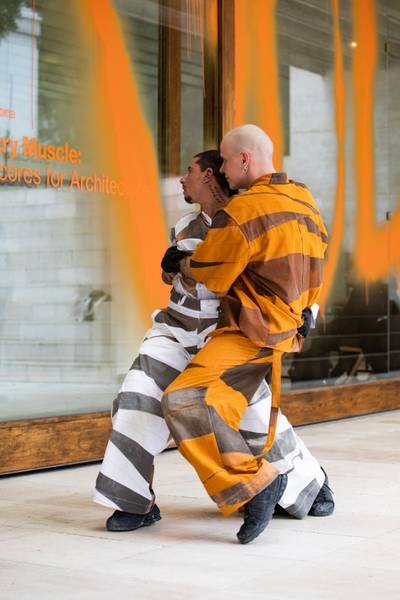
READThere is no universal ‘the’ trans body. Where does this article ‘the’ come from and what does it do? To us it seems that to look at something through the lens of ‘the trans body’ is claiming to know something that is situated in some imagined universal trans body – ultimately projecting one’s own body as that universal human in the trans context; the same universal human that the work claims to critically dismantle. White, non-disabled, thin, masculine and middle-class.
The Trans Body in Venice: A Critique of Universalising Transness
-
 READ
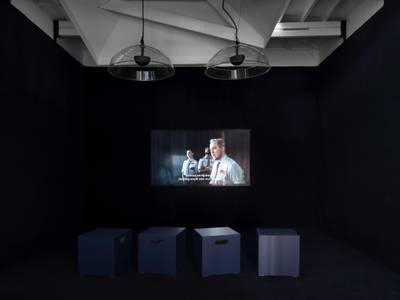
READClose Watch exhibited at the National Finnish Pavilion at Venice Biennale, 2022, is a multimedia installation that, at its core, utilises the artist themself as an embodied intervention within a focused area of artistic research and apparent critique. In the context of this work presented as an exhibition at the national pavilion and its implications of somehow representing Finnish Art, this text seeks to question whether issues pertaining to embodiment and social intervention – and by extension, research conducted and artistic practice developed through it – can ever be free of the power relations implicit in the political, identity-driven understanding of society today.
Who Watches Whom? Ruminations on Power, Gaze, and Field Through Pilvi Takala’s Close Watch
-
 READ
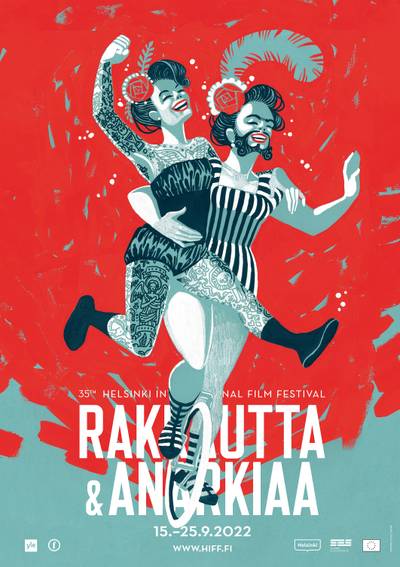
READI could see a lot of love. But I was still trying to find the anarchy that breaks through and what it breaks through. I wondered if I should write about the positionality of the festival in what can be termed as its cultural intervention into events and processes that affect us today.
Finding Anarchy: A Review of Helsinki International Film Festival
-
 READ
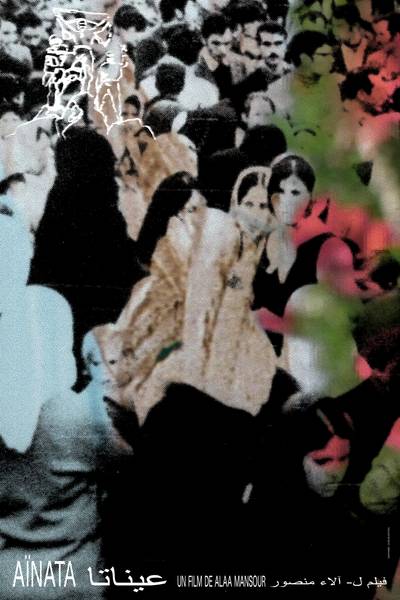
READAïnata (2018), shot in South Lebanon, is the debut documentary by the Lebanese research-based artist and filmmaker, Alaa Mansour. The memories being reconstituted in the film are those of Aïnata, a town in South Lebanon nestled within olive and tobacco farms, plagued for decades by Israeli occupation and violence.
Memory and the Fractured Image: A Review of Alaa Mansour’s ‘Aïnata’