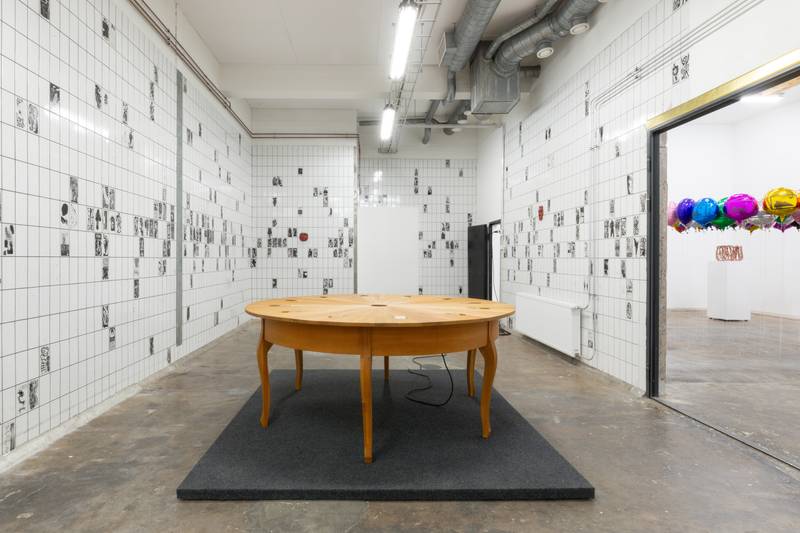
Automatia, installation view at Pitted Dates, Helsinki. Image: Sakari Tervo.
Eero Karjalainen is a critic and art historian based in Helsinki. In his writing Karjalainen has focused on topics such as the ecologies of art history, museum collections, criticism as collectivity, and contemporary painting. Karjalainen has also initiated exhibitions in Finland and internationally.
In early 2025, a few months after Pitted Dates, the non-profit exhibition platform run by curator Sakari Tervo, had opened its current location in the Teurastamo area in Helsinki, Pessi Rautio, the former editor-in-chief of the visual arts magazine Taide [Art], complained in a column that the space keeps up an exclusive attitude in the Finnish capital because it is open only on Sundays and its public communication is conducted online and in English.1 Rautio’s argument flashed into my mind a few weeks back, during the last days of September, when Taide celebrated its complete relaunch with new writers, visual identity, and a new editor at, amusingly enough, Pitted Dates.2 Although quite conservative and outdated in its techno-contextual and linguistic terms, Rautio’s point opens up wider contextual questions. What are the realities of exhibiting work in the capital region – the heavy infrastructures of the Finnish contemporary art scene? And, perhaps more figuratively, what do those structures look like, and how do they operate?
Automatia, the latest group exhibition at Pitted Dates, seems to attempt a few answers. Showing work by six artists, the exhibition carries cues from internet imagery, memes, techno-hybrid bodies, and semi-magical, semi-awkward formal technologies to attune to and, for the most part, attain a critical perspective on the rapidly changing visual landscape. This image culture is both exploited and exploiting, and we are forced to see the world through it. As Chinese and American technology companies ram their profit- and politically driven agendas onto the docket of smaller, right-wing European countries, they also shape the reception of information, which in itself is increasingly visual. As humans continue to amass (dis)information about the world through algorithmic images that are inherently “synonymous with capitalism, industrialization, colonialism, patriarchy, and all of modernity’s other attributes,” the experience of art and its circulation through social media are also changing.
Most of the non-profit spaces in Helsinki are run by artists or operate as a legal body of an artist association. The same applies to the country as a whole. The typical lifespan of an artist-run or non-profit space is short in Finland because the support systems for mediating art are negligible and lean on newness: it’s easy to argue for filling a gap in the system, but for sustaining a practice it seems almost impossible.
In Automatia, a prose poem by writer and journalist Iida Sofia Hirvonen serves as an epigraph with which to navigate the show and its, at first, seemingly loosely corresponding works. As always in the exhibitions at Pitted Dates, no press release or curatorial statement is provided; rather, a commissioned poem (or perhaps more accurately a hybrid, fictional text) serves the role of any kind of exhibition text. This leaves the visitor alone regarding a literal contextualisation but also successfully creates a freedom to encounter the works and their possible proposals as they are. Here, though, the message is delivered literally and quite straightforwardly. Hirvonen’s text – a handwritten and dated statement on bright blue paper on the wall of the space welcoming the visitor – tells the reader that “platforms shape perception” and that “our nervous systems try their best to adapt to intensifying feedback loops and new media forms.”
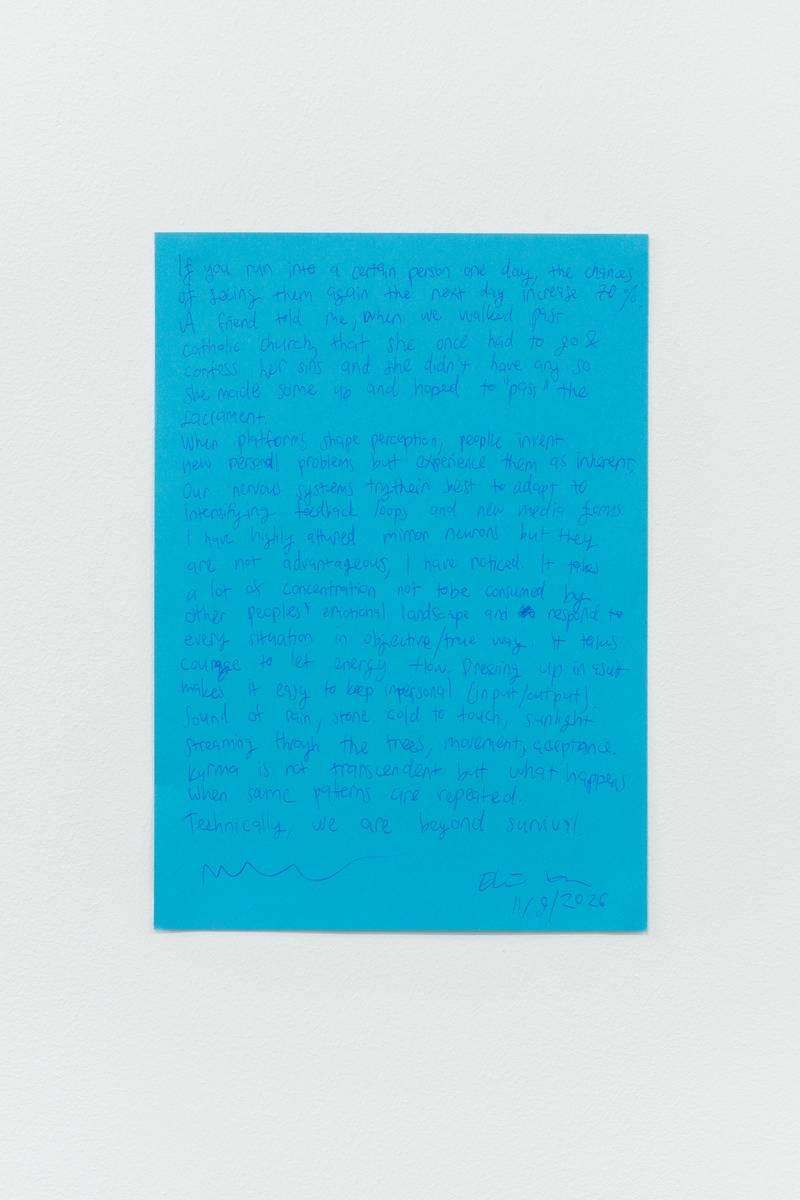
Iida Sofia Hirvonen: commissioned poem, 2026, handwritten A4-paper. Image: Sakari Tervo.
Indeed, the central concern in the exhibition revolves around the ways and strategies of information circulation in the age of hyperimages, surveillance capitalism3, and the never-ending post-post-post-internet. Automatia, from the Greek Αὐτοµατία, literally means ’the goddess of chance’ and refers etymologically to automation, that is, to things happening themselves, in a self-produced way.4 For this exhibition, the title comes across as a prompt to think about the platforms – including exhibitionary ones – that are taken for granted in the Western (art) world and about their continued usage. In a more general sense, it refers to the motion and movement on which some of the key works in the exhibition build.
The movement is seen most directly in the exhibition’s central work, Ilmari Gryta’s kinetic sculpture Fortuna (2007). The work is, in essence, a large round wooden table into which metal balls roll, only to re-emerge from its holes and roll into them again. The work’s looping, ever-moving form is juxtaposed with Ida Tomminen’s sculpture Balloons with a No Image Image (2026), which consists of mylar balloons. As the title suggests, the colourful balloons display a “no image available” symbol and hang together as a slowly deflating group. As they empty of the helium that has kept them floating, they begin to descend. While Gryta’s work keeps on looping, Tomminen’s collapses. The internet and, eventually, social media were promises of ideas, peoples, and realities crossing borders; the reality turned out to be a handful of agents destroying landscapes, profiting from data collection and the distribution of disinformation; an imploded scenery.5
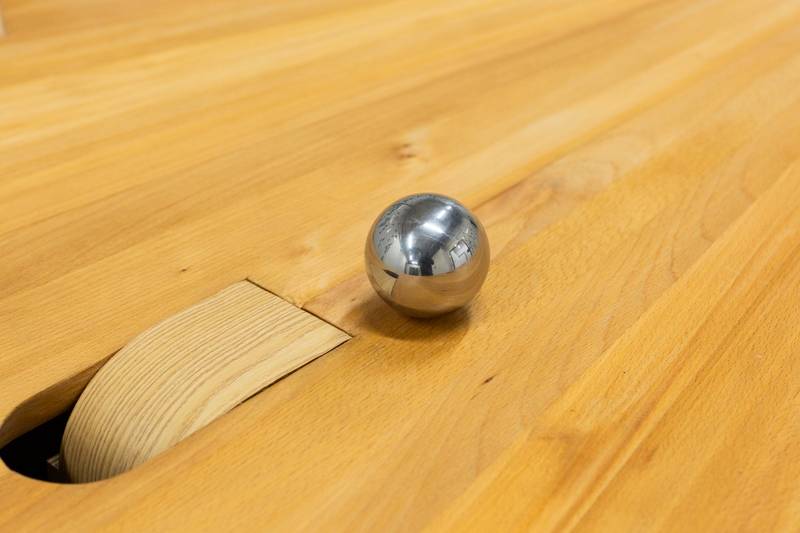
Ilmari Gryta: Fortuna, 2007, wood, metal, electricity, steel balls, 2 m Ø. Image: Sakari Tervo.
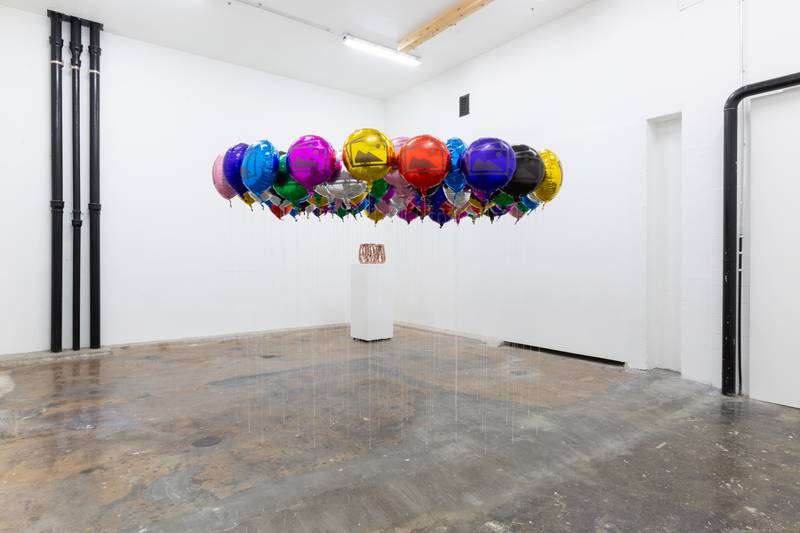
Ida Tomminen: Balloons with a No Image Image, 2026, UV Print on Mylar Balloons, size variable. Image: Sakari Tervo.
Jaakko Pallasvuo’s sibylline and humorous typographic murals bring these issues to the fore much more concretely. They continue the aesthetics for which the artist is best known from his Instagram account, @avocadoibuprophein. These meme-enforced scriptures show, for example, a list of terms and words not unknown to people who frequent exhibition texts – think “deterritorialisation,” “spiral temporalities,” or “agential realism” – and ridicule the closed-circle character of the art world that is built on capital, including discursive principles. As site-specific images, they also point back to their context. Pitted Dates operates in and champions the visual sphere of a durational exhibition, which is by all accounts a standard in this business. This is what the structures look like: when an exhibition space is open very limitedly, the influence of the exhibition documentation circling social media becomes emphasised and the meme becomes a form of debate.
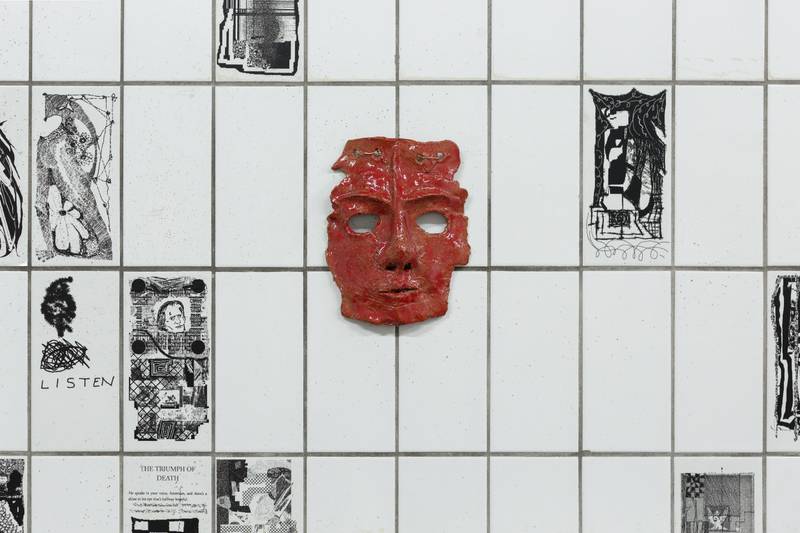
Jaakko Pallasvuo: Eternal Return, 2026, installation, dimension variable, bespoke paint software, 350 digital images reproduced as transparent stickers, three ceramic masks, red glaze. Image: Sakari Tervo.
Some of Pallasvuo’s texts remind more of poetry (though perhaps as carmina figurata) than Hirvonen’s poem does. They call to mind contemporary wall painting, that is, writing on a bathroom wall, and nudge the visitor towards the idea that art speak is exclusive precisely because it celebrates terminological uniformity over information distribution and critical commentary. With this, I mean that most of it is truly unclear and indistinct, bad writing, but that it can also be poisonous to the field from within, as ‘ideas’ are communicated in dysfunctional, regressive manners. In Pallasvuo’s installation, this exclusion effect is reinforced by three red ceramic masks hung on the wall amidst the images as figures reminding us of hiding. To hide behind mannerist structures is to disguise oneself behind a theatrical mask and strengthen universality while neglecting the pluralities of lived histories. Masks are also at play in Juhana Moisander’s video work Pied Piper (2020), which shows a white man with a lute and a pipe – one that grows out of the man’s nose or, better, has replaced it completely. The work, which is the final part of Moisander’s trilogy, Ethology of a Man, follows the cyborg trope of a prosthesis, where a tool or a technology replaces a body part. It brings to mind René Magritte’s painting La Lampe philosophique (1936): as in the surrealist painting, here the character is also a prisoner of his tool, without which he could not get the job done. Even though the work is symbolist almost too literally and the execution simple, it carries a deeply saddening effect by reminding us of the organic connections that we build with the subjugating technologies imposed on us.
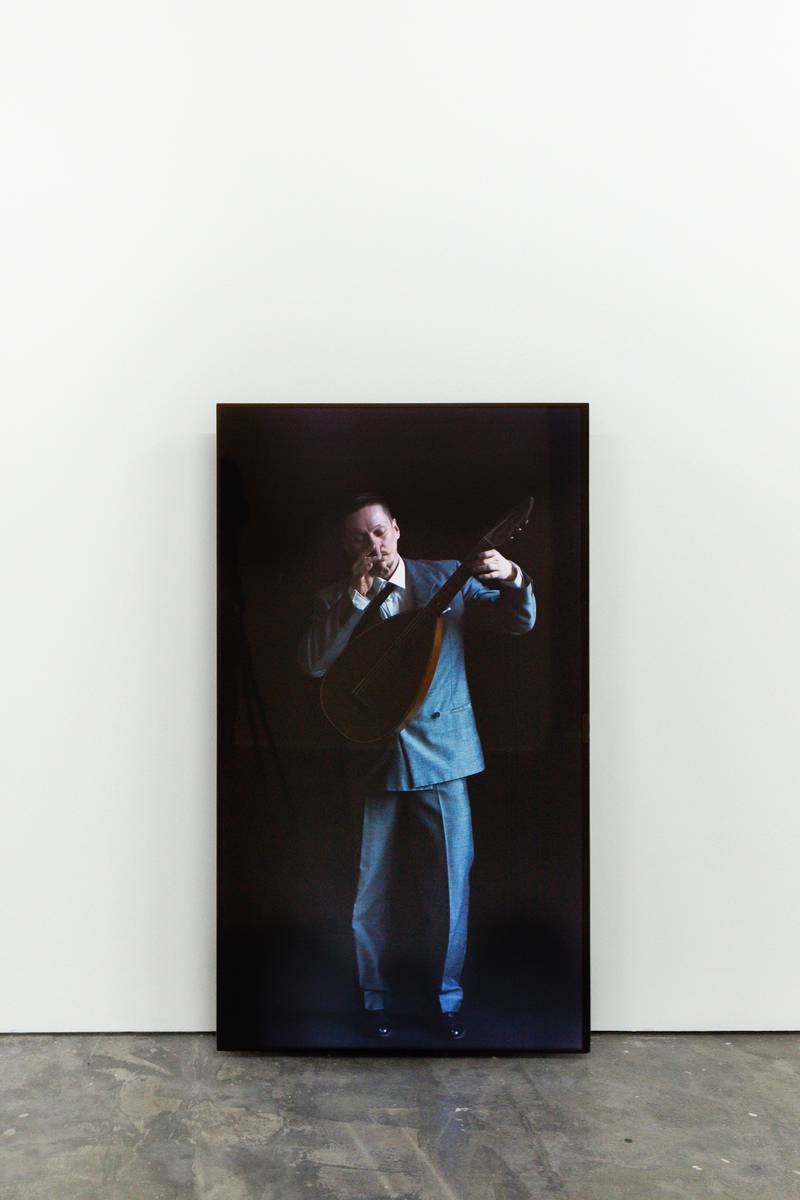
Juhana Moisander: Pied Piper, 2020, 4K video, stereo, 8 min 21 sec loop. Image: Sakari Tervo.
As non-institutional spaces in Helsinki focus almost solely on exhibiting new work, it’s delightful to see that works that are not new are also exhibited, which Pitted Dates does seem to have a subtle reputation for. This can be seen both as a relief from the pressure of producing – and exhibiting – new work constantly, including the ecological and material impact of an art object, and as a structural reality for the non-profit space. (Pitted Dates takes a 20% commission from work sold, so it’s not literally a non-profit space.)
When an exhibition space operates on the fragile combination of grants that are often allocated to curatorial work or other administrative labour, rent support from a city, as well as occasional sales, the financial support rarely reaches the artist, and so the costs of producing new work are, once more, left on the shoulders of the artistic practitioner. On the one hand, in this context, exhibiting older and existing work presents an opportunity to map out specific art-historical narratives as well as lighten the burden of constant producing; on the other, it is a reality emerging from the ‘hard-to-visitness,’ or poor economic support, of artist-run spaces.6
Yet in Finland the situation seems to often not reach even the scenario described above. As Tervo noted in an essay a couple years back, most of the non-profit spaces in Helsinki are run by artists or operate as a legal body of an artist association.7 The same applies to the country as a whole. The typical lifespan of an artist-run or non-profit space is short in Finland because the support systems for mediating art are negligible and lean on newness: it’s easy to argue for filling a gap in the system, but for sustaining a practice it seems almost impossible. This applies not only to exhibition spaces but also to freelance curatorial work, art writing, and publishing, and mirrors the unsustainable operating model of the Western contemporary art field, where people run after the novel thing without attempting to construct long-standing, community-based operating models. The landscape looks grey.
In the landscape of exhibiting contemporary art, a typical element today is a library assembled by an artist or curator, which brings out, or claims to bring out, the thinking underlying the work. Xiao Zhiyu’s captivating paintings turn this logic on its head by reminding us of the Western art world’s habit of elevating certain thinkers and vignettes of discourse into stagnant, universally accepted contextualisations. Zhiyu’s works depict classics of cultural studies and art history in painted form. The titles of the works – 374 g, 514 g, 516 g – direct one’s thoughts to what the book-object feels like when held in one’s hands: to how the printed word weighs.
Zhiyu has been working on these book paintings systematically since 2021, using them to straightforwardly bring out the theoretical framework of the history of painting, a framework that is often Eurocentric but, in the work of some, including the artist himself, also expanding and critical. The works on display in Automatia belong to the archival approach central to his practice, in which passive archiving is simultaneously criticised as alternative conceptualisations are presented alongside it. For instance, 516 g (2023), which depicts the book Iconology by cultural theorist W. J. T. Mitchell, contains a double meaning. On the one hand, the work is like an icon ironically raised onto the wall, its task being to underline the relationship between image and language and their significance in organising and processing knowledge. On the other hand, Mitchell’s book can be criticised for repeating modernist ideas about a ‘pure’ and language-free visuality, in which images, in the end, overcome the language through which they are given meaning.8 What Zhiyu seems to propose is that images are neither only visual nor only discursive, but that the language with which we approach an image is always part of a system that is at once exclusionary and potentially emancipatory.
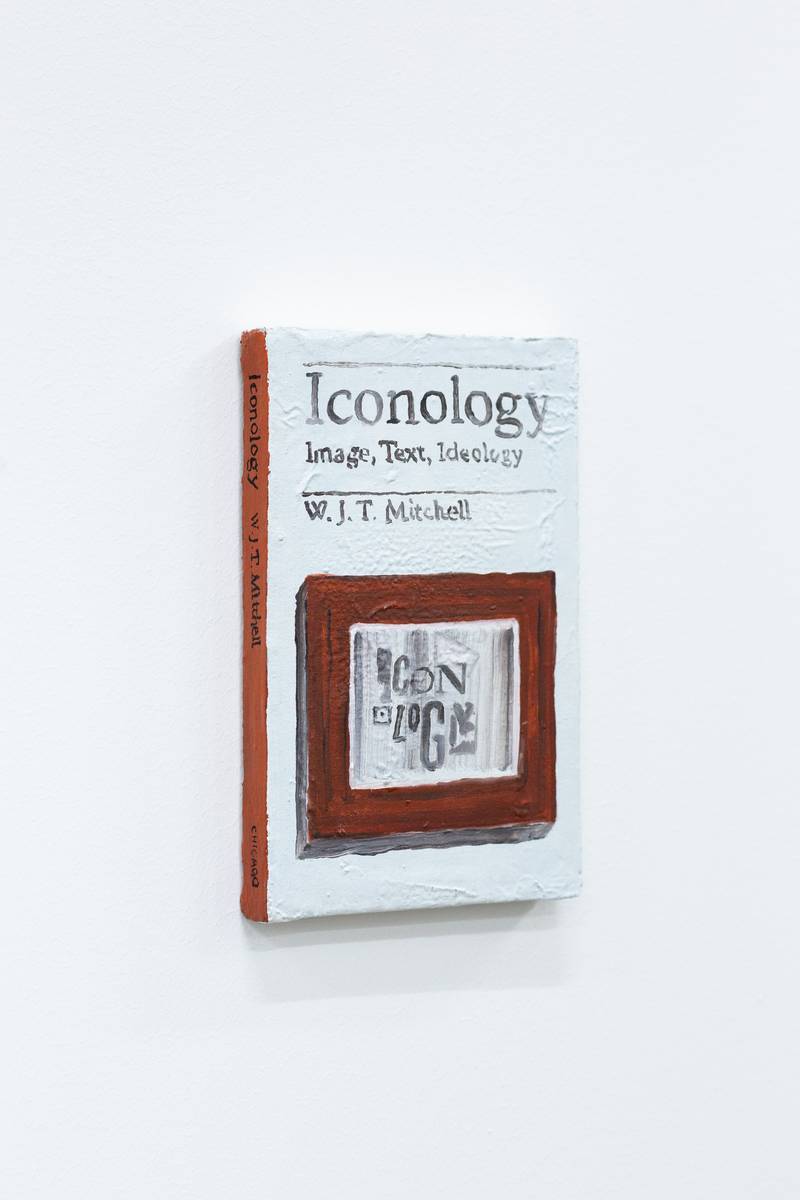
Xiao Zhiyu: 374gr, 2023, oil on linen, heavy pigments
When Pitted Dates was founded in 2023, in the back room of the playground of Herttoniemi’s shopping centre Hertsi in East Helsinki, the exhibitions could in practice only be seen by appointment, which made its level of hard-to-visitness considerably higher than it is today. In a relatively short time, the platform has become one of the most followed exhibition spaces for contemporary art in Helsinki. This is a welcome development in a city where most non-institutional art spaces are commercial galleries with uneven and curatorially weak programmes.
At the same time, it points to the paradoxical nature of the situation. In Finland, exhibiting art is forced by structures following the logic of the white cube and of perpetual novelty, a logic that nevertheless transforms the structures through which art is experienced, as opening hours, communication, and the strategies of display that lean on new works refuse to conform to middle-class expectations. Automatia leaves, in the end, some questions in the air: what do we let happen under their own weight and which structures do we accept without disturbance into our automatic, and automated lives?
-
 READ
Close Watch exhibited at the National Finnish Pavilion at Venice Biennale, 2022, is a multimedia installation that, at its core, utilises the artist themself as an embodied intervention within a focused area of artistic research and apparent critique. In the context of this work presented as an exhibition at the national pavilion and its implications of somehow representing Finnish Art, this text seeks to question whether issues pertaining to embodiment and social intervention – and by extension, research conducted and artistic practice developed through it – can ever be free of the power relations implicit in the political, identity-driven understanding of society today.
Who Watches Whom? Ruminations on Power, Gaze, and Field Through Pilvi Takala’s Close Watch
-
 READ
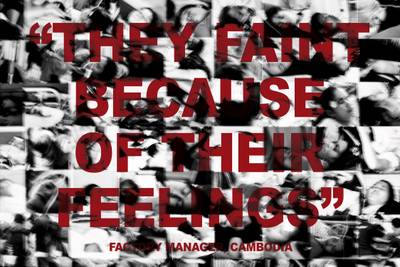
If the problems that individuals face in their personal lives are rooted in systemic issues, then it is unrealistic to expect them to find lasting solutions solely through individual self-improvement efforts. Individual change is not simply a matter of personal effort but is also shaped by the broader social conditions that individuals find themselves in. Abril’s work highlights this hypocrisy of the oppressor in a perverted patriarchal society in which women are blamed and ridiculed for showing symptoms of distress—Mass Hysteria.
Our Bodies Protest on Our Behalf: A Review of ‘Laia Abril – On Mass Hysteria’
-
 READ
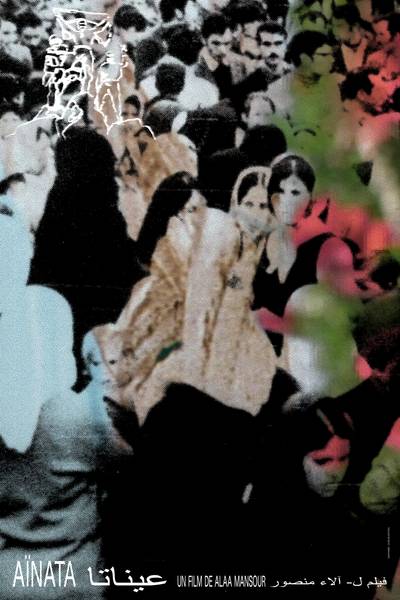
Aïnata (2018), shot in South Lebanon, is the debut documentary by the Lebanese research-based artist and filmmaker, Alaa Mansour. The memories being reconstituted in the film are those of Aïnata, a town in South Lebanon nestled within olive and tobacco farms, plagued for decades by Israeli occupation and violence.
Memory and the Fractured Image: A Review of Alaa Mansour’s ‘Aïnata’
-
 READ
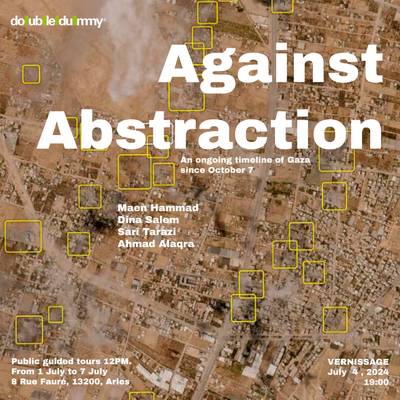
An activation by Palestinian artists Maen Hammad, Dina Salem, Sari Tarazi, and Ahmad Alaqra was hosted at DoubleDummy, Arles, between July 1-7, 2024, during the opening week of the Rencontres d’Arles. It conveys a timeline of the ongoing genocide in Gaza using information shared via alternative messaging platforms like Telegram.
Radical Re-imagining of Visual Order Amid the Ongoing Genocide of Palestinians: A Review of ‘Against Abstraction’